.svg)

Insurance agencies rely on virtual assistants to reduce administrative work, improve customer service, and give licensed agents more time to focus on selling and building client relationships. But with so many options available, choosing the best virtual assistant for insurance isn't always straightforward.
Today, agencies can choose between human virtual assistants, AI-powered virtual assistants, or a hybrid approach that combines both. The right choice depends on your agency's goals, budget, workflows, and the type of support you need.
In this guide, we'll compare each option, explore their strengths and limitations, break down costs and ROI, and help you determine which virtual assistant is the best fit for your insurance agency in 2026.
Key Takeaways
- The best virtual assistant for insurance depends on your agency's operational needs. Human virtual assistants, AI-powered assistants, and hybrid models each offer different advantages depending on the tasks you want to outsource.
- Human virtual assistants are best suited for administrative support, customer service, and relationship-driven tasks, while AI virtual assistants excel at handling routine calls, lead qualification, and appointment scheduling 24/7.
- When evaluating a virtual assistant, agencies should consider more than cost. Insurance expertise, technology integrations, scalability, compliance, and long-term return on investment are all important decision factors.
- Many insurance agencies use a hybrid approach, combining human virtual assistants with AI automation to improve efficiency, streamline operations, and enhance the customer experience.
- The right virtual assistant helps insurance agencies reduce administrative workload, improve response times, and free licensed agents to focus on sales, client relationships, and business growth.
Which Virtual Assistant Is Best for Your Insurance Agency?
The Virtual Assistant Revolution in Insurance
Insurance agencies manage a constant flow of customer calls, appointment requests, policy questions, claims follow-ups, and administrative work every day. As customer expectations continue to grow, handling these routine tasks efficiently has become just as important as delivering expert insurance advice.
This is one reason virtual assistants have become an increasingly valuable part of modern insurance operations. Businesses using virtual assistants report cost savings of up to 78%, while approximately 70% of medium and large enterprises now integrate virtual assistants into their daily operations. These solutions help agencies improve response times, reduce administrative workload, and support more consistent customer service.
Whether an agency chooses a human virtual assistant, an AI-powered solution, or a combination of both, the goal remains the same: giving licensed agents more time to focus on client relationships, complex insurance needs, and business growth.
Understanding Virtual Assistants for Insurance in 2026
The term "virtual assistant" generally refers to two distinct types of solutions, each designed to address different agency needs and operational challenges.
What Insurance Virtual Assistants Actually Do
Insurance Virtual Assistants are trained support professionals working remotely to handle critical agency operations. Their responsibilities span customer service, claims follow-up, appointment scheduling, policy management, data entry, lead nurturing, and marketing support. These professionals receive industry-specific training in insurance terminology, compliance requirements, and agency management systems.
The adoption rates tell a compelling story. About 67% of business owners have hired at least one virtual assistant, with strongest adoption in customer support, marketing operations, and sales functions. Healthcare virtual assistant providers alone reported over 1,000% revenue growth from 2021 to 2024, demonstrating the explosive demand for specialized remote support.
Human VAs Versus AI-Powered Solutions
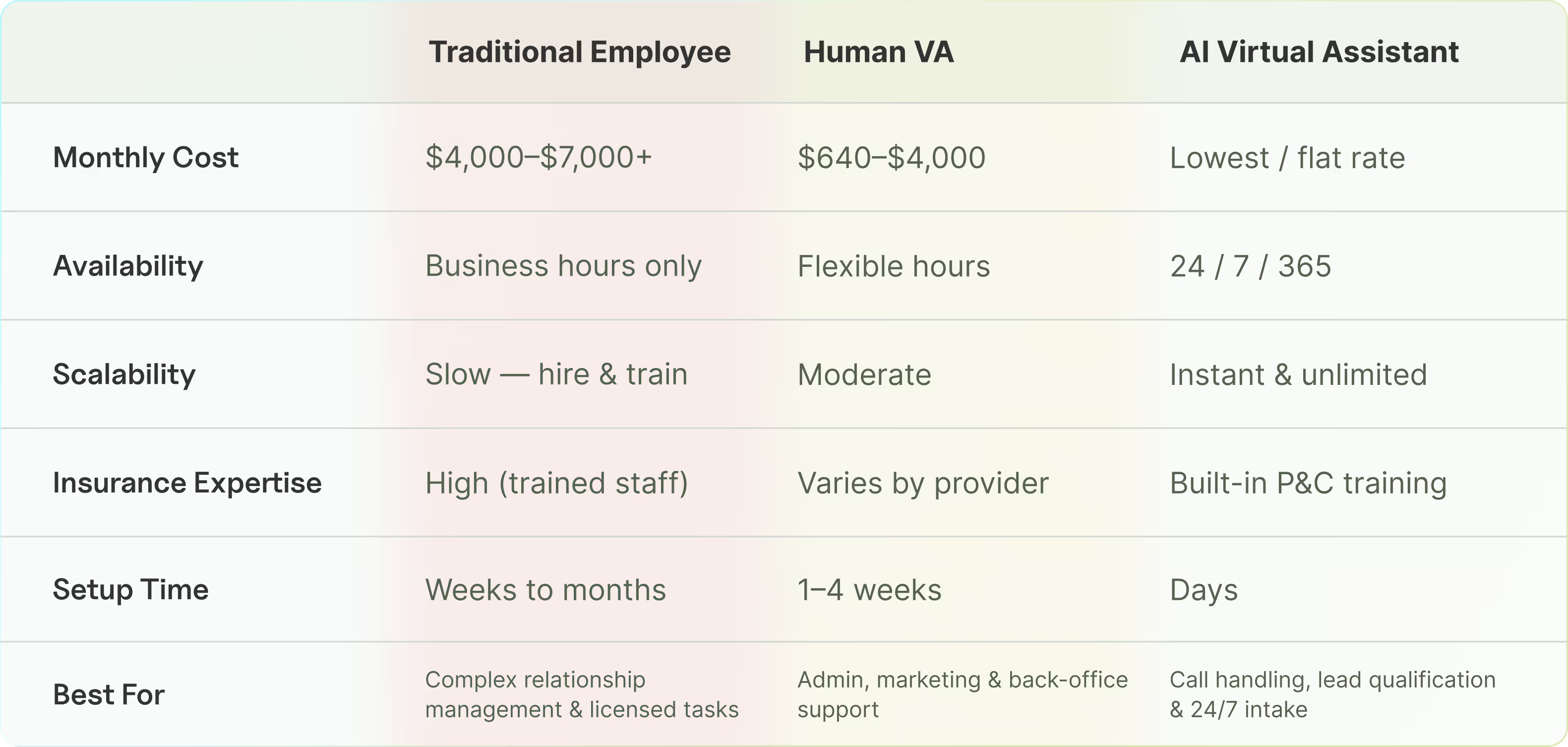
Human virtual assistants work as offshore or domestic contractors, typically hired through specialized agencies or freelance platforms. They bring cultural understanding, nuanced judgment, and adaptability to complex situations. These professionals excel at tasks requiring interpretation, empathy, and creative problem-solving.
AI-powered voice assistants like Sonant AI handle automated call handling and qualification through natural language processing and machine learning. These systems operate 24/7 without breaks, sick days, or vacation time. They capture every caller detail with perfect consistency and integrate ly with existing agency management systems.
The distinction matters because each solution addresses different operational needs. Human VAs provide flexibility and judgment for complex customer service scenarios. AI assistants deliver consistent, scalable call handling with instant response times and zero hold queues.
The Economic Case for Virtual Assistant Adoption
The financial impact extends far beyond simple salary comparisons. Hiring a virtual assistant can cut labor and overhead costs by eliminating office space, equipment, benefits packages, and non-billable downtime associated with traditional employment, the same cost logic that has made outsourcing software development a standard practice for lean, growth-focused companies. Virtual assistants work on flexible schedules aligned with actual business demand rather than fixed 40-hour weeks.
Consider the total cost of a full-time receptionist: base salary, health benefits, payroll taxes, office space, computer equipment, phone systems, training time, and management overhead. Virtual assistants eliminate most of these expenses while providing specialized insurance expertise that general administrative staff typically lack. This explains why administrative task automation has become a strategic priority for competitive agencies.
Types of Virtual Assistants for Insurance Agencies
Understanding your options allows you to choose the right solution for your agency's operational needs and growth goals.
If you're evaluating AI-powered virtual assistants, our Kay AI vs. Sonant comparison explores how the two solutions differ across features, call handling, and insurance agency workflows.
For a broader overview of automation solutions, explore our 2026 AI Tools for Insurance Agencies guide, which compares 100 AI tools for sales, customer service, underwriting, compliance, and agency operations.
Human-Based Virtual Assistant Services
Human virtual assistants remain a popular choice for insurance agencies that need ongoing administrative support and personalized customer service.
Many insurance-specific providers train their virtual assistants to work with policy management software, CRM solutions for insurance agencies, and common agency workflows. InsBOSS focuses exclusively on the insurance industry, while CoverDesk is recommended by ASNOA as an insurance-specific virtual assistant provider. Ocean Virtual Assistant also offers trained professionals who understand insurance processes and compliance requirements.
Human virtual assistants can support a wide range of day-to-day agency operations, including:
- Customer support, such as responding to inquiries, processing claims, and managing client follow-ups
- Marketing support, including social media management, content creation, email campaigns, and engagement tracking
- Administrative tasks like document management, scheduling, policy updates, and data entry
- Sales support through cold calling, appointment setting, and CRM management
- Renewal reminders and policy review scheduling
Many Insurance Virtual Assistants receive training in digital marketing and lead generation, allowing them to support agencies beyond administrative work. They can help create content for blogs and social media, schedule posts, manage email campaigns, and track engagement metrics. This SEO and digital marketing expertise helps insurance agencies strengthen their online presence without the cost of hiring a dedicated in-house marketing team.
AI-Powered Virtual Assistants
5 best AI assistants for insurance agencies
AI virtual assistants represent a fundamentally different approach to agency automation. These systems use natural language processing, machine learning, and voice synthesis to conduct human-like conversations with callers. They operate continuously without fatigue, maintain perfect consistency, and scale instantly to handle call volume spikes.
The best AI assistants for insurance integrate directly with agency management systems, CRMs, and calendars. They qualify leads using customized criteria, schedule appointments based on agent availability, and capture complete caller information without manual data entry. Advanced systems like Sonant AI handle multilingual conversations, recognize returning callers, and adapt responses based on caller needs.
AI assistants excel at repetitive, high-volume tasks that follow predictable patterns. They never forget to ask qualifying questions, always capture contact information accurately, and route calls based on predetermined criteria. This consistency transforms call handling from a variable-quality experience into a standardized process that delivers measurable results.
Hybrid Approaches Combining Human and AI Support
Forward-thinking agencies combine both solutions to maximize operational efficiency. AI assistants handle initial call screening, qualification, and appointment scheduling. Human VAs manage follow-up tasks, complex customer service issues, and relationship-building activities that require nuanced judgment.
This hybrid model delivers comprehensive coverage while optimizing costs. AI systems manage the high-volume, routine interactions that occur during business hours and after-hours. Human VAs focus on tasks that generate the highest value - nurturing qualified leads, resolving complex claims questions, and supporting producers with proposal preparation and research.
The integration between AI virtual receptionists and human support teams creates handoffs. When an AI assistant encounters a situation requiring human judgment, it transfers the call with complete context. The human VA receives caller history, qualification data, and conversation notes - eliminating redundant questions and frustration.
Key Features to Evaluate When Selecting the Best Virtual Assistant for Insurance
Choosing the right virtual assistant solution requires understanding which capabilities drive meaningful business results for insurance agencies.
Insurance Industry Expertise and Compliance Knowledge
Generic virtual assistants lack the specialized knowledge required for insurance operations. The best virtual assistant for insurance brings demonstrated experience with property and casualty products, life insurance, health coverage, and Medicare plans. They understand industry terminology, recognize policy types, and navigate conversations with appropriate language.
Compliance expertise proves equally critical. Insurance VAs must understand state-specific regulations, licensing requirements, and privacy standards. They need familiarity with TCPA guidelines for outbound calling, HIPAA requirements for health insurance discussions, and state insurance department regulations governing customer communications. This knowledge protects agencies from costly compliance violations.
Look for providers offering documented insurance industry experience. Ask about their training programs, compliance protocols, and quality assurance processes. Request references from other insurance agencies using their services and verify their understanding of your specific market segment.
Technology Integration Capabilities
Your virtual assistant solution must integrate ly with existing agency systems. Essential integrations include:
- Agency management systems like Applied Epic, AMS360, HawkSoft, and Vertafore
- Customer relationship management platforms including HubSpot, Salesforce, and Zoho CRM
- Calendar systems for appointment scheduling across multiple agents
- Phone systems and call routing platforms
- Email marketing tools for campaign management and lead nurturing
Integration quality determines operational efficiency. Poor integrations create manual data entry, duplicate records, and lost information. Strong integrations enable automatic data flow between systems, eliminating redundant work and ensuring information accuracy. The best AI tools for insurance agencies prioritize native integrations with industry-standard platforms.
Scalability and Flexibility
Insurance Virtual Assistants can expand operational capacity without the typical overhead of hiring full-time, on-site employees. They work remotely on part-time or full-time bases aligned with agency needs, offering flexibility to scale support up or down as business demands shift.
This scalability proves particularly valuable during predictable busy periods - renewal seasons, annual enrollment windows, or marketing campaign launches. Agencies can temporarily increase VA hours during these peaks without committing to permanent headcount. Conversely, agencies facing seasonal slowdowns can reduce hours without layoffs or unemployment claims.
AI-powered assistants scale even more dramatically. They handle unlimited simultaneous calls without quality degradation. During storm events or other situations driving call volume spikes, AI systems maintain consistent service levels while human-only operations face overwhelmed staff and frustrated callers on hold.
Quality Assurance and Performance Monitoring
InsBOSS provides a client portal with features like real-time task monitoring, QA audits, and end-of-day performance reports, ensuring complete accountability and transparency. Look for providers offering role-specific dashboards aligned with business needs, ticketing systems for support and issue resolution, and real-time task counters ensuring timely delivery.
Quality assurance mechanisms separate professional VA services from freelance marketplaces. Established providers conduct regular call monitoring, review work samples, and maintain documented quality standards. They provide performance metrics, identify training needs, and implement continuous improvement processes.
For AI assistants, request access to conversation transcripts, call recording samples, and analytics dashboards. Review how the system handles difficult scenarios, manages caller frustration, and escalates complex situations. The best AI call assistants provide detailed performance data including call completion rates, qualification accuracy, appointment scheduling success, and caller satisfaction metrics.
Cost Analysis: Human VAs Versus AI Virtual Assistants
Insurance virtual assistant cost breakdown
Understanding total cost of ownership allows accurate comparison between virtual assistant solutions and helps justify investment to agency stakeholders.
Human Virtual Assistant Pricing Models
VAs are typically more affordable than hiring full-time employees, working on hourly or contract bases and helping agents save on overhead costs like employee benefits, office space, computers, and other equipment.
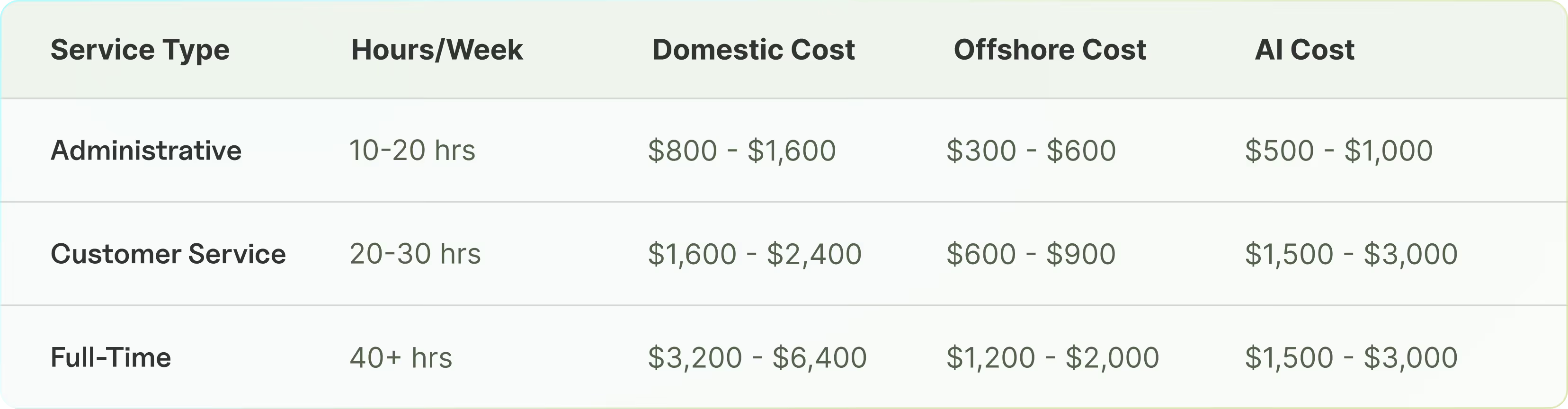
Domestic virtual assistants typically charge $20-$50 per hour depending on experience level and specialized skills. Insurance-specific VAs command premium rates reflecting their training and expertise. Offshore VAs from regions like the Philippines, India, or Latin America charge $8-$20 per hour while often providing strong English communication skills and insurance knowledge.
Monthly costs for a dedicated part-time VA (20 hours weekly) range from $1,600-$4,000 for domestic providers or $640-$1,600 for offshore options. Full-time equivalent VAs (40 hours weekly) cost $3,200-$8,000 monthly for domestic services or $1,280-$3,200 for offshore providers. These figures exclude training time, management overhead, or productivity ramp-up periods.
AI Virtual Assistant Investment Structure
AI virtual assistant pricing typically follows subscription models with tiered pricing based on call volume, features, and integration requirements. Entry-level plans start around $500-$1,000 monthly for basic call handling with limited integrations. Mid-tier plans range from $1,500-$3,000 monthly and include advanced features like CRM integration, custom qualification workflows, and analytics dashboards.
Enterprise plans supporting high call volumes with full integration suites typically cost $3,000-$8,000 monthly. These plans include dedicated implementation support, custom training, and priority technical assistance. Some providers charge per-call pricing rather than flat monthly fees, ranging from $0.50-$2.00 per call depending on complexity and duration.
Implementation costs deserve consideration. Professional AI deployments require initial setup fees of $1,000-$5,000 covering system configuration, workflow design, integration testing, and staff training. However, these one-time costs amortize quickly across months of operation.
Total Cost of Ownership Comparison
Comparing virtual assistant options requires evaluating total operational costs beyond base pricing. Human VAs incur management time for supervision, quality review, and task assignment. They require backup coverage during vacations and sick days. Productivity varies based on individual performance, experience, and workload complexity.
AI assistants operate continuously without management overhead once configured. They provide unlimited scalability without incremental per-hour costs. However, they lack flexibility for tasks requiring human judgment and may require occasional workflow adjustments as business needs evolve.
According to industry research, Virtual Assistants help companies save over 70% of their costs annually by eliminating rent, internet subscriptions, and various expenditures - saving 78% of company costs overall. This dramatic reduction reflects the elimination of traditional employment overhead while maintaining operational capacity.
For context on cost-effectiveness, compare virtual assistant expenses against insurance outsourcing services that often require long-term contracts and minimum volume commitments. Virtual assistants provide greater flexibility and control while delivering comparable or superior results.
Implementation Best Practices for Insurance Agencies
Successful virtual assistant deployment requires strategic planning, clear processes, and ongoing optimization.
Defining Roles and Responsibilities
Start by documenting exactly which tasks your virtual assistant will handle. Create detailed process documents for each responsibility including step-by-step instructions, required tools and systems, quality standards, and escalation procedures. This documentation prevents confusion and establishes clear performance expectations.
Common mistake: assigning vague responsibilities like "help with marketing" or "assist with customer service." Effective approach: specific task lists such as "respond to certificate of insurance requests within two hours using template XYZ" or "schedule renewal review appointments using Calendly integration and send confirmation emails."
Distinguish between tasks requiring licensed agent involvement and those virtual assistants can handle independently. Virtual assistants cannot provide coverage recommendations, bind policies, or give insurance advice in most states. They excel at information gathering, appointment scheduling, data entry, follow-up coordination, and administrative support.
Training and Onboarding Strategies
Allocate sufficient time for comprehensive training. Human VAs typically require two to four weeks of training before reaching full productivity. Cover your agency's products, services, systems, processes, communication style, and customer service standards. Provide recorded training sessions, written procedures, and access to a designated mentor for questions.
For AI assistants, invest time in initial configuration and testing. Define conversation flows, qualification criteria, appointment scheduling rules, and escalation triggers. Test the system extensively with various scenarios before launching to live callers. The best virtual assistants for insurance agencies offer white-glove implementation support to this process.
Establishing Communication Protocols
Set clear expectations for response times, communication channels, and availability. Specify which communication platform to use for different types of interactions - email for routine updates, instant messaging for time-sensitive questions, video calls for complex discussions.
Schedule regular check-ins to review performance, address challenges, and processes. Weekly 30-minute calls during the first month establish strong foundations. Transition to biweekly or monthly reviews once operations stabilize. Document action items, track completion, and maintain continuous improvement momentum.
Create feedback loops enabling virtual assistants to report process inefficiencies, suggest improvements, and flag recurring issues. VAs working directly with your systems and callers often identify optimization opportunities invisible to agency principals focused on sales and relationship management.
Integration with Existing Workflows
Map how virtual assistant responsibilities connect with existing agency processes. Document handoff points between VAs and licensed agents. Clarify when VAs should escalate situations and whom they should contact for specific issue types.
technology to workflows. Use shared task management systems like Asana, Monday.com, or Trello to assign work, track progress, and maintain visibility. Implement CRM automation to route leads, trigger follow-up sequences, and update records based on VA activities. These AI-powered lead qualification capabilities multiply VA effectiveness.
For call handling specifically, establish clear protocols around live transfer leads and appointment setting. Define which situations warrant immediate transfers to agents versus scheduled callbacks. Create pre-qualification criteria ensuring transferred calls represent genuine opportunities worth interrupting producer time.
Real-World Results: ROI and Performance Metrics
Measuring virtual assistant impact requires tracking specific metrics aligned with business objectives.

Productivity Gains and Time Savings
Agencies implementing virtual assistants report significant time reclaimed for revenue-generating activities. Licensed agents spending 15-20 hours weekly on administrative tasks and routine calls redirect that time toward sales, complex underwriting, and relationship building when VAs handle the repetitive work.
Calculate time savings by tracking hours previously spent on tasks now delegated to virtual assistants. Multiply saved hours by your producers' average hourly revenue to quantify opportunity value. An agent generating $150,000 annually works approximately 2,000 hours yearly - yielding $75 hourly value. Reclaiming 15 weekly hours represents $1,125 in weekly opportunity value or $58,500 annually.
This calculation demonstrates why even premium-priced virtual assistants deliver strong ROI. A $4,000 monthly investment reclaiming $4,500 in weekly producer capacity generates positive returns within the first month of operation. Learn more about remote customer service transformation benefits.
Lead Response Time Improvements
Speed-to-lead proves critical in insurance sales. Research consistently shows that contacting leads within five minutes increases conversion rates dramatically compared to 30-minute or hour-long response delays. Virtual assistants operating extended hours or AI systems running 24/7 eliminate response gaps.
Track average response time before and after virtual assistant implementation. Monitor conversion rates across different response time buckets. Agencies implementing AI receptionists often see response times drop from hours to seconds, with corresponding increases in appointment-setting success rates and quote requests.
Customer Satisfaction and Retention Impact
Customer experience is a major differentiator in the insurance industry. Prompt responses to inquiries, proactive follow-ups, and clear communication contribute to higher client satisfaction and retention rates. Virtual assistants enable consistent service delivery that strengthens client relationships.
Measure satisfaction through Net Promoter Score surveys, online reviews, and retention analytics. Track changes in client attrition rates before and after virtual assistant deployment. Monitor complaint frequency and resolution speed. According to industry surveys, 91% of users rate their VAs as excellent or good, and 86% say they would recommend their VAs to others.
Implementing 24/7 insurance support through AI assistants eliminates the frustration of calls going to voicemail outside business hours. Callers receive immediate assistance regardless of when they contact your agency, creating competitive differentiation in markets where most agencies remain bound to traditional office schedules.
Cost Savings and Revenue Impact
Track both direct cost reductions and incremental revenue gains. Direct savings include eliminated recruitment costs, reduced office space needs, lower equipment expenses, and decreased benefits overhead. Calculate these against virtual assistant fees to determine net cost impact.
Revenue impact proves harder to measure but delivers greater value. Track metrics including: new client acquisitions, average policy count per client, cross-sell success rates, renewal retention percentages, and average premium per policy. Compare periods before and after virtual assistant implementation to isolate impact.
Agencies working with AI virtual assistants often report 6x-8x ROI within the first year. This return reflects both cost savings and revenue acceleration from improved lead response, increased appointment-setting capacity, and better client service enabling higher retention and referral rates.
Selecting Your Virtual Assistant Partner
Choosing the right provider requires evaluating capabilities, cultural fit, and long-term partnership potential.
Questions to Ask Prospective Providers
Conduct thorough due diligence before committing to a virtual assistant service. Ask these critical questions:
- What insurance industry experience do your virtual assistants possess?
- Which agency management systems and CRMs do you integrate with?
- What training program do you provide for new VAs?
- How do you handle quality assurance and performance monitoring?
- What backup coverage do you provide for VA absences?
- What security protocols protect client data and ensure compliance?
- Can you provide references from similar-sized agencies in our market?
- What contract terms and cancellation policies apply?
- How do you handle VA performance issues or replacement needs?
For AI assistant providers, additional considerations include conversation quality, natural language understanding, integration depth, customization capabilities, and ongoing optimization support. Request live demonstrations with realistic insurance scenarios and review actual conversation transcripts from current clients.
Trial Periods and Pilot Programs
Insist on trial periods before committing to long-term contracts. Most reputable providers offer 30-60 day pilot programs allowing agencies to evaluate performance with limited risk. Use trial periods to test capabilities, assess cultural fit, and validate ROI assumptions.
Define clear success criteria before starting pilots. Establish metrics for response time, call handling quality, appointment-setting success, data accuracy, and customer satisfaction. Track these metrics weekly during trials and compare against baseline performance.
Start with limited scope during pilots - one or two specific responsibilities rather than comprehensive task delegation. This focused approach enables thorough evaluation while minimizing operational risk. Expand responsibilities after validating performance and refining processes.
Security and Compliance Considerations
Virtual assistants access sensitive client information requiring security measures. Verify that providers implement appropriate data protection protocols including encrypted communications, secure password management, multi-factor authentication, and regular security training for their staff.
For offshore VAs, understand data residency implications and ensure compliance with applicable privacy regulations. Some insurance carriers or states may restrict sending client data outside the United States. Review your errors and omissions insurance policy to confirm coverage extends to virtual assistant activities.
AI assistant providers should demonstrate SOC 2 compliance, data encryption at rest and in transit, and regular security audits. Review their data retention policies, deletion procedures, and incident response protocols. The best voice AI platforms for insurance prioritize security and compliance as foundational capabilities.
The Future of Virtual Assistants in Insurance
Emerging technologies and changing customer expectations will reshape virtual assistant capabilities in coming years.
Advancing AI Capabilities
AI assistants continue improving through advances in natural language processing, sentiment analysis, and conversational intelligence. Future systems will detect caller emotions more accurately, adapt communication styles to individual preferences, and handle increasingly complex scenarios requiring contextual understanding.
Integration with predictive analytics will enable AI assistants to anticipate caller needs based on policy status, renewal timing, claims history, and external triggers like weather events. Proactive outreach capabilities will shift virtual assistants from reactive call handling to strategic relationship management.
Explore how AI voice assistants are transforming insurance operations and positioning forward-thinking agencies for competitive advantage.
Evolving Customer Service Expectations
Customer expectations for immediate response, 24/7 availability, and omnichannel experiences continue rising. Virtual assistants enable agencies to meet these expectations without proportional increases in staffing costs. Younger insurance buyers particularly value instant response and digital-first interactions that virtual assistants deliver naturally.
The line between phone, chat, email, and social media inquiries will blur as AI systems manage unified communications across all channels. Callers will expect their conversation history to follow them regardless of contact method - requiring integrated platforms managing all customer touchpoints.
Integration with Broader Digital Transformation
Virtual assistants represent one component of comprehensive insurance digital transformation strategies. They work synergistically with other automation technologies including robotic process automation for back-office tasks, AI-powered underwriting systems, digital policy management platforms, and automated marketing systems.
Forward-thinking agencies view virtual assistants as the human interface layer connecting clients with increasingly automated operations. While back-end systems handle policy administration, claims processing, and compliance tasks automatically, virtual assistants maintain the personal touch that insurance relationships require.
Consider how RPA transforms insurance operations and how virtual assistants complement these automation initiatives to create comprehensive operational efficiency.
Making Your Virtual Assistant Decision
Selecting the best virtual assistant for insurance requires aligning solution capabilities with your agency's specific needs, growth objectives, and operational constraints.
Assessing Your Agency's Readiness
Evaluate whether your agency possesses the foundational elements for successful virtual assistant implementation. You need documented processes for key workflows, clear standard operating procedures, established technology systems with data you can share, and management capacity to oversee virtual assistant activities during initial implementation.
Agencies lacking process documentation should invest time creating written procedures before hiring virtual assistants. This upfront work pays dividends by enabling faster onboarding, reducing confusion, and establishing clear quality standards. The documentation effort also often reveals process improvement opportunities worth addressing regardless of virtual assistant plans.
Starting Small and Scaling Strategically
Begin with limited scope addressing your highest-impact opportunity. Many agencies start with after-hours call coverage through AI assistants, immediately eliminating missed opportunities from calls outside business hours. Others begin with part-time human VAs handling specific tasks like certificate of insurance requests or renewal follow-ups.
This focused approach allows you to validate ROI, refine processes, and build confidence before expanding virtual assistant responsibilities. Success with initial use cases creates momentum and stakeholder buy-in supporting broader deployment.
Scale gradually based on proven results and refined processes. Add responsibilities sequentially rather than simultaneously. This measured approach prevents overwhelming your team while demonstrating clear value at each expansion stage.
Measuring Success and Optimizing Performance
Establish baseline metrics before implementation and track progress consistently. Key performance indicators should include: call answer rate and average response time, appointment-setting conversion rates, lead qualification accuracy, customer satisfaction scores, agent time allocation, and revenue per agent.
Review performance data monthly with your virtual assistant provider. Identify trends, celebrate successes, and address challenges promptly. Use data to inform process refinements and training priorities. The agencies achieving the strongest virtual assistant ROI treat implementation as an ongoing optimization journey rather than a one-time project.
Conclusion: Transform Your Agency Operations in 2026
Virtual assistants represent a fundamental shift in how insurance agencies operate. Whether through human VAs bringing specialized expertise and flexible support, AI-powered assistants delivering 24/7 automated call handling, or hybrid approaches combining both solutions, agencies gain the capacity to serve more clients with higher quality while reducing operational costs.
The data speaks clearly. Agencies implementing virtual assistants cut overhead costs by up to 78%, reclaim thousands of annual producer hours for revenue-generating activities, and improve client satisfaction through faster response times and consistent service. The best virtual assistant for insurance aligns with your specific operational needs, integrates ly with existing systems, and delivers measurable ROI within months.
Start your virtual assistant journey by identifying your highest-impact opportunity - the bottleneck causing the most frustration, missed revenue, or client dissatisfaction. Whether that's after-hours calls going to voicemail, certificate requests consuming producer time, or renewal follow-ups falling through cracks, virtual assistants offer proven solutions.
The insurance agencies thriving in 2026 embrace technology that amplifies human capabilities rather than replacing personal relationships. Virtual assistants free licensed agents to focus on complex problem-solving, strategic advice, and relationship building - the high-value activities that differentiate exceptional agencies from average competitors.
For AI-powered call handling specifically, Sonant AI provides insurance-focused virtual receptionist capabilities designed around P&C agency workflows. We transform every incoming call into a qualified opportunity, operating 24/7 with perfect consistency and integration with your existing agency management system.
When the phone rings, we're already there. Sonant by Bluberry AI.





.svg)

.svg)
