.svg)


The breaking point: when your phones never stop ringing
Picture this: It's 2 PM on a Tuesday in March, and severe storms are tracking across your region. Your independent P&C agency receives 47 calls in two hours. Three licensed agents juggle basic policy questions, payment inquiries, and address updates while seven qualified prospects hang up after 45 seconds on hold. By day's end, your team has fielded 89 calls but missed 28 - a 31% miss rate that translates directly into lost revenue.
This scenario isn't hypothetical. Research shows 61% of leaders report increased call volumes since 2020-2021, yet insurance agencies continue operating with the same staffing models from a decade ago. The mismatch creates a crisis: 77% of customers expect immediate contact when reaching a company, but insurance agencies miss approximately 30% of incoming calls when relying solely on human staff.
Insurance CSR call overload isn't just an operational headache. It's leaving millions in revenue on the table while burning out your most valuable asset - your people. This article quantifies the true cost of call overload, explores why insurance agencies face unique call handling challenges, and presents proven AI-powered solutions that transform call management from bottleneck to revenue engine.
The true cost of insurance CSR call overload
Call overload inflicts damage far beyond frustrated customers. The financial hemorrhage happens in three ways: lost revenue from missed opportunities, agent burnout driving turnover costs, and service quality decline eroding your existing book of business.
The revenue hemorrhage from missed calls
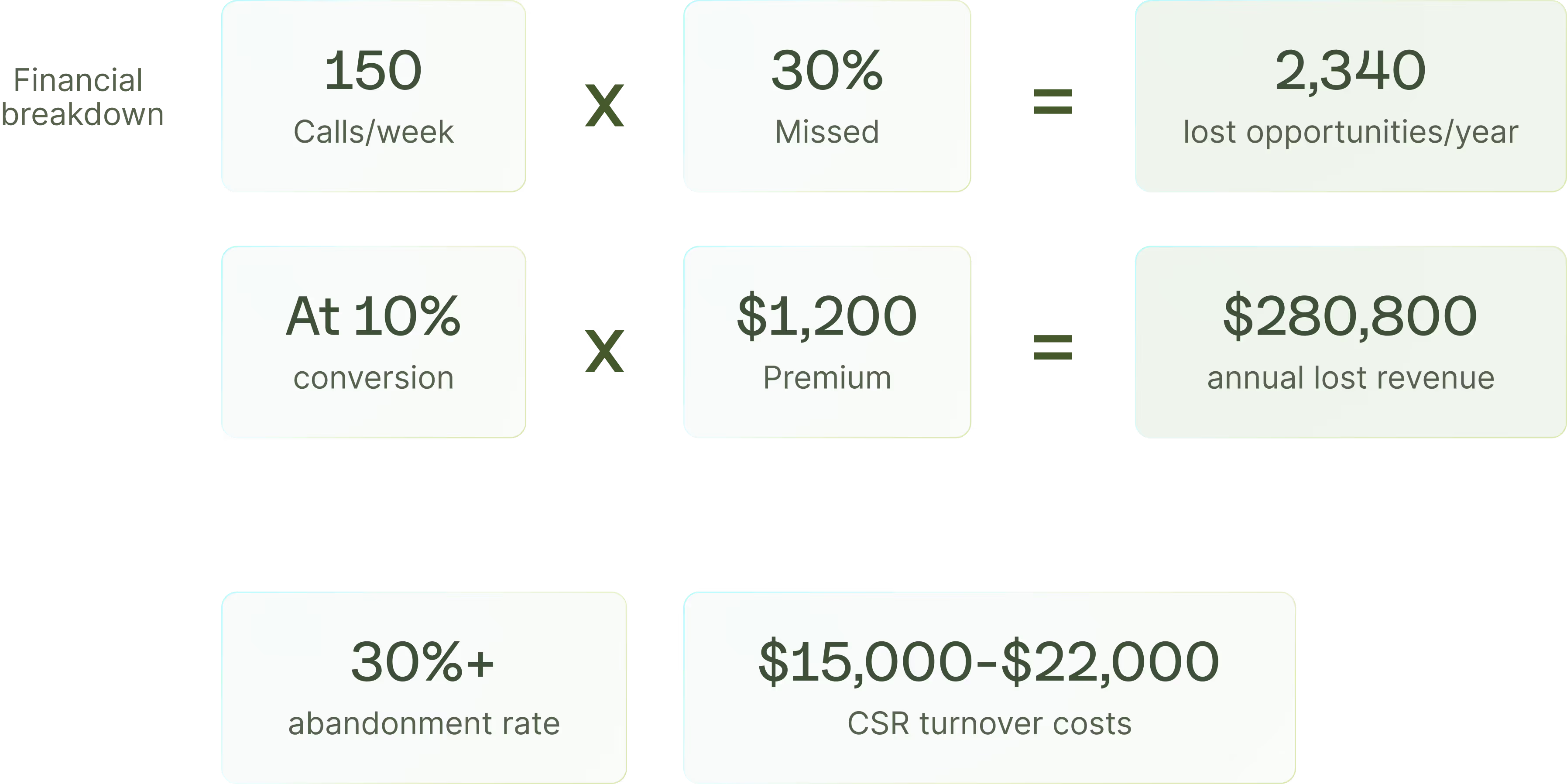
An average independent agency receives 150 calls weekly. Missing 30% means 45 potential opportunities vanish - opportunities that could convert to new policies, cross-sell existing clients, or retain at-risk accounts. Over a year, that's 2,340 missed calls. If just 10% would have converted to new policies averaging $1,200 in annual premium, you've lost $280,800 in revenue.
The math gets worse during peak periods. Storm seasons, open enrollment windows, and year-end renewals can double or triple call volumes overnight. Above-average storm activity forecasted for 2025 means P&C agencies should prepare for sustained volume spikes. When your abandonment rate climbs from 30% to 45% during these surges, you're not just missing calls - you're missing the highest-intent prospects who need coverage immediately.
Call abandonment rates below 5% are considered good for efficiency, yet many insurance agencies operate at rates six times higher. Customers abandon calls at two critical points: 30 and 60 seconds. Every caller who hits those thresholds represents a prospect you'll likely never recover. They're already dialing your competitor.
The problem compounds when you consider lifetime value. A missed call isn't just one lost policy - it's the multi-year relationship that policy could have anchored, plus the referrals that satisfied client would have generated. Our work with hundreds of insurance agencies shows that improving call handling directly correlates with retention rates climbing 12-18% within the first year.
Agent burnout and turnover costs
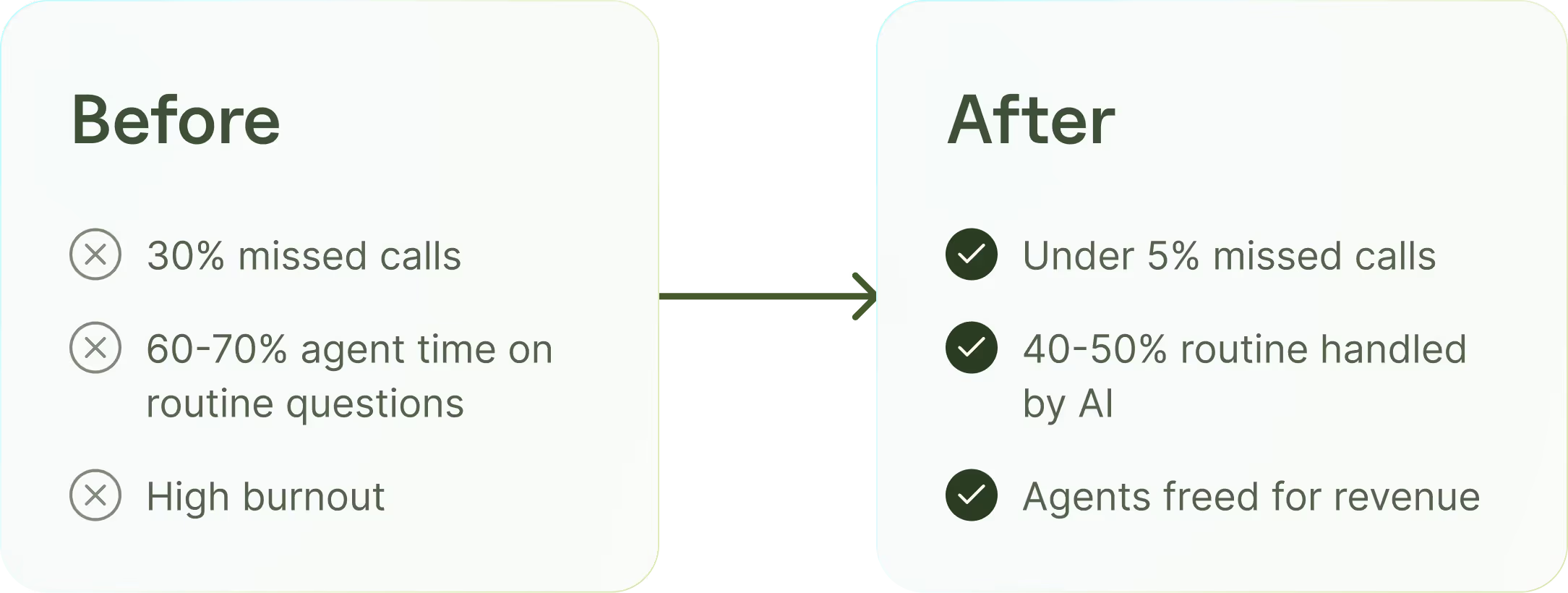
Agent turnover rates in call centers can exceed 30% annually, largely driven by monotonous work and lack of engagement in complex problem-solving. When licensed insurance agents spend 60-70% of their day answering routine questions about ID cards, payment methods, and policy documents, you're burning talent on tasks that generate zero revenue.
Calculate the replacement cost: recruiting a new CSR runs $3,000-5,000, training consumes another 90-120 hours of senior staff time (valued at $4,500-6,000), and the productivity ramp takes three to six months. For an agency losing two CSRs annually, that's $15,000-22,000 in direct costs plus the opportunity cost of 180-240 hours your best people spent training instead of selling.
The burnout extends beyond CSRs. Licensed agents forced to cover phone duties experience similar frustration. They entered insurance to build relationships and solve complex risk problems, not to reset passwords and look up effective dates. This misalignment between role expectations and daily reality drives the experienced producer turnover that truly damages agency growth. AI-powered call handling returns these producers to revenue-generating activities.
Service quality erosion under pressure
When your team operates in constant triage mode, service quality suffers in ways that directly impact retention. Rushed calls mean missed cross-sell opportunities. Harried agents skip relationship-building conversations. Follow-up commitments get forgotten in the chaos. Research indicates 28% of customers experience loyalty decline after poor service experiences.
The damage shows up in your renewal rates first. Clients who consistently experience long hold times, multiple transfers, or callbacks that never happen start shopping competitors six months before renewal. By the time you notice the erosion in retention metrics, the damage is done. Recovering these relationships requires significantly more effort than maintaining them would have.
Why insurance agencies face unique call handling challenges
Insurance CSR call overload stems from factors specific to the industry's regulatory environment, product complexity, and customer expectations. Understanding these root causes reveals why traditional call center solutions fail insurance agencies.
Regulatory compliance requirements
Insurance remains one of the most heavily regulated industries. Every customer interaction must comply with state-specific regulations, privacy laws, and licensing requirements. You can't route a life insurance question to an unlicensed CSR. You can't provide coverage advice without proper credentials. These constraints limit your staffing flexibility in ways other industries don't face.
The licensing requirement creates a ceiling on how quickly you can scale call handling capacity. Training a new licensed agent takes months, not weeks. This lag means you can't respond to sudden volume increases by simply hiring temporary staff. When storm season hits or Medicare Annual Enrollment opens, you're stuck with the capacity you built months ago. AI virtual receptionists solve this by handling routine inquiries while ensuring licensed agents remain available for regulated conversations.
Product complexity and information density
Insurance products carry more complexity than most consumer services. A single auto policy involves coverages, endorsements, deductibles, discounts, and exclusions. Commercial policies multiply that complexity by 10. Customers calling with questions often need information from multiple systems - your AMS for policy details, your carrier portals for claims status, your billing system for payment history.
This information density means longer average handle times. While retail call centers target 3-5 minute calls, insurance conversations routinely run 8-12 minutes. A P&C agency handling 150 calls weekly needs 20-30 hours of CSR time just to answer phones - before counting the research and follow-up many calls require. Call centers face large volumes of basic inquiries like data intake and form submissions, time-consuming repetitive tasks that reduce capacity for complex concerns.
Peak period volume spikes
Insurance call patterns follow predictable but intense cycles. P&C agencies see volume spikes during storm seasons. Life and health brokers manage open enrollment surges. Medicare agencies face compressed Annual Election Period timelines. These peaks can triple normal call volumes for weeks at a time.
Staffing for peak capacity means paying idle agents during normal periods. Staffing for average volumes means service collapses during peaks. Most agencies choose the latter, accepting that November through January will involve missed calls, long holds, and frustrated clients. Rising costs and labor shortages are taking a toll on insurance call centers industry-wide.
The solution requires elastic capacity that scales with demand. Traditional staffing models can't deliver this. 24/7 AI-powered support provides the answer by handling routine calls during both normal and peak periods while ensuring human agents remain available for complex situations.
Five proven strategies to eliminate call overload
Solving insurance CSR call overload requires a systematic approach that addresses root causes rather than symptoms. These five strategies, implemented together, can reduce missed calls by 80-90% while improving service quality and agent satisfaction.
Strategy 1: Deploy AI receptionists for first-contact handling
Modern AI receptionists answer every call immediately, gather caller information, and route appropriately based on intent and complexity. Unlike traditional IVR systems that frustrate callers with endless menu options, conversational AI conducts natural dialogues that feel human.
The impact proves immediate. Agencies implementing AI receptionists see missed call rates drop from 30% to under 5% within the first week. 90% of customers say quick response is critical, with 60% expecting "immediate" to mean within 10 minutes. AI delivers on this expectation every time.
AI receptionists handle routine inquiries completely - policy effective dates, payment due dates, ID card requests, address updates, and basic coverage questions. Our experience working with hundreds of insurance agencies shows 40-50% of incoming calls fall into categories AI can resolve without agent intervention. This frees licensed staff to focus on qualified opportunities and complex service needs.
The 24/7 availability transforms after-hours calls from missed opportunities into captured leads. When a prospect searches for coverage at 9 PM and calls your agency, AI answers, qualifies their needs, and schedules a callback with the appropriate agent. You wake up to a pipeline of qualified opportunities rather than a list of missed calls. Automation enables 24/7 service through platforms that let customers complete tasks outside business hours.
Strategy 2: Implement intelligent call routing and triage
Not all calls require the same expertise. A billing question doesn't need a licensed producer. A complex commercial renewal shouldn't go to your newest CSR. Intelligent routing ensures the right person handles each call based on topic, complexity, and agent availability.
Modern systems analyze caller intent in real-time using natural language processing. When someone says "I need to add my daughter to my auto policy," the system routes to a licensed agent with P&C credentials and auto policy expertise. When they say "I can't log into the customer portal," the system routes to your CSR team or handles it through automated troubleshooting.
Priority routing ensures high-value calls reach agents first. A prospect requesting a $50,000 commercial quote gets priority over a client checking on routine paperwork. This prioritization maximizes revenue capture during busy periods when you must make triage decisions. AI lead qualification automatically identifies and prioritizes these high-value opportunities.
Strategy 3: Create self-service portals with AI guidance
Many callers prefer self-service for simple tasks if the experience works smoothly. The challenge is ensuring customers can find what they need without frustration. AI-guided portals bridge this gap by providing conversational assistance within digital channels.
When a client logs in seeking their insurance ID card, an AI assistant can immediately offer to email it, text it, or display it on-screen. No navigation required. No searching through menus. The AI understands intent and delivers solutions. Automated workflows with digital forms eliminate common data entry errors by ensuring information is accurate before submission.
Self-service portals reduce call volume for transactions that don't require human judgment: downloading documents, making payments, updating contact information, and viewing coverage details. Agencies implementing comprehensive self-service see routine call volumes drop 25-35%. The remaining calls involve situations where human expertise adds real value. Remote customer service capabilities extend these self-service options across all channels.
Strategy 4: staffing through predictive analytics
Traditional staffing models react to yesterday's call volumes. Predictive analytics anticipate tomorrow's needs based on historical patterns, upcoming events, and external factors. A P&C agency can predict volume spikes three days before severe weather hits. A Medicare broker knows exactly when Annual Enrollment will peak.
This foresight enables proactive staffing adjustments. Schedule your most experienced agents during predicted high-volume periods. Cross-train staff to flex between departments as needs shift. Plan time off during predictable slow periods rather than scrambling for coverage during peaks.
Analytics also reveal call patterns throughout the day. Most agencies see morning surges, lunch lulls, and late-afternoon peaks. Align break schedules to maintain coverage during high-volume hours. AI scheduling assistants automate this optimization while giving staff schedule visibility and control.
Strategy 5: callback technology to eliminate hold times
Hold times destroy customer experience and drive abandonment. Callback technology offers an elegant solution: when wait times exceed 60 seconds, offer callers the option to receive a callback when an agent becomes available. They maintain their place in queue without staying on hold.
Customers observe critical abandonment points at 30 and 60 seconds. Callback technology intervenes before these thresholds, capturing opportunities that would otherwise vanish. Agencies implementing callback see abandonment rates drop 60-75% even during high-volume periods.
The customer experience improves dramatically. Instead of choosing between waiting on hold or hanging up, they can continue their day knowing you'll call back. Instead of repeated dial attempts, they get one guaranteed conversation. Automated callback scheduling ensures no request falls through the cracks while giving agents visibility into upcoming commitments.
Measuring the impact: key metrics to track

Implementing call overload solutions requires measuring success through metrics that tie operational improvements to business outcomes. Track these five categories to demonstrate ROI and identify optimization opportunities.
Call handling metrics
- Abandonment rate: Percentage of callers who hang up before reaching an agent - target under 5%
- Average wait time: Seconds callers spend on hold before connection - target under 30 seconds
- First call resolution: Percentage of calls resolved without follow-up - target above 75%
- Average handle time: Minutes per call including research and documentation - track trends rather than minimizing
- Call volume by type: Distribution across routine inquiries, complex service, sales opportunities - routing accordingly
Industry standard service levels target 80% of calls answered within 20 seconds, though leading agencies push this to 90% within 15 seconds. AI-powered systems routinely achieve 95%+ connection rates within 10 seconds.
Agent productivity metrics
- Calls handled per agent per day: Volume capacity per team member - track against quality scores
- Revenue per agent hour: Connect agent time to business outcomes through new policies and retention
- Time allocation: Percentage spent on routine inquiries versus complex problem-solving and sales
- Burnout indicators: Track overtime hours, sick days, and turnover intentions before losing talent
The goal isn't maximizing calls per agent but optimizing the mix between efficiency and effectiveness. AMS software integration gives agents instant access to policy information, reducing handle time while improving accuracy.
Revenue impact metrics
- Quote conversion rate: Percentage of quoted prospects who bind coverage - should improve as response time decreases
- Cross-sell success rate: Additional policies sold to existing clients - increases when agents have time for consultative conversations
- Retention rate by segment: Renewals by product line and client value - deteriorates under poor service conditions
- Cost per acquisition: Total cost of acquiring new clients including missed opportunities - decreases dramatically when you capture more inbound leads
Agencies implementing comprehensive call handling improvements see quote conversion rates climb 15-25% as response time drops and agent focus sharpens. Converting live transfer leads becomes significantly easier when your team has capacity to engage immediately.
Customer experience metrics
- Net Promoter Score: Likelihood customers recommend your agency - strong correlation with service responsiveness
- Customer effort score: How easy was it to accomplish their goal - reduces as self-service and routing improve
- Service issue resolution time: Hours from initial contact to problem resolution - compress through better triage and follow-up
- Digital engagement rate: Percentage of clients using self-service portals - indicates successful adoption of efficiency tools
Our work with insurance agencies shows NPS scores typically improve 12-18 points within six months of implementing AI-powered call handling. The improvement stems from consistently meeting expectations around availability and responsiveness. Customer service strategies that prioritize accessibility drive measurable loyalty gains.
Operational efficiency metrics
- Cost per call: Total call handling costs divided by volume - should decrease as automation handles routine inquiries
- After-hours conversion rate: Percentage of non-business-hour contacts that convert to opportunities - zero without automation
- Peak period service level: Maintain service standards during volume surges - proves scalability
- Technology ROI: Cost savings and revenue gains from automation versus implementation and operation costs
Typical agencies see 6x-8x ROI within the first year of implementing comprehensive call handling automation. The returns compound over time as you scale the business without proportionally scaling staff. AI virtual assistants provide this scalability for small to midsize agencies that previously couldn't afford specialized support roles.
Common implementation mistakes to avoid
Understanding what doesn't work prevents costly delays and false starts. These four mistakes trip up agencies attempting to solve call overload without proper planning.
Mistake 1: Implementing technology without process redesign
Technology amplifies your processes - good or bad. Dropping an AI receptionist into broken call handling workflows just automates dysfunction. Before implementing new technology, map your current call journey from first ring to resolution. Identify bottlenecks, redundant steps, and information gaps. Redesign the process to eliminate waste, then implement technology to support the improved workflow.
A common example: agencies implementing callback technology without establishing clear response time standards and accountability. Customers receive callback offers but wait hours or days for the return call. The technology created expectations the organization couldn't meet, damaging experience rather than improving it. AI assistants work best when supporting well-defined service standards.
Mistake 2: Under-investing in integration
AI receptionists and automation tools deliver maximum value when integrated with your agency management system, CRM, and communication platforms. Standalone tools require manual data transfer, creating new inefficiencies while solving old ones. Your AI receptionist should update contact records automatically, create tasks for follow-up, and give agents complete context when transferring calls.
Integration complexity varies significantly across platforms. Before selecting tools, verify integration capabilities with your existing technology stack. The best AI solutions offer AMS integration out of the box, eliminating the technical burden on your team.
Mistake 3: Neglecting staff change management
AI adoption fails when staff view it as a threat rather than a tool. Licensed agents who've spent years answering phones may resist change even when they're drowning in routine inquiries. CSRs may fear replacement. Producers may doubt AI's ability to represent your brand appropriately.
Address these concerns proactively through clear communication about goals, roles, and benefits. Emphasize that AI handles routine tasks so humans can focus on relationship-building and complex problem-solving. Share metrics showing how other agencies improved both employee satisfaction and business outcomes through automation. Involve skeptical team members in implementation planning so they feel ownership rather than imposition. AI virtual assistants enhance rather than replace human expertise when positioned correctly.
Mistake 4: Expecting instant perfection
AI systems improve through training and optimization. Your AI receptionist will make mistakes in the first weeks as it learns your specific processes, terminology, and client base. Plan for this learning curve by maintaining full human backup during initial implementation. Review call recordings to identify confusion points and provide additional training data.
Most agencies see AI accuracy reach 90-95% within the first month and continue improving from there. Set realistic expectations with your team and clients. A staged rollout - starting with after-hours calls before expanding to business hours - lets you refine the system before it handles your full call volume. Leading AI assistants include comprehensive training and optimization support to accelerate this maturation process.
The future of insurance call handling
Call handling technology continues evolving rapidly. Understanding upcoming capabilities helps agencies make forward-looking decisions that position them for long-term success rather than solving only today's problems.
Predictive outreach before calls happen
The next frontier moves beyond reactive call handling to proactive customer engagement. Advanced systems will identify clients likely to need assistance based on external events and behavioral patterns, then reach out before they call. A P&C agency's AI could text clients in severe weather paths with claims filing guidance before damage occurs. A Medicare broker's system could remind clients about formulary changes before they encounter prescription coverage issues.
This shift from reactive to proactive reduces call volume while improving customer experience. Clients appreciate agencies that anticipate needs rather than waiting for problems to escalate. The operational benefit is significant: a text or email resolves many situations that would otherwise require a phone call. AI-powered renewal automation already demonstrates this principle by handling retention conversations before lapses occur.
Multimodal AI across all channels
Current AI receptionists handle phone calls superbly but live in isolation from other channels. The evolution toward unified customer experience means AI that maintains context across phone, text, email, web chat, and social media. A client who starts a conversation via text can continue it by phone without repeating information. An email inquiry can automatically trigger a callback if the situation requires voice discussion.
This channel flexibility meets customers where they are rather than forcing them into your preferred communication method. Multilingual support capabilities extend this accessibility to non-English-speaking clients, opening market opportunities many agencies can't serve today.
AI-human collaboration becoming
Early AI implementations created hard boundaries between automated and human handling. Future systems blur these lines through real-time collaboration. AI assists agents during calls by surfacing relevant policy information, suggesting coverage options, and drafting follow-up communications. Agents guide AI through complex situations by providing decision logic the system can apply to similar future scenarios.
This collaboration amplifies human expertise rather than replacing it. Agents spend less time searching for information and more time building relationships. AI becomes more accurate by learning from agent corrections. AI meeting assistants already demonstrate this collaborative model by handling note-taking and follow-up while agents focus on relationship dynamics.
Emotional intelligence in AI interactions
Current AI excels at handling transactions but struggles with emotional nuance. A caller who just experienced a house fire needs empathy before efficiency. Advanced natural language processing will enable AI to detect emotional states through voice patterns and word choice, then adjust responses appropriately. Frustrated callers receive patient problem-solving. Confused clients get extra explanation. Urgent situations route to human agents immediately.
This emotional awareness transforms AI from a tool that handles routine calls into one that enhances relationship quality across all interactions. The technology isn't quite there yet, but rapid progress suggests emotionally intelligent AI will become standard within 2-3 years.
Getting started: your 90-day implementation roadmap
Solving insurance CSR call overload doesn't require years of planning or six-figure budgets. This 90-day roadmap provides a practical path from decision to measurable results.
Days 1-30: Assessment and planning
Start by quantifying your current state. Track these metrics for two weeks: total call volume, missed calls, average wait time, abandonment rate, and call types. Analyze your busiest and slowest periods. Identify which calls require licensed agents versus CSR support versus potential automation.
Interview your team to understand pain points beyond the numbers. Which tasks frustrate them most? Where do they spend time that doesn't require their expertise? What capabilities would help them serve clients better? This qualitative input often reveals opportunities metrics miss.
Research solutions that fit your specific needs and technology stack. Not all AI receptionists offer insurance-specific capabilities or integrate with your AMS. Comprehensive tool guides help agencies evaluate options efficiently. Schedule demos with your top two to three candidates and prepare specific scenarios to test - don't accept generic demonstrations that may not reflect your reality.
Select your solution by day 30. Factor in not just capabilities but implementation support, training resources, and integration requirements. The best technology poorly implemented delivers worse results than good technology with excellent support.
Days 31-60: Implementation and training
Begin implementation with a clearly defined scope. Most agencies should start with after-hours call handling where downside risk is minimal - any calls captured represent pure opportunity gain. This limited scope lets you refine the system before expanding to business hours.
Work closely with your implementation team to train the AI on your specific processes, terminology, and brand voice. Provide call recordings, scripts, and FAQ documents that give the system context. The more information you provide upfront, the faster it reaches useful accuracy.
Train your human team simultaneously. Ensure everyone understands how calls will be routed, what information AI will gather, and how they'll receive leads and service requests. Create clear protocols for situations requiring escalation. Establish response time standards for AI-scheduled callbacks.
Begin soft launch by day 45. Route a portion of calls through the new system while maintaining full human backup. Monitor every interaction initially. Look for confusion points, unclear routing decisions, and brand voice mismatches. Provide feedback to continuously improve performance.
Days 61-90: Optimization and expansion
Analyze results from your initial implementation. What's working well? Where does the system struggle? Which call types should continue going to AI versus human agents? Use this data to refine routing rules, expand AI capabilities, and adjust human workflows.
Expand gradually to business hours, starting with your lowest-volume periods. As confidence grows, expand coverage until AI handles first contact for all routine inquiries. Maintain human monitoring initially, then transition to sampling-based quality assurance.
Measure impact against your baseline metrics from month one. Track not just operational improvements but business outcomes: quote conversion rates, retention trends, agent satisfaction scores, and customer feedback. Share wins with your team to build momentum and address remaining concerns.
Plan your next phase by day 90. With basic call handling d, where else can automation drive efficiency? Claims automation, renewal automation, and scheduling automation represent natural next steps for agencies seeing strong results from call handling improvements.
Transform call overload from crisis to competitive advantage
Insurance CSR call overload isn't inevitable. It's a solvable problem that, once addressed, transforms your agency's capacity for growth. The agencies that move first gain a structural advantage competitors will struggle to match - they capture more opportunities, serve clients better, and scale efficiently while others remain stuck in reactive firefighting mode.
The math is straightforward. Missing 30% of calls costs your agency hundreds of thousands in lost revenue annually while burning out your most valuable people. Implementing AI-powered call handling reduces missed calls to under 5%, frees licensed agents to focus on high-value activities, and provides consistent 24/7 service that builds loyalty and drives referrals. The investment pays for itself within months while creating a foundation for sustainable growth.
The technology exists today. The question isn't whether AI can handle insurance calls effectively - hundreds of agencies already prove it can. The question is how long your agency will continue operating at partial capacity, losing opportunities to competitors who answer every call, while your team drowns in routine inquiries.
Start with clear-eyed assessment of your current state. Measure what you're missing, quantify the cost, and identify the highest-impact opportunities. Choose purpose-built insurance technology that integrates with your existing systems rather than creating new silos. Implement systematically with proper training and optimization. Measure results against concrete business outcomes.
The agencies we work with typically see ROI within 30-60 days as missed call rates plummet and agent productivity soars. They reclaim 10-15 hours per agent weekly that previously went to routine phone work. They convert after-hours inquiries that previously vanished into qualified opportunities. Most importantly, they transform their relationship with inbound calls from dreaded disruption to welcome revenue opportunity.
Your phones will keep ringing. The only question is whether you'll capture the opportunity or watch it ring through to voicemail - and then to your competitor who did answer. Building effective customer service capacity isn't optional in 2025's competitive insurance market. It's the difference between agencies that thrive and those that survive.
When the phone rings, we're already there.





.svg)

.svg)
