.svg)


Insurance virtual assistant costs vary widely depending on whether you hire a human assistant or use an AI-powered solution. Human virtual assistants are typically priced by the hour or through monthly retainers, while AI receptionists usually operate on predictable subscription plans based on call volume and features.
The right choice depends on more than the advertised price. Factors such as industry expertise, training requirements, software access, availability, and scalability all affect the total cost of ownership. While a lower hourly rate may seem attractive, additional expenses can significantly increase the overall investment.
This guide compares the pricing of human and AI-powered insurance virtual assistants, explains the factors that influence cost, highlights hidden expenses, and helps you evaluate which solution offers the best value for your agency.
Key Takeaways
- Insurance virtual assistant costs vary based on the type of assistant, pricing model, experience level, and required insurance expertise.
- Human virtual assistants are typically priced hourly or through monthly retainers, while AI-powered assistants generally use subscription-based pricing.
- The advertised rate is only part of the total cost. Training, software, management, and after-hours coverage can significantly affect the overall investment.
- Comparing human and AI virtual assistants requires evaluating both cost and operational factors, including availability, scalability, and workflow efficiency.
- The right solution depends on your agency's call volume, administrative workload, budget, and long-term growth goals.
Understanding Insurance Virtual Assistant Pricing Models
Insurance virtual assistants are typically priced using one of three models: hourly rates, monthly retainer packages, or usage-based AI subscriptions. Understanding how each model works is the first step in comparing costs and choosing the right solution for your agency.
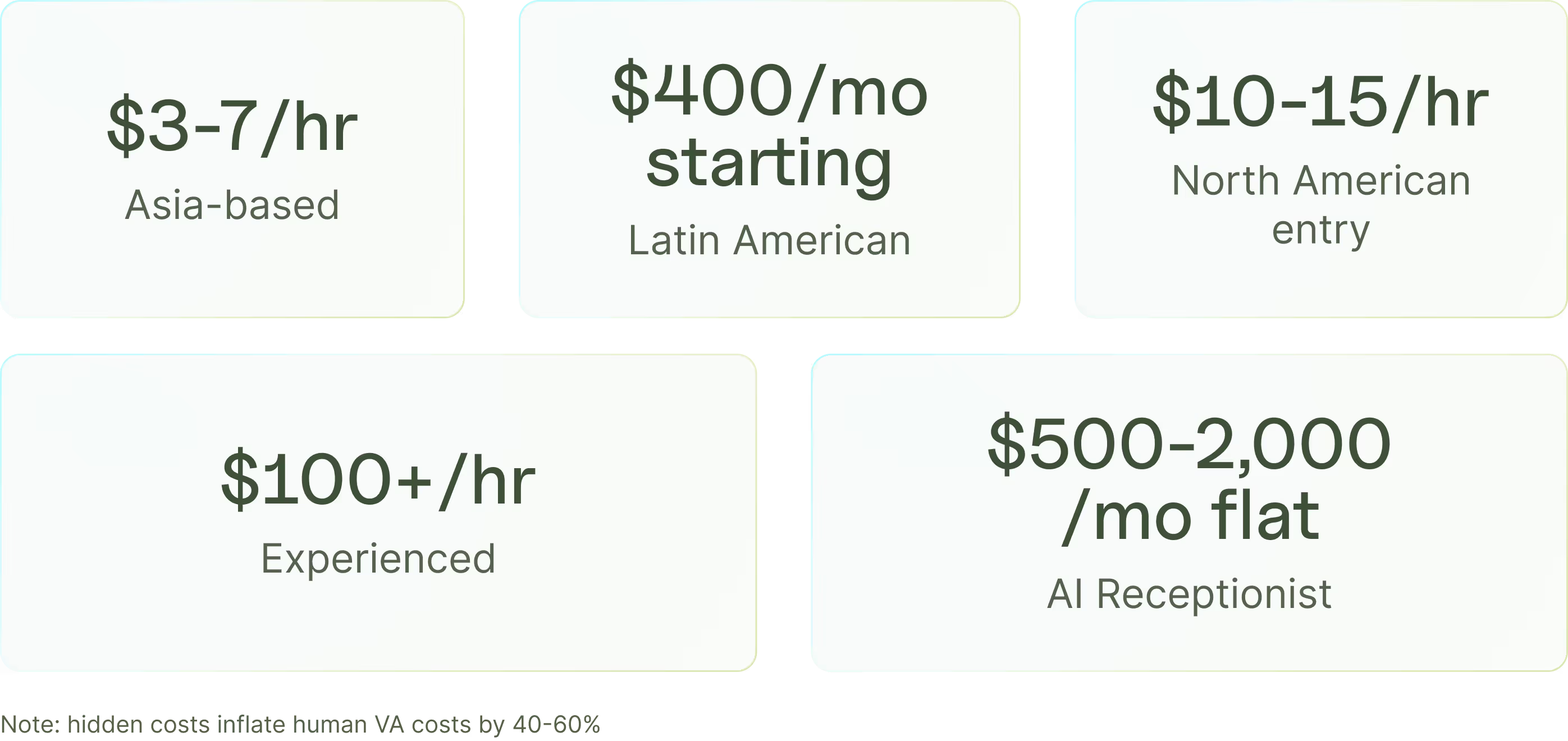
Entry-level virtual assistants in North America earn around $10 to $15 per hour, while experienced VAs command over $100 per hour. This dramatic range reflects skill level, industry specialization, and task complexity. An insurance-specialized VA who understands AMS systems, policy terminology, and regulatory compliance demands significantly higher compensation than a general administrative assistant.
Location is one of the biggest factors affecting virtual assistant pricing. According to ScaleUp Teams data, VAs in Latin America start at just $400 per month, while Asia-based assistants range from $3 to $7 per hour. European VA rates typically fall between €10 to €30 per hour, positioning them in the mid-tier of global pricing.
Platform choice affects your bottom line. Recent platform comparisons reveal that hourly rates vary significantly:
- Zippia reports $19 per hour
- Upwork charges $10 to $20 per hour
- ZipRecruiter averages $24 per hour
Insurance agencies often require VAs who understand certificate requests, endorsements, loss runs, renewal workflows, and agency management systems (AMS). This specialization justifies premium pricing but creates qualification challenges when sourcing from general VA marketplaces.
Monthly retainer packages typically bundle a set number of hours - commonly 20, 40, or 80 hours - at discounted rates compared to pure hourly arrangements. These structures provide predictable costs but create utilization pressure. IMonthly retainers provide predictable costs, but agencies may pay for unused hours or incur additional charges if workloads exceed the agreed package.
AI-powered virtual assistants typically use subscription or usage-based pricing rather than hourly billing. Depending on the provider, pricing may be based on conversations, minutes, call volume, or completed tasks.
Human Virtual Assistant Costs: The Complete Picture
The advertised hourly rate is only one part of the total cost. Depending on your agency's workflows, additional expenses such as onboarding, software, management, and training can significantly increase the overall investment.
For example, hiring a full-time VA at $15 per hour (40 hours per week) results in an annual labor cost of approximately $31,200 before additional expenses are considered.
Training and Ongoing Management
Platform fees can add 10% to 20% to the cost of hiring through many freelance marketplaces.
Training time represents pure cost with zero productivity return - expect 20 to 40 hours before a VA handles insurance-specific tasks competently. Quality assurance oversight requires your licensed agents or operations manager to review work, correct errors, and provide feedback, typically consuming five to eight hours weekly.
Experience and Location Affect Pricing
According to Invedus research, Virtual Assistant Experts earn within the range of $400 and $5,600 per month. This massive variance reflects experience, specialization, and geographic location. Insurance-specific VAs cluster at the higher end of this spectrum because policy knowledge, compliance awareness, and AMS familiarity command premium compensation.
Time zone differences create coordination friction. A Philippines-based VA operates 12 to 14 hours ahead of U.S. Eastern Time, requiring asynchronous communication that delays decisions and extends project timelines. Latin American VAs offer better timezone alignment but command higher rates due to U.S. proximity and cultural familiarity.
Staff Turnover
Staff turnover is another cost to consider. Replacing a VA often means repeating the recruitment, onboarding, and training process, which requires additional time and resources. Industry data suggests VA turnover rates of 30% to 40% annually, meaning agencies face replacement costs every two to three years on average.
Additional Operating Costs
Software and system access generate additional costs. Your VA needs licenses for your AMS, CRM, email platform, and communication tools. These subscriptions range from $20 to $150 monthly per user depending on your technology stack. Security requirements may mandate VPN services, encrypted communication channels, and data loss prevention tools.
Communication infrastructure matters. VAs require reliable high-speed internet, professional phone systems, and video conferencing capabilities. While these costs technically belong to the VA, unreliable infrastructure forces your agency to provide backup systems or tolerate service interruptions that damage client relationships.
The Real Cost of Missed Opportunities
Your agency can lose potential revenue when calls go unanswered, appointments aren't scheduled promptly, or quote requests remain unanswered. While these opportunity costs don't appear directly on financial statements, they can have a significant impact on business growth.
Insurance buyers demonstrate extreme impatience. When prospects call your agency outside business hours, they contact competitors within 15 minutes. Your 9:00 AM return call reaches someone who already purchased coverage elsewhere. The average P&C policy generates $800 to $2,500 in annual commission - revenue that disappears when prospects can't reach you immediately.
Response time directly correlates with conversion rates. AI lead qualification research shows that contacting leads within five minutes generates 10 times higher conversion than waiting 30 minutes. Your human VA checking email twice daily creates multi-hour response delays that kill opportunities.
Consider renewal season dynamics. Your agency handles hundreds of renewal conversations in compressed timeframes. Human VAs struggle with volume spikes, creating service bottlenecks when client retention matters most. Hiring temporary VAs for seasonal coverage requires training investment that produces short-term value.
Cross-selling and upselling opportunities require consistent follow-up. Your VA should systematically contact clients approaching life events - home purchases, vehicle acquisitions, business expansions - that create coverage needs. Human VAs handle this inconsistently, forgetting follow-ups or prioritizing urgent tasks over strategic outreach.
To see how automation addresses many of these operational challenges, explore our comparison of AI versus insurance outsourcing.
AI-Powered Virtual Assistants: The 2026 Cost Reality
AI-powered virtual assistants have become an increasingly common option for insurance agencies, offering subscription-based pricing and automated customer interactions. Unlike traditional staffing models, AI solutions typically have predictable monthly costs and don't require recruitment, onboarding, or ongoing employee management.
Typical AI receptionist pricing for insurance agencies ranges from $500 to $2,000 monthly depending on call volume, integration complexity, and feature requirements. This all-inclusive cost covers unlimited conversation capacity, 24/7 availability, multilingual support, and AMS integration without additional per-user licenses or training expenses.
One operational advantage of AI is its ability to handle multiple conversations simultaneously. Unlike a human assistant, AI systems can respond to several callers at once, helping agencies manage periods of higher call volume without increasing staffing.
AI platforms generally require less onboarding than hiring and training a new employee. Once configured, updates to workflows, knowledge, or agency information can typically be applied across all future interactions without retraining staff.
Consistency represents AI's fundamental advantage.
AI systems follow the same predefined workflows for every interaction, providing a consistent experience regardless of call volume or time of day. Human assistants may naturally vary in experience, communication style, and availability.
Integration depth determines practical value. The ultimate virtual assistant for insurance agencies connects natively with Applied Epic, AMS360, QQCatalyst, HawkSoft, and other major AMS platforms. This integration enables AI to pull client data, update contact information, and log interactions automatically without manual data entry.
Exploring the best AI assistants for insurance agencies reveals feature differentiation that impacts pricing. Basic systems handle appointment scheduling and message taking. Advanced platforms qualify leads, provide quote information, process certificate requests, and manage renewal conversations.
ROI Analysis: Human VAs Versus AI Solutions

While upfront pricing is important, agencies should also consider the long-term return on investment (ROI) of different virtual assistant solutions. Comparing ongoing operating costs, staffing requirements, and potential efficiency gains provides a more complete picture than monthly pricing alone.
Start with direct cost comparison. A full-time insurance VA at $15 per hour costs $31,200 annually for 40 hours weekly. Add 15% for platform fees ($4,680), training time investment ($1,500), quality oversight ($3,000), and software licenses ($1,200). Your true annual cost reaches $41,580.
Research confirms these calculations. Virtual Rockstar data shows that hiring a virtual assistant can save businesses $30,000 plus per year compared to full-time staff. However, this comparison measures VA costs against in-house employees, not against AI alternatives.
An AI receptionist priced at approximately $1,200 per month would cost around $14,400 annually. Because pricing is subscription-based, ongoing costs are generally more predictable and don't include recruitment or employee-related expenses, although implementation and integration costs may still apply.
Faster response times and extended availability may also help agencies capture opportunities that could otherwise be missed, particularly outside normal business hours. The financial impact will vary depending on call volume, lead quality, and conversion rates.
AI systems answer every call immediately, schedule appointments 24/7, and qualify leads consistently. Agencies implementing 24/7 insurance support report 30% to 45% increases in scheduled appointments and 20% to 35% improvements in quote-to-bind ratios within 90 days.
Apply conservative estimates to your agency. Capturing just 10% more opportunities from improved availability generates $80,000 in additional annual premium at typical $800,000 agency size. Commission rates of 12% to 15% produce $9,600 to $12,000 in incremental revenue. Combined with $27,180 in direct cost savings, your total economic benefit reaches $36,780 to $39,180 annually.
This represents six times to eight times return on your AI investment within the first year. We've documented these outcomes across hundreds of agency implementations, with results typically appearing within 30 to 45 days of deployment.
Service consistency provides additional value difficult to quantify. AI eliminates the variation inherent in human performance. Every caller receives identical professional treatment regardless of time, complexity, or concurrent demands. This consistency builds client satisfaction scores and referral rates.
Understanding virtual receptionist software ROI requires examining customer lifetime value.
Retaining additional policyholders through faster response times and consistent service can increase recurring commission revenue over the long term, although the financial impact will vary between agencies.
Hidden Costs of Human VAs Insurance Agencies Overlook
When evaluating the cost of a human virtual assistant, agencies should also consider expenses that may not be obvious during the hiring process. Ongoing management, training, software access, and operational inefficiencies can increase the total cost over time.
Error correction also carries a cost. When incorrect client information, appointment details, or policy data needs to be corrected, licensed staff may need to review and update records, reducing the time available for revenue-generating activities.
Knowledge gaps create service limitations.
Human VAs are often responsible for administrative work, while licensed agents continue handling policy advice and complex insurance questions. Depending on the agency's workflow, this may require frequent handoffs between team members, reducing some of the expected efficiency gains.
Communication overhead drains productivity. Managing a remote VA requires daily check-ins, task assignments, priority updates, and performance feedback. Operations managers report spending eight to 12 hours weekly on VA coordination - time that could drive revenue through producer support or client relationship building.
Communication quality can also influence the client experience. Agencies serving specific regions or customer segments may benefit from VAs who are familiar with local terminology, insurance vocabulary, and communication styles. As ASNOA research confirms, virtual assistants can help strengthen client loyalty through consistent service. However, achieving these outcomes depends on clear communication, appropriate training, and alignment with the agency's workflows.
Data security and compliance create risk exposure. Your VA accesses sensitive client information including Social Security numbers, health data, and financial records. HIPAA violations, data breaches, or privacy lapses generate legal liability, regulatory fines, and reputation damage. Implementing proper security controls for remote VAs requires technical infrastructure and monitoring systems that add cost and complexity.
Technology troubleshooting disrupts operations. When your VA's internet fails, computer crashes, or software malfunctions, your agency loses productivity while they resolve technical issues. Unlike in-house staff where your IT support provides immediate help, remote VAs troubleshoot independently, creating extended outages during critical business periods.
Scope creep inflates hours. VAs initially hired for 20 hours weekly gradually expand to 30 or 40 hours as your agency discovers additional tasks they can handle. This expansion feels organic and justified but transforms your cost structure. A $15 per hour VA working 40 hours weekly costs double the initial 20-hour budget without explicit approval or evaluation.
Examining ways AI boosts agency efficiency reveals how automation eliminates these hidden costs entirely. AI systems don't make data entry errors, don't escalate routine questions, don't require daily management, and don't create security vulnerabilities through inconsistent practices.
Making the Right Choice for Your Agency in 2026
The right virtual assistant solution depends on your agency's size, workload, growth plans, and operational priorities. While cost is an important consideration, long-term scalability, efficiency, and customer service should also factor into the decision.
Start by identifying your agency's biggest operational challenges. If you're frequently missing calls outside business hours, experiencing slow response times, or spending significant staff time on administrative tasks, it may be worth evaluating solutions that provide broader coverage and greater automation.
Consider your growth trajectory. Agencies planning to add producers, expand geographic coverage, or enter new product lines need flexible capacity that scales instantly. Hiring additional VAs creates lead time for recruitment, training, and integration. AI systems scale immediately without incremental hiring costs or onboarding delays.
According to Deloitte's 2026 outlook, combined ratios for P&C insurance in the United States are expected to worsen from 97.2% in 2024 to 99% in 2026. This compression forces agencies to improve operational efficiency and reduce administrative costs while maintaining service quality. Automation provides the only viable path to achieving these conflicting objectives.
Technology integration capabilities separate viable solutions from expensive experiments. Your virtual assistant must connect natively with your AMS, extract client data automatically, update contact information in real-time, and log all interactions without manual entry. Solutions requiring duplicate data entry or manual synchronization create more work than they eliminate.
The complete guide to AI tools demonstrates how leading agencies build technology stacks that eliminate administrative overhead while improving client experiences. AI receptionists represent the foundation of this transformation.
Testing proves value faster than analysis. Rather than conducting endless cost-benefit analyses, implement a 30-day pilot program with clear success metrics. Track appointment scheduling rates, lead qualification accuracy, client satisfaction scores, and agent time savings. Real performance data reveals whether a solution delivers promised value or creates new problems.
We've implemented these pilots with hundreds of agencies. The consistent pattern shows measurable improvements within two weeks - more appointments scheduled, higher lead qualification rates, and immediate reduction in agent time spent on phone coverage. Agencies that test AI receptionists convert to permanent implementation at 85% to 90% rates because results speak clearly.
Risk tolerance affects timing. Conservative agency owners prefer proven solutions with extensive track records. Early adopters accept higher risk for competitive advantage. In 2026, AI receptionists have matured beyond experimental technology. The Global Healthcare Virtual Assistants Market is projected to grow from $1.1 billion in 2024 to $15.11 billion by 2035, demonstrating mainstream adoption across adjacent industries.
What Leading Agencies Do Differently
Agencies adopting virtual assistants and automation often follow similar implementation strategies. Rather than focusing solely on reducing costs, they also use technology to improve operational efficiency, customer service, and scalability.
Many agencies automate repetitive tasks such as appointment scheduling, certificate requests, renewal reminders, and policy change notifications. This allows licensed agents to spend more time on client relationships, coverage advice, and other higher-value activities.
Leading agencies rely on data to evaluate performance. They track metrics such as calls answered, appointments scheduled, qualified leads, and conversion rates to understand how their workflows are performing and identify opportunities for improvement. Monitoring these metrics also helps agencies evaluate the impact of new technology over time.
They staff for strategy, automate for execution. Human team members handle relationship management, risk assessment, coverage consultation, and claims advocacy. AI systems manage scheduling, information gathering, routine inquiries, and administrative follow-up. This division maximizes each resource's strengths while eliminating costly mismatches.
Rather than relying on disconnected tools, many agencies integrate their virtual assistants with existing systems so information flows more efficiently between platforms. AI receptionists that integrate with AMS platforms, CRM systems, and email marketing tools can reduce manual data entry, improve workflow efficiency, and create a more connected customer experience.
They implement comprehensive customer service strategies that combine AI automation with strategic human touchpoints. Clients receive immediate AI-powered responses for simple requests while complex situations escalate smoothly to licensed agents who deliver personalized expertise.
Technology investment also varies between agencies. Organizations that prioritize digital tools may invest a larger share of their budgets in technology to improve operational efficiency and customer service.
Rather than automating every workflow at once, many agencies begin with a specific use case, such as after-hours call coverage, certificate request processing, or renewal appointment scheduling. Once those workflows are established, automation can be expanded to additional areas as business needs evolve.
Exploring insurance renewal automation reveals how sophisticated agencies apply AI throughout the policy lifecycle rather than treating it as a simple call answering solution.
Implementation Roadmap: Your First 90 Days
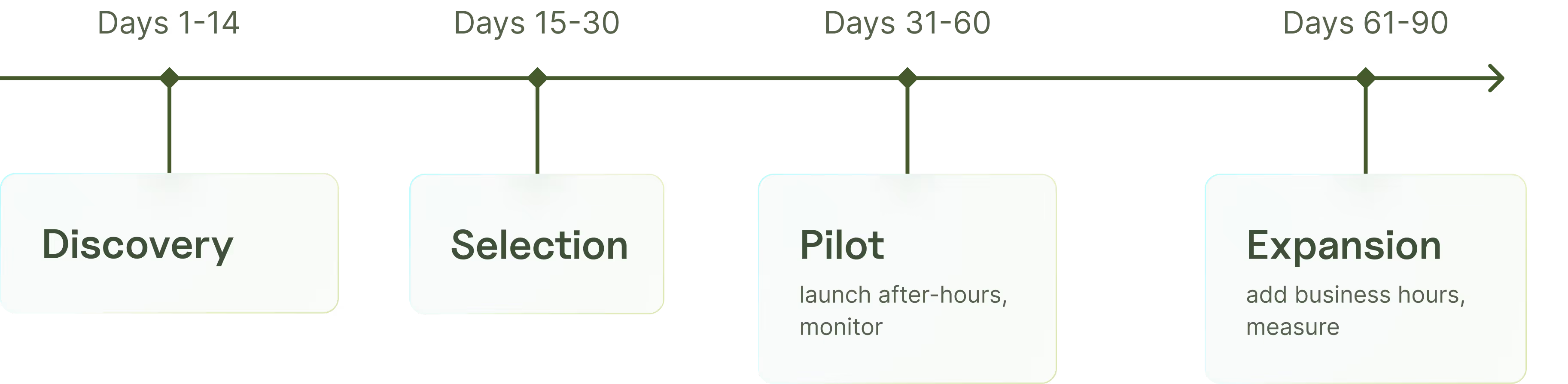
Once you've selected a virtual assistant solution, a structured implementation plan can help reduce disruption and improve adoption. The following 90-day roadmap outlines one approach to introducing AI-powered automation into an insurance agency.
Days 1-14: Discovery and Baseline
Document your current state comprehensively. Track all incoming calls for two weeks, categorizing by type - quote requests, policy changes, certificate requests, billing inquiries, and claims notifications. This data reveals your call volume patterns, peak times, and task distribution.
Measure existing performance metrics including calls answered, average response time, appointment scheduling rates, and lead-to-quote conversion. These baselines enable accurate before-and-after comparison once you implement automation.
Identify integration requirements. List your AMS platform, CRM system, email marketing tools, and phone system. Verify that your AI solution connects natively with these technologies to eliminate manual data transfer.
Days 15-30: Selection and Configuration
Evaluate AI receptionist providers against your specific requirements. Test conversation quality, assess integration capabilities, verify insurance industry knowledge, and confirm multilingual support if your agency serves diverse communities.
Configure your AI system with agency-specific information including operating hours, appointment availability, producer calendars, carrier appointments, and service area boundaries. Upload frequently asked questions, policy information, and common scenarios to train the AI on your agency's unique characteristics.
Implement AI scheduling assistants that sync with your producers' calendars in real-time, preventing double-bookings and ensuring appointment confirmation.
Days 31-60: Pilot and Optimization
Launch your AI receptionist for specific use cases. Start with a specific use case, such as after-hours call coverage, where performance can be measured before expanding automation further. This limited scope builds confidence while minimizing risk.
Monitor every conversation during the pilot phase. Review call recordings, examine data capture accuracy, and identify improvement opportunities. Most AI platforms improve rapidly with feedback during early deployment.
Gather feedback from producers, operations staff, and customer service teams throughout the pilot. Their input can help identify workflow improvements, data quality issues, and opportunities to refine the implementation.
Days 61-90: Expansion and Measurement
Expand AI coverage to business hours for routine inquiries while maintaining human escalation paths for complex situations. This hybrid approach delivers automation benefits while preserving relationship continuity.
Measure results against your baseline metrics. Calculate improvement in calls answered, appointments scheduled, lead qualification accuracy, and agent time savings. Translate these operational improvements into revenue impact and cost reduction.
Document lessons learned and identify additional workflows that could benefit from automation, such as certificate requests, renewal reminders, or claims notifications.
Understanding claims automation processes positions your agency to extend AI benefits throughout the policy lifecycle rather than limiting automation to initial contact.
The Future of Insurance Agency Operations
Choosing a virtual assistant solution is about more than comparing monthly costs. It is a long-term operational decision that can influence how efficiently your agency serves clients, manages administrative work, and scales over time.
AI capabilities accelerate rapidly. Systems that handled basic appointment scheduling in 2024 now conduct sophisticated needs analysis conversations, provide preliminary quote information, and identify cross-selling opportunities during every interaction. This evolution continues as natural language processing improves and industry-specific training data expands.
Client expectations shift based on experiences outside insurance. Consumers who interact with AI assistants for banking, healthcare, and e-commerce expect similar responsiveness from their insurance agencies. Agencies that force clients to leave voicemails or wait for business hours callbacks feel outdated and lose business to more responsive competitors.
As AI adoption grows, insurers and technology providers continue to invest in compliance, documentation, and oversight to support its use in regulated environments.
Recruiting and retaining administrative staff remains challenging for many agencies. Automation can help reduce pressure on teams by handling routine tasks and supporting more consistent service.
According to Remote Coworker research, about 67% of business owners have hired at least one virtual assistant, demonstrating mainstream adoption. However, the shift toward AI-powered solutions accelerates as cost advantages and performance improvements become undeniable.
As more agencies adopt automation, clients may increasingly expect faster response times and greater availability. Agencies evaluating AI today can better prepare for these changing expectations.
Ultimately, the right solution depends on your agency's goals, workflows, and budget. Looking beyond the monthly subscription cost and considering long-term efficiency, scalability, and customer experience can help you make a more informed decision.
If you're evaluating whether an AI-powered virtual assistant is the right fit for your agency, seeing one in action can make the decision easier.
Schedule a demo to explore how Sonant AI helps insurance agencies manage incoming calls, qualify leads, and automate routine conversations while keeping licensed agents focused on higher-value client interactions.





.svg)

.svg)
