.svg)


Key Takeaways
- There's no single "best" voice AI platform for claims, the real question is which process you're automating: Sonant AI wins on turnkey agency deployment, Synthflow on no-code speed, Cognigy on complex NLU routing, each platform earns its "best for" tag by solving a different problem, not by beating the others outright.
- Sonant AI is built specifically for P&C, life, health, and Medicare agencies with 5 to 200 employees, and it's not a hypothetical productivity gain, Cornerstone Insurance's documented case study reported a 43% jump in staff productivity after implementation.
- McKinsey's research on AI in insurance found that insurers taking a domain-based approach, rewiring specific functions like claims rather than making piecemeal changes, saw 10 to 15% premium growth, 20 to 40% lower onboarding costs, and a 3 to 5% improvement in claims accuracy.
- Picking a platform comes down to prebuilt FNOL workflows, reliable telephony/SIP, and compliance coverage (GDPR, SOC 2, CCPA, PCI), and pricing varies widely, from usage-based rates around $0.05 per minute up to quote-only enterprise contracts for carriers and large MGAs.
- Sonant AI's Insurance Call Answering Service and Customer Conversation Management are what let a P&C agency route every claims call correctly and keep a full record of the conversation without adding headcount.
Strategic Overview
Voice AI for insurance claims refers to conversational AI systems that call, answer, or interact with policyholders by phone to automate First Notice of Loss (FNOL) intake, claim status updates, coverage checks, and routine servicing. Instead of a policyholder waiting on hold or leaving a voicemail, the system captures the details, verifies coverage, and either resolves the request or routes it to the right person.
The best voice AI for insurance claims handling in 2026 pairs insurance‑tuned workflows with reliable telephony, secure integrations, and fast deployment. Voice AI in insurance refers to AI‑powered systems that converse with policyholders to automate First Notice of Loss (FNOL), claim updates, coverage checks, and status notifications. Choosing the right platform now reduces cost‑to‑serve, boosts first‑contact resolution, and improves customer experience by handling routine calls 24/7 with accurate data capture. This list covers top insurtechs with varied strengths—turnkey agency solutions, enterprise orchestration, no‑code FNOL launches, and omnichannel support. Sonant AI is included for small‑to‑large agencies needing a purpose‑built insurance voice receptionist with rapid ROI and deep AMS/CRM integration.
Quick picks
- Fast ROI for agencies: Sonant AI
- Enterprise multilingual scale: Ema
- No‑code FNOL launch: Synthflow
- Complex routing and NLU: Cognigy
- Omnichannel voice + chat: Yellow.ai
- Carrier‑grade security: Kore.ai
- Low‑code design/prototyping: Voiceflow
- Model‑agnostic speed: Talkie.ai

1. Sonant AI
Sonant AI is a turnkey insurance voice receptionist built for property and casualty, life, health, and Medicare agencies with 5 to 200 employees. It delivers 24/7 multilingual voice automation, accurate data capture, and built-in lead intake to eliminate missed calls and reduce manual work.
Agencies see measurable productivity gains through fewer abandoned calls, faster FNOL capture, and efficient call routing. For example, Cornerstone Insurance reported a 43% jump in staff productivity after implementation.
Sonant integrates with leading AMS/CRM systems (e.g., EZLynx, Applied Epic), supports GDPR and SOC 2 controls, and offers live lead transfer plus analytics that quantify impact. For small-to-large agencies, Sonant removes IT heavy-lift, aligns to insurance workflows on day one, and frees licensed staff for revenue work.
High‑impact features
- Insurance voice receptionist purpose‑built for agencies; turnkey setup and go‑live in days
- Automated claims intake and FNOL with validation, summarization, and disposition tracking
- Live warm transfer to licensed agents; configurable escalation and office hours logic
- Analytics dashboards: call outcomes, containment, SLA, and missed‑call reduction
- Multilingual voice support; templated workflows for P&C, life, health, Medicare
- Outcome reporting that ties calls to appointments, quotes, and bound policies
- Compliance for insurance AI: GDPR/SOC 2 controls, consent flows, redaction options
- Deep AMS/CRM integration (e.g., EZLynx, Applied Epic) for real‑time data syn
-

Further reading
2. Ema
Ema is an enterprise‑focused voice AI provider with prebuilt insurance conversation templates and robust telephony integrations, making it fit for carriers and large agencies operating at scale. Its UI/UX supports diverse policyholder profiles and complex routing, with extensive multilingual capabilities for global operations. Ema is strong where resilient telephony, language coverage, and governance are critical. It suits organizations that need customizable templates, centralized controls, and cross‑channel reporting at high call volumes, with flexible deployment and change management across product lines, geographies, and brands. For complex contact environments, Ema aligns templates, languages, and SLAs to enterprise standards.
Ema at a glance
- Strengths: Multilingual support, template libraries, carrier‑scale telephony
- Ideal for: Carriers and large MGAs needing global, multi‑brand operations
- Notes: Strong governance and reporting for regulated environments
Suggested visual
- Alt text: “Ema enterprise console showing multilingual claims flows and telephony mapping”
3. Synthflow
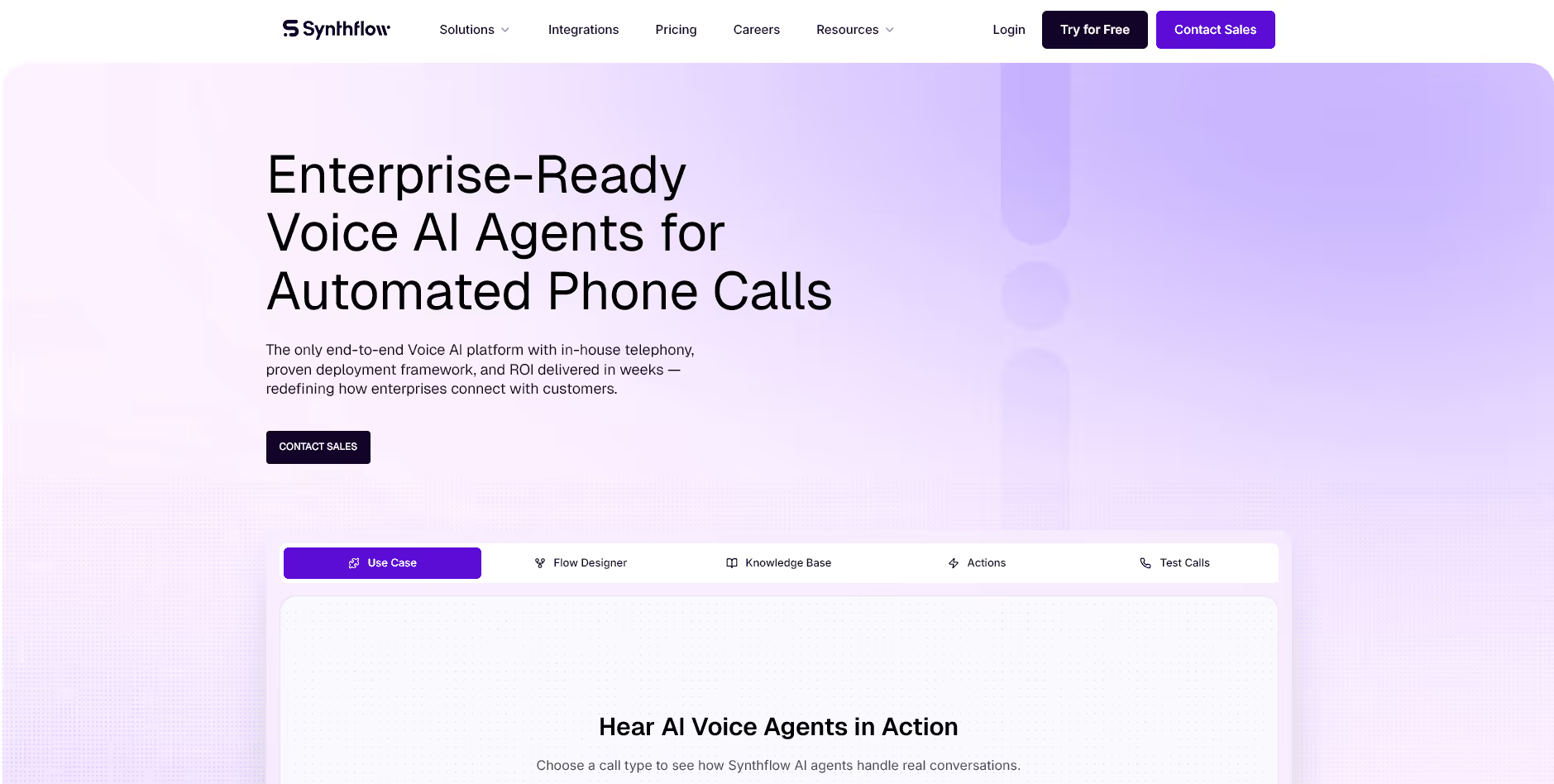
Synthflow enables no‑code voice automation designed for fast FNOL and claims triage launches without heavy IT involvement. It fits non‑technical insurance teams that need to automate routine intake, claim updates, and after‑hours coverage checks quickly. Teams can scale new lines of business or seasonal surge handling by cloning flows and updating prompts. Synthflow’s value is speed to market: design, test, and deploy basic claims intake in days with accessible tooling. For agencies piloting voice AI, it offers a low‑risk path to validate containment and customer experience before deeper integrations.
DIY launch steps
- Map FNOL entities: coverage, incident type, loss date, location, and photos
- Configure prompts and validation; set routing for complex or high‑severity cases
- Pilot with after‑hours calls; measure containment, transfers, and CSAT
- Iterate on phrasing, intents, and escalation; then expand to daytime calls
4. Cognigy
Cognigy is a platform offering robust natural language understanding (NLU) and routing for complex insurance workflows, ideal for large contact centers requiring precise agent handoff. It excels at context‑aware orchestration, where multi‑party claims, third‑party liability, or severity‑based routing require smart escalation and CRM/CTI synchronization. Cognigy suits insurers who need advanced NLU tuning, cross‑bot orchestration, and agent co‑pilot features to reduce handle time on complicated cases. It is best when the environment demands granular control over intents, slot‑filling, and policy data lookups aligned to legacy systems and IVR trees cited in industry comparisons.
Advanced capabilities
- Context‑aware escalation and blended bot‑agent routing
- Agent co‑pilot with real‑time summarization and suggestion prompts
- Multi‑system orchestration across CRM, claims, and telephony stacks
- Fine‑grained NLU, intent disambiguation, and slot validation
5. Yellow.ai
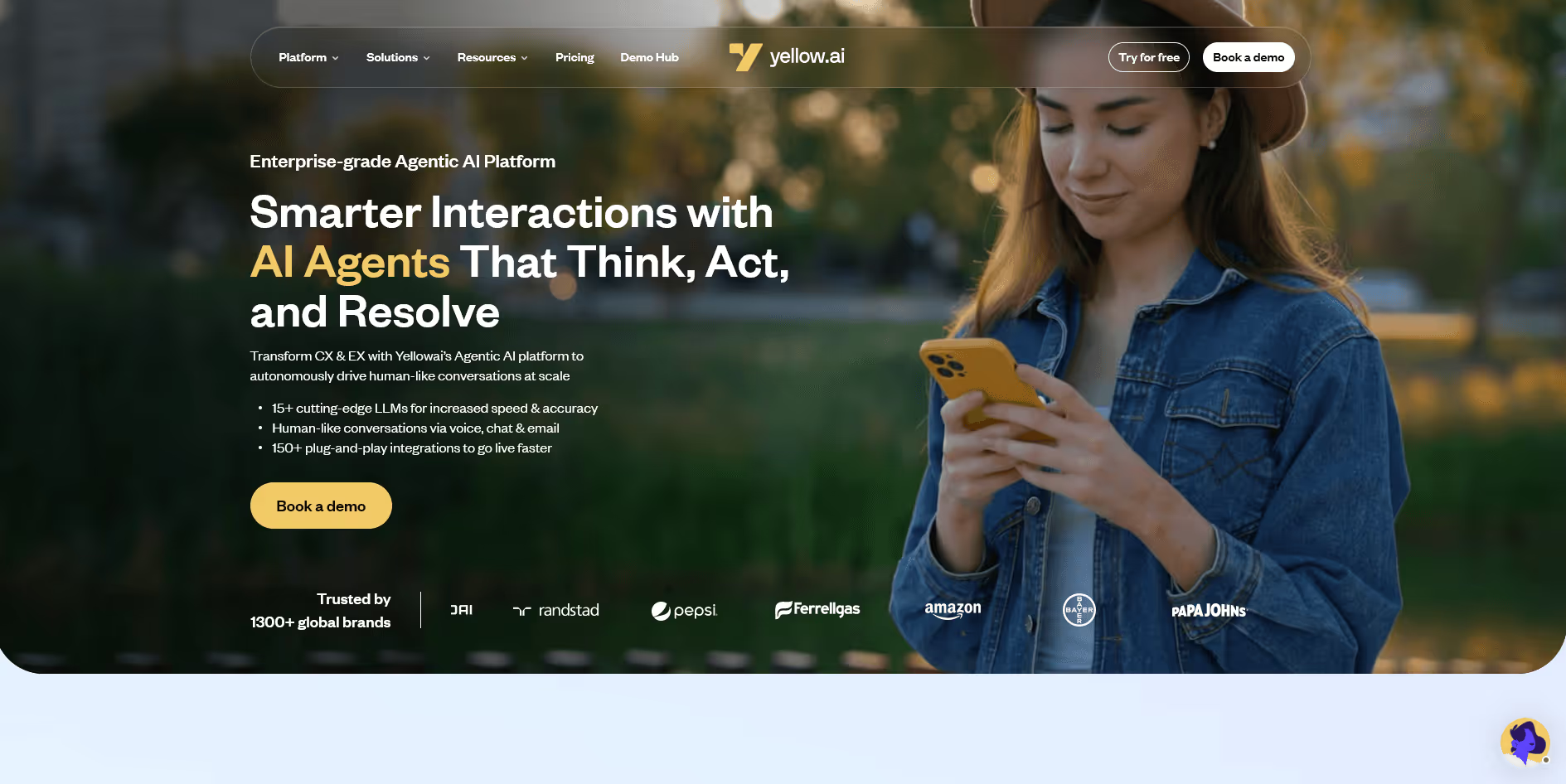
Yellow.ai is an omnichannel conversational AI platform with proven deployments in insurance and hybrid handoff between AI and human agents. It unifies voice, SMS, and chat, allowing policyholders to start a claim by phone, receive SMS updates, and self‑serve status checks across channels. For insurers, omnichannel reduces friction, shortens time to acknowledgment, and provides audit trails. Yellow.ai fits teams that want one workflow to serve multiple channels with consistent intents, messaging, and guardrails. It supports proactive notifications (e.g., documentation reminders) and escalations to adjusters when rules or thresholds are met, aligning with insurers’ need for seamless digital‑voice operations highlighted in industry overviews of omnichannel leaders.
Omnichannel use cases
- SMS claims status updates triggered by voice intake completion
- Hybrid routing to adjusters when injury or total loss is detected
- Proactive documentation reminders with secure upload links
6. Kore.ai
Kore.ai is a platform offering pre‑trained insurance flows plus robust telephony and authentication tools for carriers. It is suited to large, complex operations that need identity verification, DTMF and voice biometrics support, and routing controls tied to claim severity or customer segment. Kore.ai emphasizes enterprise readiness: scalable contact center deployments, privacy‑by‑design, and governance aligned to regulated industries. Its insurance accelerators speed up FNOL, policy servicing, and payment workflows, while security features and authentication integrations help protect sensitive PII/PHI in claims. As carriers standardize on robust voice technology, Kore.ai’s prebuilt flows and security posture reduce risk and time to value.
Integration‑friendly highlights
- Telephony connectors and SIP integration; carrier‑grade routing
- Authentication options (OTP, KBA, biometrics) and consent management
- Pre‑trained insurance workflows for claims, policy, and billing
7. Voiceflow
Voiceflow is a visual, low‑code conversation design tool that accelerates insurance voice bot creation and prototyping. Product and operations teams use drag‑and‑drop builders to prototype FNOL, coverage checks, and claim status flows, then iterate quickly as regulations or policy language evolve. Voiceflow’s strengths are speed and collaboration—teams can test branching scenarios, refine prompts, and export artifacts for deployment. It is ideal for insurers that want to improve conversation quality before scaling in production, reducing rework and shortening design cycles compared to code‑first approaches referenced in design‑centric platform lists.
Mini‑guide: design, test, deploy
- Design: Define intents, entities, error recovery, and escalation criteria
- Test: Simulate edge cases; measure path completion and confusion turns
- Deploy: Handoff to engineering for telephony and system integrations
8. Talkie.ai
Talkie.ai is a solution with pre‑built, insurance‑specific voice workflows for fast deployment and flexible AI model integration. Its model‑agnostic approach lets teams “bring your own LLM,” supporting future‑proofing as models evolve. For agencies and carriers wanting time‑to‑value, Talkie.ai enables rapid FNOL rollout, customizable servicing flows, and performance tuning across models. It fits organizations that need quick wins without long build cycles, while keeping options open for model policy, cost, or performance objectives—an approach aligned with market movement toward modular, swappable AI stacks noted in recent insurtech voice overviews.
Time‑to‑value examples
- Launch FNOL intake with verification, summarization, and ticketing in days
- Add claims status, document prompts, and callback scheduling in sprints
- Switch or ensemble LLMs to optimize accuracy and cost by use case
Why Insurers Need Voice AI for Claims Handling
Voice AI is now strategic for P&C, life, and health insurers because it speeds FNOL, raises first‑contact resolution, and lowers per‑call costs while providing consistent experiences. FNOL is the policyholder’s initial claim report and often suffers delays due to manual intake and limited hours. Automated voice intake captures structured data, verifies coverage, and creates claim records instantly, accelerating acknowledgment and triage. Industry analysis indicates AI can deliver 10–15 % premium growth, 3–5 % uplift in claims accuracy, and up to 40 % lower onboarding costs, underscoring its impact on operations and growth (McKinsey analysis of AI in insurance).
Key benefits
- 24/7 availability and surge handling without added headcount
- Lower staffing and recruitment pressure during peak seasons
- Improved CSAT/NPS via faster answers and clear next steps
- Compliance‑ready tracking with auditable call summaries
Key Features of Leading Voice AI Platforms for Insurance Claims
- Prebuilt FNOL/claims workflows – templated conversation flows tuned for insurance, accelerating deployment and standardizing data capture.
- Telephony and SIP/program‑mable voice integrations – reliable call handling with SIP trunks, PSTN reach, and low latency.
- Escalation and agent handoff controls – configurable thresholds, warm transfers, and callback orchestration.
- Document‑capture hooks – secure links for images, PDFs, and other claim artifacts.
- Analytics and ongoing QA tools – dashboards, transcript search, and A/B testing for continuous improvement.
Feature comparison snapshot
Comparison table snapshot
Advanced considerations
- Multilingual support: native languages and locale‑specific prompts
- Compliance tools: consent capture, redaction, and role‑based access
- Real‑time analytics: live dashboards, alerts, and SLA monitoring
- Model flexibility: bring‑your‑own‑LLM or pluggable NLU
- Omnichannel: consistent intents across voice, SMS, and chat
How to Choose the Best Voice AI Platform for Claims Automation
- Define claim types and goals – classify calls by complexity and target measurable outcomes (containment, FCR, AHT).
- Run a pilot with realistic volumes – track automatic resolution, latency, sentiment, and handoff quality.
- Prioritize insurance‑native capabilities – prebuilt FNOL flows, robust telephony, transparent analytics.
- Validate pricing models – compare per‑minute, subscription, outcome‑based, and quote‑only contracts (see the Telnyx insurance voice roundup).
- Confirm SLAs and support – ensure uptime, response times, and change‑management align with contact‑center demands before scaling.
Pricing models and coverage
Secondary considerations
- Conversation design governance
- Multilingual coverage and regulatory locales
- Scalability to new products, geographies, and brands
Security and Compliance Considerations in Voice AI for Insurance
Insurers must meet GDPR (EU privacy), SOC 2 (cloud security), CCPA (California privacy), and PCI (payment data) when applicable. Choose platforms that encrypt data in transit and at rest, support consent management, and provide audit‑grade recordings with access controls. Authentication options—OTP, KBA, or biometrics—should be available for sensitive actions, along with redaction for PII/PHI in transcripts. Enterprise buyers should select vendors already certified or attested for insurance use cases and that integrate with identity and telephony stacks referenced in enterprise platform reviews.
Compliance checklist
- Encryption at rest/in transit and secure key management
- Consent capture, retention policies, and data‑subject rights
- Role‑based access, SSO/SAML, and audit logging
- Redaction for PII/PHI; PCI scope controls if payments involved
- Auth flows: OTP/KBA/biometric options and step‑up triggers
- Data residency and deletion SLAs in BAAs or DPAs
Future Trends in Voice AI for Insurtech Claims Processing
Voice AI will become multimodal, combining voice, text, images, and documents to triage and assess claims more accurately. Expect AI to prompt for photos, parse police reports, and summarize adjuster notes automatically, consistent with market tracking of multimodal tools in insurance (multimodal claims tooling overview). Hybrid AI + human approaches will continue to dominate complex or high‑severity claims as organizations balance speed with empathy and compliance. Analysts also forecast meaningful cost reductions from onboarding automation and AI‑enabled productivity, aligning with findings that AI can drive 20–40 % cost savings in onboarding and lift frontline performance noted by McKinsey’s insurance AI analysis).
What to expect
- Integrated fraud detection powered by behavioral and metadata signals
- Sentiment and empathy models that guide escalation in real time
- Predictive routing based on severity, coverage, and past outcomes
- Policy‑aware copilots that assist adjusters and contact‑center agents
FAQ
What is AI voice automation for insurance?
AI voice automation for insurance is a system that answers or places calls to policyholders and automates routine phone-based tasks, like FNOL intake, claim status checks, coverage verification, and appointment scheduling, without a human agent on the line for every call. It captures structured data from the conversation and can route or resolve the request based on what the caller needs.





.svg)

.svg)
