.svg)


The Hidden Cost of Losing Your Best People
Picture this: your top CSR - the one who remembers every client's name, knows the renewal calendar by heart, and handles escalations with grace - just handed in her two-week notice. She's taking institutional knowledge, client relationships, and team morale with her. And you're left scrambling to cover phones, reassign accounts, and somehow find a replacement in a labor market tighter than anyone can remember.
This scenario plays out thousands of times each year across American insurance agencies. According to MarshBerry's 2025 report, employee turnover in insurance brokerage firms hit 16.4% in 2024 - notably below the 20-25% range of broader financial services but still devastating for small agencies where every person matters. Meanwhile, industry-wide turnover rates have climbed from a historical 8-9% to 12-15%, signaling a structural retention problem that won't resolve itself.
Understanding why insurance staff quit requires looking beyond exit interview platitudes. This article breaks down the root causes behind insurance staff attrition - from burnout and compensation gaps to career stagnation - and delivers concrete, technology-enabled solutions your agency can implement now. With the industry on track to lose around 400,000 workers by 2026, the time to act is yesterday.
The State of Insurance Turnover in 2026: What the Data Says
Before you can fix a retention problem, you need to understand its shape. The data paints a nuanced picture - one where headline numbers can mislead agency principals into complacency.

Voluntary vs. involuntary turnover trends
Research from ProgramBusiness shows the six-month voluntary turnover rate stands at 5.8%, lower than the 12-month average of 8.5%. This suggests some stabilization, but it does not signal resolution. The six-month involuntary turnover rate dropped from 4.1% to 2.9%, meaning fewer companies are downsizing - but employees are still choosing to leave at concerning rates.
Voluntary departures carry a heavier toll than layoffs. When someone walks away by choice, they typically leave for better pay, more flexibility, or less frustrating work. Every voluntary departure signals that your agency failed to meet someone's expectations - and that others watching may be thinking the same thing.
How P&C agencies compare to the broader market
Insurance Insider reports that personnel movement in the US P&C insurance industry in 2025 was 16% below 2024 levels. That sounds positive. But lower movement doesn't necessarily mean happier employees - it can also reflect a cooling labor market where people stay put out of caution rather than satisfaction.
Mercer's analysis places the Insurance/Reinsurance industry at the lowest turnover rate in the US at just 8.2% for 2024-2025. Yet this figure masks acute pain in specific roles and small agencies, where the loss of even one or two key people can destabilize operations for months. Agencies navigating the insurance staffing shortage feel this pressure acutely.
The true replacement cost most agencies underestimate
Insurance industry unemployment rose only modestly from 2.0% to 2.5% in 2024, per MarshBerry data, while U.S. unemployment held steady at 4.1%. Translation: employees who leave find new positions quickly, and you spend months trying to backfill their role.
Consider what replacement actually costs:
- Recruiting fees and job advertising expenses
- Three to six months of reduced productivity during onboarding
- Lost client relationships and institutional knowledge
- Increased workload on remaining staff, accelerating their burnout
- Potential E&O exposure during transition periods
ProgramBusiness notes that 14% of companies report hiring has become more difficult, up from 11% in mid-2024. Every departure now costs more to fix than it did a year ago.
Reason #1: Burnout From Repetitive, Low-Value Tasks
call overload as a CSR retention issue
Ask any CSR or account manager what drains them the most, and you'll hear the same answer: the relentless cycle of routine calls, data entry, and paperwork that consumes hours better spent on meaningful client work.
The administrative task burden
Licensed agents spend 2.5+ hours daily on administrative tasks - answering routine calls, processing basic certificate requests, chasing down missing documents, and entering data into systems that should already have it. These aren't tasks that require a license. They're tasks that waste one.
Mercer identifies burnout as a primary driver behind why insurance staff quit, noting it stems from too much work, too little pay, poor benefits, unhealthy work environments, or unsupportive management. In many agencies, burnout compounds because the same person handles both revenue-generating activities and mundane administrative work. The result? Your highest-trained, most-expensive employees spend their days doing work a well-designed system could handle.
How repetition erodes job satisfaction
Nobody enters insurance dreaming of answering the same five questions on a loop. Staff who chose this career typically did so because they enjoy problem-solving, relationship-building, and helping people navigate complex decisions. When the actual job becomes 60% data entry and phone tag, disillusionment sets in fast.
The pattern looks like this:
- New hire feels energized by client-facing work during the first three months
- Administrative volume steadily increases as they take on more accounts
- Creative and consultative work gets squeezed out by routine tasks
- Frustration builds as the gap between expectations and reality widens
- Employee updates their resume and starts interviewing elsewhere
Agencies that handle more calls without adding staff through AI-powered solutions report significantly lower burnout rates. When you remove the repetitive work that erodes morale, the remaining work becomes the job people actually wanted.
The downstream effect on remaining staff
When someone burns out and leaves, their workload doesn't disappear. It redistributes - usually to the people who were already stretched thin. This creates a vicious cycle where each departure accelerates the next one. Agencies need to break this pattern by eliminating the low-value work that triggers burnout in the first place, not by hiring more people to drown in it.
Reason #2: Compensation That Doesn't Match the Market
Money isn't everything. But it's not nothing, either - and for many insurance professionals, compensation has failed to keep pace with what the market demands.
The pay gap in agency roles
Insurance brokers reported a 19.9% new hire rate in 2024, per MarshBerry data, underscoring continued investment in growth. But here's the problem: many agencies invest heavily in acquiring new talent while underinvesting in retaining current staff. New hires often receive market-rate offers while tenured employees fall behind through modest annual raises.
This creates pay compression - where a five-year veteran earns only slightly more than someone hired last month. Few things demoralize experienced staff faster than discovering this disparity.
Beyond base salary: total compensation matters
Compensation extends far beyond the paycheck. The agencies with the lowest turnover rates tend to offer:
- Competitive base salaries benchmarked annually against market data
- Performance bonuses tied to retention, cross-selling, or client satisfaction
- Comprehensive health benefits including mental health coverage
- Retirement contributions that vest within two to three years
- Professional development budgets for continuing education and designations
Risk & Insurance reports that it remains critical for organizations to maintain strong career development and competitive compensation programs to retain and develop talent. Agencies that treat compensation as a strategic investment rather than a cost center see measurably better retention.
Using technology savings to fund better compensation
Here's a practical approach: agencies deploying AI receptionists and automation tools often save the equivalent of one to two full-time salaries annually. Redirect a portion of those savings into compensation improvements for existing staff. You address two retention drivers simultaneously - reducing burnout through automation and improving pay through reinvestment.
Reason #3: Limited Career Growth and Stagnation
Small agencies face a structural challenge: there simply aren't many rungs on the career ladder. A CSR can become a senior CSR, maybe an account manager, and then - what? In many agencies, the only real advancement means becoming a producer or leaving.
The "dead-end" perception
Mercer's research confirms that higher positions tend to have lower turnover rates, likely due to better compensation, positive work environments, strong support systems, and more autonomy. The inverse is equally true: entry-level and mid-level positions hemorrhage talent because employees see no clear path forward.
Young professionals especially - the ones the industry desperately needs to replace its aging workforce - won't stay in roles where advancement requires waiting for someone to retire. They'll move to a carrier, a tech company, or another industry entirely. Actuarial, executive, and analytics roles remain the hardest to fill, partly because the pipeline of developed internal talent has dried up.
Building career pathways in small agencies
Even agencies with 10 employees can create meaningful advancement opportunities:
- Define skill-based tiers (CSR I, II, III) with clear criteria for advancement
- Create specialization tracks - commercial lines specialist, claims advocate, digital operations lead
- Sponsor professional designations (CISR, CIC, CPCU) with compensation bumps upon completion
- Establish mentorship programs pairing junior staff with experienced producers
- Assign cross-functional projects that build new competencies
Agencies investing in AI-driven efficiency can also create entirely new roles: automation coordinator, client experience manager, or data analyst. These positions didn't exist five years ago, and they give tech-savvy employees growth opportunities that align with where the industry is heading.
Reason #4: Inflexible Work Arrangements
The pandemic proved that insurance work doesn't require a desk in an office five days a week. Many employees haven't forgotten that lesson, even as some agency leaders have.
The flexibility divide
MarshBerry found that approximately 80% of insurance firms reported no planned changes to remote or hybrid work in 2025. Meanwhile, Risk & Insurance data shows that 75% of carriers anticipate implementing a hybrid model combining in-office and remote work, with only 3% mandating daily office attendance - down from 6% the previous year.
The takeaway: carriers are adapting to employee preferences faster than agencies. If your agency demands five days in the office while the carrier down the street offers three, you'll lose people - especially younger professionals and working parents who prioritize flexibility.
Enabling remote work through technology
Agencies often resist remote work because phones need answering, walk-ins need greeting, and someone has to be physically present. These concerns are valid - but solvable. 24/7 AI-powered support handles inbound calls regardless of where your team sits. Remote customer service models have proven effective across hundreds of agencies.
Flexibility doesn't mean abandoning structure. It means giving employees control over where and when they do their best work, backed by technology that ensures clients never notice the difference.
Reason #5: Inadequate Technology and Outdated Workflows
Nothing makes a talented employee feel undervalued quite like forcing them to wrestle with a 15-year-old management system that crashes twice a week.
The frustration of manual processes
Many agencies still rely on fragmented workflows: information lives in spreadsheets, emails, sticky notes, and multiple disconnected systems. Staff spend significant time re-entering data, toggling between platforms, and manually tracking tasks that modern technology handles automatically.
This isn't just inefficient. It's demoralizing. Employees who see their friends in other industries using sleek, integrated tools wonder why their agency can't keep up. The best AI assistants for insurance now integrate directly with agency management systems (AMS) and CRMs, eliminating the double-entry problem that drives staff mad.
Technology as a retention tool
Risk & Insurance notes that automation improvements were cited by 9% of respondents as a reason for staff reductions - but that statistic misses the bigger story. Agencies that deploy automation intelligently don't reduce headcount. They redeploy talent toward higher-value work, which improves satisfaction and retention simultaneously.
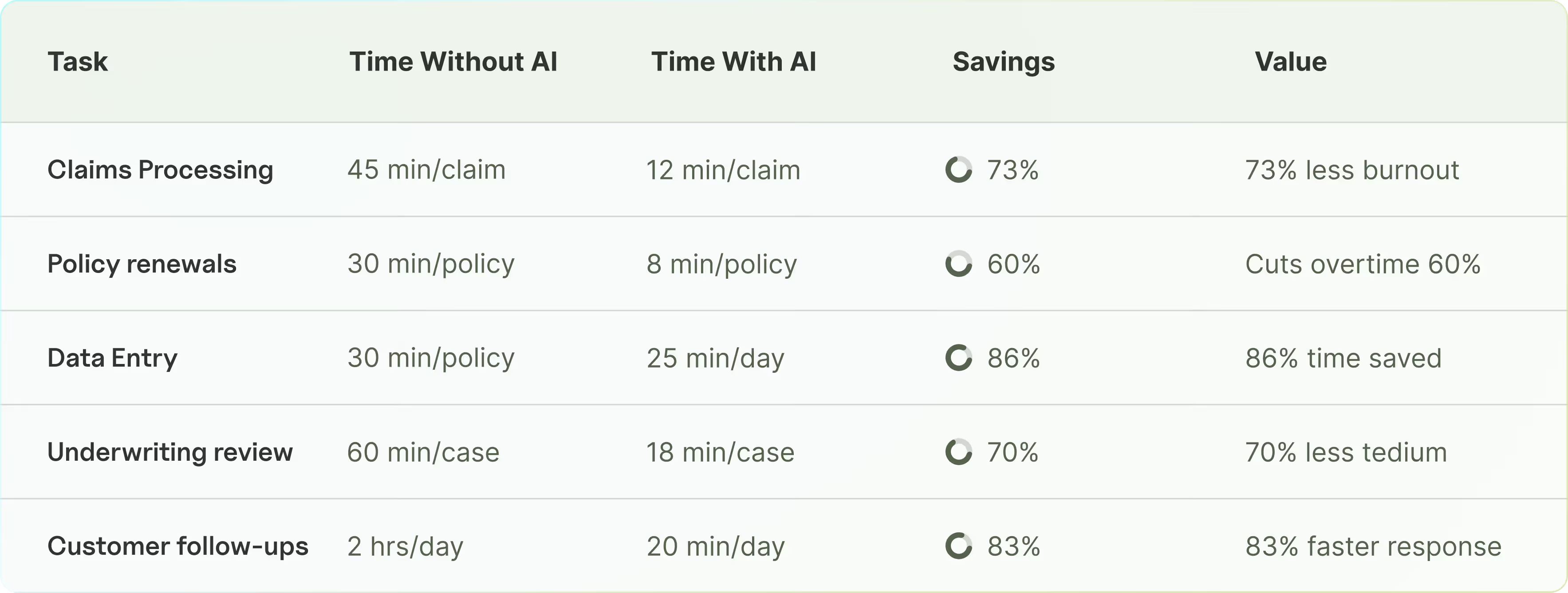
Consider the difference between these two employee experiences:
When you invest in tools like AI scheduling assistants and automated claims processing, you send a clear message: we value your time and want you focused on work that matters.
Reason #6: Poor Onboarding and Management Support
The first 90 days determine whether a new hire becomes a long-term contributor or a short-term expense. Too many agencies fail this critical window.
The onboarding gap
Small agencies often lack formal onboarding programs. New hires get handed a login, pointed to a desk, and told to shadow someone who's already too busy to train them effectively. The result: confusion, mistakes, frustration, and early departure.
Effective onboarding should include:
- A structured 30-60-90 day plan with clear milestones
- Dedicated training time on systems, workflows, and carrier appointments
- Regular check-ins with a manager or mentor - not just "let me know if you have questions"
- Gradual increase in responsibility as competence builds
- Early exposure to the technology tools that will make their job easier
Management quality drives retention
The old adage holds: people don't leave companies, they leave managers. In small agencies, the agency principal often serves as the primary manager for everyone. When that person is consumed by production, sales, and operations, staff feel unsupported and invisible.
Agencies using AI virtual receptionists to handle routine call volume free up principals and senior staff to actually lead. More time for coaching, feedback, and career conversations means employees feel invested in - and they reciprocate with loyalty.
Turning Insight Into Action: A Retention Framework
Understanding why insurance staff quit matters only if you do something about it. Here's a practical framework organized by timeline and investment level.
Quick wins (implement within 30 days)
- Audit your compensation against current market benchmarks using MarshBerry or industry salary surveys
- Deploy an AI phone answering solution to immediately reduce call-handling burden on staff
- Schedule one-on-one conversations with every employee to understand their frustrations and career goals
- Establish a flexible work policy that allows at least partial remote work
Medium-term initiatives (60-180 days)
- Build formalized career pathways with documented progression criteria
- Implement AI lead qualification to ensure producers focus on closeable opportunities
- Create a professional development budget and encourage designation attainment
- Redesign your onboarding program using the 30-60-90 framework
- Automate renewal processes to eliminate the annual retention crunch that burns out account managers
Long-term culture shifts (6-12 months)
- Develop an employee value proposition that differentiates your agency from competitors
- Build a technology stack that eliminates manual work wherever possible
- Create mentorship and succession planning programs
- Establish regular feedback loops - quarterly engagement surveys, monthly team retrospectives
- Partner with local colleges and insurance programs to build a pipeline of future talent
The Technology Bridge: How AI Addresses Multiple Quit Factors
Every reason why insurance staff quit connects back to a common thread: agencies ask too much of too few people, using tools that haven't kept pace with the work. Technology won't solve culture problems or fix a bad manager. But it can remove the friction that makes good employees question whether this career is worth the grind.
Reducing burnout through intelligent call handling
At Sonant AI, we've seen firsthand how agencies transform when routine call volume no longer falls on human shoulders. An AI call assistant handles the repetitive inquiries - policy status checks, certificate requests, payment questions - while routing complex situations to the right person. Staff stop dreading the ringing phone and start viewing it as an opportunity rather than an interruption.
Freeing capacity for meaningful work
When AI virtual assistants absorb two to three hours of daily administrative work per employee, something remarkable happens. People rediscover why they entered insurance. They spend more time advising clients, building relationships, and solving complex problems. The work becomes fulfilling again. And fulfilled employees don't quit.
Supporting flexibility without sacrificing service
Agencies can confidently offer remote and hybrid work when they know every inbound call receives immediate, professional attention regardless of who's in the office. AI phone agents provide that continuity, operating 24/7 with consistent quality that doesn't depend on someone being physically at a desk.
Building an Agency People Want to Stay At
The data tells a clear story. Insurance turnover, while lower than many industries, creates outsized damage in small agencies where every person carries significant responsibility. The reasons why insurance staff quit aren't mysterious - burnout, underwhelming pay, career stagnation, inflexible work arrangements, outdated technology, and poor management all contribute. And each reason reinforces the others.
The agencies winning the retention battle share common traits. They pay competitively. They invest in technology that respects their employees' time and talent. They create clear career pathways. They offer flexibility. And they build cultures where people feel valued for their expertise rather than exploited for their availability.
Mercer's data showing that 40.3% of US respondents reported difficulty hiring should motivate every agency principal: retention is now cheaper than replacement. The tools exist to address the biggest drivers of attrition. The question isn't whether you can afford to invest in them. It's whether you can afford not to.
Start by eliminating the low-value work that drains your best people. Sonant AI helps insurance agencies handle every inbound call with consistency and intelligence, freeing your licensed staff to do work that keeps them engaged and your clients well-served. The phone rings. We're already there.





.svg)


.svg)
