.svg)


The After-Hours Call Problem in Insurance
After-hours call burden on CSRs
It's 6:15 PM on a Tuesday evening. Your insurance agency closed 15 minutes ago. A potential client who just totaled their car calls your main line with an urgent coverage question. They get voicemail. They hang up and call a competitor whose AI receptionist answers immediately, captures their information, and schedules a consultation. You just lost a premium customer worth thousands in annual revenue because nobody answered the phone.
This scenario plays out hundreds of times daily across insurance agencies nationwide. Research shows that 11% of customer calls occur outside regular hours or on weekends - and that pattern extends across insurance sectors. When agencies rely solely on human staff during traditional business hours, they miss approximately 30% of incoming calls. Each missed call represents potential revenue loss. When abandonment rates reach just 7% on 2,000 daily calls, agencies lose up to $45,000 in daily revenue opportunities.
This comprehensive guide examines the after-hours call challenge facing insurance agencies today. We'll explore call volume patterns outside business hours, quantify the true cost of missed opportunities, evaluate traditional coverage solutions, and demonstrate how AI-powered receptionists transform insurance after hours calls into qualified leads and booked appointments. Round-the-clock availability isn't a luxury anymore - it's essential for competitive positioning in 2025.
Understanding After-Hours Call Patterns in Insurance

When Insurance Emergencies Actually Happen
Insurance emergencies don't follow 9-5 schedules. Car accidents spike during evening rush hours. Storms damage property overnight. Urgent policy questions arise when clients review documents after dinner. Research indicates 78% of insurance consumers call agencies after searching online, creating demand that extends well beyond traditional office hours.
Peak after-hours contact periods include:
- 5-7 PM weekdays when commuters experience accidents and have time to address insurance needs
- Saturday mornings when families plan major purchases requiring coverage
- Sunday evenings when professionals prepare for the week ahead and remember pending insurance tasks
- Late evenings following severe weather events when property damage becomes apparent
Healthcare sectors provide useful comparison data. Only 19% of call centers operate true 24/7 service, while 53% offer near-round-the-clock coverage with extended hours or 24/5 models. Insurance agencies typically lag even further behind, with most closing by 5 or 6 PM weekdays and remaining closed weekends.
Volume and Impact Statistics
The numbers paint a stark picture. Agencies handling 2,000 average daily calls experience proportionally higher after-hours demand during crisis periods. Insurance questions account for 41% of calls in related service centers, making it one of the top three inquiry categories alongside billing and policy information.
If 11% of calls occur after standard hours and agencies close during those periods, that represents 220 potential contacts daily going unanswered. The conversion impact is massive. Connecting with leads within one minute increases conversion rates by 391% compared to longer response times. Every hour of delay reduces the likelihood of converting that prospect exponentially.
Why Traditional Coverage Models Fail
Many agencies attempt after-hours coverage through traditional methods - and struggle with consistent results. Rotating on-call schedules burden licensed agents who need personal time to avoid burnout. Voicemail systems capture messages but create frustrating delays for urgent matters. Third-party answering services lack insurance expertise and cannot qualify leads effectively.
The fundamental problem: these approaches treat after-hours calls as an inconvenience rather than revenue opportunities. They create friction instead of removing it. Modern clients expect immediate engagement, not callbacks the next business day. When agencies fail to meet that expectation, competitors gain the advantage.
The True Cost of Missed After-Hours Opportunities
Direct Revenue Loss Calculations
Calculate your agency's after-hours revenue gap using this framework. Start with your average monthly premium per new client. Multiply by your typical client lifetime value considering renewals and cross-sells. An auto insurance client might represent $1,200 annually over five years - a $6,000 lifetime value.
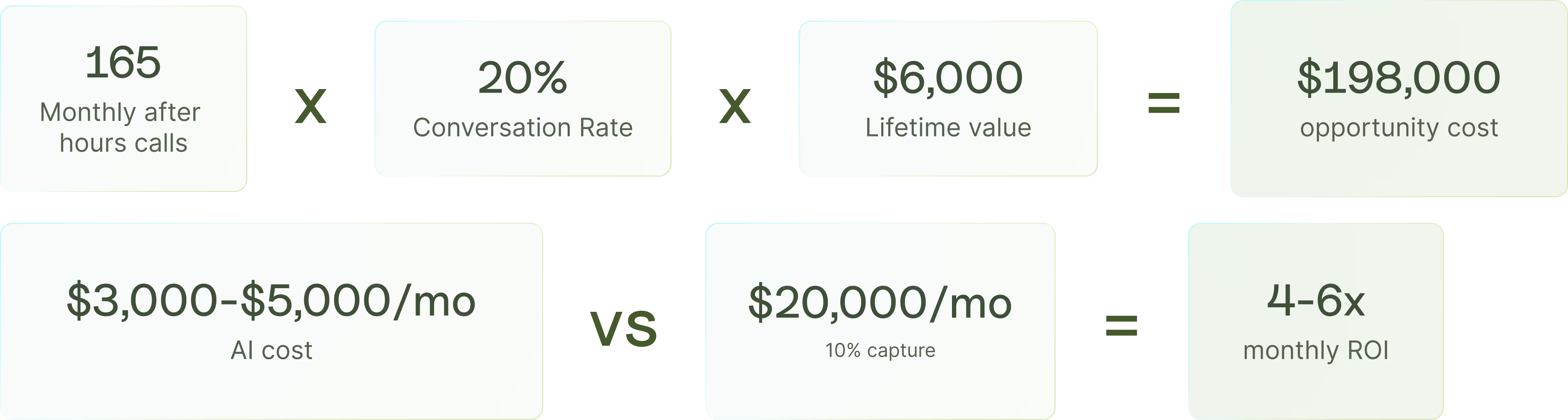
Next, estimate your after-hours call volume. If you receive 50 calls daily and 11% occur after hours, that's 5.5 calls per day or 165 monthly after-hours contacts. Apply your standard conversion rate. If 20% of qualified conversations convert to policies, missing those 165 calls means losing 33 potential clients monthly. At $6,000 lifetime value each, that equals $198,000 in lost revenue per month - nearly $2.4 million annually.
These calculations become more dramatic for commercial lines where single policies generate tens of thousands in premium. Proper lead qualification becomes critical when each after-hours inquiry might represent a six-figure commercial account.
Competitive Disadvantage and Market Share Impact
The consequences extend beyond immediate revenue loss. When prospects call multiple agencies comparing options, the first to respond meaningfully wins the business. Your competitors implementing AI-powered call handling capture leads while you send those same callers to voicemail.
Market share erodes gradually but persistently. If competitors answer 24/7 and convert even 10% more prospects than agencies with limited hours, that gap compounds over quarters and years. Client acquisition costs increase as your agency must work harder to replace business lost to more accessible competitors. Industry trends for 2025 show increased consumer expectations for immediate service across all sectors.
Agent Productivity and Burnout Costs
Beyond lost revenue, consider the human toll. Agencies attempting after-hours coverage through rotating on-call schedules create unsustainable workloads. Licensed agents interrupted during personal time experience higher stress and burnout rates. This reduces daytime productivity when they should focus on complex risk assessment and relationship building.
Agent turnover costs run high in insurance. Replacing an experienced agent requires six to nine months of recruiting, onboarding, and training before that person reaches full productivity. When agencies lose talented producers to burnout partially caused by excessive after-hours responsibilities, those replacement costs compound the revenue loss from missed calls. AI automation strategies preserve agent capacity for high-value activities instead of routine call screening.
Traditional After-Hours Coverage Options
Rotating On-Call Agent Schedules
Many agencies attempt coverage by rotating agents through on-call duties. One agent carries the agency phone each week, responding to after-hours calls and emergencies. This approach provides real insurance expertise when clients call but creates significant drawbacks.
Agents on call interrupt personal time with family, sacrifice evenings and weekends, and experience constant low-level stress wondering when the next call will arrive. The quality of service suffers when tired agents handle complex inquiries after long workdays. Consistency becomes impossible as different agents rotate through coverage, each interpreting policies and handling situations slightly differently.
Cost analysis reveals hidden expenses. If agents receive overtime or additional compensation for on-call duties, those costs add up quickly. Even without direct payment, the productivity loss and increased turnover from burnout create substantial financial impact. Time savings from automation allow agents to focus on revenue-generating activities instead of routine call coverage.
Third-Party Answering Services
Generic answering services provide 24/7 human operators who answer calls using your agency's name. They take messages, handle basic inquiries, and forward urgent matters to on-call staff. While better than voicemail alone, these services create their own problems.
Generic operators lack insurance expertise. They cannot answer policy questions accurately, qualify leads effectively, or capture the detailed information agents need. Clients recognize immediately they're speaking with someone outside your agency, reducing trust and satisfaction. Many callers hang up rather than leaving messages with unfamiliar voices.
The process creates delay and friction. Instead of immediate assistance, callers leave messages that agents must return the next business day - by which time the prospect often selected a competitor. Quality issues arise when operators mishear or incorrectly transcribe critical information about coverage needs, claims, or policy details.
Voicemail and Automated Systems
The simplest approach involves directing after-hours callers to voicemail with a promise of next-day callbacks. This option costs nothing to implement but delivers equally minimal value. Studies show 78% of callers who reach voicemail hang up without leaving messages.
Those who do leave messages often provide incomplete information - no callback number, vague descriptions of their needs, or urgent situations requiring immediate attention. Agents arriving the next morning face a stack of voicemails requiring callbacks, many reaching prospects who already purchased coverage elsewhere.
Interactive voice response (IVR) systems attempt to route callers or provide basic information through menu options. However, complex phone trees frustrate callers expecting human interaction. Customer experience metrics consistently show preference for conversational engagement over robotic menu navigation.
AI-Powered After-Hours Call Solutions
How AI Receptionists Transform Insurance After Hours Calls
AI receptionist technology specifically built for insurance agencies provides true 24/7 coverage with human-like conversation quality. These systems answer every call immediately, understand insurance terminology, qualify leads through intelligent questioning, and integrate ly with agency management systems to capture information accurately.
Unlike generic answering services, purpose-built insurance AI understands the questions callers ask and provides accurate responses about coverage types, claims processes, and policy information. The technology handles multiple languages, accommodates diverse accents, and maintains consistent service quality regardless of call volume or timing. AI virtual assistants deliver superior client experiences while reducing operational costs.
Sonant AI was designed specifically for property and casualty insurance agencies facing these exact challenges. Our platform transforms every inbound call into a qualified opportunity by delivering 24/7 human-like conversations and integration with leading agency management systems.
Key Capabilities for Insurance-Specific AI
Effective AI receptionists for insurance must deliver capabilities beyond basic call answering. Essential features include:
- Natural language processing that understands insurance terminology and client intent
- Lead qualification through intelligent questioning about coverage needs, property details, and urgency
- Appointment scheduling integrated with agent calendars to book consultations automatically
- Claims intake capturing essential information and routing urgent matters appropriately
- Policy lookup providing current coverage details and answering basic questions
- CRM integration updating client records in real-time with call details and outcomes
Voice AI platforms vary significantly in insurance-specific capabilities. Generic chatbots cannot handle the complexity and compliance requirements of insurance conversations. Purpose-built solutions understand TCPA compliance, data security requirements, and the nuanced questioning needed to properly qualify insurance leads.
Integration with Agency Management Systems
AI receptionists deliver maximum value when integrated tightly with your existing technology stack. Direct connections to agency management systems like Applied Epic, Vertafore AMS360, or Hawksoft enable real-time data flow without manual entry.
When a client calls after hours asking about their policy, integrated AI can access current coverage details and answer questions accurately. When a prospect calls requesting a quote, the system captures detailed information and creates a new lead record automatically. AMS integration eliminates duplicate data entry and ensures information accuracy across systems.
CRM integration enables sophisticated lead nurturing workflows. After qualifying an after-hours caller, the AI can trigger automated email sequences, assign follow-up tasks to specific agents, and update lead scoring models based on conversation content. This automation ensures no opportunity falls through the cracks regardless of when the initial contact occurred.
Implementation and ROI Considerations
Calculating Return on Investment
AI receptionist ROI calculations start with quantifying your current after-hours opportunity loss. Use the framework from earlier: monthly after-hours call volume multiplied by your conversion rate and average client lifetime value. That figure represents your revenue opportunity.
Next, calculate implementation costs. AI receptionist platforms typically charge monthly fees based on call volume and features. Compare this to your current after-hours coverage costs - agent overtime, answering service fees, or the productivity loss from rotating on-call schedules.
Most insurance agencies achieve positive ROI within 30-60 days. If you're missing $200,000 in monthly after-hours opportunities and AI receptionist costs run $3,000-$5,000 monthly, capturing even 10% of those missed opportunities generates $20,000 in new premium - a 4x to 6x monthly return. Live transfer lead quality metrics help refine these calculations based on actual conversion data.
Deployment Timeline and Change Management
Implementing AI receptionist technology requires planning but shouldn't disrupt operations. Typical deployment follows this timeline:
- Discovery and customization (Week 1-2): Configure the AI with your agency's specific information, coverage types, and call handling preferences
- Integration setup (Week 2-3): Connect to your AMS, CRM, and scheduling systems
- Testing and refinement (Week 3-4): Run parallel testing while monitoring call quality and making adjustments
- Full deployment (Week 4): Switch after-hours calls to AI handling with human oversight initially
- Optimization (Ongoing): Analyze call patterns and outcomes to continuously improve performance
Change management focuses on helping your team understand how AI enhances rather than replaces their roles. AI assistants handle routine screening so agents spend time on complex risk assessment and relationship development. Frame the technology as giving agents their evenings and weekends back while growing the agency through better lead capture.
Measuring Success Beyond Revenue
Revenue impact provides the clearest ROI metric, but successful AI implementation delivers additional benefits worth measuring. Track these key performance indicators:
- Call answer rate (target: 100% of after-hours calls answered immediately)
- Lead qualification rate (percentage of calls resulting in qualified opportunities)
- Appointment booking rate (conversations converting to scheduled consultations)
- Agent satisfaction scores (reduction in burnout and stress from on-call duties)
- Customer satisfaction ratings (feedback from clients experiencing after-hours service)
- Response time metrics (minutes from initial call to agent follow-up)
AI-powered lead qualification provides detailed analytics showing exactly which after-hours callers represent the highest-value opportunities, enabling smarter resource allocation for follow-up.
Best Practices for 24/7 Insurance Call Coverage
Setting Appropriate Response Expectations
Clear communication helps clients understand what to expect from after-hours coverage. Your website, voicemail messages, and client communications should explain that AI technology handles initial calls 24/7, with licensed agents following up on complex matters during business hours.
Frame this positively: "We're available 24/7 to capture your information, answer common questions, and schedule consultations. For complex policy reviews or claims requiring immediate agent attention, we'll connect you with our on-call specialist." This sets realistic expectations while emphasizing your commitment to accessibility.
Many clients prefer self-service options for routine matters. Customer service strategies that blend AI-powered immediate response with human expertise for complex situations deliver optimal satisfaction scores.
Handling True Emergencies Appropriately
AI systems must recognize genuine emergencies requiring immediate human attention. Configure your platform to identify keywords and scenarios indicating urgent situations - active property damage, injury claims, immediate coverage needs for closing transactions.
Establish clear escalation protocols. True emergencies trigger immediate connection to your on-call agent rather than message-taking. The AI should gather critical details while initiating the warm transfer, ensuring agents have context before speaking with distressed clients.
Document and train your team on emergency response procedures. Claims automation can handle intake efficiently, but human judgment remains essential for complex or emotionally charged situations.
Continuous Improvement Through Call Analytics
AI platforms generate detailed analytics about call patterns, common questions, and outcome metrics. Review these reports monthly to identify improvement opportunities. If callers frequently ask about specific coverage types, add more detailed information to your AI's knowledge base. If certain question patterns correlate with higher conversion rates, train the AI to explore those topics more thoroughly.
A/B testing different call handling approaches provides data-driven optimization. Test variations in how the AI qualifies commercial versus personal lines leads. Compare appointment booking rates for different scheduling approaches. AI call assistants improve continuously through machine learning and human feedback.
Future Trends in After-Hours Insurance Service
Rising Consumer Expectations for Instant Service
Client expectations continue shifting toward immediate engagement across all industries. Insurance consumers increasingly demand the same instant response they receive from e-commerce, banking, and other digital-first sectors. Agencies maintaining traditional 9-5 availability face growing competitive disadvantages.
Younger demographics entering peak insurance-buying years expect 24/7 digital access. They research options online outside business hours and want immediate answers when questions arise. Multilingual support capabilities become increasingly important as agencies serve diverse communities where English may not be the primary language.
Integration with Omnichannel Communication
Future after-hours strategies extend beyond phone calls to text messaging, chat, email, and social media. Clients might initiate contact through Facebook Messenger at 10 PM, continue the conversation via text the next morning, and complete an application through email that afternoon.
Unified AI platforms manage these conversations across channels while maintaining context. The system remembers previous interactions regardless of communication method. Remote customer service transformation enables experiences whether clients call, text, or message through digital channels.
Predictive Outreach and Proactive Service
Advanced AI moves beyond reactive call handling to predictive outreach. Systems analyze client data to identify renewal risks, coverage gaps, or life events likely triggering insurance needs. The technology initiates proactive contact - calling clients whose policies expire soon or whose mortgages indicate recent home purchases.
This proactive approach transforms after-hours coverage from cost center to revenue generator. Instead of waiting for clients to call, agencies using predictive AI reach out during convenient evening hours when clients have time for detailed conversations. Renewal automation combined with intelligent outreach timing dramatically improves retention rates.
Taking Action: Next Steps for Your Agency
Assessing Your Current After-Hours Performance
Start by measuring your existing after-hours call handling. Review phone system data to determine actual call volume outside business hours. Calculate your current answer rate, response time, and conversion metrics for after-hours inquiries.
Survey recent clients about their experience trying to reach your agency outside standard hours. Ask prospects who didn't convert whether inability to connect after hours influenced their decision. These insights quantify the opportunity cost your agency currently experiences.
Compare your capabilities to competitors in your market. Mystery shop other agencies by calling after hours to experience their response. This competitive intelligence reveals whether you're falling behind or have opportunity to differentiate through superior availability.
Evaluating AI Receptionist Solutions
When evaluating AI platforms for after-hours coverage, prioritize these factors:
- Insurance-specific training and terminology understanding
- Integration capabilities with your existing AMS and CRM systems
- Conversation quality and natural language capabilities
- Lead qualification depth and accuracy
- Compliance with insurance regulations and data security requirements
- Scalability to handle call volume fluctuations during crisis periods
- Analytics and reporting for continuous improvement
AI virtual receptionist comparisons help identify which platforms deliver genuine insurance expertise versus generic call handling with superficial customization.
Building Internal Support for Implementation
Successful AI implementation requires buy-in from your entire team. Present the technology as enhancing agent effectiveness rather than replacing human expertise. Demonstrate how 24/7 AI coverage eliminates the burden of rotating on-call schedules while capturing more revenue opportunities.
Involve your top producers in the customization process. Their input on qualifying questions, objection handling, and appointment setting ensures the AI reflects your agency's approach. When agents feel ownership over the implementation, adoption and optimization improve significantly. Customer retention strategies benefit when your entire team understands how AI supports superior client experiences.
Conclusion: Turning After-Hours Calls into Revenue
Insurance after hours calls represent one of the largest untapped revenue opportunities for agencies today. With 11% of inquiries occurring outside standard business hours and 30% of calls going unanswered when relying on traditional staffing, agencies leave hundreds of thousands in premium on the table annually. The solution isn't forcing agents into unsustainable on-call rotations or settling for generic answering services that lack insurance expertise.
Purpose-built AI receptionist technology transforms after-hours coverage from operational burden to competitive advantage. By delivering 24/7 human-like conversations, intelligent lead qualification, and integration with agency management systems, we enable agencies to capture every opportunity regardless of when the phone rings. Implementation requires minimal disruption, ROI appears within 30-60 days, and agents reclaim personal time while serving clients better than ever.
The agencies winning in 2025 recognize that client expectations have permanently shifted toward instant engagement. Those maintaining 9-5 availability watch prospects select competitors who answer immediately at 6 PM, on weekends, and during holidays. The question isn't whether your agency needs 24/7 coverage - it's whether you'll implement it before competitors capture your market share.
When the phone rings, we're already there.





.svg)

.svg)
