.svg)


Insurance Lead Qualification Automation: 2026 Guide
An incoming call arrives at two o'clock on a Friday afternoon. Your team is buried in policy renewals. The phone rings. And rings. By the time someone picks up, the prospect has moved on to a competitor. This scenario plays out thousands of times every day across insurance agencies nationwide.
The cost of this inaction is staggering. The average leakage rate for unanswered inquiries in the insurance industry ranges between 30% and 90%, depending on agency size and processes. For a mid-sized brokerage handling 50 inbound calls daily, that translates to 15 to 45 lost prospects every single day. Over a year, that's 5,475 to 16,425 missed revenue opportunities.
Research from Harvard Business Review reveals that firms responding to leads within an hour are seven times more likely to qualify them than those who delay. Speed matters. Consistency matters more.
This is where insurance lead qualification automation transforms the game. Rather than relying on whoever answers the phone to evaluate whether a prospect is worth pursuing, AI-powered lead qualification uses real-time data analysis and natural language processing to assess every caller in seconds. Your team captures genuine opportunities instantly. Your processes become predictable. Your revenue grows.
In this guide, we explore what insurance lead qualification automation is, why it matters in 2026, and how to implement it successfully.
What Is Insurance Lead Qualification Automation?
The definition and core mechanics
Lead qualification is a systematic process for separating serious buyers from tire kickers by evaluating prospects based on their genuine interest, financial capacity, and readiness to purchase. Automation eliminates the guesswork.
Traditional lead qualification depends on a person answering the phone, asking basic questions, and deciding on the fly whether the caller deserves immediate attention. This approach introduces human bias, inconsistency, and delays. One agent might spend five minutes with a low-intent caller while ignoring a high-quality prospect waiting on hold.
Insurance lead qualification automation uses artificial intelligence, machine learning, and natural language processing to evaluate every prospect using standardized criteria. The system operates continuously, asking relevant questions, analyzing responses, and assigning qualification scores in real-time. AI-powered lead scoring systems analyze multiple data points simultaneously-demographic information, behavioral signals, engagement history, and financial indicators-to predict conversion likelihood.
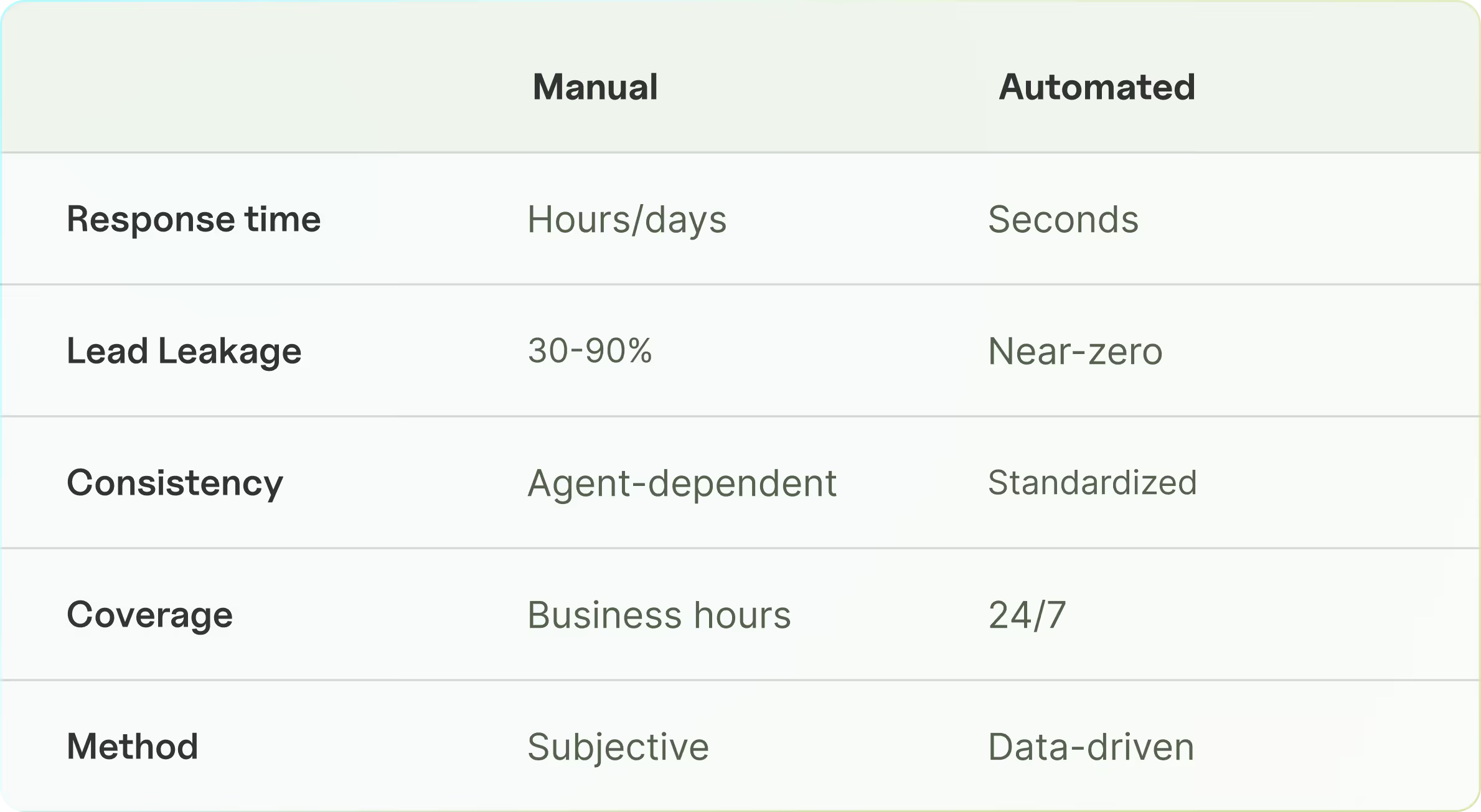
How automation handles the qualification process
When a prospect calls, the system immediately engages them in a natural conversation. It identifies the caller, retrieves their history if they exist in your CRM, and asks targeted questions that reveal their needs and urgency. The technology captures policy type, coverage gaps, budget range, and timeline information ly. By using AI, machine learning, and intelligent document processing, insurers can handle thousands of data points in minutes with far fewer mistakes.
The system then scores the prospect and routes them appropriately. High-intent, qualified leads go directly to your best agents. Medium-intent prospects enter an automated nurturing sequence. Low-intent callers receive information and a callback option. This happens instantly, 24/7, without missing a single call.
Why traditional manual qualification fails
Manual lead qualification creates three critical problems. First, it's inconsistent. Each agent uses different criteria and asks different questions. One person might qualify someone based on coverage type alone; another might require a specific annual premium threshold. Your qualification standards drift over time.
Second, it's slow. Callers reach an agent, explain their needs, answer preliminary questions, and then wait while that agent determines if they're worth immediate follow-up. This delay costs conversions. When prospects wait for qualification decisions, engagement drops and competitor acquisition increases.
Third, manual qualification ties up your highest-value talent. Agents spend time on intake questions instead of closing deals. A producer capable of generating $500,000 in annual revenue spends two hours daily answering phones and repeating the same intake questions. That's $96,000 in lost productivity per agent annually-just from answering phones during business hours.
The Business Case for Automation in Insurance (2026)
Market growth and adoption trends
The global AI in insurance market, valued at $4.59 billion in 2022, is projected to grow to $79.86 billion by 2032, at a compound annual growth rate of 33.06%. This explosive expansion reflects a fundamental shift: agencies that ignore AI automation will lose market share to those who embrace it.
A 2025 survey by Conning found that 90% of insurers are exploring generative AI, yet only 55% report being in early or full deployment phases. This gap presents an opportunity. Early adopters are capturing market share right now.
The shift toward automation accelerated post-pandemic as agencies realized they couldn't scale service without scaling headcount-an impossibility given labor costs and recruitment challenges. Automation offers a third path: maintain or improve service while controlling costs.
ROI metrics: what the numbers reveal
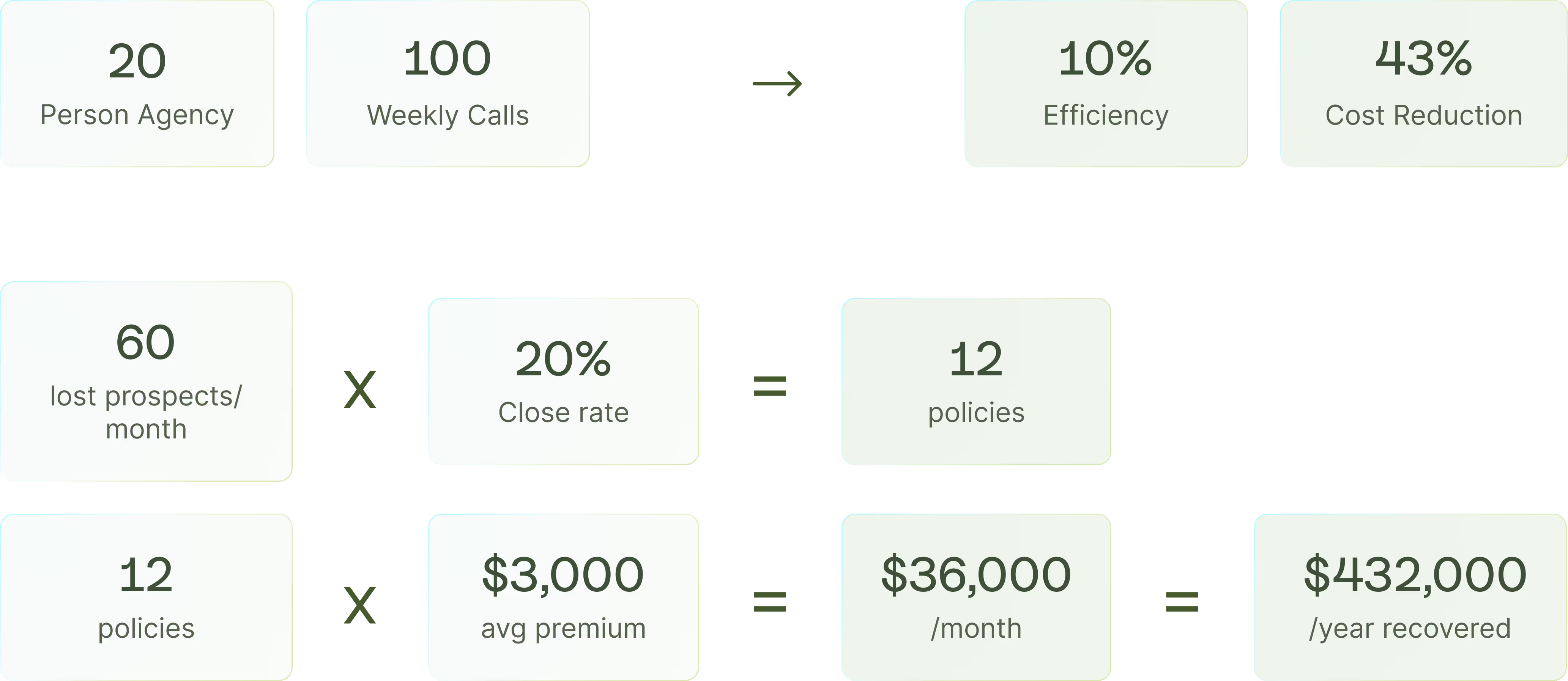
The financial case for lead qualification automation is compelling. AI algorithms score and qualify leads in real-time, delivering up to 10x higher qualification efficiency. This means your team closes more deals from fewer calls.
Response speed creates measurable ROI. Chatbots and automated responses reduce response times by 80%, allowing agents to focus on closing deals rather than initial outreach. When you respond to prospects within minutes instead of hours, conversion rates spike.
Agentic AI handles 24/7 lead qualification and objection handling, slashing costs by 43% for early adopters. This cost reduction comes from eliminating routine phone work and reducing errors in data capture and qualification decisions.
Consider a 20-person agency with 100 inbound calls weekly. If 60% are currently missed or mishandled, that's 60 lost prospects monthly. Assume a 20% close rate on qualified leads and $3,000 average premium. Each recovered prospect represents $600 in expected revenue. Recovering 60 monthly prospects generates $36,000 in new monthly recurring revenue-$432,000 annually-from simply answering calls that were already coming in.
Efficiency gains across operations
Insurance companies using automated customer service workflows like chatbots and digital assistants report a 90% boost in customer satisfaction by providing instant support and self-service options for policy queries, claims tracking, and updates. This isn't just internal efficiency-it's measurable customer delight.
By automating data entry and document processing in customer onboarding and policy renewals, insurers report an 80-90% reduction in manual data entry errors and a 20-25% increase in employee productivity, as less time is spent on repetitive administrative tasks. Fewer errors mean fewer rework cycles, faster policy issuance, and higher customer satisfaction.
Automated policy issuance reduces the time required to issue a new policy by 50% or more, as data capture, verification, and document generation are d, improving sales conversion rates by making the process more responsive and user-friendly. Speed becomes a competitive advantage.
Key Insurance Lead Qualification Automation Statistics
Missed opportunity costs
Every statistic in this section highlights a failure point that automation fixes. The most urgent metric: call abandonment. When prospects can't reach someone, they call someone else.
- 30-90% of inbound inquiries go unanswered or mishandled, depending on agency size and staffing
- Firms responding to leads within one hour are seven times more likely to qualify them versus those who wait
- Agencies using automated lead recovery report retaining up to 90% of prospects that would have otherwise been lost
- Average insurance prospect follows up with three to five competitors before selecting a provider
- Each unanswered call costs $100-$500 in lost premium opportunity based on typical conversion assumptions
Automation performance benchmarks
Workflow automation in insurance handles lead qualification, call routing, and follow-up sequencing without human intervention, delivering measurable performance gains across every metric that matters.
- AI lead qualification systems achieve 10x higher efficiency than manual assessment
- Automated response times drop to 80% faster than human-only processes
- Lead scoring accuracy improves 30-40% within the first 90 days as machine learning systems refine their models
- 24/7 automation captures 100% of inbound calls, regardless of time or day
- System uptime typically exceeds 99.9%, ensuring no calls are dropped due to technical failure
- Cost per lead handled drops 43% or more compared to manual qualification processes
Cross-functional impact metrics
Automation creates downstream benefits that ripple across your entire operation. When leads arrive pre-qualified and data-rich, every downstream process improves.
- Underwriting cycle time drops by 40-70% when application data arrives pre-validated and complete
- Agent productivity increases 20-25% when routine phone intake work is eliminated
- Customer satisfaction climbs 90% when prospects receive immediate responses and self-service options
- Data accuracy jumps to 80-90% error reduction through automated capture and validation
- Policy issuance accelerates 50%+ as manual data entry and verification delays disappear
How Insurance Lead Qualification Automation Works in Practice
The call journey: from ring to routing decision
Understanding how automation processes a call reveals why it's more effective than manual methods. The entire process completes in 30-60 seconds.
Second 1-3: Recognition. The system answers the call and identifies the caller using phone number, CRM database lookup, or verbal confirmation. If they're an existing customer, their full history appears instantly-policy details, claim history, previous interactions, and communication preferences.
Second 4-10: Engagement. The AI receptionist greets the caller by name (if known) and asks an open-ended question: "What brings you in today?" The system listens using advanced natural language processing, understanding not just words but intent, emotion, and urgency. Is this a new customer or renewal? Do they need a quote, have a claim, or need policy information?
Second 11-40: Qualification. Based on the caller's response, the system asks targeted follow-up questions to gather critical qualification data. For a new customer quote: type of coverage, current provider, timeline, and rough budget range. For a claim: date of incident, type of loss, and claim amount estimate. For a renewal: confirmation of existing details and any coverage changes needed.
Second 41-50: Scoring. The AI system assigns a qualification score based on predefined criteria. Machine learning algorithms continuously refine their accuracy by learning from actual conversion outcomes, creating increasingly precise predictions about which leads deserve immediate focus.
Second 51-60: Routing. High-quality leads transfer immediately to the best-matched available agent. Medium-intent prospects enter an automated nurturing sequence with targeted follow-up. Lower-intent callers receive information and a scheduled callback option.

Integration with existing systems
AI-driven systems automatically convert customer calls into business actions across CRM, AMS, and claims systems, eliminating manual follow-up. This integration is critical to ROI.
When the AI system captures qualification data, it simultaneously pushes that information into your agency management system (AMS), customer relationship management platform (CRM), and any other relevant tools. Your agents see a pre-populated prospect record with all qualification details, recent activity, and recommended next steps before the hand-off call even connects.
Strada Workflows uses AI-driven phone agents to extract key data directly during conversations, capturing policy info or claim details in real-time through voice interaction during policy renewals or FNOL (First Notice of Loss) reporting. Your team never re-asks questions the caller already answered.
This integration eliminates the manual data entry step entirely. Traditional processes require someone to listen to a call recording or review notes, then manually type information into your systems. Automated systems do this instantly and with 99%+ accuracy.
The role of machine learning in improving accuracy
Machine learning is what separates good automation from great automation. Static rule-based systems qualify leads using fixed criteria. Machine learning systems learn from every interaction.
When your team closes a deal, the system notes which combination of qualification factors predicted that outcome. When a prospect doesn't convert, the system analyzes what signals were missed. Over 90 days, the system refines its scoring model based on your actual conversion data.
When agents assess financial capacity, decision authority, and genuine need upfront, conversion rates spike. Machine learning ensures the system prioritizes these factors consistently and improves at identifying them with each conversation.
Understanding which metrics identify best live transfer leads helps your system continuously improve its routing decisions. Does a prospect mentioning a specific deadline close faster? Does a caller who's been shopping for quotes convert better than a cold prospect? The system learns your patterns and adapts.
Real-World Applications in Insurance Agencies
New business and quote requests
For new business inquiries, lead qualification automation delivers immediate impact. When someone calls asking for a quote, the system captures coverage type, current carrier (if applicable), reason for shopping, timeline, and budget range in one natural conversation.
This pre-qualification accomplishes several things simultaneously. First, it confirms the caller is genuinely interested in purchasing-not just comparison shopping or gathering information for a future date. Second, it identifies your most saleable opportunities first. A caller on a tight deadline looking to switch providers ranks higher than someone casually gathering quotes.
Third, it routes intelligently. A complex commercial package goes to your most experienced commercial agent. A straightforward homeowners quote routes to whoever specializes in personal lines. A bilingual caller reaches a bilingual agent. The system removes friction from the agent-prospect matching process.
Mastering insurance lead generation starts with understanding that every first interaction shapes conversion probability. Automation ensures that first interaction is consistently excellent, regardless of when or how the prospect calls.
Claims intake and reporting
Claims processing is where automation creates operational magic. When a policyholder calls to report a claim, time is critical. The sooner you gather information, the sooner you can respond.
The AI system greets the claims caller, retrieves their policy information, and asks targeted questions about the loss-date, location, type of damage, injuries, estimated loss amount. It captures critical details instantly and creates a complete claim file. Some systems even capture photos or video through the call, using voice-guided instructions.
Claims automation boosts agency efficiency by reducing processing time, eliminating redundant data entry, and enabling faster claims decisions. Your adjuster receives a complete, organized claim file minutes after the policyholder calls, not days later.
Renewals and customer retention
Renewals are where many agencies lose customers through inattention. When it's time to renew, the customer often hasn't heard from their agent in months. A competitor calls first. The customer switches.
AI s renewal automation by automating outreach, policy review, and coverage updates without sacrificing the personal touch. The system initiates renewal conversations weeks before expiration, confirms current coverage details, identifies coverage gaps, suggests updates based on life changes, and handles the paperwork entirely through the call.
For customers who want to renew, the system completes the transaction automatically. For customers considering switching, it flags them for agent outreach. Your team focuses retention effort on prospects most likely to leave, not on routine renewals that can be handled entirely by automation.
Voice AI automation in insurance achieves 30-200% ROI by recapturing revenue from renewals, claims, and new business that would otherwise be lost. Renewal automation alone can improve retention by 15-25%.
Implementation: Getting Started with Lead Qualification Automation
Assessment and planning phase
Before selecting tools or making technology investments, assess your current state honestly. Where do you lose prospects today? Where does manual qualification slow things down? Where do errors occur?
Start by analyzing your call patterns. How many calls arrive daily? During what hours? What percentage do you answer? Of answered calls, what percentage convert to quotes or appointments? This baseline data reveals where automation delivers the highest ROI.
Next, audit your current qualification process. What questions does your team ask? What data do they capture? What decisions do they make? What information ends up in your CRM? What gets lost? This documentation becomes your automation blueprint.
Then, identify your biggest pain points. Are you losing leads due to unanswered calls? Are qualification inconsistencies costing deals? Are your agents spending too much time on intake? Are manual data entry errors creating rework? Prioritize based on revenue impact and fix what costs you the most.
Selection and integration process
Choosing an automation platform requires evaluating multiple dimensions: AI quality, integration capabilities, compliance features, and support quality. Insurance workflow automation platforms must integrate ly with your AMS, CRM, and other business systems to capture the full ROI.
Verify the platform handles insurance-specific scenarios. Can it understand policy types, coverage options, and insurance terminology? Does it work across all lines you offer-P&C, health, life, Medicare? Can it handle multi-lingual conversations? Does it comply with industry regulations and security requirements?
Integration capability matters enormously. The best system is worthless if it doesn't connect with your AMS and CRM. Verify that data flows bidirectionally-the system pulls existing customer information and pushes new qualification data back into your systems automatically.
Ask for references from agencies similar to yours. How long was their implementation? Did they hit their ROI targets? Would they choose the same platform again? Honest references reveal far more than vendor presentations.
Rollout and optimization strategy
Successful implementation follows a phased approach rather than a big-bang launch. Start narrow to build internal confidence and refine processes before expanding.
Phase One: Pilot. Choose one call type or one team to pilot the system. Perhaps it's after-hours calls when no one is available, or a specific call type like renewals. Operate both the old process and new process in parallel for 30 days. Compare results. Refine settings based on what you learn.
Phase Two: Expansion. Once you've proven the model works in your environment, expand to additional call types or teams. Your pilot learnings inform configuration changes that improve results at scale.
Phase Three: Optimization. After 90 days of full operation, analyze results against your targets. Review conversations to identify patterns. Adjust qualification scoring. Improve agent training based on where live transfers struggle. Converting live transfer leads requires proven scripts and agent training that reflects lessons learned from automated conversations.
Throughout implementation, maintain transparency with your team. Explain why you're implementing automation-to eliminate tedious work and help them focus on high-value activities, not replace them. Involve agents in refining the system. Their feedback makes it better and increases adoption.
Measuring Success: KPIs That Matter
Call-level metrics
These metrics reveal what happens when automation handles the phones.
- Call answer rate: What percentage of inbound calls connect with someone (agent or system)? Track this separately from historical answer rates to see the immediate improvement
- Average time to qualification: How quickly does the system gather the information needed to score a lead? Automation should do this in 45-90 seconds, compared to 5-15 minutes for manual intake
- Qualification accuracy: When leads scored as high-quality by the system reach agents, what percentage actually convert? Track this monthly; it should improve as machine learning refines the model
- Caller satisfaction: Survey callers after interactions to measure how they felt being handled by the system. Voice quality, conversation naturalness, and problem resolution matter
Business outcome metrics
Ultimately, you care about revenue and efficiency-not technology metrics. Track these rigorously.
- Lead recovery rate: What percentage of previously missed calls now convert to quotes or appointments? The best live transfer leads demonstrate specific metrics that predict conversion, and tracking these helps you continuously improve
- Cost per qualified lead: What does it cost to generate a lead ready for agent follow-up? This should drop significantly when automation eliminates manual qualification labor
- Agent productivity: How many quotes or policies does each agent write per week? This should increase when they spend less time on intake
- Close rate: What percentage of leads sourced from automation convert to policies? Compare this to leads from other sources
- Average premium per lead: Does automation source higher-quality, more valuable leads? Premium value should remain stable or increase
- Customer acquisition cost: What's your all-in cost to acquire each new customer, including automation, labor, and overhead? Track this monthly and use it to forecast ROI
Operational efficiency metrics
Beyond leads and revenue, automation should improve how your agency operates.
- Agent time allocation: What percentage of each agent's day involves routine tasks versus relationship-building and closing? Automation should shift this ratio dramatically
- Data entry errors: How many policy records need correction due to manual data capture mistakes? Automation should reduce this to near zero
- Policy issuance cycle time: How long from qualified lead to bound policy? Automation eliminates data entry delays, accelerating this process
- Customer satisfaction: Do customers rate their onboarding experience higher when it's automated? Faster response times and 24/7 availability improve satisfaction
- Employee satisfaction: Do your agents report higher job satisfaction when freed from routine phone intake? Better satisfaction correlates with lower turnover
Overcoming Common Implementation Challenges
Technology adoption and change management
The biggest implementation barrier isn't technology-it's people. Agents who've answered phones for years may worry automation is eliminat their jobs. Customers comfortable with a familiar agent may feel impersonal talking to a system.
Address these concerns directly and early. Reframe automation as liberation, not replacement. Position it as eliminating the tedious work that keeps agents from what they do best. Agents spend less time on intake, more time on relationship building and closing. That's a career upgrade.
Involve staff in the implementation process. Ask agents what questions they ask most frequently-this becomes automation content. Ask what frustrates them about current call handling-automation solves these frustrations. When employees see their feedback shape the system, adoption increases dramatically.
Plan for a transition period. Don't expect overnight behavioral change. Some agents will resist initially. Provide clear training, celebrate early wins, and showcase agent success stories. Within 60 days, most teams embrace automation when they see it improving their results.
Data quality and integration concerns
Automation depends on clean data. If your CRM contains duplicate records, incomplete information, or inaccurate contact details, the system struggles. Before launching automation, invest in data cleanup.
Run a data audit. Identify duplicate customer records and merge them. Find incomplete records and fill in missing information. Verify contact information accuracy. Remove inactive records. This work takes time but pays dividends. Clean data improves every system that touches it.
For integration challenges, work closely with your technology partner and AMS/CRM vendor. Map data flows explicitly. Test bidirectional sync-data flowing from CRM to automation system and back. Run extended pilot tests before going live. Integration issues discovered during pilots are easy to fix. Issues discovered after launch create customer-facing problems.
Compliance and security considerations
Insurance is a regulated industry. Any system handling customer data must comply with state insurance regulations, TCPA (Telephone Consumer Protection Act) rules, data privacy requirements, and your company's compliance standards.
Verify your automation platform maintains compliance across all jurisdictions where you operate. Does it capture and honor do-not-call requests? Does it follow TCPA calling restrictions? Can it maintain separate compliance requirements for different states or product lines?
Security matters equally. Verify the system encrypts data in transit and at rest. Confirm it undergoes regular security audits. Check its backup and disaster recovery capabilities. Insurance customer data is sensitive-breaches damage reputation and create liability. Choose platforms with enterprise-grade security.
Work with your compliance officer and legal team during implementation. They'll identify specific requirements you must meet and ensure your chosen platform can meet them.
The Future of Insurance Lead Qualification Automation
Emerging capabilities and trends
The AI systems available today are substantially better than those from two years ago and will look primitive compared to systems available in 2027. Several emerging capabilities reshape what automation can accomplish.
Advanced conversation understanding is improving rapidly. Systems are becoming better at detecting frustration, sarcasm, urgency, and emotional subtext. A prospect mentioning "I'm comparing three other carriers" is far different from one saying "I'm definitely switching"-advanced systems now distinguish these nuances.
Predictive recommendation is another emerging strength. Rather than just qualifying existing needs, systems will recommend coverage changes based on life events. A customer mentioning a new home purchase gets proactive homeowners insurance recommendations. Someone mentioning a new car gets auto coverage suggestions. The system becomes consultative, not just transactional.
Multi-channel integration is expanding. NLP powers chatbots, virtual assistants, and automated email routing, enabling policyholders to get instant answers, file claims, or request quotes anytime, reducing manual communication handling. In 2026, agencies operate across phone, web chat, email, text, and social media. Unified automation handles all channels with consistent qualification and service.
Integration with broader agency operations
Lead qualification automation won't exist in isolation. It's becoming part of a broader of agency management tools that work together ly.
Voice AI revolution in insurance automation is enabling agencies to automate customer interactions across the entire relationship-from lead capture to renewal and claim handling. Rather than separate systems for calls, renewals, and claims, integrated platforms handle all customer interactions using consistent logic and data.
This integration enables sophisticated workflow automation. When a new customer books a meeting through the phone system, it automatically triggers a pre-meeting email with a required document checklist. When the meeting occurs, the system captures meeting notes and sends the customer a summary email and next-step instructions. When it's time for renewal, the system proactively reaches out based on policy expiration dates. Everything flows automatically.
The competitive imperative in 2026
By 2026, insurance lead qualification automation has moved from "nice to have" to "table stakes." Agencies that haven't adopted it are losing market share to those who have. The question isn't whether to implement automation-it's when and how well.
AI boosts insurance agency efficiency across 10+ operational areas, from lead capture to customer retention, and agencies leveraging these capabilities consistently outperform competitors. This is no longer about being an early adopter pursuing a competitive edge. It's about catching up to industry standard practice.
Younger customers expect 24/7 service and instant responses. They're accustomed to interacting with AI in every other industry. If your agency doesn't offer comparable convenience, they'll switch to competitors who do. Automation isn't optional-it's the cost of remaining competitive.
Getting Started: Your Next Steps
Immediate actions to take this month
Don't wait for the perfect moment or complete industry alignment. Start building momentum now.
- Audit your current call handling. For one week, track every inbound call. Note: time of day, whether it was answered, if it was qualified, and whether it converted. This baseline reveals your opportunity
- Interview your team. Ask agents what calls frustrate them most, which questions they ask repeatedly, and what would free up their time for more productive work. Document their responses
- Research platforms. Identify 3-5 lead qualification automation platforms built for insurance. Download their information, watch demos, and request references from agencies similar to yours
- Calculate potential ROI. Estimate your current monthly call volume, qualification percentage, and conversion rates. Model what 50%, 75%, and 100% improvement in call answer rate means for your revenue. This business case drives buying decisions
Partnership and support during implementation
You don't need to navigate this transition alone. Leading automation platforms provide implementation support, training, and ongoing optimization. Agencies adopting AI and automation successfully work closely with partners who understand both the technology and insurance operations.
Choose a vendor that offers dedicated implementation support. Your team shouldn't learn on their own. The vendor should provide configuration expertise, staff training, quality assurance, and ongoing optimization support. This support is what separates successful implementations from frustrating false starts.
Look for vendors who provide benchmark data. How do your results compare to similar agencies? What's average performance? Where are you outperforming? Where are there improvement opportunities? This comparative data helps you extract maximum ROI from the platform.
Building a long-term automation strategy
Lead qualification automation is the beginning, not the end. Once you've mastered it, expand to other operational areas. Insurance claims automation can reduce processing time by 50% or more. Renewal automation can improve retention by 15-25%. Insurance workflow automation connects all these pieces into a operation.
Think of automation as a journey, not a destination. Year one focus: capture and qualify every inbound call. Year two focus: automate renewals and claims intake. Year three focus: integrate everything into a unified customer experience platform. Each phase builds on the previous one and compounds ROI.
The agencies thriving in 2026 aren't those who adopted automation earliest. They're the ones who adopted it intelligently, implemented it thoroughly, measured it rigorously, and continuously d it. They treated automation as a strategic capability, not just a cost-cutting measure.
Conclusion: Your Opportunity Is Now
Insurance lead qualification automation has moved from emerging technology to industry standard. The question isn't whether your agency will adopt it-it's whether you'll lead the transition or lag behind competitors who embrace it first.
The financial opportunity is enormous. Every unanswered call costs $100-$500 in lost premium. Every delayed qualification response costs conversions. Every manual data entry error costs accuracy. When you add up the daily impact across hundreds of calls monthly, the ROI from automation becomes impossible to ignore.
Beyond financials, automation improves what your team does daily. Your agents spend less time answering phones and more time building relationships and closing deals. Your customers experience faster response times and 24/7 availability. Your operations run more smoothly with fewer errors and better information flow.
Converting live transfer leads and maximizing ROI requires systems that qualify prospects intelligently before connecting them with agents. Modern automation systems do exactly this-instantly, 24/7, consistently, and accurately.
The first step is simple: audit your current call handling and calculate what improved qualification could mean for your revenue. That exercise clarifies whether automation deserves investment. For most insurance agencies, the answer is unambiguously yes.
When the phone rings, we're already there. Sonant by Bluberry AI.





.svg)


.svg)
