.svg)

Liberate is a multi-channel voice-AI platform for insurance carriers, and for a P&C agency the honest verdict is that it’s a genuine AI competitor aimed at the carrier side of the policy, not the retail agency front desk. This review covers what Liberate does, what it costs, what it integrates with, and where it fits. The short version: Liberate automates FNOL and claims for carriers, while an insurance-native AI receptionist answers agency calls and writes them into your AMS.
All facts below are sourced from Liberate’s public materials and publicly available information.
Key takeaways
- What it is: multi-channel voice AI for insurance carriers and financial services (FNOL, claims).
- Best for: carriers and claims departments automating claims intake across channels.
- vs Sonant: true alternative, but carrier/claims-focused - not retail-agency-native.
- Watch-outs: integrations are carrier-grade systems, not retail AMS; custom pricing.
- Bottom line: strong for carriers; an agency wants an insurance-native receptionist with AMS write-back.
TL;DR
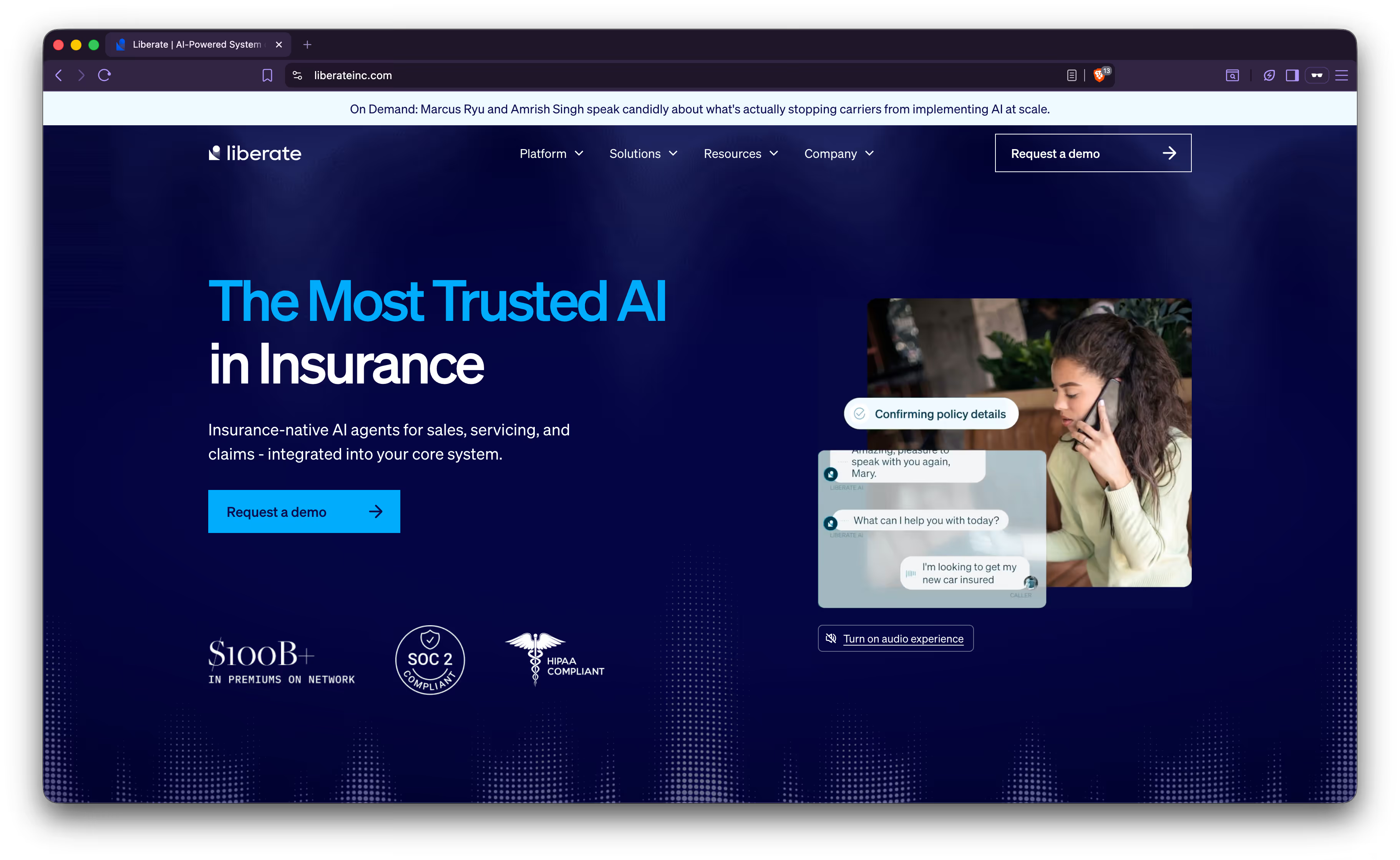
Liberate AI is a multi-channel voice-AI platform for insurance carriers and financial-services companies, specializing in FNOL (First Notice of Loss) automation across voice, chat, email, and WhatsApp.
Best for: insurance carriers, claims departments, and enterprise policyholder services.
Less of a fit for: retail P&C agencies needing native AMS write-back (EZLynx, Applied Epic, HawkSoft, AMS360).
Pricing: Custom, based on carrier size.
Implementation: Scoped per carrier engagement (not publicly detailed).
1. What is Liberate?
Liberate AI is a multi-channel voice-AI platform for insurance carriers and financial-services companies, focused on FNOL automation - handling claims intake across voice, chat, email, and WhatsApp. It integrates with carrier systems like Verisk, CCC, and Insuresoft rather than retail agency AMS platforms. That carrier focus is the deciding factor for an agency.
2. Who uses Liberate?
Liberate’s public materials describe insurance carriers, policyholder-service departments, and financial-services organizations needing omnichannel customer engagement. The typical user is a carrier automating claims and FNOL at scale - not a retail agency handling quote and service calls, which is the distinction that decides fit.
3. How much does Liberate cost?
Liberate uses custom pricing based on carrier size, with no public rate card - typical for an enterprise carrier platform. For an agency, the absence of public pricing plus the carrier orientation signals it’s scoped to carrier deployments. The cost covers carrier-grade claims automation, not agency reception.
4. Key features
- Multi-channel voice AI (voice, chat, email, WhatsApp)
- FNOL (First Notice of Loss) automation
- Claims intake and processing
- Carrier platform integrations (Verisk, CCC, TurboRater, Corelogic)
- Enterprise policyholder services
- SOC 2 Type 2 and GDPR certified (per Liberate)
Communication channels: voice, chat, email, WhatsApp.
Conversation design: multi-channel conversational AI.
Insurance terminology handling: trained on carrier FNOL and claims terminology.
Feature breakdown
5. How long does it take to implement Liberate?
Liberate’s deployment is scoped per carrier engagement and not publicly detailed - consistent with an enterprise carrier platform that integrates into claims and policyholder systems. For an agency, the more relevant point is that its integrations and workflows target carriers, so the fit is on that side.
6. What does Liberate integrate with?
Liberate integrates with carrier-grade systems - Snapsheet, Salesforce, Insuresoft, Verisk, CCC, TurboRater, and Corelogic. It does not list native connectors for retail agency management systems (EZLynx, Applied Epic, HawkSoft, AMS360). For agency-side write-back, see AI receptionists built for agency AMS platforms.
7. Compliance and security
Liberate reports SOC 2 Type 2 and GDPR compliance - appropriate for carrier deployments handling claims data. A published SOC 2 Type 2 report is the documentation carrier procurement expects.
8. Pros and cons for insurance buyers
Pros:
- Purpose-built FNOL and claims automation for carriers.
- True omnichannel (voice, chat, email, WhatsApp).
- Carrier-grade integrations (Verisk, CCC, Insuresoft).
- SOC 2 Type 2 and GDPR compliant.
Cons / where it may fall short for retail P&C agencies:
- Integrations are carrier core systems, not retail AMS - no EZLynx/Epic/HawkSoft/AMS360 write-back.
- Carrier/claims orientation rather than retail-agency reception; custom pricing only.
9. When Liberate fits an insurance buyer
Liberate fits a carrier or claims operation automating FNOL and policyholder service across channels, with carrier-system integrations in place. If you’re on the carrier side of the policy, it’s a capable platform.
10. Liberate vs an insurance-native agency AI receptionist
For a retail P&C agency, Liberate is aimed at the wrong side: it integrates with carrier platforms, not your AMS. An agency wants P&C-trained answering that writes to EZLynx, Applied Epic, HawkSoft, or AMS360. Sonant™ AI is built for that. See Sonant vs Liberate and the best AI for HawkSoft and Applied Epic agencies.
Verdict
Liberate is a strong voice-AI platform - for carriers and claims operations that want FNOL wired into Verisk, CCC, and Insuresoft. For an independent retail agency the gap is concrete: Liberate integrates with carrier platforms, not the AMS your team lives in, so a Liberate call doesn’t post back to your system of record. If you’re a carrier, shortlist it; if you’re an agency, an insurance-native receptionist with AMS write-back is the closer fit.
Related reading
- Sonant vs Liberate alternative
- Best Voice AI Insurance Vendors
- FNOL Automation Guide
- 100 AI Tools for Insurance Agencies (2026 Guide)
Disclaimer
Liberate is a trademark of its respective owner. Sonant™ is not affiliated with or endorsed by the owner of Liberate. This review was created using publicly available information about Liberate and Liberate’s public materials. We encourage readers to visit the official Liberate website for the most current product information. Last verified: 2026-06-15.





.svg)


.svg)
