
.avif)
Balto Alternative for AI Voice Agents for Insurance Agency
Sonant and Balto both leverage AI to improve phone conversations but serve different use cases. Sonant is an AI receptionist that handles calls autonomously with native AMS integration, plus Coaching Insights for agent performance. Balto provides real-time guidance to human agents during live calls. Compare autonomous AI handling vs. human agent assistance.
Why agencies prefer Sonant
AI Call Technology:
Quick Comparison
Sonant is an AI receptionist built exclusively for P&C insurance agencies with native AMS integrations (EZLynx, Applied Epic, Hawksoft, Momentum), insurance-specific terminology training, and enterprise-grade security (SOC2 Type 2, GDPR certified). The platform handles incoming phone calls 24/7 autonomously, plus offers Coaching Insights to analyze agent calls and improve performance.
Balto is a real-time AI call guidance platform founded in 2017 in St. Louis, Missouri. With $52M in funding and 170+ employees, Balto provides live prompts, compliance checklists, and coaching alerts to human agents during calls. The platform serves contact centers across insurance, healthcare, and financial services with SOC 2, HIPAA, and PCI compliance.
Choose Sonant if you need AI to handle calls autonomously AND want coaching insights to improve your human agents' performance.
Choose Balto if you have a contact center with human agents who need real-time prompts and guidance during calls.
We were getting disrupted constantly (...) My team couldn't focus on insurance consultations because they were always picking up the phone just to transfer calls to someone else.
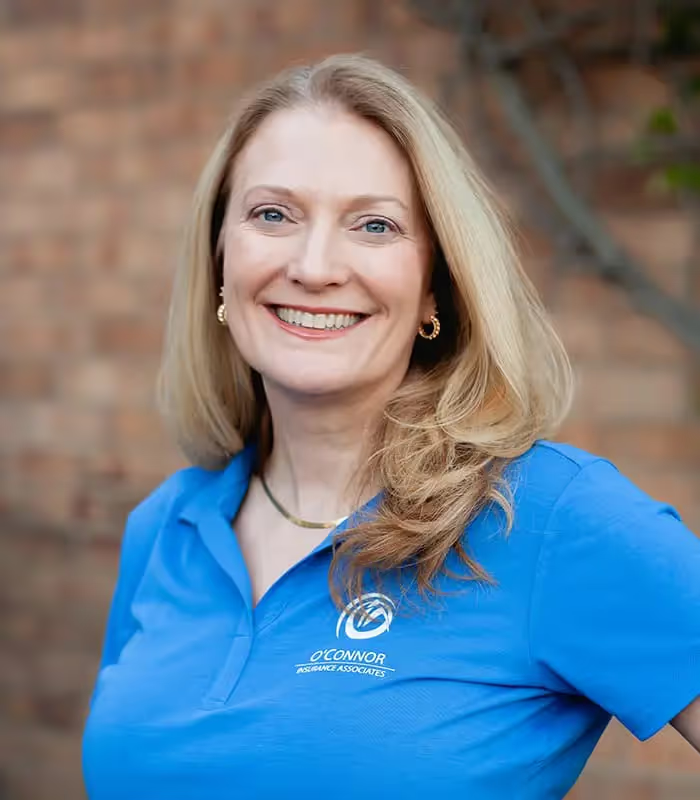
Michelle O'Connor
President at O'Connor Insurance and Associates

AI Capabilities Autonomous Handling vs. Agent Assistance

24/7 AI Receptionist Coverage
Round-the-clock phone answering ensuring insurance agencies never miss calls during nights, weekends, or holidays.

White-Glove setup
Implementation in under 30 days with dedicated developers and insurance AI specialists.

Insurance specific
Pre-trained on P&C insurance terminology, policy types, and agency workflows. No custom training required.

Native AMS integrations
Direct sync with Momentum, Hawksoft, EZLynx, Applied Epic, and 8+ major AMS and BMS.
Side-by-side Feature Comparison between Sonant and Balto
.svg)
%201.avif)

Sonant vs Balto: Different AI Approaches

Sonant is an AI receptionist built exclusively for P&C insurance agencies and brokers. The platform handles incoming phone calls 24/7, managing quote requests, policy inquiries, appointment scheduling, and claims routing with insurance-specific training and native AMS integrations.
Sonant also offers Coaching Insights, which analyzes calls handled by your human agents to identify coaching opportunities, track performance metrics, and improve agent effectiveness over time.
Key Sonant Features:
- AI receptionist for autonomous phone handling
- Coaching Insights for agent performance analysis
- Native AMS integrations (8+ platforms)
- Insurance-specific training (P&C terminology)
- 24/7 phone coverage
- White-glove implementation (under 30 days)
- Enterprise security (SOC2 Type 2, GDPR)
- Proven 8X ROI within 30 days
Best For: P&C agencies wanting AI to handle calls AND improve human agent performance
Balto is a real-time AI guidance platform founded in 2017 that pioneered the real-time guidance category for contact centers. The platform has delivered over 1 billion real-time recommendations and powered 400+ million calls.
Balto provides live assistance to human agents during calls—suggesting responses, displaying compliance checklists, and alerting supervisors to coaching moments as they happen.
Key Balto Features:
- Real-time prompts during live calls
- Compliance checklists and alerts
- 100% automated QA scoring (not sampled)
- Live coaching alerts for supervisors
- Win Rate Analysis (A/B test phrases)
- AI-powered call notetaker
- 50+ integrations (Five9, Genesys, NICE, etc.)
- SOC 2, HIPAA, PCI compliant
Best For: Contact centers with human agents needing real-time guidance during calls
Sonant vs Balto: Which AI Solution to Choose?
✅ Are an insurance agency or broker (not a carrier)
✅ Offer P&C insurance products (auto, home, commercial lines)
✅ Need AI to handle calls autonomously 24/7
✅ Use an AMS like EZLynx, Applied Epic, or Hawksoft
✅ Want both AI call handling AND coaching insights
✅ Need insurance-specific training and terminology
✅ Want turnkey implementation (under 30 days)
✅ Require SOC2 Type 2 and GDPR security certifications
- AI handles calls autonomously + Coaching Insights
- Purpose-built for P&C insurance agencies
Sonant: Best for P&C Insurance Agencies
✅ Have a contact center with human agents
✅ Need real-time prompts during live calls
✅ Want compliance monitoring as calls happen
✅ Need automated QA scoring for 100% of calls
✅ Want to A/B test agent language/phrases
✅ Use CCaaS like Five9, Genesys, or NICE
✅ Need supervisor alerts for coaching moments
- 1 billion+ real-time recommendations delivered
- Real-time guidance during live human calls
Balto: Best for Contact Center Guidance
What You Gain by Switching
Independent P&C insurance agencies switch to Sonant for one reason: it's the only AI receptionist purpose-built for how agencies actually run - quote intake, policy inquiries, appointment scheduling, and claims routing, all synced natively to your AMS. Here's how your day-to-day changes after the switch:
- Insurance-specific AI vs multi-industry universal AI employee
- Native retail AMS integrations vs general enterprise system integrations
- Pre-trained P&C terminology
- Faster, more focused implementation for retail agencies
Migration: What Switching Looks Like
Migration takes 30 days or less, with our insurance specialists handling every step. No engineering work, no DIY configuration, no extra hires required. Here's exactly what happens week-by-week:
The Bottom Line
Sonant is the best choice for P&C insurance agencies who want AI to handle calls autonomously AND want Coaching Insights to improve human agent performance—all with native AMS integration.
Balto is the best choice for contact centers with large human agent teams who need real-time guidance, compliance monitoring, and automated QA during live calls.
The key difference: Sonant's AI handles calls autonomously (replacing the need for some human calls) while also coaching agents. Balto assists human agents in real-time but doesn't handle calls itself.
Disclaimer: This comparison was created using publicly available information from Balto's website and public sources. We encourage you to visit balto.ai for the most current information.
Frequently Asked Questions
How does Balto compare to Sonant for insurance agencies?

Balto is a real-time AI coaching platform for contact center agents during live calls. Sonant is an AI receptionist that handles calls autonomously without human agents. Different operational models — Balto assists humans, Sonant replaces them.
Why would I consider Sonant instead of Balto?
Sonant handles calls 24/7 without human staffing. Balto requires human agents to be on the line — it provides real-time coaching but doesn't automate the call itself.
Does Balto handle calls without human agents?
No. Balto coaches human agents in real-time during calls. Sonant handles calls autonomously with AI.
How does pricing compare?
Balto uses per-agent monthly pricing for contact center coaching. Sonant uses custom agency-level pricing for AI phone automation (different operational model).
Should I choose Balto or Sonant for my insurance agency?
Choose Sonant for autonomous AI phone automation. Choose Balto if you want to keep human agents and provide them real-time AI coaching during calls.










.avif)



.avif)
.avif)

.avif)
%201.avif)








.avif)
.avif)


%201.avif)






























.svg)

.svg)
