.svg)

The phone is the biggest unoptimized workflow at most P&C (property and casualty) agencies. Quoting has a rater, renewals have a calendar, marketing has a dashboard, but inbound call handling usually runs on "whoever picks up, picks up." Optimizing the way your agency answers the phone means treating it like any other production workflow: measure the volume, route by intent, resolve on first contact, log every call to the AMS (agency management system), trigger the follow-up, and cover all 24 hours. This piece is the 6-step sequence, with the metric that proves each step worked.
Key Takeaways
- Phone handling is a production workflow and should be optimized like one: measured, routed, logged
- First-ring pickup and first-contact resolution are the two metrics that move everything downstream
- Routing by caller intent beats routing by line or pickup order
- A call that does not produce an AMS note did not operationally happen
- 24/7 coverage is part of optimization, not an add-on; after-hours is where the leak concentrates
Step 1: Measure what actually happens when your phone rings
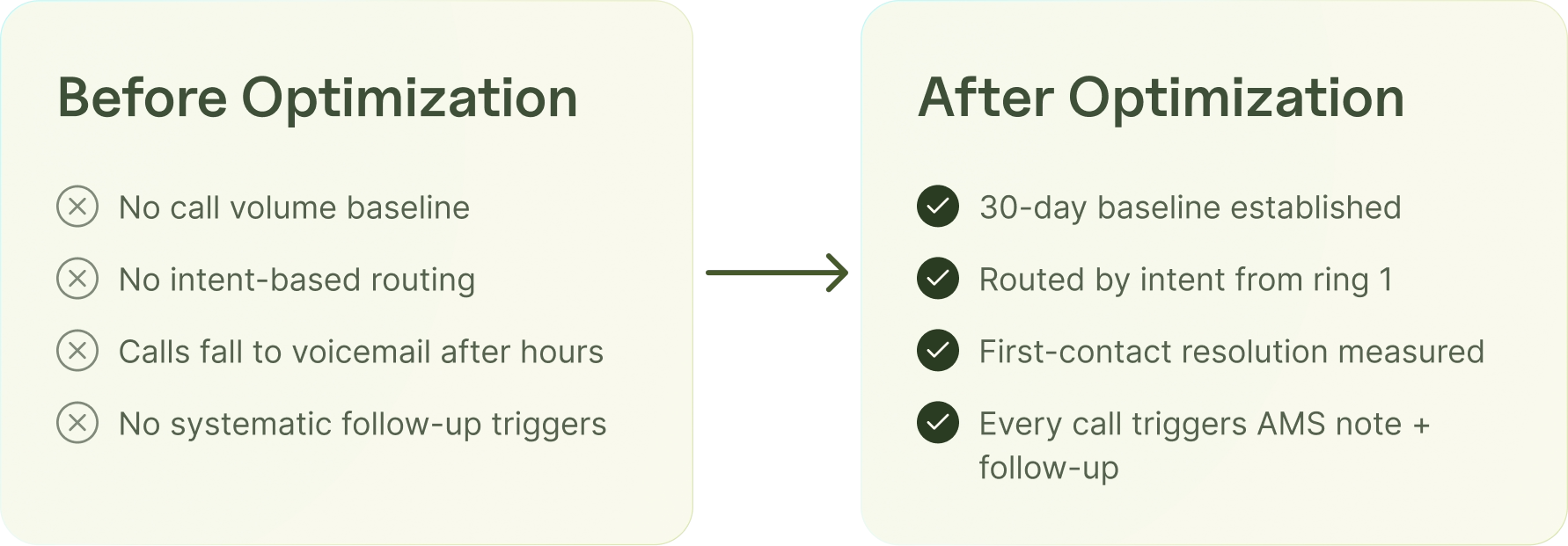
You cannot optimize an invisible workflow. Pull 30 days of phone-system data and answer five questions: how many calls per day, what percentage gets answered within 5 seconds, where overflow goes, what callers wanted (sampled from notes or recordings), and how much volume arrives after hours. ACT benchmarks put the typical agency at 70–82% business-hours pickup and near-zero after-hours capture, which means most agencies start with a 20–30% invisible leak.
Want a baseline audit of your phone workflow? → Talk to Sonant
Step 2: Route by intent, not by pickup order
The optimization with the highest leverage: stop treating every call the same. A quote shopper, a billing question, and a claim each have a different right destination. Intent-based routing, the caller says what they need, the system parses and routes; cuts transfers per call below 1.2 and abandonment below 5%, versus 18–35% abandonment on IVR (interactive voice response) menu trees.
Step 3: Resolve tier-1 on first contact
40–60% of agency inbound is tier-1 routine: ID cards, billing questions, claim status, COIs (certificates of insurance), policy confirmations. Each one resolved on the first call is a callback that never enters the queue. First-contact resolution is the single best predictor of caller satisfaction in the J.D. Power insurance study; ahead of wait time and channel.
Here is the full sequence as a scoreboard, with the metric that proves each step and the healthy target the post argues for:
Step 4: Log every call to the AMS - automatically
A call that produced no AMS note did not operationally happen: the follow-up has no trigger, the E&O (errors and omissions) trail has a hole, and the next person to touch the account is blind. Manual logging fails under load; note completion collapses exactly when call volume peaks. The optimization is automatic write-back: the call summary, intent, and action items post to the AMS within 60 seconds, every call, including the busy ones.
Step 5: Trigger the follow-up from the note
Speed-to-lead conversion is roughly 4× higher at 5 minutes than at one hour. When the AMS note posts automatically, the follow-up workflow can fire from it: quote details to the producer with the appointment booked, pending-document requests queued, service tasks assigned. The phone workflow stops ending at hang-up and starts ending at resolution.
The Sonant Consumer AI Readiness Report confirms the caller-side ranking of what matters: fast pickup, no repeated information, and a real resolution, the exact outputs of steps 2 through 5.
Step 6: Extend the optimized workflow to all 24 hours
After-hours is not an edge case; it is where the leak concentrates. Most agencies lose nearly 100% of weekend calls and 60–80% of weekday evening calls to voicemail, and personal-lines quote shoppers call evenings. An optimized phone workflow that stops at 5 PM is optimized for two-thirds of the day. AI coverage runs the same routing, resolution, and logging at 2 AM as at 2 PM, at the same per-call cost.
What the optimized workflow looks like assembled
Caller dials at any hour → answered within the first ring → states their need in their own words → tier-1 resolved on the call, quotes booked to producers, complex work escalated with context → AMS note posted within 60 seconds → follow-up triggered within 5 minutes. The team's phone role shrinks to the escalation queue, and the six metrics on the scoreboard stay green without anyone managing them manually.
How Sonant runs the optimized workflow
Sonant implements steps 2 through 6 from a single deployment: first-ring pickup 24/7 in English and Spanish, intent-based routing, tier-1 resolution end-to-end, AMS write-back within 60 seconds to EZLynx, Applied Epic, HawkSoft, AMS360, QQCatalyst, Momentum, AgencyZoom, or Zywave, and follow-up triggers firing from the note. Output is the green scoreboard: pickup above 95%, abandonment under 5%, note completion above 95%, and the after-hours leak closed.
The practical takeaway for the operations lead
Optimize the way your agency answers the phone the same way you would optimize any production line: baseline the six metrics, fix routing and resolution first, automate the logging, and extend coverage to the full day. Run the scoreboard monthly. Most agencies that complete the sequence recover a 20–30% call leak they could not previously see.
Ready to put your phone workflow on a scoreboard? Book a Sonant demo →
Related reading
- AI Voice Agents vs. Live Call Center Reps: What's Better?
- The Best AI Answering Services for Insurance Agencies in 2026
- 10 Ways to Reduce Insurance Operational Costs in 2026
- 100 AI Tools for Insurance Agencies (2026 Guide)






.svg)

.svg)


