.svg)

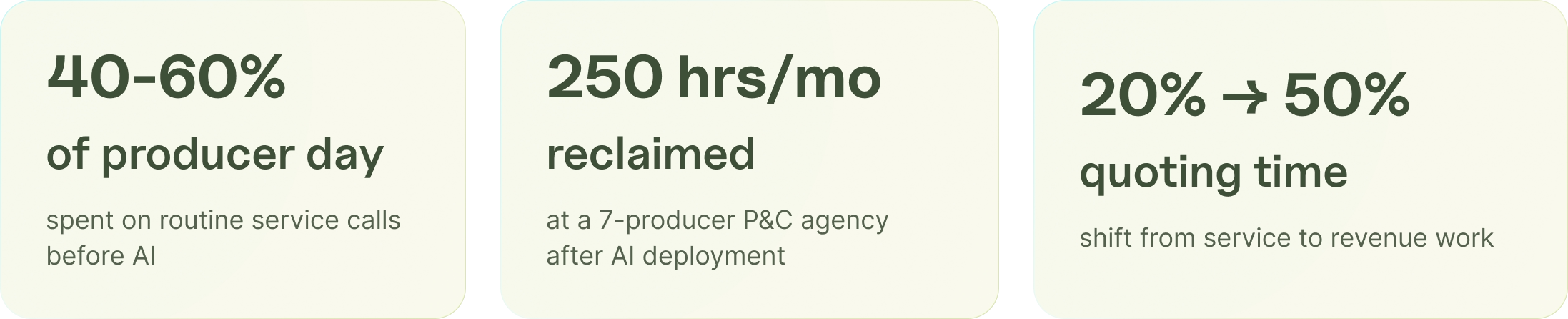
At a 52-year-old retail P&C (property and casualty) agency with seven producers, the front-desk problem was not missed calls. It was the calls that did get answered - by the wrong people. Roughly 1,000 inbound calls a month were creating a voicemail "waterfall" that dragged producers off quoting and rating and into routine servicing: ID cards, billing, claim status, policy changes. Reclaiming that producer time is not just an operations win. It compounds into quoting volume, retention, EBITDA, and ultimately agency valuation (one referenced case grew from $2.9M to $4.3M). This piece connects the dots for agency leaders who treat the front desk as a revenue problem, not just an operations one.
Key Takeaways
- Producers absorbed into tier-1 servicing is the highest-leverage time leak at most P&C agencies
- Reclaiming 250 producer hours/month translates to measurable quoting volume lift
- The compounding chain: producer time → quoting volume → bind rate → retention → EBITDA → agency valuation
- One referenced agency case: valuation grew from $2.9M to $4.3M after the producer-time fix
- The AI fix targets tier-1 routine; producers stay on the work where their judgment matters
Why producers become order-takers at insurance agencies
The producer role at an insurance agency is supposed to be revenue generation: quoting new business, binding policies, running renewal outreach with discretionary changes, building the book. The role becomes order-taking when:
- Inbound call routing dumps service questions on whoever picks up
- The front-desk seat is unfilled or part-time
- CSRs (customer service reps) are at capacity and overflow rolls up to producers
- The AMS (agency management system) workflow makes it easier for a producer to answer the question themselves than to route it correctly
Reagan Consulting's producer compensation studies consistently show producer time is the most expensive labor in the agency. When that time gets spent on $20 ID-card requests instead of $2,000 commission opportunities, the math is brutal.
Want to model your producer-time leak? → Talk to Sonant
The 250-hour reclamation math
A 7-producer agency averaging 35 hours/producer/month on routine service calls (5 hours/week per producer) is leaking 245 producer hours monthly into tier-1 work. At fully-loaded producer cost of $80–$120/hour, that is $20K–$30K/month of producer time absorbed by work that an AI receptionist can handle for $0.40–$1.20 per call.
Side by side, the tier-1 cost comparison looks like this:
The reclaimed time does not all flow into quoting - some flows into renewal outreach, cross-sell, and producer-driven retention work. The compounding effect is what changes the agency's economics.
How the chain compounds into agency valuation
The chain from "producer time reclaimed" to "agency valuation" runs through five linked metrics:
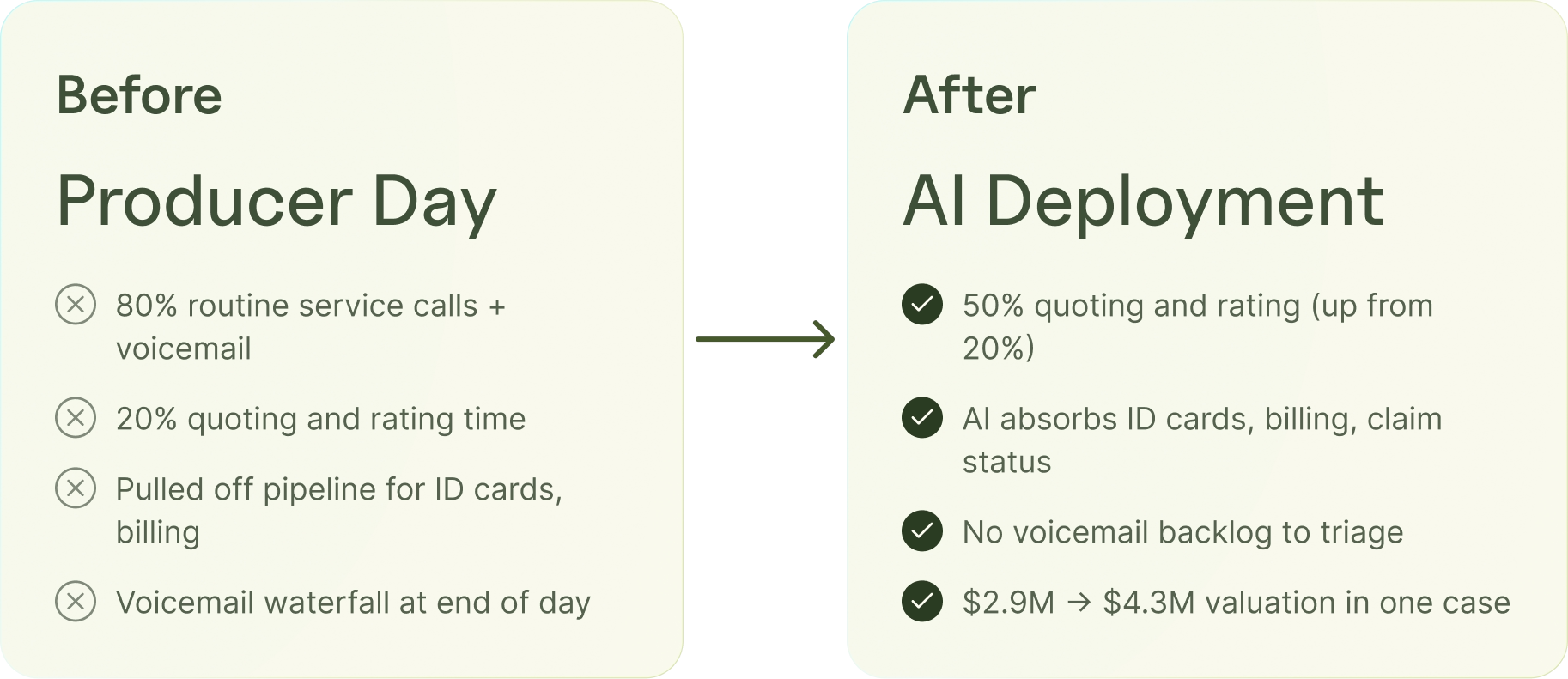
- Producer hours on quoting rise from ~20% of the day to ~50% of the day
- New-business quoting volume rises 30–60% within 6 months
- Bind rate stays flat or improves slightly (better quoting time per quote)
- Premium growth rises into double-digit annual range
- EBITDA margin rises 3–6 percentage points from operating leverage on the recovered capacity
MarshBerry's agency valuation benchmarks confirm EBITDA margin is the largest single driver of insurance agency M&A multiples. An agency growing premium at double-digits with rising EBITDA margin trades at meaningfully higher multiples than a flat-revenue agency at the same EBITDA dollar level.
The referenced case (valuation $2.9M → $4.3M) reflects this chain compounding over 24–30 months after the producer-time fix.
The Sonant Consumer AI Readiness Report provides consumer-side validation that the routine service calls absorbing producer time are exactly the calls policyholders are comfortable having AI handle.
What producers should actually be doing
Once tier-1 routine moves to AI, the producer day shifts toward:
- New-business quoting: the highest-margin work, where producer judgment on carrier selection and submission quality matters
- Renewal outreach with discretionary changes: producers handle the cases where the policyholder needs coverage advice, not just confirmation
- Cross-sell and upsell: the conversations the AI flags as opportunities but cannot close
- Strategic account work: the top 10–20% of book by premium where the relationship matters
- Complex commercial servicing: mid-term endorsements requiring underwriting judgment
The tier-1 work - ID cards, billing, claim status, COIs (certificates of insurance), policy changes - flows to the AI receptionist with native AMS write-back.
What changes in the AMS after the fix
The AMS data quality changes measurably:
- Note completion rate rises to 95%+ (versus 60–80% with manual producer entry)
- Note timeliness drops to under 60 seconds from call end (versus hours or days)
- Caller intent capture becomes standardized across calls
- Follow-up task creation becomes automatic
- Cross-sell trigger detection runs on every call instead of relying on producer memory
Reagan Consulting consistently identifies AMS data quality as the operational driver that separates top-quartile agencies from median.
How Sonant absorbs the producer time leak
Sonant handles the routine tier-1 inbound (ID cards, billing, claim status, COIs, policy detail confirmations) and writes the AMS note within 60 seconds. Native integrations to EZLynx, Applied Epic, HawkSoft, AMS360, QQCatalyst, Momentum, AgencyZoom, and Zywave keep the producer team out of the call queue for routine work. The workflow: caller calls → Sonant answers within first ring → captures intent → resolves routine OR escalates complex to the right producer → writes AMS note. Output is the AMS-attached note, the recovered producer time, and the cross-sell trigger flagged for follow-up.
How an agency owner should think about the valuation lift
The investment math: $80K–$180K annual on AI delivers 200–300 hours of producer time reclaimed per producer per year. At 7 producers, that is 1,400–2,100 reclaimed hours, mapped to roughly 30–60% new-business quoting volume lift over 12 months. Premium growth into double-digits raises EBITDA margin 3–6 points; the multiple expansion follows. Most agency owners running the math underweight the multiple-expansion piece because it is non-linear. The referenced case ($2.9M → $4.3M) is on the higher end but within the range agencies running this sequence routinely see.
Ready to reclaim 250 producer hours a month? Book a Sonant demo →
Related reading
- AI Voice Agents vs. Live Call Center Reps: What's Better?
- The Best AI Answering Services for Insurance Agencies in 2026
- 10 Ways to Reduce Insurance Operational Costs in 2026
- 100 AI Tools for Insurance Agencies (2026 Guide)






.svg)


.svg)


