.svg)

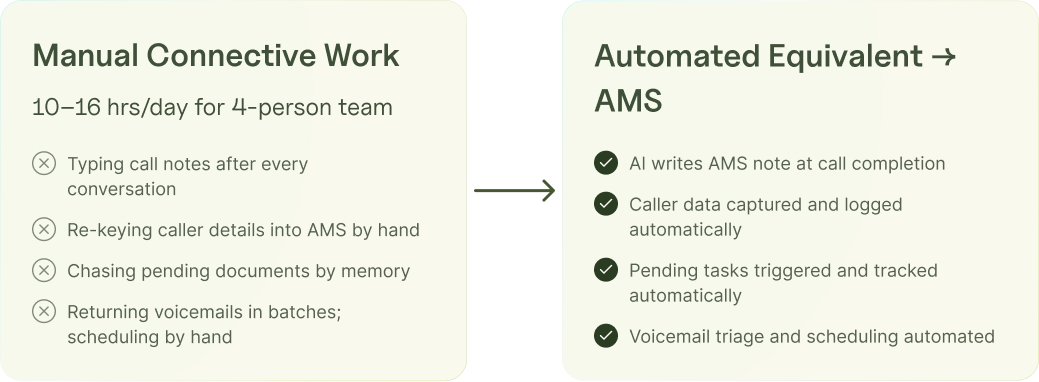
To reduce manual workload at your insurance agency, start by naming where the hours actually go. It is rarely the visible work: quoting, binding, renewals. It is the connective tissue around every task: typing call notes after each conversation, re-keying caller details into the AMS (agency management system), chasing pending documents by memory, returning voicemails in batches, and confirming appointments by hand. At a four-person service team, this connective work consumes 10–16 hours a day. This piece is the manual-work audit: the five categories that eat the hours, which ones automate cleanly in 2026, and the order to remove them.
Key Takeaways
- Manual workload hides in the connective work around tasks, not the tasks themselves
- Call documentation alone consumes 1–2 hours per CSR per day when typed by hand
- Five categories cover most of the manual load: notes, re-entry, follow-up chasing, voicemail triage, scheduling
- Four of the five automate cleanly with current tools; judgment work stays human
- Removing the manual layer returns 2–4 hours per person per day for revenue work
Run the manual-work audit first
The audit takes one week: every team member tallies time in five buckets at day's end. The buckets:
- Call documentation: typing notes into the AMS after each call
- Data re-entry: moving the same information between phone, AMS, rater, and email
- Follow-up chasing: remembering and re-requesting pending photos, signatures, COIs (certificates of insurance)
- Voicemail triage: listening, transcribing, prioritizing, returning
- Scheduling: booking, confirming, and rescheduling appointments by hand
Reagan Consulting's operating studies consistently show that the agencies with top-quartile revenue per employee did not find harder-working people: they removed the connective work.
Want the audit run against your call data? → Talk to Sonant
Automate call documentation end-to-end
Call notes are the largest single manual category, and the one with the cleanest fix. When the answering layer writes the AMS note itself: caller intent, details captured, action items, timestamp, within 60 seconds of hang-up, the typing disappears and the note quality rises. Manual notes degrade exactly when volume peaks; automated notes do not.
Kill data re-entry at the source
Re-entry exists because the phone, the AMS, and the calendar are separate systems with a human as the integration. The fix is native write-back: the call layer posts directly to the AMS record, the appointment lands on the producer calendar, and the follow-up task creates itself. Middleware (copy-paste, Zapier chains) reduces the typing but keeps the human in the loop; native integration removes the loop.
Mapped to actions, the five buckets look like this:
Replace follow-up chasing with cadences
Pending-task follow-up fails because it depends on memory under interruption load. The fix is mechanical: every request becomes a tracked task with an automatic reminder cadence (day 1 text, day 3 call, day 7 escalation), and the human only enters at the escalation. The chasing disappears; the completion rate rises.
.avif)
Let voicemail triage die with voicemail
Voicemail triage is manual work created by a coverage gap. When calls are answered at first ring, in English and Spanish, around the clock, there is no backlog to listen to, transcribe, prioritize, and return. The Sonant Consumer AI Readiness Report confirms callers prefer immediate answering to leaving messages anyway: the manual work and the bad experience are the same artifact.
Keep the judgment work manual on purpose
Not everything should automate. Coverage advice, complex commercial servicing, claim counseling, and the empathy-heavy conversations stay with licensed staff. The point of removing the manual layer is to give those conversations full attention instead of fragments between interruptions. An AI receptionist should not replace licensed insurance staff; it should protect their time.
.avif)
How Sonant removes the manual layer
Sonant answers at first ring 24/7 in English and Spanish, resolves tier-1 routine end-to-end, books appointments onto the right calendar, runs follow-up cadences on pending tasks, and writes every AMS note within 60 seconds, natively, to EZLynx, Applied Epic, HawkSoft, AMS360, QQCatalyst, Momentum, AgencyZoom, or Zywave. Complex calls escalate to licensed staff with the note pre-written. Output: the five manual buckets shrink to one (judgment work), and each team member recovers 2–4 hours a day.
The practical takeaway for the owner watching the team type
To reduce manual workload at your insurance agency, audit the five connective-work buckets, automate documentation and re-entry first, replace follow-up chasing with cadences, and let voicemail triage disappear with voicemail. Keep the judgment work human on purpose. The recovered 2–4 hours per person per day is the cheapest capacity expansion available.
Ready to remove the manual layer? Book a Sonant demo →
Related reading
- AI Voice Agents vs. Live Call Center Reps: What's Better?
- The Best AI Answering Services for Insurance Agencies in 2026
- 10 Ways to Reduce Insurance Operational Costs in 2026
- 100 AI Tools for Insurance Agencies (2026 Guide)





.svg)

.svg)
