

Bilingual Answering Service for Insurance Agencies
Every Spanish call answered on the first ring, handled on the line, and written into your AMS, without staffing a second bilingual desk.
Book a Demo ->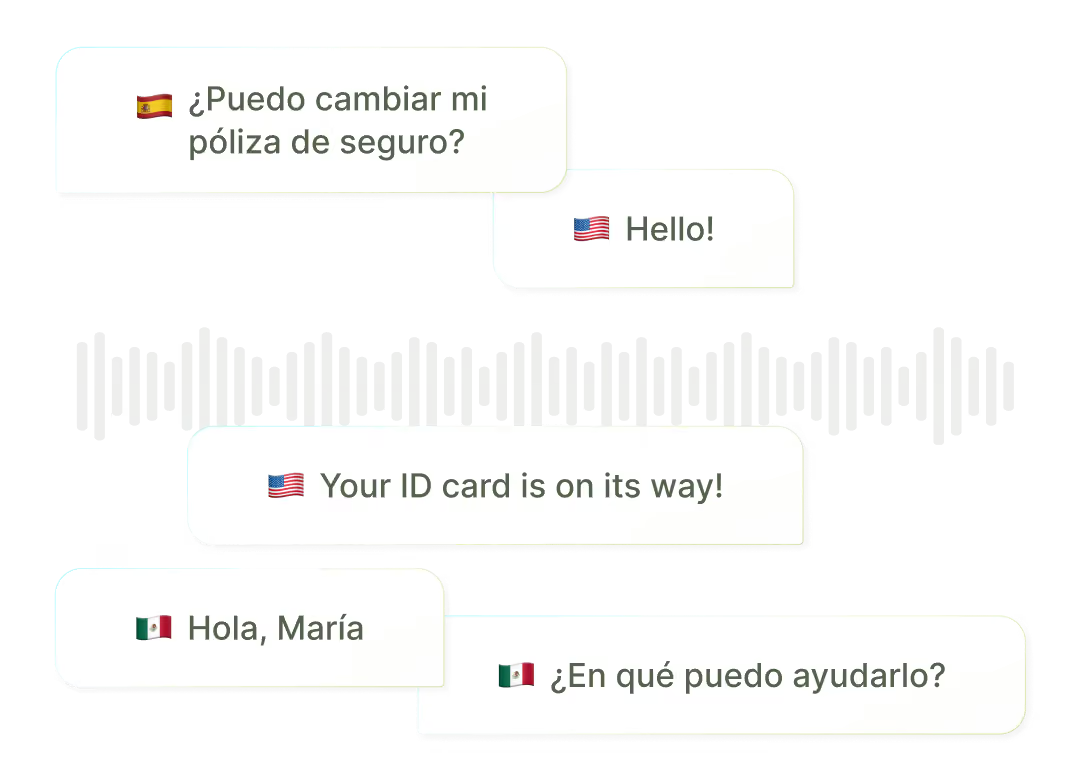
Trusted by Industry Leaders & Partners

























Industry Stats
people, almost 1 in 5, speak a language other than English at home
of Spanish speakers spoke English “less than very well”
Hispanic-owned employer firms in the United States
What Is a Bilingual Answering Service for Insurance?
A bilingual answering service answers your agency's calls in more than one language, most often English and Spanish. The traditional version routes the caller to an operator who speaks their language and takes a message.
Sonant handles the call instead. It picks up on the first ring in the caller's language, verifies who they are, reads their policy record live, completes the request, and writes a structured activity into your AMS before they hang up. For a side-by-side of providers, see our comparison of the best bilingual answering services for insurance agencies.
Serve Every Caller in Their Own Language
Book a Demo ->


Natively your customers’ language.
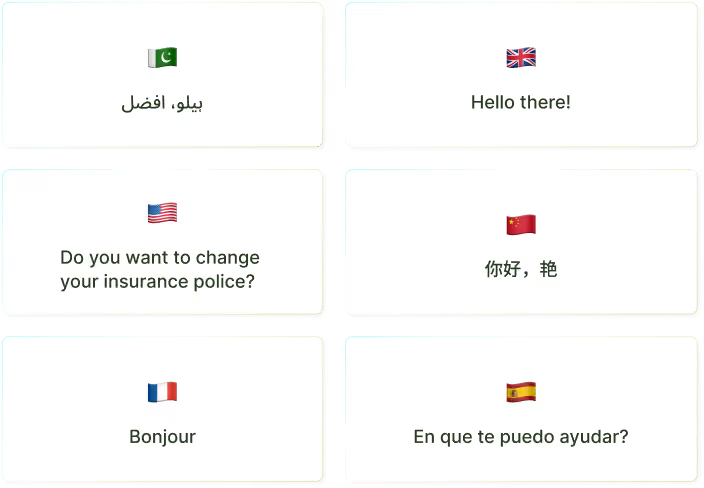
English, Spanish, and Portuguese, with mid-call switching. If a caller starts in Spanish and moves into English partway through, the agent moves with them.

Skip the language menu.
No "press 9 for Spanish," no separate queue, no callback when the bilingual desk frees up. Same first-ring pickup for every caller.

The policy record opens in Spanish too.
Renewal date, coverage, deductible, lienholder. Read live during the call, so the request gets finished rather than logged.

Coverage that doesn't depend on one desk.
Same quality at 2 AM as at 10 AM, on a vacation week as on a Tuesday. Unlimited concurrent calls, no bilingual staffing to schedule.
How the Bilingual Answering Service Works
What's included
Book a demo ->
Mid-call switching supported
Unlimited concurrent calls
Phone match, date of birth, ZIP
Policy, coverage, renewal date, deductible
To the CSR who owns the relationship
Calendar and out-of-office aware
Texted to the caller
Mid-call, auto-titled, English summary
Results From Agencies Like Yours

"Grace is better than I am - she handles more calls at once and speaks Spanish!"
Emmanuel Osuyah
Principal
"It seems very realistic, probably more realistic than I anticipated."
Anthony Libardi
Vice President at Libardi Service Agency, Inc.

"The situation was honestly disgusting"
Ali Farouqi
Operations Manager at BIG Pickering Insurance

Sonant vs Traditional Bilingual Answering Service
Outcome

Traditional bilingual answering service
Answered in the caller's language on the first ring
✓ Natively your customers’ language, unlimited concurrent
✗ Queue for a bilingual operator
✗ Menu first, then a queue
Language switches mid-call
✓ Mid-call switching
✗ One language per operator
✗ One language per branch
The agent reads the caller's policy record
✓ Live AMS lookup during the call
✗ No live policy lookup during the call
✗ No live policy lookup during the call
The request gets completed
✓ Payments, quote intake
✗ Message taken
✗ Routed to voicemail
A Spanish call is documented in English
✓ Recording, transcript, English summary in the AMS
✗ Operator's typed message
✗ No AMS record
Routed to the CSR who owns the account
✓ Account-based routing, warm transfer
✗ Whoever is next
✗ Department only
Language isn't a separate line item
✓ Included in the partner rate
Traditional bilingual answering service
✗ Per-call or per-minute surcharge
Press 9 language menu
✗ Not offered
Coverage survives a vacation week
✓ 24/7, no staffing to schedule
✗ Depends on bilingual staffing
✗ Depends on bilingual staffing
What the Bilingual Answering Service Returns
Purpose-built for insurance
Trained on real insurance calls, formatted for the systems your team already uses.
What your team stops doing?

No more “press 9 for Spanish.”
No more waiting on the bilingual desk.
No more message pads nobody can service.
No more scheduling bilingual shifts.
Book a Demo ->
Frequently asked questions
What is a bilingual answering service for an insurance agency?

A bilingual answering service answers your agency's inbound calls in more than one language, usually English and Spanish. The traditional model routes the caller to an operator who speaks their language, takes a message, and emails it over. Sonant handles the call instead, verifying the caller, reading their policy record live, completing routine requests like payments and ID cards, and writing a structured activity into your AMS. Your team comes back to actioned calls rather than a message queue.
How much does a bilingual answering service cost?
A bilingual answering service runs roughly $250 to $2,100 a month among providers that publish pricing, and the language itself is sometimes metered separately. Smith.ai™ charges $300 to $2,100 for 30 to 300 calls plus $1.00 per call to route to a Spanish-speaking receptionist; MAP Communications™ includes bilingual support at no per-language surcharge, with pricing quoted per agency rather than published, and Ruby™ runs $250 to $1,725 by minute bundle, with 24/7 Spanish and bilingual call handling included, as published by each vendor in August 2026 and re-checked against each vendor's own pricing page. Confirm current rates directly. Per-minute and per-call billing means a busy month costs more than a quiet one. Sonant charges a predictable partner rate per agency, and it doesn't move when call volume spikes. The full answering service cost comparison breaks the models down side by side.
Does Sonant speak my clients' language?
Yes. Sonant answers natively in your clients' language, and English, Spanish, and Portuguese are the languages we focus on today. If a caller opens in Spanish and switches to English partway through, the agent switches with them. You don't have to staff a multilingual team to cover it.
Is a Spanish answering service right for an agency our size?
A Spanish answering service fits agencies from about 5 employees up, once phone traffic has become a capacity problem. The proof sits in that range, with Libardi at 14 people, Alpha Direct at 13, and BIG Pickering operating inside an 80-office group. Below 5 employees the call volume rarely justifies the spend. Agencies with assigned CSRs get the most out of it, because account-based routing is exactly where message-taking breaks down.
Does it write Spanish calls into my AMS in English?
Yes. Every call produces a structured activity in your AMS, auto-titled from the call summary with required fields filled and attached to the right account, written in English regardless of the language spoken. The recording and transcript are attached alongside it. That matters for errors and omissions (E&O) exposure, because documentation is what a defense turns on, and a message pad in a second language isn't documentation.
Will our Spanish-speaking clients accept an AI on the phone?
Most consumers will, and the data cuts both ways. In Sonant's consumer AI readiness survey of more than 1,000 US consumers, 61.2% said they're comfortable with a voice AI assistant and another 18.2% were neutral, while 68.4% still reported concerns about voice AI in insurance. Those concerns are worth designing around, which is why chosen clients can bypass the AI entirely through VIP routing. BIG Pickering has logged zero complaints since launch, and the wider question of whether callers accept AI has its own data.
Does it replace our bilingual CSR?
No. Sonant is team backup, not a substitute for staff, and your bilingual people are the reason those clients stay. It absorbs the routine traffic, which is payments, ID cards, certificates, renewal dates, and first-line intake, so your team spends the day on conversations that need judgment. The real problem is that coverage currently depends on one or two desks being staffed. Alpha Direct freed four people from phone duty without cutting headcount.
Is a Spanish speaking answering service the same as bilingual?
Not quite. A Spanish speaking answering service covers Spanish specifically, while a bilingual answering service usually means English plus one other language, most often Spanish. Both describe the same job, picking up in the caller's language, and neither says anything about what happens after the call ends. What matters for an agency is whether the request gets completed and written into the AMS, and Sonant answers in your clients' language, switching mid-call when they do.
How does Sonant pricing work?
Sonant charges a predictable partner rate structured around your operation. Onboarding, ongoing configuration, and support are included. It doesn't change when call volume spikes, so a storm week or an open-enrollment rush costs the same as a quiet month. There's no per-minute meter and no surcharge for answering in a second language.
How fast can Sonant be implemented at my agency?
Most agencies go live in under 30 days. Onboarding covers phone-line forwarding, AMS integration, team and assignment mapping, and transfer rules, plus calibration against a sample of your recent calls. There's no script library to write and no language training on your book, because insurance fluency and multilingual handling ship with the product. Libardi Service Agency planned a three-hour trial on day one and never turned it off.
Ready to see every call your team takes as data you can act on?