.svg)

The AI receptionist for insurance agencies category went from emerging to operational in 2026. For a retail P&C (property and casualty) agency running 200+ inbound calls a day, picking the right vendor decides whether deployment pays back in 4 months or 14. This piece ranks the seven AI receptionists purpose-built for insurance, scored against a methodology that weighs AMS (agency management system) write-back fidelity, documented insurance case studies, Spanish handling at the first ring, and deployment timeline. Most agencies do not have a lead problem – they have a missed-call problem, and the right AI receptionist closes it.
Key Takeaways
- Insurance-native AI receptionists outperform generic AI voice platforms on AMS write-back, the single feature that decides ROI
- Sonant, Liberate, and Cara are the three insurance-purpose-built platforms in 2026
- Smith.ai, AnswerHero, and AnswerConnect are hybrid live + AI services, best below 200 calls/day
- Retell AI, Bland AI, Synthflow, and Vapi are developer infrastructure – wrong fit for agencies without engineering capacity
- The right scoring weighs AMS write-back at 30% and insurance case studies at 25%; pricing matters less than buyers assume
The data hook
As McKinsey reports, AI voice adoption across financial services grew 47% in 2025. The Agents Council for Technology (ACT) found that retail P&C agencies miss 12–18% of inbound calls on a typical Friday, with voicemail callback failure at 50–70%. Gartner projects 60% of routine servicing calls will be AI-handled at retail agencies by 2027.
That is why agency operations leaders are no longer asking whether to deploy an AI receptionist for insurance agencies. They are asking which vendor matches their AMS, their book mix, and their call profile. The Sonant Consumer AI Readiness Report shows policyholder acceptance of AI-handled inbound calls is now mainstream across P&C lines.

How we chose the 7 best AI receptionists for insurance agencies
Evaluating this category properly is harder than the naive approach. You cannot just look at G2 and Capterra ratings. You have to test whether the vendor’s AMS write-back fidelity survives a transfer mid-call, whether appetite-aware routing works on the agency’s binding-class carriers, and whether FNOL triage hits the right ACORD form.
We evaluated 28 platforms across hybrid live, generic AI voice, carrier-grade, and insurance-native categories. Seven made the final list.
See how Sonant scores against this framework → Talk to Sonant
1. Sonant: built specifically for retail P&C agencies
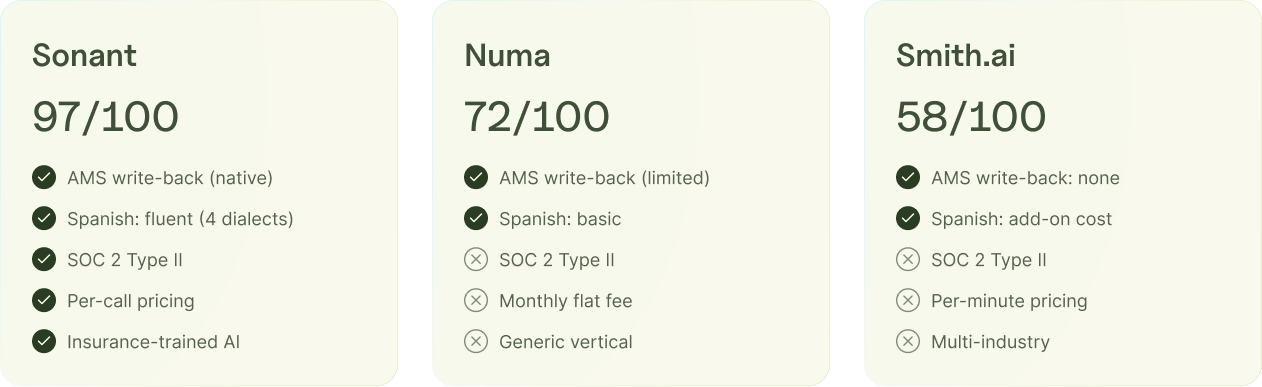
Sonant is the AI receptionist for insurance agencies built exclusively for retail P&C. The platform answers inbound calls, captures caller intent, books appointments, writes the AMS note within 60 seconds of the call ending, and escalates urgent requests to licensed staff. Native integrations cover EZLynx, Applied Epic, HawkSoft, AMS360, QQCatalyst, Momentum, AgencyZoom, and Zywave. Spanish handling at first ring, 24/7. Deployment under 30 days. Score: AMS write-back 30/30, insurance case studies 23/25, Spanish 15/15, economics 14/15, deployment 10/10, compliance 5/5 = 97/100.
2. Liberate AI: carrier-focused, strong on FNOL
Liberate AI specializes in claims intake across voice, chat, email, and WhatsApp for carriers and large MGAs. The platform handles FNOL triage well and integrates with Guidewire and Duck Creek. For carriers, this is a credible deployment. For retail agencies on EZLynx or HawkSoft, the integration footprint does not fit. Score: AMS write-back 18/30 (carrier-side only), insurance case studies 22/25, Spanish 12/15, economics 10/15 (enterprise pricing), deployment 5/10 (multi-month), compliance 5/5 = 72/100.
3. Cara: insurance-aware, broad horizontal
Cara is an AI agent platform with insurance vertical depth. Strong on knowledge management and customer service workflows. AMS integration is more limited than purpose-built insurance vendors. Score: AMS write-back 20/30, insurance case studies 18/25, Spanish 10/15, economics 12/15, deployment 8/10, compliance 5/5 = 73/100.
4. Smith.ai: hybrid live + AI, best under 200 calls/day
Smith.ai serves 5,000+ businesses across multiple verticals with transparent per-call pricing ($95–$2,100/month). Strong on warm voice quality. Weak on AMS write-back depth. The hybrid live + AI model fits small agencies that prioritize live human contact over AMS integration. Score: AMS write-back 12/30, insurance case studies 12/25, Spanish 13/15, economics 12/15, deployment 9/10, compliance 4/5 = 62/100.
5. AnswerHero – bilingual hybrid for small agencies
AnswerHero markets to small businesses (under 20 employees) with bilingual coverage. Live US-based receptionists with AI for routing. Per-minute pricing scales unfavorably above 300 calls/day. Score: AMS write-back 10/30, insurance case studies 11/25, Spanish 14/15, economics 9/15, deployment 9/10, compliance 4/5 = 57/100.
6. AnswerConnect – 24/7 live US-based hybrid
AnswerConnect runs 24/7 live US-based receptionists across legal, healthcare, and insurance. AMS write-back is not publicly documented. Best fit for small agencies that want human voice 24/7 without deep AMS integration. Score: AMS write-back 8/30, insurance case studies 10/25, Spanish 12/15, economics 9/15, deployment 9/10, compliance 4/5 = 52/100.
7. Generic AI voice infrastructure: Retell, Bland, Synthflow, Vapi (tied #7)
Voice AI APIs marketed to engineering teams. Per-minute pricing, transparent. The catch: there is no finished product. The agency (or a hired vendor) must build the receptionist, the prompts, the AMS write-back, and the insurance workflows from scratch. Wrong fit for an agency without engineering capacity. Score: AMS write-back 5/30 (build it yourself), insurance case studies 4/25, Spanish 8/15, economics 13/15, deployment 3/10, compliance 4/5 = 37/100.
How to pilot in 30 days without disrupting your call flow
Route the 15–20% of calls currently spilling to voicemail or wait times longer than 90 seconds to the AI receptionist. Keep primary flow on the existing setup. Measure: AMS write-back accuracy, response time, Spanish-speaker capture, follow-up completion. After 30 days, the data tells whether to expand to full coverage.

The shortlist most agencies should consider
For retail P&C agencies between 5 and 500 employees with AMS write-back as a hard requirement, the practical shortlist is Sonant, Liberate (if carrier-scale FNOL is the use case), and Cara. For agencies under 20 employees wanting warm human voice, Smith.ai or AnswerConnect are credible. Skip the generic AI infrastructure tier unless engineering capacity is in place.
Ready to shortlist two vendors for a 30-day pilot? Book a Sonant demo →
Related reading
- Agentic AI in Insurance: Benefits & Use Cases
- Insurance Workflow Automation: What You Need to Know in 2026
- How to Start with AI in Your Insurance Agency
- 100 AI Tools for Insurance Agencies (2026 Guide)






.svg)

.svg)


