.svg)

If you have outgrown Google's chatbot builder, the strongest Dialogflow alternatives for insurance agencies are Sonant, Voiceflow, Vapi, Bland AI, Retell AI, and Synthflow. Dialogflow is a general-purpose conversational AI platform built for developers across many industries, which means an agency has to build insurance logic, phone handling, and agency management system write-back from scratch. The alternatives below range from an insurance-native voice pick to flexible developer platforms. This guide explains what each tool does, who it fits, and how we scored them, so you can match the right option to how your agency actually answers, routes, and books calls.
Key Takeaways
- Dialogflow is a horizontal conversational AI builder from Google; it is not tailored to P&C (property and casualty) insurance workflows out of the box.
- The best Dialogflow alternatives split into insurance-native voice tools and general developer platforms you configure yourself.
- Sonant is the insurance-native voice pick, built around inbound calls, AMS (agency management system) write-back, and escalation to licensed staff.
- Voiceflow, Vapi, Bland AI, Retell AI, and Synthflow are real, capable platforms, but most require you to build the insurance layer.
- Score vendors on how hard their proof is to fake: insurance workflow depth and AMS write-back matter more than a demo voice.
Why are insurance agencies looking for Dialogflow alternatives?
Insurance agencies look for Dialogflow alternatives because a general chatbot builder leaves the insurance-specific work undone: phone-first intake, quote and renewal questions, FNOL (first notice of loss) triage, and writing notes back to the agency system. The Sonant Consumer AI Readiness Report found that consumers increasingly expect fast, capable phone answering from the businesses they call. Meanwhile, the Insurance Information Institute documents how service expectations shape retention across P&C lines. Agencies do not want to become software shops; they want calls answered and logged.
The category these tools compete in is conversational AI: software that understands natural language over chat or voice and can take actions like routing a caller, booking a callback, or capturing intake. For a broader map of the space, see our overview of conversational AI use cases across insurance operations.
See how insurance-native voice AI handles your calls → Talk to Sonant
How we scored the Dialogflow alternatives
We reviewed 20+ conversational and voice AI tools and scored them on the criteria that predict whether an agency actually gets value, weighting hardest-to-fake proof highest. The concepts that separate a real insurance fit from a generic bot are AMS write-back, FNOL intake, and intent routing to the right licensed person.
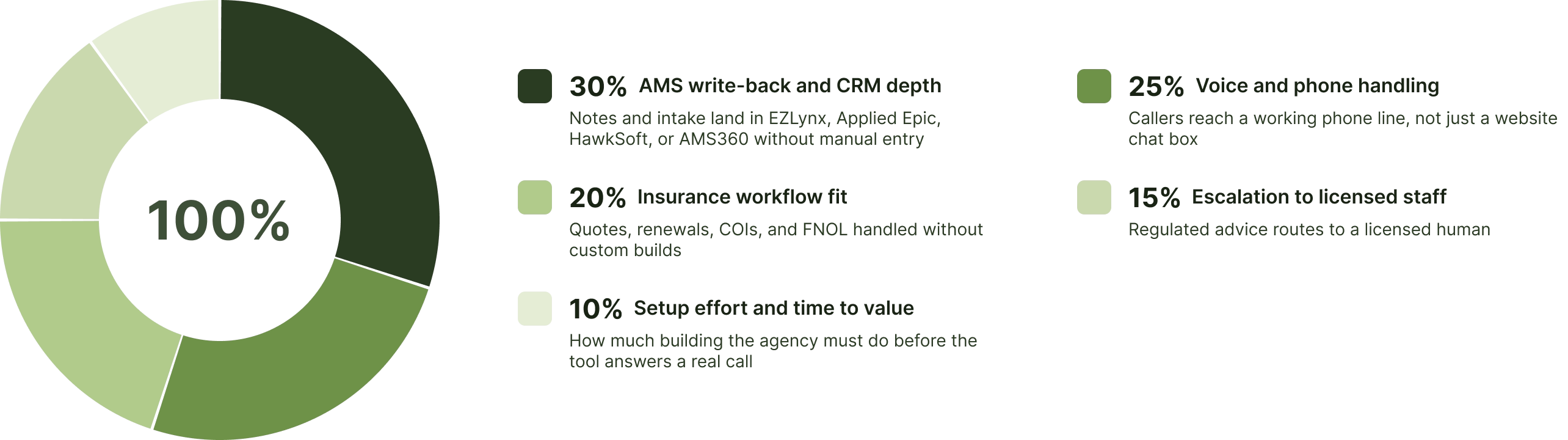
- AMS write-back and CRM depth (30%): whether the tool writes call notes and intake back to an AMS or CRM (customer relationship management system) like EZLynx, Applied Epic, HawkSoft, or AMS360, versus leaving you to build the integration.
- Voice and phone handling (25%): native inbound call answering, call routing, and telephony quality, versus chat-only or bring-your-own-telephony setups.
- Insurance workflow fit (20%): out-of-the-box handling of quotes, renewals, COI (certificate of insurance) requests, and FNOL triage.
- Escalation to licensed staff (15%): clean handoff to a human when a caller needs a licensed CSR (customer service representative) or producer.
- Setup effort and time to value (10%): how much building the agency must do before the tool answers a real call.
Weights total exactly 100%. The top weight sits on AMS write-back because it is the claim most vendors cannot demonstrate quickly.
The 6 best Dialogflow alternatives for insurance agencies
Each vendor below is real. Descriptions stay factual and general; specifics you should confirm with the vendor are marked.
1. Sonant - the insurance-native voice pick
Sonant is an AI voice receptionist built specifically for P&C insurance agencies. Unlike a horizontal builder, Sonant answers inbound calls, routes by intent, captures quote and service requests, handles after-hours volume, and writes notes back to your AMS, with escalation to licensed staff when a caller needs a human. It fits agencies that want calls answered and logged without building the insurance layer themselves. See where it sits among voice AI vendors evaluated for insurance agencies.
2. Voiceflow - visual conversation design
Voiceflow is a design platform for building chat and voice assistants with a visual, no-code-leaning canvas. It fits teams that want to prototype and manage conversation flows across channels. As with Dialogflow, the insurance workflows, telephony, and AMS write-back are things your team designs and connects.
3. Vapi - developer voice infrastructure
Vapi is a developer platform for building voice AI agents, giving engineering teams control over models, telephony, and call logic. It suits agencies with in-house developers who want to assemble a custom voice experience. It is infrastructure, not an insurance product, so expect to build intake and integrations.
4. Bland AI - programmable phone calls
Bland AI focuses on programmable AI phone calls for inbound and outbound use cases through an API. It fits technical teams comfortable wiring up their own flows. Insurance-specific routing, FNOL triage, and AMS write-back are yours to define.
5. Retell AI - voice agent API
Retell AI provides an API and tooling for building real-time voice agents, aimed at developers integrating voice into their own applications. It fits teams that want a voice layer inside a product they already run. Like the others in this tier, it does not ship insurance workflows.
6. Synthflow - no-code voice agents
Synthflow offers a no-code builder for creating voice AI agents and connecting them to phone numbers and tools. It fits agencies that want to configure a voice agent without heavy engineering. You still supply the insurance logic and confirm any AMS or CRM connections.
Dialogflow vs. the alternatives: a quick comparison
Dialogflow is capable and widely used, but it is a horizontal builder. The table compares how each option maps to agency needs. Treat feature specifics as items to confirm with each vendor.
For a wider survey of tools an agency might layer in, see our guide to AI tools for insurance agencies in 2026. If your priority is fewer dropped calls, our note on cutting missed calls at insurance agencies covers the operational case.
How Sonant fits
Among these Dialogflow alternatives, Sonant is the option built for the insurance phone workflow end to end: a caller reaches the line, Sonant identifies intent, captures the quote, service, or FNOL details, and writes a structured note back to the agency system, with a clean handoff to licensed staff when the caller needs one. The workflow is call → intent routing → AMS write-back → measured outcome (calls answered, notes logged, callbacks booked) → output your team can act on.
Sonant supports native AMS integrations including EZLynx, Applied Epic, HawkSoft, and AMS360, so intake does not sit in a separate inbox. When a caller needs regulated advice, Sonant escalates to a licensed CSR or producer rather than guessing. Wage and staffing context from the BLS occupational data helps agencies weigh what answering coverage costs in headcount, and NAIC guidance at content.naic.org frames how AI should be governed in an insurance setting. To see how this maps to your stack, start with our primer on voice AI for insurance operations and how an AI receptionist handles agency phone work.
Ready to compare the best Dialogflow alternatives against a tool built for your calls? Book a Sonant demo →
Related reading
- Answering insurance calls after hours without adding staff
- A wider survey of conversational AI across insurance operations
- How voice AI changes inbound handling for agencies
- The full 2026 catalog of AI tools for agencies
- What is an AI voice agent?
- 7 Best Kore.ai Alternatives for Insurance Agencies






.svg)


.svg)


