.svg)


.avif)
A P&C (property and casualty) agency misses 12–18% of inbound calls on a typical Friday. Half of those callers never call back. For a typical book, that translates to $1.4M–$2.1M of leaked new business and retention annually. Reducing missed calls at an insurance agency is not a technology problem - it is a routing problem solved by technology. This piece is the 30-day operations playbook for cutting missed-call rate below 3%. Most agencies do not have a lead problem; they have a missed-call problem, and the playbook below is what closes it.
Key Takeaways
- The industry baseline first-ring pickup runs 70–82% business hours, below 50% after 6 pm
- Voicemail callback failure runs 50–70%; every voicemail is a quiet churn risk
- Spanish handling at first ring closes 15–35% of pipeline in TX, CA, FL, AZ books
- AI overflow + after-hours coverage cuts missed-call rate below 3% within 30 days
- The 30-day playbook applies across personal lines and commercial books
Step 1: Measure the current missed-call rate
Most agencies do not know. They should. The metrics to capture for a 30-day baseline:
- First-ring pickup rate (% picked up within 5 seconds)
- Calls going to voicemail
- Calls abandoned in queue
- Spanish-speaker call abandonment
- After-hours call volume
- Weekend call volume
- Friday afternoon volume (highest-leak window)
Your phone system or AMS (agency management system)-attached call platform should report this. If it does not, you have a measurement problem before you have a missed-call problem.
Need a missed-call audit for your agency? → Talk to Sonant
The Sonant Consumer AI Readiness Report provides consumer-side data on what callers do when they hit voicemail or long waits.
Where overflow calls should go when your queue fills up
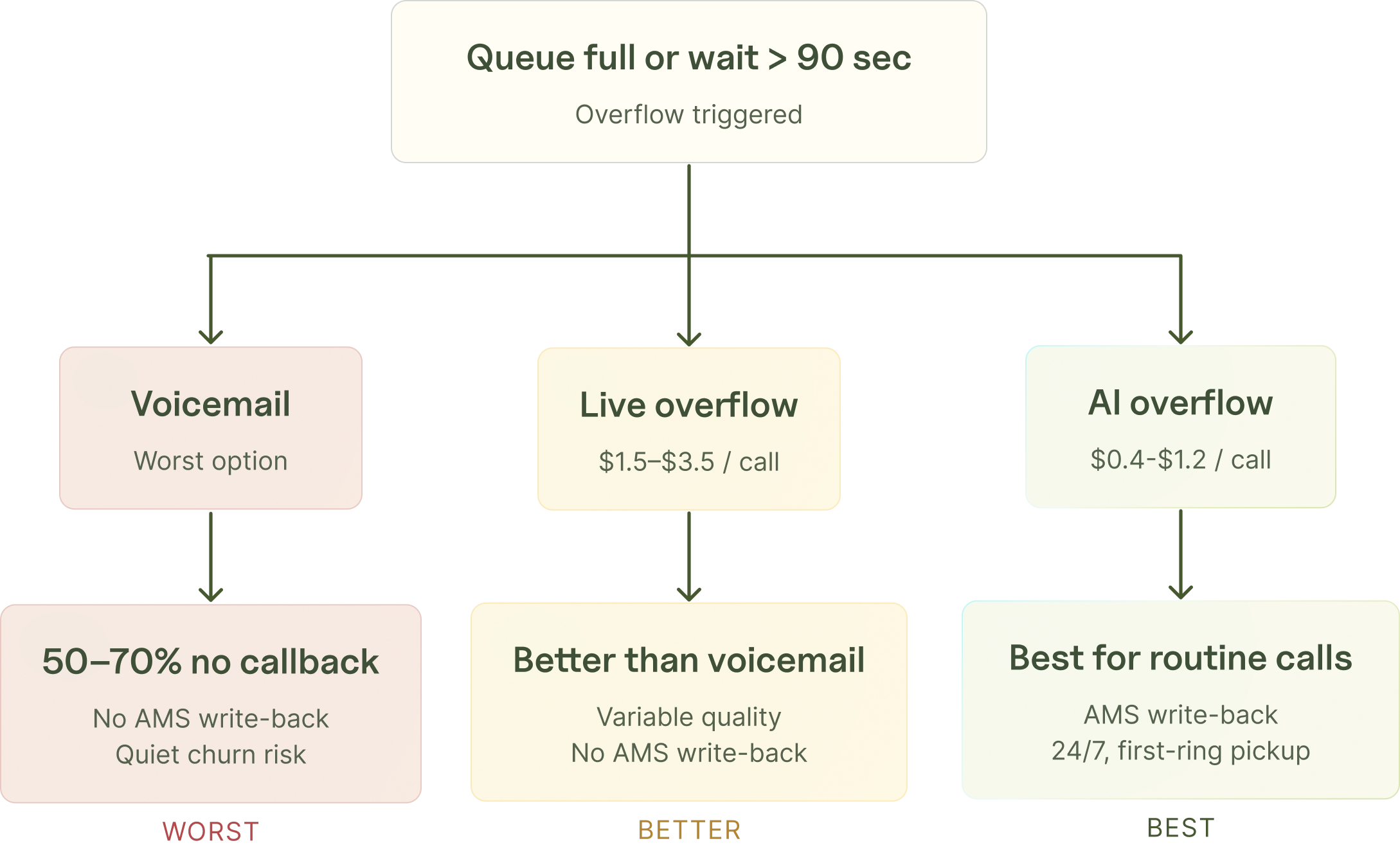
The three options when the queue is full or wait time exceeds 90 seconds:
Voicemail. Worst option. 50–70% of voicemail callers do not call back. Every voicemail is a quiet churn risk.
Live overflow service. Better. Per-call cost $1.50–$3.50. Quality varies. No AMS write-back.
AI overflow. Best for routine calls. Per-call cost $0.40–$1.20 with AMS write-back. 24/7. First-ring pickup consistency.
For most agencies, AI overflow as the primary safety net cuts missed-call rate below 3% within 30 days.
What weekend and night calls actually cost your agency
An agency typically loses 100% of weekend calls and 60–80% of weekday after-hours calls to voicemail. Hiring night-shift staff costs $30K–$45K per FTE in shift differentials. AI after-hours coverage runs 24/7 at the same per-call cost as daytime. For a 600 calls/day agency with 30% after-hours volume, the annual recovered premium runs $400K–$700K.
Why Spanish callers abandon at the first ring (and how to fix it)
For agencies in Texas, California, Florida, and Arizona, 15–35% of inbound calls are Spanish-speaking. Routing to a “press 2 for Spanish” line that goes to voicemail outside business hours kills new business. The right move is Spanish handling at first ring, 24/7, with native-speaker quality. Insurance-native AI platforms do this by default.
IVR vs AI front door
Traditional IVR (interactive voice response). “Press 1 for billing, 2 for claims, 3 for new quotes.” Frustrating. Caller abandonment rate 18–35% before reaching a person.
AI front door. Natural conversation. Caller says what they need. AI routes accordingly. Caller abandonment rate under 5%.
For agencies still running traditional IVR, the AI upgrade typically cuts missed-call rate 8–12 points within 30 days.
How many CSRs you would need to hit 95% first-ring pickup without AI
These numbers assume English-only, business hours only, no weekend coverage. Add 60–90% if 24/7 with Spanish. The CSR cost at 600 calls/day with 24/7 Spanish runs $1.4M–$2M annually. The AI alternative with the same coverage runs $80K–$180K.
Which vendor type fits which agency profile
Insurance-native AI receptionists. Sonant, Liberate, Cara. Best for the bulk of overflow and after-hours coverage. Native AMS write-back.
Hybrid live + AI services. Smith.ai, AnswerHero, AnswerConnect. Live US-based receptionists with AI overlay. Higher per-call cost; transparent pricing. Fit for agencies under 200 calls/day.
Offshore live answering. Lower cost ($1.50–$3.50) but no AMS write-back, accent variability, and per-call economics that do not scale to 24/7 well.
The 30-day plan to cut missed-call rate
Week 1 -measure. Baseline first-ring pickup, voicemail rate, abandonment, after-hours volume.
Week 2 -select vendor. Apply 5-question demo framework. Prioritize AMS write-back and Spanish handling.
Week 3 -pilot on overflow. Route the 15–20% of spilled calls to AI vendor. Do not touch primary flow.
Week 4 -measure improvement. Compare to baseline. Expand if metrics validate.
Day 30 -add after-hours and weekend coverage. Route 24/7 to AI. Voicemail goes away as the primary fallback.
Day 60 -move tier-1 servicing. COIs, billing, claim status handled by AI end-to-end. Live CSRs focus on complex.
Expected outcome by day 60: missed-call rate below 3%, AMS data quality up, after-hours quotes captured.
How Sonant cuts missed-call rate at retail agencies
Sonant handles overflow, after-hours, and primary first-ring pickup with native AMS write-back to EZLynx, Applied Epic, HawkSoft, AMS360, QQCatalyst, Momentum, AgencyZoom, and Zywave. Spanish at first ring, 24/7. The workflow: caller calls → Sonant answers within first ring → captures intent → resolves routine OR escalates complex → writes AMS note within 60 seconds. Output is the note that posts plus the recovered call that would have hit voicemail.
The 30-day path to a sub-3% missed-call rate
Measure the baseline, select a vendor with native AMS write-back and Spanish handling, pilot on overflow for 30 days, expand to after-hours and weekend coverage by day 60. Most P&C agencies running this playbook cut missed-call rate below 3% and recover $1M+ in previously-leaked premium annually.
Related reading
- 12 Ways to Improve Customer Service in Insurance Companies
- AI Voice Agents vs. Live Call Center Reps: What's Better?
- The Best AI Answering Services for Insurance Agencies in 2026
- 100 AI Tools for Insurance Agencies (2026 Guide)






.svg)

.svg)


