.svg)


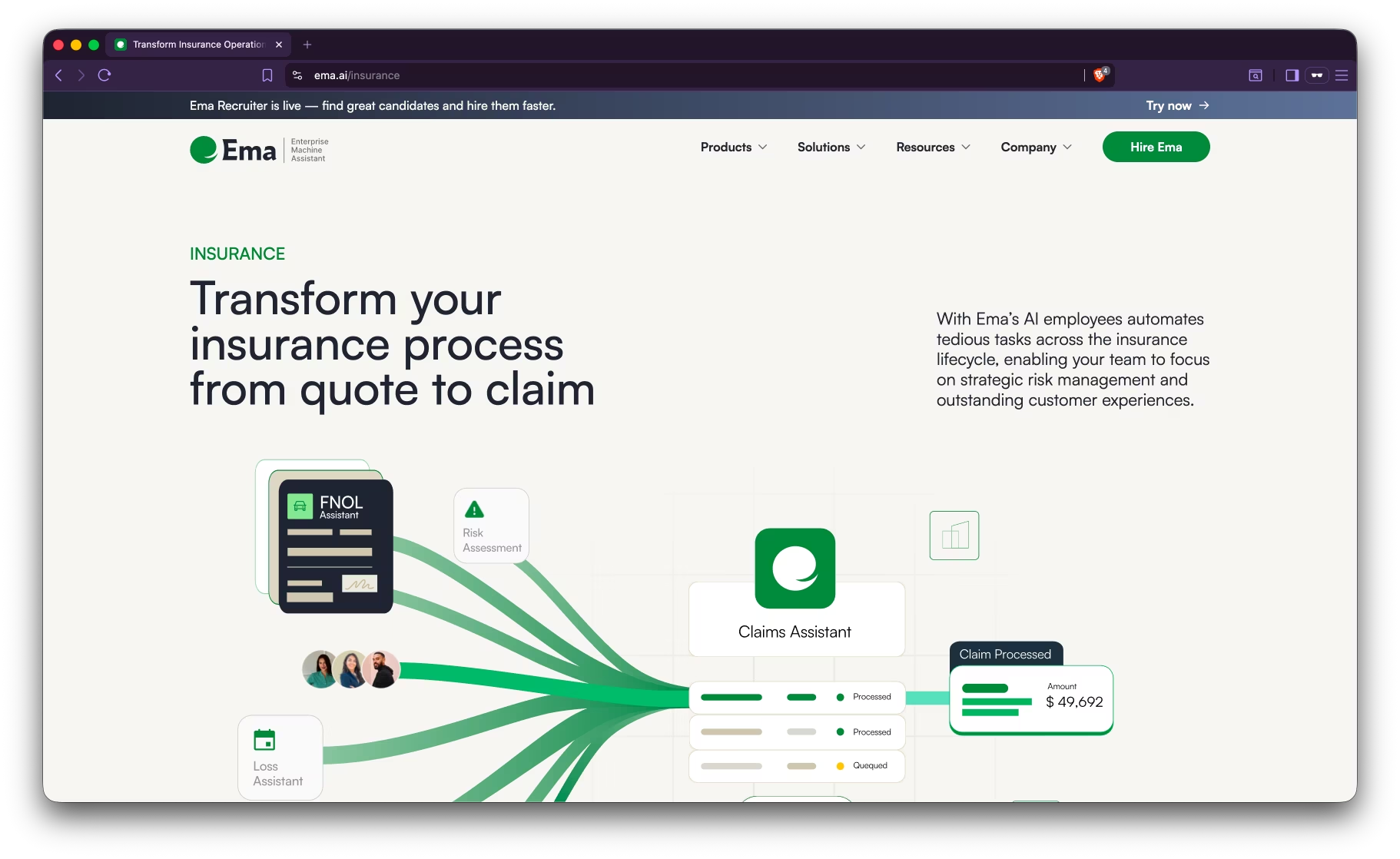
Ema is an enterprise “agentic” AI platform that builds cross-function AI employees, and for a P&C insurance agency the honest verdict is that it’s a genuine AI competitor built for the wrong scale - large, regulated enterprises, not independent agencies. This review covers what Ema does, what it costs, who it fits, and how it compares to insurance-native AI. The short version: Ema automates whole departments across enterprise systems, but it has no public pricing, an enterprise build, generic (non-P&C) training, and no retail-AMS connector - so an agency is better served by a purpose-built AI receptionist.
All facts below are sourced from Ema’s public materials and publicly available information.
Key takeaways
- What it is: enterprise agentic-AI platform building “AI employees” across HR, finance, sales, CS, and legal.
- Best for: large, regulated enterprises automating multiple departments across many systems.
- vs Sonant: true alternative, but horizontal/enterprise - not P&C-native.
- Watch-outs: no public pricing; enterprise deployment; no retail-AMS write-back.
- Bottom line: strong for enterprises; an agency wants a turnkey, insurance-native tool.
TL;DR
Ema is a “Universal Agentic Control Plane” for enterprises, founded in 2023, that builds and deploys AI agents across business functions, connecting to 200+ enterprise systems with on-premise and air-gapped deployment options.
Best for: global enterprises in regulated industries needing cross-function AI employees.
Less of a fit for: retail P&C agencies needing native AMS write-back (EZLynx, Applied Epic, HawkSoft, AMS360) or transparent public pricing.
Pricing: Not publicly listed.
Implementation: Custom enterprise; on-premise and air-gapped deployment available.
1. What is Ema?
Ema is an enterprise agentic-AI platform - a control plane for building AI “employees” that work across HR, finance, sales, customer support, and legal, connected to 200+ enterprise systems. It’s built for large, regulated organizations, with on-premise and air-gapped deployment options. That’s the opposite end of the market from an independent agency’s front desk.
2. Who uses Ema?
Ema’s public materials describe global enterprises across healthcare, financial services, legal, and technology. The typical user is a large organization automating entire functions - not an agency buying a receptionist. Its insurance relevance is as a horizontal enterprise platform, not a P&C-specific tool.
3. How much does Ema cost?
Ema’s pricing is not publicly listed - engagements are custom and enterprise-scoped. For an agency comparing options, that absence of pricing, combined with the enterprise feature set (air-gapped deployment, 100+ LLM orchestration), is itself a clear signal that the platform is sized well beyond a retail agency’s reception needs.
4. Key features
- EmaFusion (orchestration across 100+ LLMs)
- Generative Workflow Engine (GWE) for multi-agent workflows
- Enterprise Context Graph (permissioned memory)
- 200+ enterprise system integrations
- On-premise and air-gapped deployment
- ISO 42001, SOC 2 Type II, ISO 27001, HIPAA (per Ema)
Communication channels: multi-function AI employees across HR, finance, sales, CS, legal.
Conversation design: EmaFusion, Generative Workflow Engine, and Enterprise Context Graph.
Insurance terminology handling: cross-industry (not P&C-specific).
Feature breakdown
5. How long does it take to implement Ema?
Ema is a custom enterprise deployment, with on-premise and air-gapped options for regulated organizations - a project scoped to the enterprise, not a turnkey switch-on. The depth (cross-function agents, permissioned memory) is the point for a large buyer and the overhead for a small one.
6. What does Ema integrate with?
Ema connects to 200+ enterprise systems across functions. It does not list native connectors for retail P&C agency management systems, so linking it to EZLynx, Applied Epic, HawkSoft, or AMS360 would be a custom build. For native write-back, see AI receptionists built for agency AMS platforms.
7. Compliance and security
Ema reports a strong enterprise posture - ISO 42001, SOC 2 Type II, ISO 27001, and HIPAA, plus air-gapped deployment. That breadth suits regulated enterprise procurement; a SOC 2 Type II report plus ISO certifications is the documentation a large security review expects.
8. Pros and cons for insurance buyers
Pros:
- Cross-function automation - one platform for HR, finance, sales, CS, and legal agents.
- Model-flexible - EmaFusion blends 100+ LLMs to balance accuracy, cost, and latency.
- Heavy compliance, including air-gapped deployment for regulated data.
- Enterprise-grade governance and permissioned memory.
Cons / where it may fall short for retail P&C agencies:
- No public pricing and an enterprise deployment cycle.
- Generic (non-insurance) training; no native retail-AMS write-back.
9. When Ema fits an insurance buyer
Ema fits a large, regulated enterprise automating whole departments across many systems, with the resources to run an enterprise deployment. If you’re standardizing AI across functions at that scale, it’s a serious platform. The fit collapses at independent-agency scale.
10. Ema vs an insurance-native AI receptionist
For a retail P&C agency, Ema is the wrong tool: enterprise pricing and builds, generic training, and no AMS write-back. A purpose-built insurance receptionist answers your calls and documents them without an enterprise program. Sonant™ AI ships P&C training and native AMS integrations, deployed in under 30 days. See Sonant vs Ema and Best Voice AI Insurance Vendors.
Verdict
Ema is a serious enterprise AI-agent platform - for global, regulated enterprises automating entire departments. For a retail P&C agency it’s the wrong tool entirely: enterprise pricing and builds, generic training, and no AMS write-back. A purpose-built insurance receptionist answers your calls and documents them without an enterprise program.
Related reading
- Sonant™ vs Ema alternative
- Best Voice AI Insurance Vendors
- AI Receptionists for Insurance Agencies: Buyer’s Guide
- 100 AI Tools for Insurance Agencies (2026 Guide)
Disclaimer
Ema is a trademark of its respective owner. Sonant™ is not affiliated with or endorsed by the owner of Ema. This review was created using publicly available information about Ema and Ema’s public materials. We encourage readers to visit the official Ema website for the most current product information. Last verified: 2026-06-15.






.svg)


.svg)


