.svg)

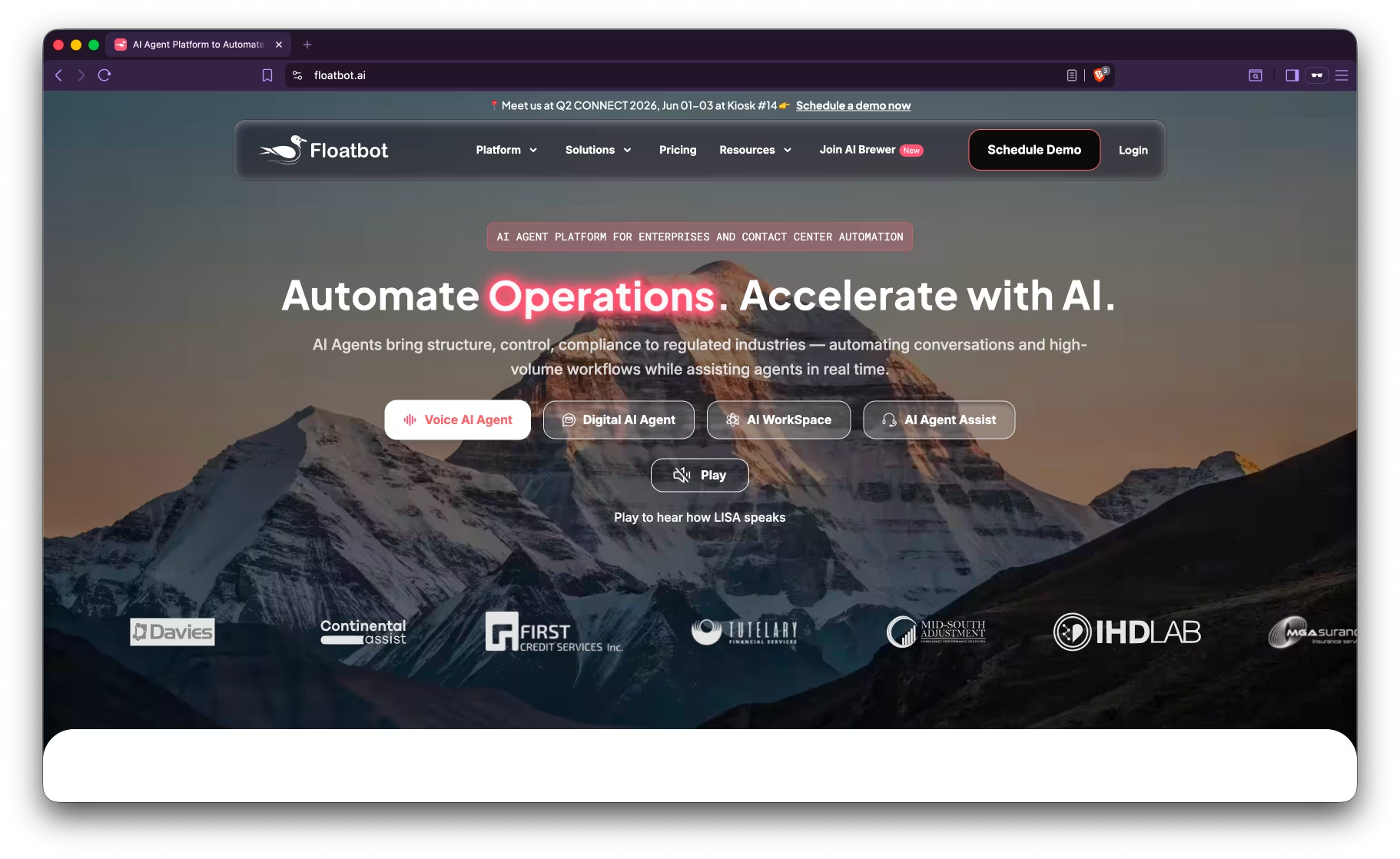
Floatbot is a multi-channel conversational-AI platform for insurance carriers and MGAs, and for a P&C agency the honest verdict is that it’s a genuine AI competitor aimed at the wrong side of the policy - the carrier and claims stack, not the retail agency front desk. This review covers what Floatbot does, what it costs, what it integrates with, and where it fits. The short version: Floatbot automates FNOL and claims for carriers, while an insurance-native AI receptionist answers agency calls and writes them into your AMS.
All facts below are sourced from Floatbot’s public materials and publicly available information.
Key takeaways
- What it is: multi-channel conversational AI for insurance carriers, MGAs, and TPAs (FNOL, claims, underwriting).
- Best for: carriers and claims departments automating FNOL at scale.
- vs Sonant: true alternative, but carrier/MGA-focused - not retail-agency-native.
- Watch-outs: integrations are carrier core systems, not retail AMS; carrier-scale orientation.
- Bottom line: strong for carriers; an agency wants an insurance-native receptionist with AMS write-back.
TL;DR
Floatbot is a multi-channel conversational-AI platform for insurance carriers, MGAs, and multi-industry enterprises, with specialized agents for claims FNOL and adjuster support. Founded in 2017, it integrates with carrier core systems and contact-center platforms.
Best for: insurance carriers, MGAs, TPAs, and claims departments automating FNOL and customer engagement.
Less of a fit for: retail P&C agencies needing native AMS write-back (EZLynx, Applied Epic, HawkSoft, AMS360).
Pricing: Starts at $99/month (Lite), up to $4,999/month (Growth); enterprise custom.
Implementation: Self-service no-code setup with enterprise support options.
1. What is Floatbot?
Floatbot is a multi-channel conversational-AI platform built for insurance carriers, MGAs, and TPAs, with specialized agents for claims FNOL (LISA), adjuster support (ADDI), underwriting (AURA), and customer service (LEXI). It integrates with carrier core systems - Insurity, Snapsheet, Duck Creek, Guidewire - and contact-center platforms. That carrier orientation is the fit question for an agency.
2. Who uses Floatbot?
Floatbot’s public materials describe a multi-industry buyer led by insurance carriers, MGAs, TPAs, banking, and collections. The typical insurance user is a carrier or claims operation automating FNOL and policyholder service at scale - not a retail agency answering quote and service calls.
3. How much does Floatbot cost?
Floatbot publishes tiered pricing from $99/month (Lite) up to $4,999/month (Growth), plus custom enterprise plans. That range spans small pilots to large deployments. For a retail agency, the more relevant cost is the build to make it agency-specific - Floatbot’s strength and integrations sit on the carrier side.
4. Key features
- Multi-channel AI (voice, SMS, WhatsApp, web chat, email)
- LISA: claims FNOL automation
- ADDI: digital adjuster support
- AURA: underwriting and distribution automation
- LEXI: customer service and billing automation
- 150+ language support
- SOC 2, ISO 27001, GDPR, HIPAA certified (per Floatbot)
Communication channels: voice, SMS, WhatsApp, web chat, email, Microsoft Teams.
Conversation design: no-code platform with specialized AI agents (LISA, ADDI, AURA, LEXI).
Insurance terminology handling: trained on carrier FNOL, claims, and underwriting terminology.
Feature breakdown
5. How long does it take to implement Floatbot?
Floatbot offers self-service no-code setup with enterprise support options, so timing depends on scope - a Lite pilot is fast, while a carrier-grade FNOL deployment is a larger project. For an agency, the work would include adapting carrier-oriented agents to agency workflows, which is where the fit weakens.
6. What does Floatbot integrate with?
Floatbot integrates with carrier core systems - Insurity, Snapsheet, Duck Creek, Guidewire - and contact-center platforms like Genesys, Five9, Cisco, and Avaya. It does not list native connectors for retail agency management systems (EZLynx, Applied Epic, HawkSoft, AMS360). For agency-side write-back, see AI receptionists built for agency AMS platforms.
7. Compliance and security
Floatbot reports SOC 2, ISO 27001, GDPR, and HIPAA - a strong posture appropriate for carrier deployments. A published SOC 2 report plus ISO certifications is the documentation carrier procurement expects.
8. Pros and cons for insurance buyers
Pros:
- Deep claims automation - purpose-built FNOL and adjuster-support agents.
- Carrier-grade integrations (Duck Creek, Guidewire, Insurity, Snapsheet).
- No-code build with broad omnichannel coverage.
- Strong compliance posture.
Cons / where it may fall short for retail P&C agencies:
- Integrations are carrier core systems, not retail AMS - no EZLynx/Epic/HawkSoft/AMS360 write-back.
- Carrier/MGA/TPA orientation rather than retail-agency reception.
9. When Floatbot fits an insurance buyer
Floatbot fits a carrier, MGA, or TPA automating FNOL, claims, and underwriting at scale, with carrier-system integrations already in place. If you’re on the carrier side of the policy, it’s a capable platform.
10. Floatbot vs an insurance-native agency AI receptionist
For a retail P&C agency, Floatbot is aimed at the wrong side: its integrations are carrier core systems, not your AMS. An agency wants P&C-trained answering that writes to EZLynx, Applied Epic, HawkSoft, or AMS360. Sonant™ AI is built for that - agency reception with native AMS write-back. See Sonant vs Floatbot and Best Voice AI Insurance Vendors.
Verdict
Floatbot is a strong conversational-AI platform - for carriers, MGAs, and TPAs running claims and underwriting at scale. For a retail P&C agency it’s aimed at the wrong side of the policy: its integrations are carrier core systems, not your AMS. If you’re a carrier, shortlist it; if you’re an agency, an insurance-native receptionist that writes to your AMS is the closer fit.
Related reading
- Sonant™ vs Floatbot alternative
- Best Voice AI Insurance Vendors
- AI Receptionists for Insurance Agencies: Buyer’s Guide
- 100 AI Tools for Insurance Agencies (2026 Guide)
Disclaimer
Floatbot is a trademark of its respective owner. Sonant™ is not affiliated with or endorsed by the owner of Floatbot. This review was created using publicly available information about Floatbot and Floatbot’s public materials. We encourage readers to visit the official Floatbot website for the most current product information. Last verified: 2026-06-15.





.svg)

.svg)
