.svg)


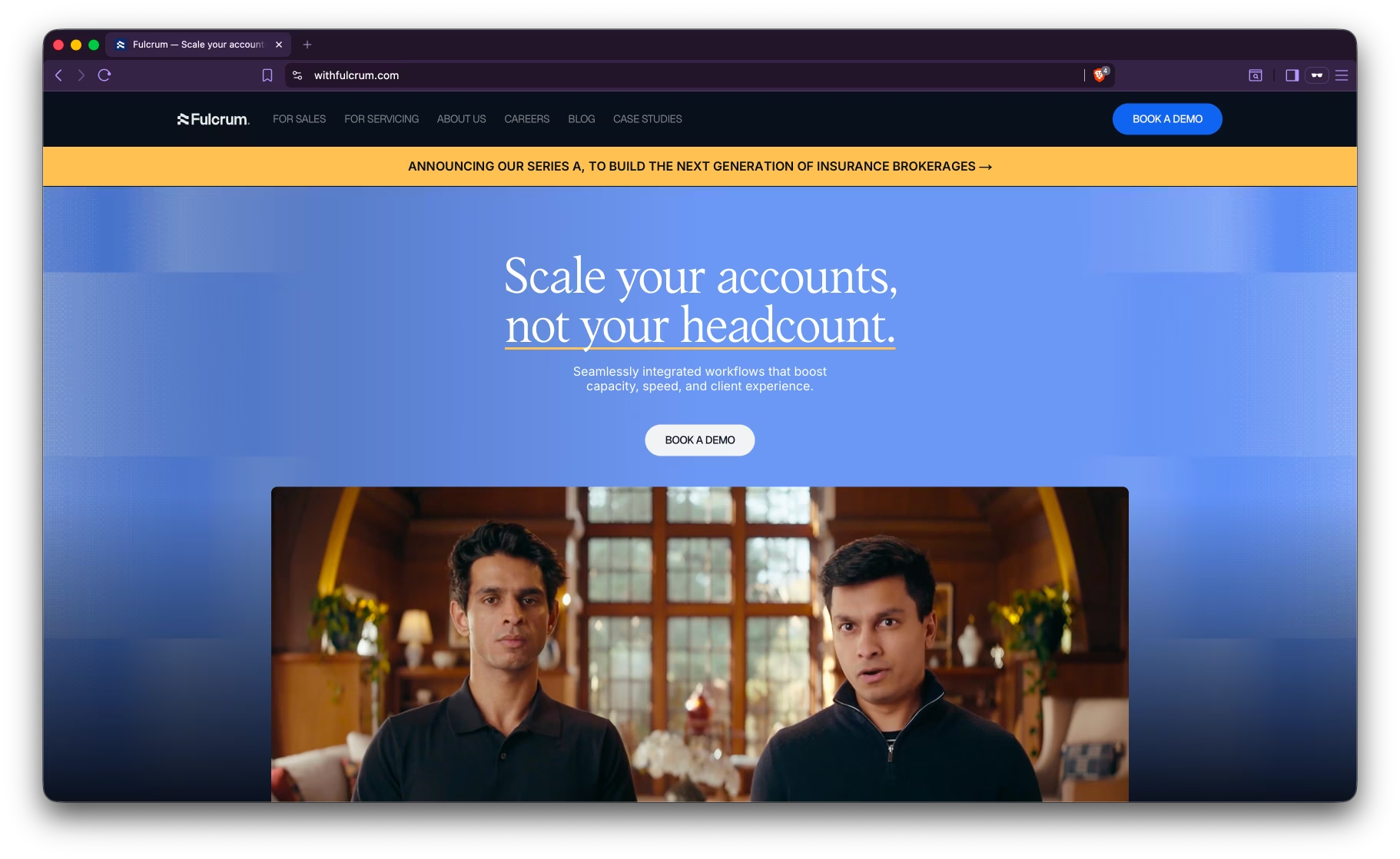
Fulcrum is an AI platform for insurance account managers at brokerages, and for a P&C agency the honest verdict is that it’s adjacent to - not the same as - an AI receptionist: it automates the document side of account management, not the phone. This review covers what Fulcrum does, what it costs, what it integrates with, and where it fits. The short version: Fulcrum reads policies and generates polished outputs, while an AI receptionist answers and documents inbound calls - different bottlenecks.
All facts below are sourced from Fulcrum’s public materials and publicly available information.
Key takeaways
- What it is: AI document/policy-checking platform for brokerage account managers.
- Best for: brokerages scaling account-manager capacity without more headcount.
- vs Sonant: adjacent / complementary - document-first AI vs voice-first AI.
- Watch-outs: no public pricing; it’s documents, not the phone.
- Bottom line: if policy-checking volume is the bottleneck, Fulcrum fits; if it’s the phone, that’s a voice-first job.
TL;DR
Fulcrum is an AI platform for insurance account managers that processes documents, detects subtle coverage changes across long (300+ page) policies, and generates proposals and certificates in minutes. It’s SOC-2 compliant and reports $25M in funding.
Best for: insurance brokerages needing to scale account-manager capacity without increasing headcount.
Less of a fit for: buyers wanting transparent public pricing, or anyone whose bottleneck is the phone.
Pricing: Not publicly listed (contact sales).
Implementation: Platform onboarding.
1. What is Fulcrum?
Fulcrum is an AI platform for account managers at brokerages: it reads policy documents, detects subtle coverage changes across long policies, and produces polished outputs - proposals, comparisons, certificates - in minutes. SOC-2 compliant, it reports it doesn’t train models on customer data. It’s a document tool, built to let account managers handle bigger books without more hires.
2. Who uses Fulcrum?
Fulcrum’s public materials describe insurance brokerages and account-management teams handling complex commercial policies. The typical user is buried in policy checking and renewals - a document problem, distinct from inbound phone volume, which is the distinction that decides fit.
3. How much does Fulcrum cost?
Fulcrum’s pricing is not publicly listed - you contact sales, and pricing is scoped to brokerages. For an agency that prefers transparency, that’s a hurdle. The cost covers document automation; capturing and documenting inbound calls is a separate need a voice-first AI receptionist fills.
4. Key features
- Policy checking with verbiage change detection
- Side-by-side year-over-year coverage analysis
- Proposal generation with flexible templates
- Certificate issuance
- Claims analysis
- Direct AMS integration
- SOC-2 compliant; data not used for model training (per Fulcrum)
Communication channels: document processing (no voice/phone).
Conversation design: AI document analysis with verbiage detection.
Insurance terminology handling: insurance-specific (complex commercial coverage).
Feature breakdown
5. How long does it take to implement Fulcrum?
Fulcrum onboards by connecting to your documents and AMS so it can read policies and generate outputs. As an account-manager tool it’s a configuration effort rather than a major project; the value is account managers carrying bigger books without proportional hiring.
6. What does Fulcrum integrate with?
Fulcrum reports direct AMS integration, though it doesn’t publish a detailed connector list. Because its strength is documents, it can complement a voice-first layer: an AI receptionist handles inbound calls and writes them to the AMS while Fulcrum handles policy checking and proposals.
7. Compliance and security
Fulcrum reports SOC-2 compliance and states it doesn’t use customer data for model training. A SOC 2 posture plus a no-training data commitment is reassuring for a tool processing complex policies; confirm the current report scope.
8. Pros and cons for insurance buyers
Pros:
- Catches what humans miss - verbiage-level change detection across complex policies.
- Year-over-year comparison for renewals.
- Scales account managers - bigger books without proportional hiring.
- SOC-2 compliant with a no-training-data commitment.
Cons / where it may fall short for retail P&C agencies:
- No public pricing - every quote requires a sales conversation.
- Document-side only - no inbound answering or lead capture.
9. When Fulcrum fits an insurance buyer
Fulcrum fits a brokerage that wants account managers handling bigger books without more hires - especially with complex commercial policies. If policy-checking and proposal volume is your constraint, it’s purpose-built for it.
10. Where Fulcrum and an AI receptionist differ
Fulcrum automates the document side of account management; an AI receptionist automates the phone side. If your constraint is policy-checking volume, Fulcrum fits. If it’s missed and after-hours calls, that’s a voice-first job. Many agencies run both. See Sonant vs Fulcrum and reducing manual workload.
Verdict
Fulcrum is a strong document-AI tool for brokerages that want account managers handling bigger books without more hires. It isn’t a phone tool - different bottleneck. Agencies whose real constraint is inbound call volume should pair it with a voice-first AI receptionist; many would run both.
Related reading
- Sonant™ vs Fulcrum alternative
- Best Voice AI Insurance Vendors
- AI Receptionists for Insurance Agencies: Buyer’s Guide
- 100 AI Tools for Insurance Agencies (2026 Guide)
Disclaimer
Fulcrum is a trademark of its respective owner. Sonant™ is not affiliated with or endorsed by the owner of Fulcrum. This review was created using publicly available information about Fulcrum and Fulcrum’s public materials. We encourage readers to visit the official Fulcrum website for the most current product information. Last verified: 2026-06-15.






.svg)


.svg)


