.svg)


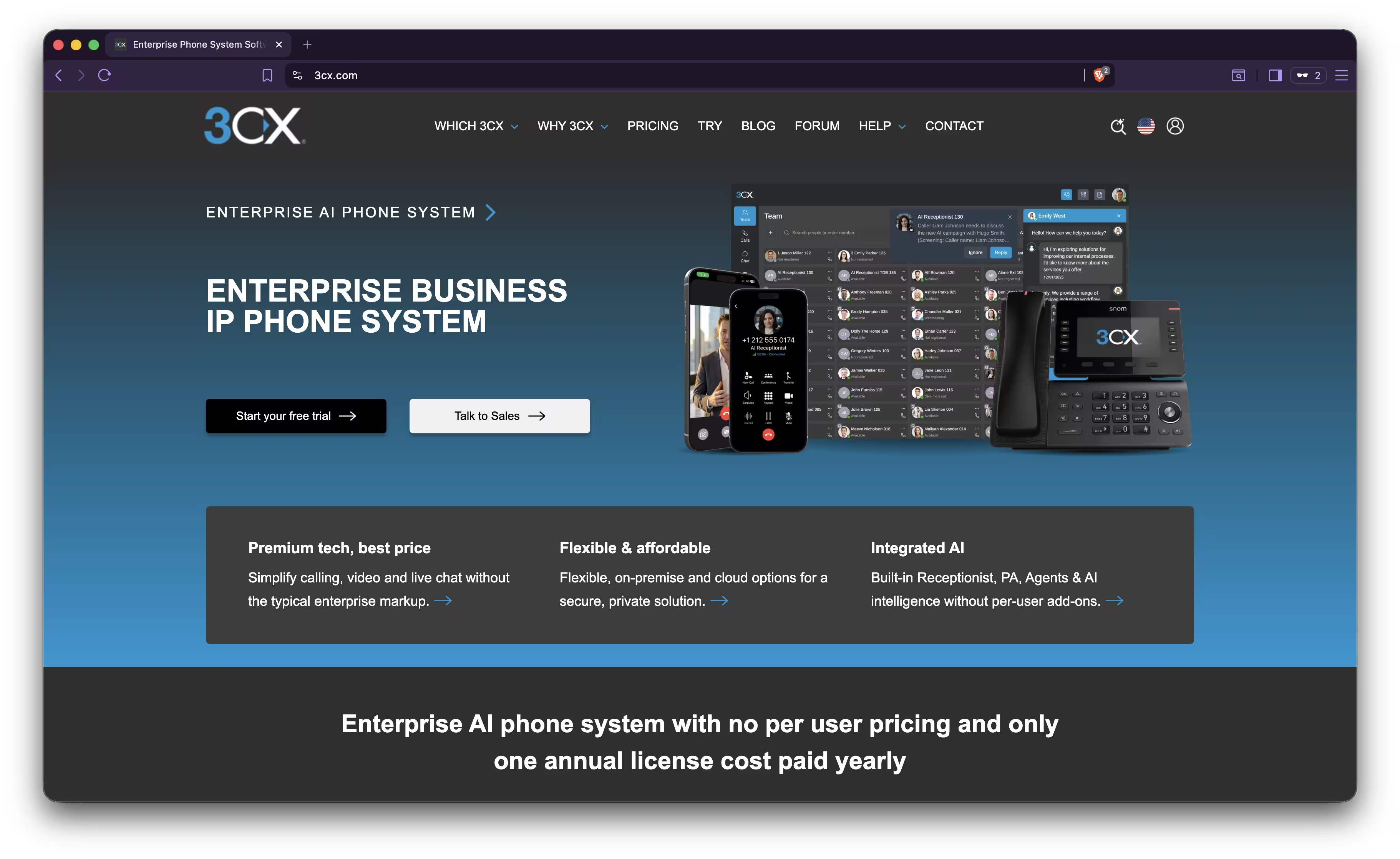
3CX is self-hosted IP PBX software - the phone system itself, run on-premise or in your own cloud - and for a P&C insurance agency the honest verdict is that it’s infrastructure, not an answer to the front desk. This review covers what 3CX costs, how it’s deployed, what it integrates with, and the kind of agency it actually fits. The short version: 3CX gives you dial tone and call routing with full control if you have the IT to run it, but it carries no insurance training and no agency-AMS write-back - so most agencies pair it with an AI receptionist that answers, qualifies, and documents calls.
All facts below are sourced from 3CX’s public materials and publicly available information.
Key takeaways
- What it is: self-hosted IP PBX / business phone software (horizontal, all industries).
- Best for: organizations that want to own and self-host their phone system and have IT to run it.
- vs Sonant: complementary - 3CX is the phone layer; Sonant is the AI that answers on it.
- Watch-outs: requires IT for setup and maintenance; no insurance training; no native AMS write-back.
- Bottom line: keep 3CX (or any PBX) as the dial tone and add an AI receptionist for the calls.
TL;DR
3CX is enterprise IP PBX software you can self-host on-premise, in your own cloud, or on 3CX-hosted infrastructure. Pricing is based on simultaneous calls rather than users, starting from $350/year for the system.
Best for: organizations wanting self-hosted control, businesses with IT resources, agencies needing a customizable PBX backbone.
Less of a fit for: agencies that want calls answered and qualified out of the box, or native write-back to EZLynx, Applied Epic, HawkSoft, or AMS360.
Pricing: From $350/year per system (by simultaneous calls).
Implementation: Self-managed; requires IT resources.
1. What is 3CX?
3CX is self-hosted IP PBX software - the phone system that runs your lines, extensions, and call routing. You can host it on-premise, in your own cloud, or on 3CX’s infrastructure, and higher tiers add an optional AI-receptionist add-on and transcription. It serves businesses in any industry that want full control of their telephony, with no insurance-specific capability built in.
2. Who uses 3CX?
3CX’s public materials describe a horizontal buyer: businesses across all industries that want self-hosted control of their phone system. There’s no insurance specialization. For P&C agencies, that means 3CX is a general telephony backbone - the kind of tool an agency with internal IT might choose for the lines, then layer insurance-specific answering on top.
3. How much does 3CX cost?
3CX prices by simultaneous calls rather than per user, starting around $350/year for the system, with PRO and Enterprise editions above that. For an agency the model can be cost-effective as you grow, but the figure covers the phone system only - not an AI answering layer, insurance training, or AMS integration, each of which is a separate consideration.
4. Key features
- Self-hosted PBX software (on-premise, your cloud, or 3CX-hosted)
- Per-system pricing from $350/year (not per user)
- PRO and Enterprise editions
- Video conferencing up to 100 participants
- Microsoft 365 and general CRM integrations
- Optional AI-receptionist add-on (generic, not insurance-trained)
- Windows, Linux, and cloud hosting options
Communication channels: voice, video, SMS, chat.
Conversation design: IVR, auto-attendant, optional AI receptionist add-on.
Insurance terminology handling: none.
Feature breakdown
5. How long does it take to implement 3CX?
3CX is self-managed: you (or your IT resource) handle hosting, SIP-trunk configuration, setup, and ongoing maintenance. There’s no fixed vendor timeline - the work scales with your infrastructure and skills. Agencies without dedicated IT should weigh that overhead against turnkey options that deploy as configuration rather than an infrastructure project.
6. What does 3CX integrate with?
3CX connects to general business tools - Microsoft 365 and generic CRMs such as Salesforce, HubSpot, Zendesk, and Zoho - through plugins. It does not list native connectors for retail P&C agency management systems (EZLynx, Applied Epic, HawkSoft, AMS360), so call data won’t post into your book automatically. For context on why that matters, see AI receptionists that integrate with HawkSoft and Applied Epic.
7. Compliance and security
3CX’s security posture depends on how you host it - on-premise, your own cloud, or 3CX-hosted - so compliance is largely your responsibility rather than a published attestation. For an agency handling policyholder data, that differs from vendors that publish SOC 2 reports you can point to during a security review.
8. Pros and cons for insurance buyers
Pros:
- Per-system pricing (by simultaneous calls, not per seat) can scale economically.
- You own the infrastructure - full control of hosting, routing, and data residency if you have IT.
- Standard PBX feature set: IVR, auto-attendant, routing, video, SMS in one system.
- Optional AI add-on exists in higher tiers.
Cons / where it may fall short for retail P&C agencies:
- No native connectors for major retail P&C AMS platforms (EZLynx, Applied Epic, HawkSoft, AMS360, QQCatalyst, Momentum).
- Requires IT resources to deploy and maintain; the bundled AI is generic, not insurance-trained.
9. When 3CX fits an insurance buyer
3CX fits an agency that wants to own and self-host its phone infrastructure, has IT to manage it, and values control over turnkey simplicity. If you run multiple locations and want a customizable PBX - and you’re treating call answering as a separate layer - 3CX can be a sound backbone for the lines themselves.
10. Where 3CX leaves a gap for retail insurance agencies
3CX gives you dial tone and routing; it doesn’t answer insurance calls, qualify callers, or write notes into your AMS. That’s the gap for a retail agency. Tools built for agency-side workflows fill it: Sonant™ AI, for example, is purpose-built for retail P&C agencies with native integrations to EZLynx, Applied Epic, HawkSoft, Momentum, QQCatalyst, AMS360, AgencyZoom, and Zywave, deployed in under 30 days. Compare the two directly in Sonant vs 3CX, or see the field in Best Voice AI Insurance Vendors.
Verdict
3CX fits agencies that want to own and self-manage their phone infrastructure and have the IT to do it. What it isn’t is an answer to the front-desk problem: it routes calls, it doesn’t handle them, and nothing it captures lands in EZLynx, Applied Epic, HawkSoft, or AMS360. Most agencies run a PBX like 3CX as the dial tone and put an insurance-trained AI receptionist on top to actually answer, qualify, and document the call - see how to stop missing calls for why that layer matters.
Related reading
- Sonant™ vs 3CX alternative
- Best Voice AI Insurance Vendors
- AI Receptionists for Insurance Agencies: Buyer’s Guide
- 100 AI Tools for Insurance Agencies (2026 Guide)
Disclaimer
3CX is a trademark of its respective owner. Sonant™ is not affiliated with or endorsed by the owner of 3CX. This review was created using publicly available information about 3CX and 3CX’s public materials. We encourage readers to visit the official 3CX website for the most current product information. Last verified: 2026-06-15.






.svg)


.svg)


