.svg)

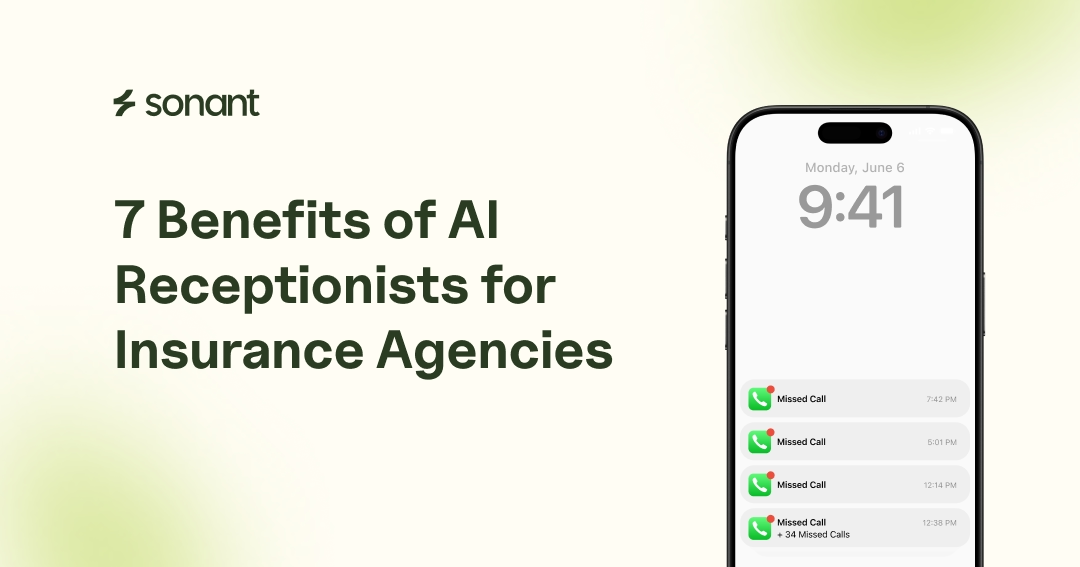
An AI receptionist for insurance agencies does seven things a live front-desk hire structurally cannot do at the same cost or consistency. These are not “benefits” in the marketing sense. They are operational differences that show up in the AMS (agency management system) within 30 days of deployment. This piece is the 7 differences ranked by measurable agency impact, with the workflow detail behind each one. An AI receptionist should not replace licensed insurance staff. It should protect their time – and that is what the seven differences below are actually about.
Key Takeaways
- AI does what a live hire cannot at the same per-call cost – not what a live hire does better
- The 7 differences cluster around first-ring pickup, AMS write-back, 24/7 coverage, Spanish, and scale economics
- The dollar impact compounds – recovered after-hours premium plus reduced CSR (customer service rep) interruption
- Live hires still win on empathy-heavy conversations and complex commercial servicing
- The hybrid model (AI + live escalation) is the practical 2026 default
The data hook
The Agents Council for Technology (ACT) reports retail P&C agencies miss 12–18% of inbound calls on a typical Friday. McKinsey research shows first-call response speed is the largest single predictor of bind rate in personal lines. J.D. Power’s 2024 insurance satisfaction study identified first-ring pickup as the top NPS driver at independent agencies.
That is why agency operations leaders are looking at AI receptionists not as a “feature stack” but as a structural shift in what the front-desk role can do. The Sonant Consumer AI Readiness Report confirms the consumer-side data: policyholders rate the AI-handled experience favorably on the dimensions that drive retention.
How we ranked the 7 differences
We compared what AI does that a live hire cannot do at the same cost or consistency. Each item below is ranked by:
1. First-ring pickup above 95% across 24/7
A live hire works business hours. AI works first-ring pickup across all hours at the same per-call cost. Dollar impact: $1.4M–$2.1M in recovered premium at typical book mix.
2. Native AMS write-back within 60 seconds of the call ending
A live hire transcribes notes manually, often hours later. AI posts the note natively to EZLynx, Applied Epic, HawkSoft, AMS360, QQCatalyst, Momentum, AgencyZoom, or Zywave within 60 seconds. Impact: 30–60 CSR (customer service rep) hours per month recovered from transcription work.
3. Spanish handling at first ring with native-speaker quality
A live hire requires bilingual staff to handle Spanish callers – hard to hire, variable quality. AI handles Spanish at first ring 24/7. Impact: 15–35% pipeline recovery in TX, CA, FL, AZ books.
See what this looks like in your AMS → Talk to Sonant
4. Per-call economics that scale to 2,000+ calls/day
A live hire costs $45K–$60K fully loaded plus 2–3× for night shifts. AI runs $0.40–$1.20 per call across any volume. Impact: at 600 calls/day, $200K–$500K annual savings.
5. Consistent escalation routing on the appetite-aware quote intake
A live hire’s appetite knowledge varies by tenure. AI runs appetite checks against the agency’s binding-class carriers consistently. Impact: 30–50% reduction in producer time wasted on quotes that were never going to bind.
6. Voicemail backlog elimination
A live hire creates voicemail backlog during busy windows. AI does not. Voicemail callback failure runs 50–70%; eliminating the backlog removes that loss. Impact: retention +1–2 points.
7. Follow-up completion tracking at the workflow layer
A live hire’s follow-up completion depends on memory and notes. AI triggers follow-up workflows the moment the AMS note posts. Impact: follow-up completion rate from ~70% to 95%+.
What an AI receptionist does not do better than a live hire
Empathy-heavy conversations (claim denials, total losses, business closures), complex commercial servicing on bespoke accounts, and high-value account work for the top 10–20% of book. Live hires still win those. The right deployment is hybrid: AI runs the routine, live handles the complex.
How Sonant covers all 7 differences
Sonant lifts first-ring pickup above 95% (1), writes natively to the major AMS platforms within 60 seconds (2), handles Spanish at first ring (3), runs per-call economics that scale (4), runs appetite-aware quote intake (5), eliminates voicemail backlog (6), and triggers follow-up workflows on AMS note post (7). The workflow: caller calls → Sonant answers → captures intent → resolves or escalates → writes AMS note → triggers follow-up. Output is the AMS-attached note plus the appointment booked plus the follow-up sequence started.
How to test these 7 in a 30-day pilot
Route the 15–20% of calls currently spilling to voicemail or wait times over 90 seconds to AI for 30 days. Measure first-ring pickup, AMS write-back accuracy, Spanish-speaker capture, and follow-up completion. After 30 days, the data tells whether to expand. Most agencies running this pilot expand to full coverage within 60 days.
Ready to test the 7 differences in a 30-day pilot? Book a Sonant™ demo →
Related reading
- The Best AI Receptionists for Insurance Agencies in 2026
- How to Start with AI in Your Insurance Agency
- AI Voice Agents vs. Live Call Center Reps: What's Better?
- 100 AI Tools for Insurance Agencies (2026 Guide)






.svg)

.svg)


