.svg)


Cover Desk staffs insurance agencies with office-based virtual assistants, and for a P&C agency the honest verdict is that it’s a genuine alternative for servicing and judgment work - but a per-seat, business-hours model rather than flat-cost, 24/7 automation. This review covers what Cover Desk offers, how it’s priced, how it onboards, and where it fits. The short version: Cover Desk’s trained people handle policy servicing and quoting, while an AI receptionist answers every call around the clock at flat cost.
All facts below are sourced from Cover Desk’s public materials and publicly available information.
Key takeaways
- What it is: insurance virtual-assistant / BPO staffing (office-based VAs, business hours).
- Best for: agencies needing dedicated human staff for servicing, quoting, billing, and admin during business hours.
- vs Sonant: alternative - business-hours human VAs vs flat-cost, 24/7 AI answering.
- Watch-outs: not 24/7; per-seat cost; no native AMS write-back.
- Bottom line: use VAs for daytime servicing; use AI for around-the-clock phone coverage.
TL;DR
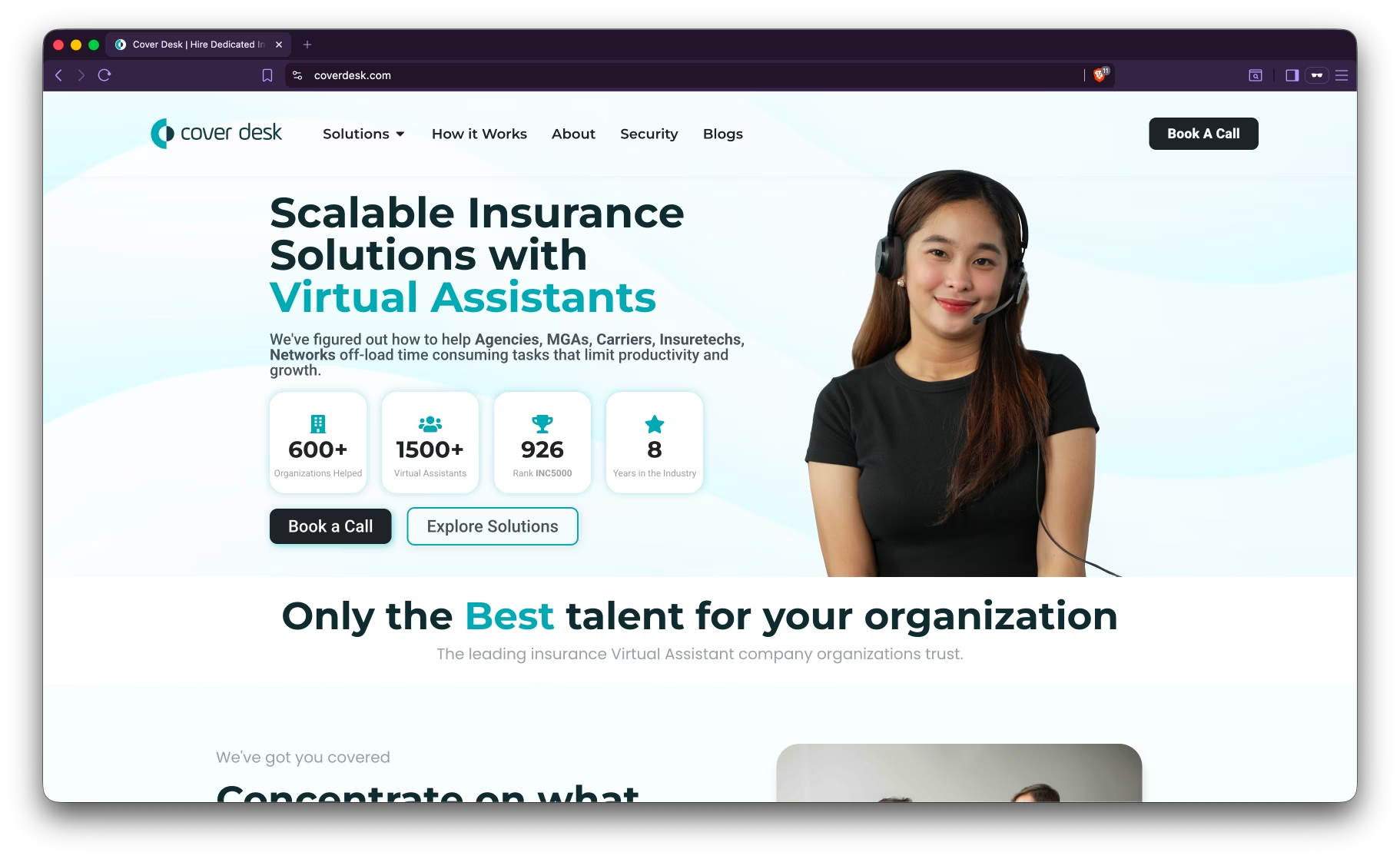
Cover Desk is an Austin-based insurance virtual-assistant company, founded in 2018, that places office-based VAs with insurance agencies. Cover Desk reports 1,500+ VAs serving 600+ insurance organizations, with bilingual Spanish support from a Monterrey team.
Best for: agencies needing dedicated human staff for policy servicing, quoting, billing, and admin during business hours.
Less of a fit for: buyers wanting transparent public pricing, a 30-day turnkey deployment, or 24/7 coverage.
Pricing: Contact-based; on-demand requires a setup fee and minimum commitment.
Implementation: 2–3 weeks onboarding; the client participates in hiring.
1. What is Cover Desk?
Cover Desk staffs insurance agencies with office-based virtual assistants - Cover Desk reports 1,500+ VAs serving 600+ organizations, with VAs from the Philippines and bilingual Spanish support from Monterrey. VAs complete a two-week insurance training program and work during your agency’s office hours, with deep Vertafore-product familiarity.
2. Who uses Cover Desk?
Cover Desk’s public materials describe insurance organizations - agencies, MGAs, carriers, insurtechs, and networks - that want dedicated, insurance-trained staff without direct hiring. The typical user needs daytime servicing and quoting capacity, especially on Vertafore systems, rather than after-hours phone coverage.
3. How much does Cover Desk cost?
Cover Desk uses contact-based pricing, with on-demand services requiring a setup fee and minimum commitment, so there’s no public rate card. The model is per-seat: cost scales with the number of VAs. Budget for it as managed headcount rather than a flat software fee, and expect a sales conversation to scope it.
4. Key features
- Office-based human virtual assistants (1,500+ VAs serving 600+ organizations)
- Personal and commercial lines training (2-week program)
- Vertafore product specialization
- Secure access via Cover Desk Cloud
- 2–3 week implementation
- Spanish bilingual support (Monterrey team)
- Licensed and unlicensed options
Communication channels: human staff handling calls, email, and policy servicing.
Conversation design: human virtual assistants with insurance training (not AI).
Insurance terminology handling: personal and commercial lines training.
Feature breakdown
5. How long does it take to implement Cover Desk?
Cover Desk reports 2–3 weeks of onboarding, with the client participating in the hiring process and VAs completing a two-week training program. That’s reasonable for a staffing engagement. The ongoing trade-off is that a VA is a person you manage and scale by headcount, working set hours rather than around the clock.
6. What does Cover Desk integrate with?
Cover Desk’s VAs work within your existing systems - Vertafore products (AMS360, QQCatalyst, BenefitPoint, ImageRight, Sagitta), plus EZLynx, HawkSoft, Applied Epic, Partner XE, TAM, and QuickBooks - via training rather than native software connectors. Documentation depends on the person, unlike an AI receptionist that writes calls into the AMS automatically.
7. Compliance and security
Cover Desk reports secure system access via its proprietary Cover Desk Cloud, plus background checks. For an agency granting staff access to policyholder data, confirm the specifics and ask whether a SOC 2 report is available as part of your review.
8. Pros and cons for insurance buyers
Pros:
- Insurance-trained, dedicated humans with Vertafore specialization.
- Bilingual Spanish support from the Monterrey team.
- Handles judgment-heavy work (servicing, quoting, claims tasks) an AI won’t.
- Secure access via Cover Desk Cloud.
Cons / where it may fall short for retail P&C agencies:
- Not 24/7 - VAs work agency office hours; coverage scales with headcount.
- Per-seat cost and a multi-week start; no native AMS write-back.
9. When Cover Desk fits an insurance buyer
Cover Desk fits an agency that needs insurance-trained people for daytime servicing and quoting, especially on Vertafore systems. If your constraint is back-office and business-hours capacity rather than after-hours phone coverage, it’s a strong, insurance-specific staffing option.
10. Cover Desk vs an AI receptionist for retail agencies
Where Cover Desk differs from an AI receptionist is the phone: VAs answer one call at a time, during business hours, at per-seat cost, with no native AMS write-back. Agencies whose bottleneck is after-hours and overflow call volume often pair Cover Desk (back office) with AI (the phone). Sonant™ AI answers every call 24/7 and writes it to your AMS. See Sonant vs Cover Desk and answering service vs virtual assistant.
Verdict
Cover Desk is a strong fit when you need insurance-trained people for servicing and judgment-heavy work, especially on Vertafore systems. Where it differs from an AI receptionist is the phone: VAs answer one call at a time, during business hours, at per-seat cost. Agencies losing after-hours and overflow calls often pair Cover Desk for the back office with flat-cost AI for the phone.
Related reading
- Sonant™ vs Cover Desk alternative
- Best Voice AI Insurance Vendors
- AI Receptionists for Insurance Agencies: Buyer’s Guide
- 100 AI Tools for Insurance Agencies (2026 Guide)
Disclaimer
Cover Desk is a trademark of its respective owner. Sonant™ is not affiliated with or endorsed by the owner of Cover Desk. This review was created using publicly available information about Cover Desk and Cover Desk’s public materials. We encourage readers to visit the official Cover Desk website for the most current product information. Last verified: 2026-06-15.





.svg)

.svg)
