.svg)

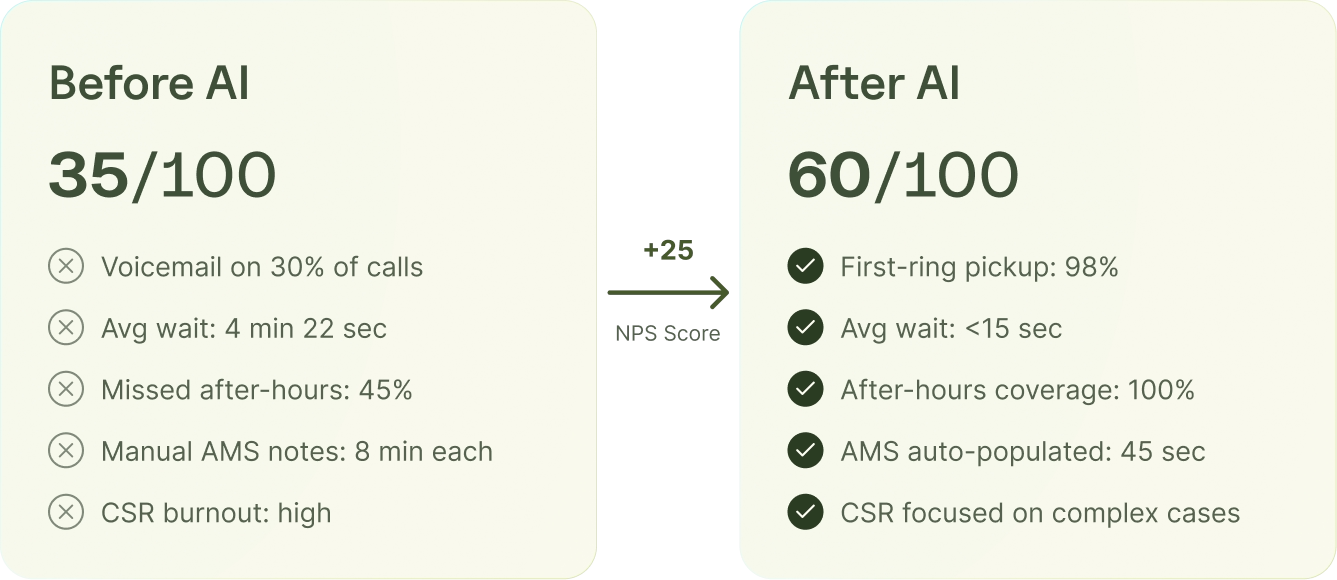
Customer service at an insurance agency is measured at the call layer first and the renewal layer second. NPS (net promoter score) moves with first-ring pickup rate, response time, and follow-up completion – not with brand messaging. This piece ranks the 12 customer service improvements that actually shift NPS and retention at P&C (property and casualty) agencies in 2026, scored by impact on measurable metrics and effort to implement. If your team only sees the calls that were answered, you are not seeing the full front-desk problem – and the service gap usually starts there.
Key Takeaways
- First-ring pickup rate is the single largest driver of NPS at retail insurance agencies
- Voicemail backlog correlates inversely with retention – every voicemail left is a small churn risk
- Spanish handling at first ring lifts NPS 5–10 points in Texas, California, Florida, Arizona books
- The 12 moves below sequence into a 6-month service improvement roadmap
- AMS (agency management system) write-back at the call layer is the prerequisite for every other improvement
The data hook
Bain research on NPS in financial services shows a 7+ point lift drives 12–15% retention improvement. J.D. Power’s 2024 insurance satisfaction study identified first-ring pickup rate as the top driver of policyholder NPS at independent agencies. The Agents Council for Technology (ACT) reports the industry baseline at 70–82% during business hours, dropping below 50% after 6 pm.
That is why agency operations leaders are focused on the call layer first when they set out to improve customer service in insurance companies. The Sonant Consumer AI Readiness Report provides additional consumer-side data showing how policyholders rate AI-handled service against live service across the dimensions that matter most.
How we ranked the 12 moves
Evaluating customer service moves cleanly is harder than the naive approach. You cannot just count NPS deltas. You have to look at whether the move shifts the underlying metric (first-ring pickup, response time, follow-up completion) and at what cost.
1. Move first-ring pickup above 95%
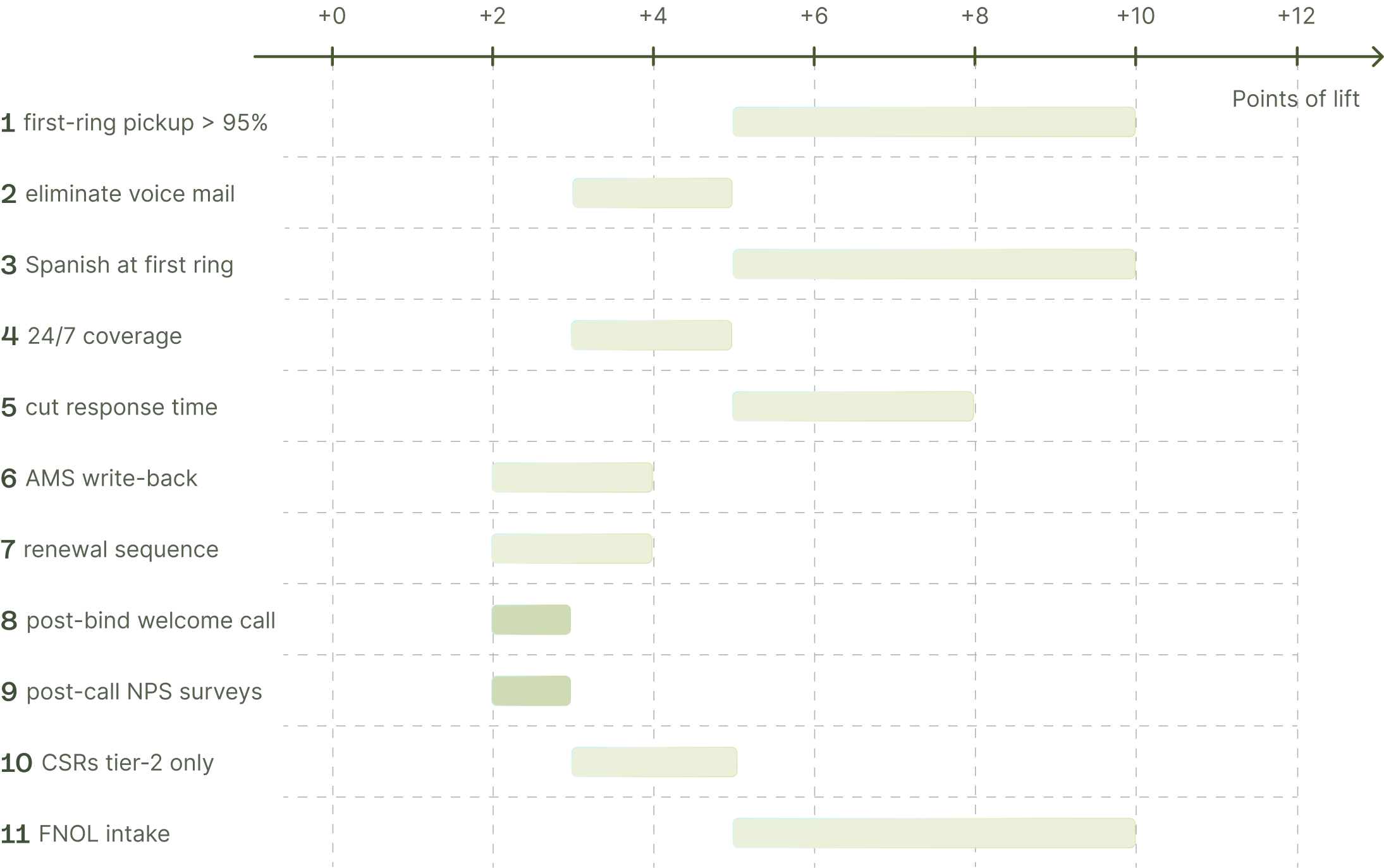
The largest single NPS lever. Industry baseline 70–82% business hours, below 50% after hours. Lift: NPS +5–10. Cost: AI receptionist at $80K–$180K annual. Payback: under 6 months.
2. Eliminate voicemail backlog
Voicemail callback failure runs 50–70%. Every voicemail left is a small churn risk. Lift: NPS +3–5. Cost: included in AI deployment.
3. Add Spanish at first ring
15–35% of inbound in TX, CA, FL, AZ. Spanish callers abandoning at the IVR (interactive voice response) account for measurable churn. Lift: NPS +5–10 in affected markets.
Want to fix the top 3 NPS levers in one deployment? → Talk to Sonant
4. Run 24/7 inbound coverage
Most agencies lose 100% of weekend calls. Lift: NPS +3–5.
5. Cut response time on service requests from hours to seconds
AI handles routine COIs (certificates of insurance), billing, claim status at the call layer. Lift: NPS +5–8.
6. Force AMS write-back at the call layer
Every interaction logged, time-stamped, attached to the right account. Lift: NPS +2–4 (compound, not immediate).
7. Automate the 90/60/30-day renewal sequence
Most renewal interactions go untouched. Lift: Retention +2–4 points.
8. Run the post-bind welcome call within 48 hours
Personal lines automation is mature. Lift: Retention +2–3 points, cross-sell hit rate +15–25%.
9. Send NPS surveys post-call automatically
Closes the feedback loop before issues compound. Lift: NPS +2–3.
10. Train CSRs (customer service reps) on tier-2 only
AI absorbs tier-1. CSRs focus on complex servicing. Lift: NPS +3–5 (CSR attention quality up).
11. Standardize FNOL (first notice of loss) intake
ACORD (industry data standard) form filled automatically, routed to the carrier portal. Lift: Claim-experience NPS +5–10.
12. Audit the top 50 churn calls quarterly
The transcripts tell you what is breaking. Lift: variable but compounding.
How Sonant addresses moves 1, 2, 3, 4, 5, 6, 8, 11
Sonant lifts first-ring pickup above 95% (move 1), eliminates voicemail backlog (move 2), handles Spanish at first ring (move 3), runs 24/7 (move 4), cuts response time to seconds (move 5), forces AMS write-back to EZLynx, Applied Epic, HawkSoft, AMS360, QQCatalyst, Momentum, AgencyZoom, and Zywave (move 6), runs the post-bind welcome workflow (move 8), and handles FNOL intake (move 11). The workflow: caller calls → Sonant answers → captures intent → writes AMS note → triggers follow-up. Output is measurable NPS lift within 30 days of full deployment.
The 3 service moves that move NPS fastest
Move 1 (first-ring pickup), Move 2 (eliminate voicemail backlog), Move 3 (Spanish at first ring). Together they cover 60–70% of the available NPS lift at most P&C agencies. All three solve through a single AI deployment.
Ready to operationalize customer service improvements? Book a Sonant™ demo →
Related reading
- How to Improve Customer Retention in Insurance
- How to Reduce Missed Calls in the Insurance Industry
- AI Voice Agents vs. Live Call Center Reps: What's Better?
- 100 AI Tools for Insurance Agencies (2026 Guide)






.svg)

.svg)


