.svg)


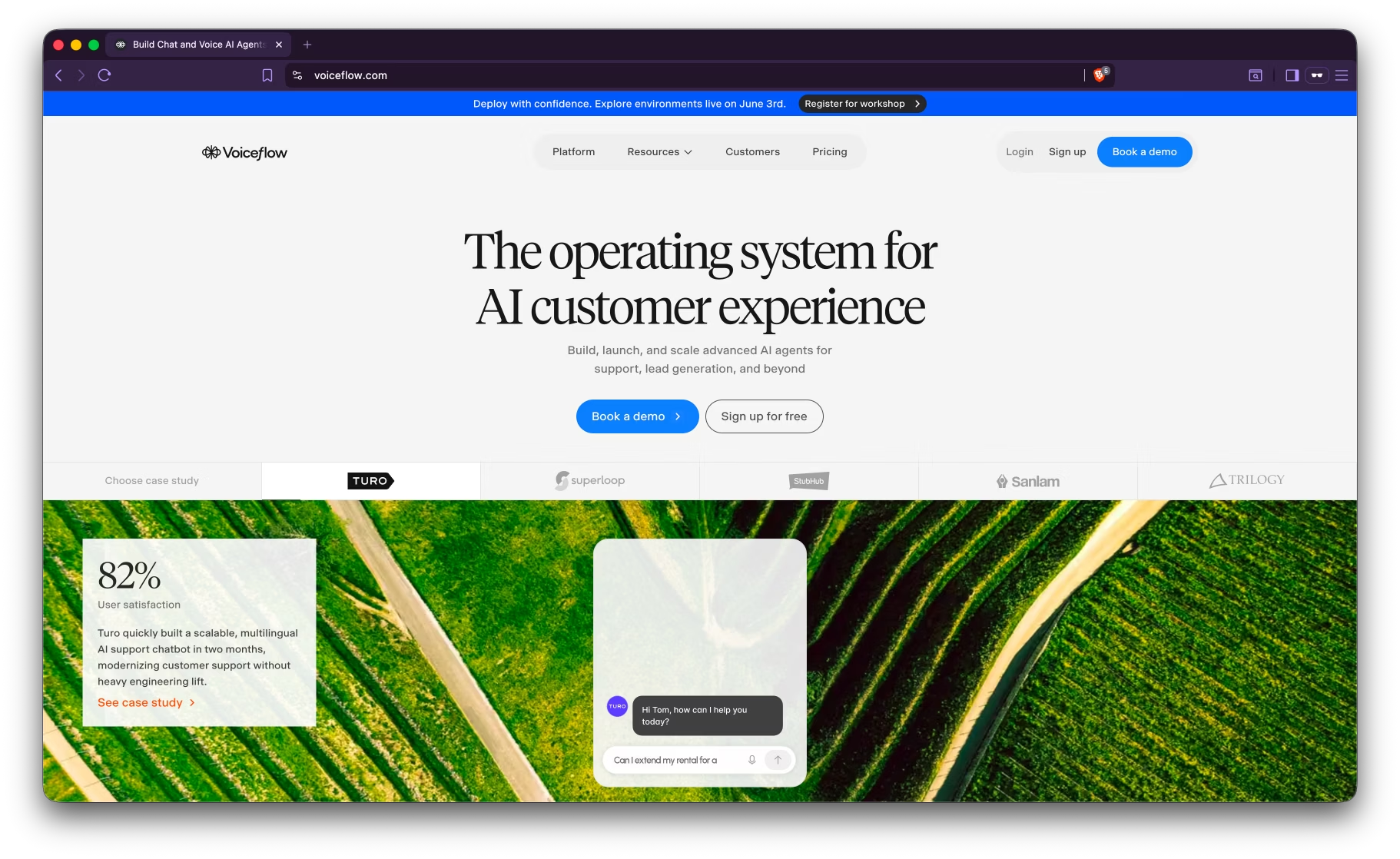
Voiceflow is a no-code AI agent builder, and for a P&C agency the honest verdict is that it's a strong platform for CX teams that want to design their own agents - but still a build: you'd configure the insurance training and AMS write-back a purpose-built tool already ships. This review covers what Voiceflow does, what it costs, what it integrates with, and where it fits. The short version: Voiceflow lets you design agents across channels, while an AI receptionist is the finished insurance product you deploy.
All facts below are sourced from Voiceflow's public materials and publicly available information.
Key takeaways
- What it is: no-code/low-code AI agent builder for CX and support teams, deployable across web chat, phone, and mobile.
- Best for: CX teams and conversation designers that want to build and own their own agents.
- vs Sonant: alternative (competing voice AI) - a DIY builder vs a turnkey, insurance-native product.
- Watch-outs: you build and maintain the agent; no P&C model or native retail-AMS write-back out of the box.
- Bottom line: a good platform to design your own; a finished insurance product is faster to answering calls.
TL;DR
Voiceflow is an AI agent platform that lets organizations build, launch, and scale conversational AI agents for support and lead generation without extensive coding. Voiceflow reports 4,000+ customers and 200,000+ users; named customers include Allstate and JP Morgan Chase (enterprise CX deployments, not retail agencies).
Best for: CX and support teams that want a no-code builder to design their own agents across channels.
Less of a fit for: retail P&C agencies needing native AMS write-back (EZLynx, Applied Epic, HawkSoft, AMS360).
Pricing: Not displayed on voiceflow.com.
Implementation: Self-service - timing depends on the agent you build.
1. What is Voiceflow?
Voiceflow is a no-code/low-code AI agent platform that lets organizations build, launch, and scale conversational AI agents for support and lead generation across web chat, phone, and mobile, with LLM flexibility (GPT, Claude, Gemini). It serves CX leaders, conversation designers, engineers, and enterprise teams. For an agency the trade-off is build-vs-buy: Voiceflow is the toolkit, not a finished insurance product. P&C training and AMS write-back are things you configure, not features it ships.
2. Who uses Voiceflow?
Voiceflow's public materials describe CX and support teams across enterprises - 4,000+ customers and 200,000+ users, with a 4.8/5 G2 rating. Named customers like Allstate and JP Morgan Chase are enterprise CX deployments, not retail agencies. The typical user wants to design and own its own agent rather than buy a finished, insurance-specific product.
3. How much does Voiceflow cost?
Voiceflow doesn't display pricing on its website - you'd contact the company. For an agency, the subscription is only part of the picture: the real investment is the time to design, configure, and maintain the agent, including the insurance handling and any AMS connection a finished product already includes.
4. Key features
- No-code/low-code agent builder with visual workflow design
- Omnichannel deployment (web chat, phone, mobile API)
- LLM model flexibility (GPT, Claude, Gemini)
- Sub-500ms voice latency; high message throughput
- Real-time collaboration; agent observability and evaluation
- White-glove options for enterprise teams
Communication channels: web chat, phone, mobile API.
Conversation design: no-code/low-code agent builder with visual workflow design.
Insurance terminology handling: none out of the box (you build your own training).
Feature breakdown
5. How long does it take to implement Voiceflow?
Voiceflow is self-service, so timing depends entirely on the agent you build. You can prototype quickly, but a production insurance agent means designing the flows, configuring P&C handling, and wiring any AMS connection yourself - work a purpose-built insurance product ships ready to deploy.
6. What does Voiceflow integrate with?
Voiceflow integrates with Salesforce, Shopify, Zendesk, HubSpot, and Airtable, with LLM flexibility. It lists no native connectors for retail P&C AMS platforms (EZLynx, Applied Epic, HawkSoft, AMS360), so any AMS write-back is something you configure rather than a feature it ships.
7. Compliance and security
Voiceflow reports SOC 2 Type II, ISO/IEC 27001:2022, GDPR, and HIPAA - strong governance for a build-your-own platform. A SOC 2 Type II report is the document to confirm, though your own implementation affects your posture. For AI-in-insurance context, see the NAIC's model bulletin.
8. Pros and cons for insurance buyers
Pros:
- No-code builder - visual workflow design, accessible to non-engineers.
- Omnichannel - web chat, phone, and mobile from one build.
- LLM flexibility - choose GPT, Claude, or Gemini.
- Strong governance (SOC 2 Type II, ISO 27001, GDPR, HIPAA).
Cons / where it may fall short for retail P&C agencies:
- DIY, not insurance-native - you build and maintain the agent.
- No P&C model or native retail-AMS write-back out of the box.
9. When Voiceflow fits an insurance buyer
Voiceflow fits a CX or support team - including at a larger agency - that wants to design and own its own conversational agents across channels, and has the capacity to build and maintain them. If designing your own is the goal, it's a capable, well-governed platform.
10. Voiceflow vs an insurance-native AI receptionist
The difference is build vs buy. Voiceflow is the no-code builder; an insurance-native receptionist is the finished product, pre-trained on P&C conversations with AMS write-back included. If you want to design your own across channels, Voiceflow is a good platform; if you want to answer agency calls next month, a finished product is faster. See Sonant vs Voiceflow and best voice AI for insurance.
Verdict
Voiceflow is a strong no-code agent builder - for CX teams that want to design their own agents. For a retail P&C agency it's still a build: you'd configure the insurance training and AMS write-back a purpose-built tool already ships. If you want to design your own across channels, it's a good platform; if you want to answer agency calls next month, a finished insurance product is faster.
Related reading
- Sonant™ vs Voiceflow alternative
- Best Voice AI Insurance Vendors
- AI Receptionists for Insurance Agencies: Buyer’s Guide
- 100 AI Tools for Insurance Agencies (2026 Guide)
Disclaimer
Voiceflow is a trademark of its respective owner. Sonant™ is not affiliated with or endorsed by the owner of Voiceflow. This review was created using publicly available information about Voiceflow and Voiceflow's public materials. We encourage readers to visit the official Voiceflow website for the most current product information. Last verified: 2026-06-15.






.svg)


.svg)


