.svg)

An AI receptionist for insurance brokers handles personally identifiable information (PII) on every inbound call: client names, policy numbers, carrier names, renewal dates, vehicle VINs, dates of birth, driver's licenses, premium amounts. For a P&C (property and casualty) agency owner evaluating AI phone systems, the question is not "does the AI work", it is "what stops a competitor or bad actor from calling in and extracting that data?" This piece walks through the real verification layers that gate sensitive information, explains why SOC 2 Type 2 and GDPR compliance matter when AI handles PII at scale, and gives operations leaders a practical security checklist before signing with any vendor.
Key Takeaways
- AI receptionists handle PII on every call; verification gates decide whether that data stays protected
- Multi-factor identity checks (VIN + date of birth + custom "stump" questions) raise the bar past what an untrained human receptionist typically does
- SOC 2 Type 2 and GDPR are the published compliance baselines for insurance-grade AI vendors
- The Sonant Consumer AI Readiness Report shows policyholders accept AI-handled service when verification is visible and consistent
- Vendor security posture is a procurement requirement for PE-backed agencies, not a nice-to-have
The 5 verification layers an AI receptionist for insurance should run
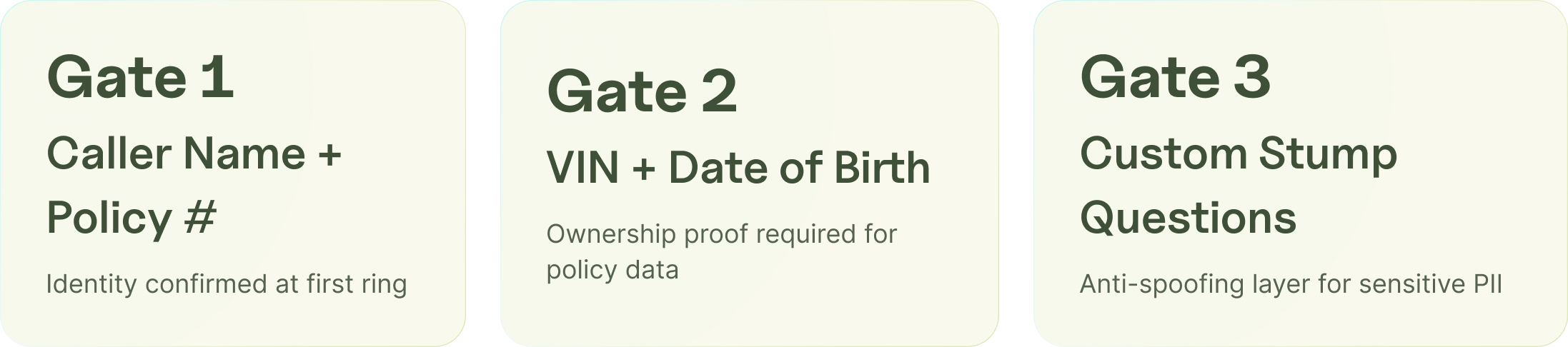
Insurance-native AI receptionists gate sensitive information through layered identity checks before disclosing anything. Each layer is configurable per workflow; quote intake might use one set, policy detail disclosure another. The five layers most agencies should require:
- Layer 1 - Policy number or account ID: caller states the policy number; the AI cross-checks against the AMS record
- Layer 2 - Date of birth: standard identity verification, matched against AMS-stored DOB
- Layer 3 - Vehicle VIN or property address: ties the caller to a specific covered asset on the policy
- Layer 4 - Driver's license number: harder to socially engineer than DOB alone
- Layer 5 - Custom "stump" questions: agency-defined verifiers (last carrier, last endorsement date, named insured spouse) that competitors and bad actors cannot guess
For most agencies, Layers 1+2+3 are the practical minimum for routine servicing. Layer 4+5 should be required before disclosing premium, renewal dates, or carrier information.
Want help configuring verification gates for your agency? → Talk to Sonant
How SOC 2 Type 2 and GDPR shape the vendor evaluation
SOC 2 Type 2 is the AICPA framework that audits how a vendor handles security, availability, processing integrity, confidentiality, and privacy over a 6–12 month period. For an insurance agency handling commercial accounts with sensitive data; financial services, healthcare-adjacent, government contractors, a vendor without SOC 2 Type 2 is a procurement risk.
Use this checklist to pressure-test each vendor on the points covered in this post:
GDPR matters even for US-only agencies because some commercial accounts have EU-resident employees on the policy. A vendor that publishes a GDPR posture is signaling it has thought about data residency, right-to-erasure, and processing records.
Insurance-native AI vendors publish SOC 2 Type 2 reports under NDA on request. If a vendor cannot share a report, or only points to a SOC 2 Type 1 (a point-in-time snapshot, not an audited period), that is a signal to keep looking.
The Sonant Consumer AI Readiness Report confirms policyholder comfort with AI-handled service rises sharply when verification steps are visible and consistent across calls.
What the NAIC says about AI in insurance
The NAIC Model Bulletin on Use of AI Systems by Insurers (adopted by an increasing number of US states) sets the regulatory baseline for AI systems that touch underwriting, claims, or policyholder interactions. For agencies, the bulletin matters because carrier-side AI scrutiny eventually trickles down to agency operations: documentation discipline, audit trails, and explainability become procurement requirements.
The practical takeaway: vendor selection should include "regulatory roadmap fit" alongside security posture. An AI receptionist that writes every call to the AMS with timestamped detail is creating the audit trail the NAIC framework anticipates.
What an AI receptionist refuses to disclose without verification
The deployment configuration decides what gets disclosed at each verification level. A common starting policy for retail agencies:
- No verification required: office hours, general scope of services, ability to book an appointment, ability to leave a message
- Layer 1+2 required: confirmation that a policy exists, basic policy status (active/lapsed)
- Layer 1+2+3 required: policy details, coverage limits, claim status
- Layer 1+2+3+4 required: premium amounts, renewal dates, payment history
- Layer 1+2+3+4+5 required: carrier name, broker-of-record details, sensitive endorsements
The PE-backed agency procurement bar is usually Layer 1+2+3+5 minimum for any disclosure that names a carrier, since carrier names are competitive intelligence.
The pre-purchase security checklist for AI vendors
Before signing with any AI receptionist vendor, the agency should confirm in writing:
- SOC 2 Type 2 report shareable under NDA
- GDPR posture documented
- HIPAA BAA available if commercial accounts include healthcare exposure
- Encryption at rest (AES-256) and in transit (TLS 1.2+)
- Verification gate configurability (which layers fire on which workflows)
- AMS write-back fidelity for EZLynx, Applied Epic, HawkSoft, AMS360, QQCatalyst, Momentum, AgencyZoom, or Zywave
- Audit log retention period and access controls
- Penetration test cadence (annual minimum)
- Incident response notification commitment in the MSA
- Data residency policy (US-only vs cross-border)
If a vendor cannot answer all 10 with specifics, the vendor is not the right fit for a P&C agency handling commercial accounts.
How Sonant handles client data security
Sonant runs 5-layer caller verification configurable per workflow, publishes SOC 2 Type 2 and GDPR documentation, and offers HIPAA BAAs for agencies handling healthcare-adjacent commercial accounts. Native AMS write-back to EZLynx, Applied Epic, HawkSoft, AMS360, QQCatalyst, Momentum, AgencyZoom, and Zywave creates the timestamped audit trail the NAIC framework anticipates. The workflow: caller calls → Sonant runs verification gates → discloses only what the verification level permits → writes the AMS note with full audit detail within 60 seconds. Output is the AMS-attached note plus the audit log entry retained per the agency's retention policy.
The procurement bar for AI receptionists handling client data
Verification gates protect client data; SOC 2 Type 2 and GDPR set the compliance floor; AMS write-back creates the audit trail. An AI receptionist for insurance brokers should clear all three bars before going live on any policyholder-facing line. Pick the vendor that demos the verification flow live on your platform, shares the SOC 2 Type 2 under NDA, and writes the AMS note with full audit detail. Skip vendors that cannot answer the 10-item security checklist with specifics.
Ready to pressure-test an AI receptionist on data security? Book a Sonant demo →
Related reading
- AI Voice Agents vs. Live Call Center Reps: What's Better?
- The Best AI Answering Services for Insurance Agencies in2026
- 10 Ways to Reduce Insurance Operational Costs in 2026
- 100 AI Tools for Insurance Agencies (2026 Guide)






.svg)

.svg)


