

The best insurance agency management system for your agency is the one your team works inside every day. A good agency management system (AMS) is the system of record for an independent agency: policies, carriers, documents, accounting, commissions, and the servicing history that decides whether a renewal conversation takes two minutes or twenty.
Choosing one is a decision an agency lives with for years, and it usually gets made on the strength of a demo cycle. The demos all look alike because every vendor shows the same screens.
What separates these systems is what happens at the edges, meaning what the price includes once the add-ons are counted, whether another tool can read and write the client record through a published interface, and who picks up the phone when your team is already on it. This comparison reviews 10 options on those terms, and also covers how Sonant™, the AI receptionist built for independent property and casualty (P&C) insurance agencies, fits alongside the systems on this list rather than inside the ranked table.
Key Takeaways (TL;DR)
- The best overall insurance agency management system setup: Pick one system of record from the list below based on your line mix and size, then pair it with an AI-powered call answering platform for insurance agencies for the layer every AMS leaves empty, which is the live phone call. Sonant is a companion to whichever AMS holds your book, never a substitute for one, which is why it does not appear in the ranked table.
- Why you need it: An agency without a system of record runs on spreadsheets, inboxes, and memory, and P&C insurance is a renewal business where forgetting is expensive. An agency management system puts every policy, document, carrier download, and servicing note on one record with an owner and a date attached.
- Who it is for: Independent P&C agencies of about 15 people and up, where producers, Customer Service Representatives (CSRs), and account managers all touch the same clients, plus smaller agencies replacing a desktop system that is running out of road.
- How to choose the right one: Check whether the vendor publishes a rate card at all, because half of this category quotes only after a demo. Then check whether the system exposes a two-way interface other tools can read from and write to. Then price it at your real seat count with the add-ons included, not at the headline plan.
- Expected price: Across the systems reviewed here, only three publish a rate card. HawkSoft lists $99 per user a month retail on HawkSoft 6, Momentum AMP runs from $99 to $349 a month before modules with extra seats at $45, and AgencyBloc AMS+ Grow starts at $109 per user a month. The other seven quote only after a scoping conversation. Sonant charges a predictable partner rate per agency with onboarding, configuration, and support included, so a heavy call week does not change the invoice. All figures are in US dollars.
Top Insurance Agency Management System Picks in 2026 at a Glance
The table below leads with the six Sonant integration partners, which read and write to Sonant’s call layer through established connections, and then lists the four systems to also consider by category. Every row names the category the product belongs to, because a system of record, a rating-led platform, and a benefits-focused platform solve different parts of the same day.
Pricing is as published by each vendor and verified against the vendor’s own pricing materials in October 2026. Confirm current rates directly before you buy. Figures should be re-verified by April 2027.
How Sonant™ Fits With Your Insurance Agency Management System
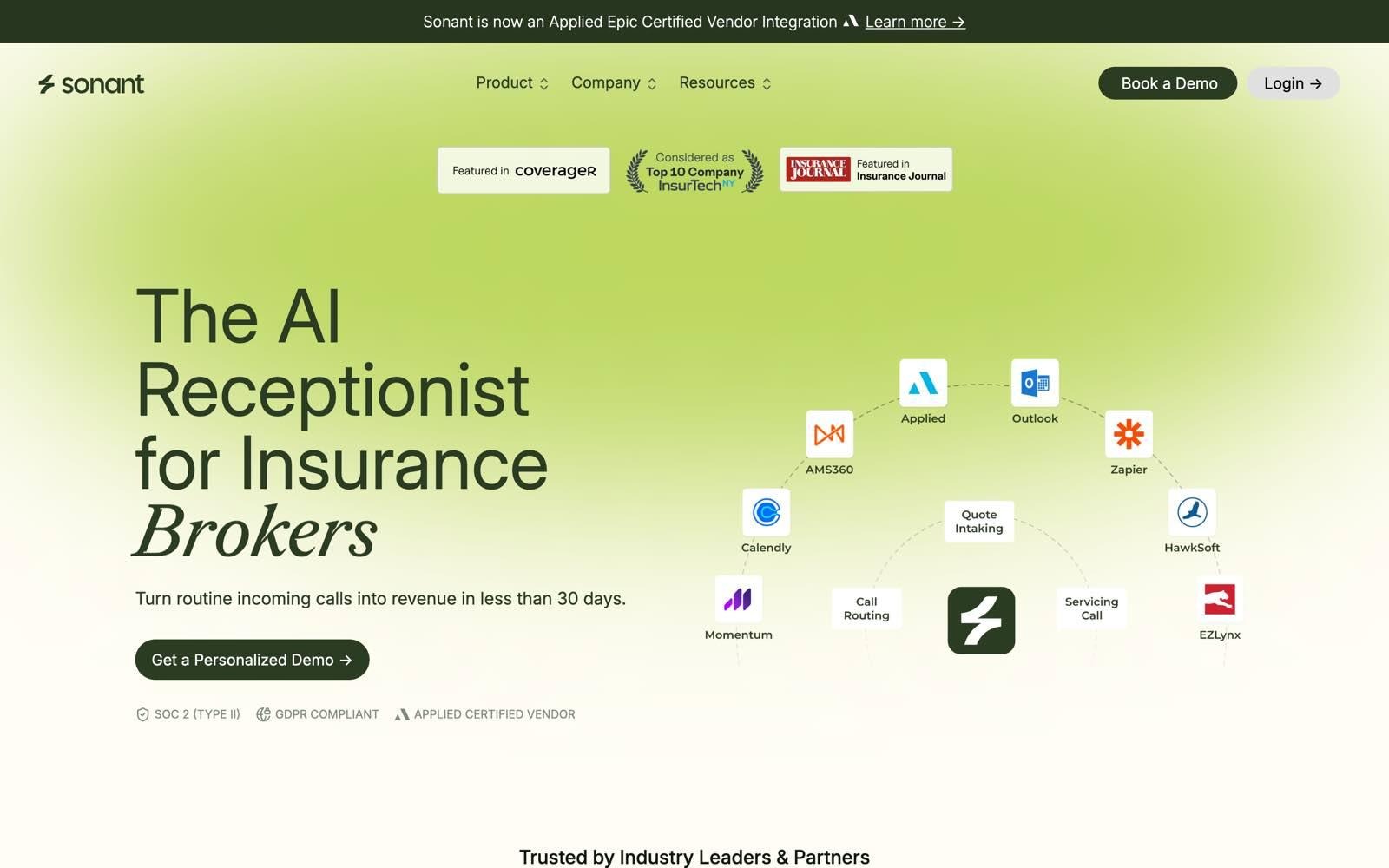
Sonant is not on the ranked list because Sonant is not an agency management system. The product occupies the layer the ten systems above all leave empty: the live phone call. Every AMS on this list is only as current as the conversations somebody enters, which is why the phone work your team fields all day stops counting the moment it hangs up. Sonant answers the call, verifies the caller against the client record, resolves the servicing or quote intake question live during the conversation, and writes the outcome back as a documented, routed task in the system you already run.
Sonant’s Agency Management System Integration Partners
Sonant plugs into six of the ten systems reviewed below through established partner connections. The Applied Epic connection runs through the Applied Systems Vendor Certification Program, launched August 2026, where Sonant joined the inaugural class of 11 certified vendors and became the first voice AI certified for Applied Epic. Activating a certified integration does not require any additional purchase from Applied, which takes real cost out of the deployment. The HawkSoft API partnership is documented on HawkSoft’s own partners page, which describes the integration as pulling real-time client data from HawkSoft during calls and automatically logging detailed call notes and tasks under the specific client section. EZLynx, AMS360, QQCatalyst, and Momentum AMP complete the native partner list.
What the Integration Does on a Live Call
When a caller phones an agency running Sonant alongside one of the partner systems, three things happen inside the one conversation. Sonant opens the client record in the agency management system while the caller is still talking, so a renewal date or coverage question gets answered on the line instead of turning into a callback promise. The call lands on the record as documented notes plus a task routed to whoever owns the account, which is the write-back half of the integration. And mid-call texting sends payment, quote, or claims links to the caller’s phone before the call ends, so the request finishes on the call rather than on a follow-up. Those three behaviors together are what voice AI agents built for insurance workflows change about the shape of a service call.
What Sonant Does and Does Not Replace
Sonant does not hold policies, does not run carrier downloads, does not post commissions, and does not touch agency accounting. The AMS you pick from this list is still the system of record, and Sonant sits alongside it as the call layer. Agencies on Jenesis, AgencyBloc, Amplo, and Partner XE can still work with Sonant, with the write-back path running through webhooks or the system’s own interface rather than through a native integration. The AI call note taker that writes activity back to your AMS and the inbound conversation and task management layer do the work either way, with the native partnerships above closing the gap tightest.
How We Chose the 10 Best Insurance Agency Management Software Options
Evaluating this category is different from buying any other business software, because the monthly seat price tells you nothing about whether the system can finish a renewal, close out a claim, or produce a clean audit trail. You have to look at "carrier download", meaning whether policy data arrives in the record automatically instead of being typed, and at "trust accounting", meaning whether the system can handle agency-bill and direct-bill flows cleanly.
We started from more than 35 products that appear in independent agency searches, association technology directories, and vendor partner listings, then shortlisted 10 using a weighted scoring system. Six of the ten shortlisted products are published Sonant integration partners (Applied Epic, HawkSoft, EZLynx, Vertafore AMS360, QQCatalyst, Momentum AMP), which we have stated in their entries rather than left implied.
- System of record depth (25%): How well the platform holds policies, carriers, downloads, documents, commissions, and accounting as first-class objects. A system that handles billing in a side module scores below one that handles it in the core.
- Integration surface and API posture (20%): Whether a documented interface lets third-party tools read and write the client record, whether partner directories are public, and whether API access is a separate purchase or part of the base platform.
- Pricing transparency and total cost at your real seat count (15%): Whether the vendor publishes a rate card at all, how extra seats are priced, and what sits in add-on modules versus the base platform. We modeled a 20-person agency including seat charges, module prices, and onboarding fees. All prices are in US dollars as published by each vendor and verified in October 2026. Figures should be re-verified by April 2027.
- Onboarding, time to value, and support (15%): How many weeks from signature to a working system, how much configuration lands back on your team, and how support is staffed and paid for after go-live.
- Insurance-native data model and workflows (15%): Whether coverages, carriers, downloads, renewals, and commissions ship as native objects or need to be configured from generic fields.
- Security and data documentation (10%): Whether compliance posture, hosting, encryption, and retention practices are published rather than described on a sales call.
Vendor-reported metrics are labeled as such throughout. Where a company publishes an uptime, retention, or productivity figure with no independent verification, we have said so instead of treating it as measured.
What Is an Insurance Agency Management System?
An insurance agency management system is the central platform an independent agency uses to run its daily operations: client and policy management, carrier connectivity and downloads, document storage, ACORD forms, commissions, agency accounting, and the reporting that supports management decisions. The management system is the system of record. Everything else your agency buys is designed to feed data into it or pull data out of it.
The confusion worth clearing up first is AMS versus Customer Relationship Management (CRM) software, because most agencies are shopping for one and describing the other. The CRM holds leads, pipelines, producer activity, and renewal outreach, while the AMS holds the record itself. A closer look at the split is in this guide to the best insurance agency CRM software.
- The system of record: Policies, endorsements, carriers, downloads, documents, commissions, and accounting. This is the AMS.
- The sales and relationship layer: Leads, pipelines, outreach, campaigns, and renewal follow-up. This is the CRM.
- The communication layer: Calls, texts, and emails, and whether any of them reach the record without someone typing them in.
Four shapes of product compete for the AMS budget. The shape predicts more about your experience than any feature grid does.
- Enterprise AMS platforms: Built for complex books and larger operations, with the deepest reporting and the broadest carrier connectivity. Applied Epic and Vertafore AMS360 sit here.
- Independent cloud AMS platforms: Built around personal lines or small commercial, with modern browser interfaces and tighter price bands. HawkSoft, EZLynx, QQCatalyst, Momentum AMP, Partner XE, and Jenesis sit here.
- Vertical AMS platforms: Built around a specific line of business, with native data models and workflows for that line. AgencyBloc covers health and benefits in this slot.
- Modern AI-native AMS platforms: Rebuilt on contemporary cloud architecture, often on Salesforce, with AI data extraction and workflow automation designed in rather than added later. Amplo (formerly Veruna) sits here.
A fifth product sits outside the AMS category entirely. The call layer answers the phone, verifies the caller, and writes the outcome back into whichever AMS the agency runs. That is where Sonant sits, and it is the layer most agencies discover last.
Why Do You Need an Insurance Agency Management System?
Because the alternative is running a renewal business on inboxes and memory, and the arithmetic punishes it harder every year.
LexisNexis Risk Solutions reported that at the end of the first quarter of 2026, 47.3% of policies in force had been shopped at least once in the previous 12 months, the highest rate since its Insurance Demand Meter began tracking in 2020, and that the direct channel posted the strongest growth at 9.4% year-over-year. Quarterly shopping growth slowed and even turned negative in March 2026, so demand is not what is holding the channel back. Every renewal is now a contested transaction, and the agency that remembers the last conversation is the one that keeps it.
An agency management system is what makes those renewal conversations possible. It replaces four problems that cost real money.
- Documentation gaps that become errors and omissions exposure: Analyzing Swiss Re Corporate Solutions claims data, IA Magazine reported that failure to procure coverage accounts for about 30% of all claims, with the next highest cause barely reaching 10%. In those cases what was documented decides the defense, and notes typed from memory at 6pm are the weakest part of that file. A system of record with structured documentation changes what the file looks like at the point a claim becomes a dispute.
- Carrier downloads that have to be typed in by hand: A modern AMS pulls policies, endorsements, and billing data from carriers through the industry standard Ivans network, which means the first screen your CSR sees already has the right numbers on it. Without that, somebody rekeys the data, and errors land on policies rather than on scratch pads.
- Commissions tracked in a spreadsheet: Commission reconciliation is where the money leaks that nobody notices, because a difference between what the carrier paid and what the agency expected gets written off as "the usual variance" when it should be a reconciliation line. An AMS with proper commission handling catches that at month-end rather than at year-end.
- Renewals that depend on one person’s memory: If a senior CSR takes a week off and renewals slip, your retention is a function of that CSR’s habits rather than of your operation. Cornerstone Insurance’s 43% productivity gain and O’Connor Insurance’s 8x return on investment in 30 days both ran on phone work landing as structured tasks in the agency management system rather than as sticky notes on monitors.
The limit worth naming up front: the AMS records, but it cannot answer a ringing phone. If the calls generating your service and quote work never make it into the system, a better AMS gives you a tidier picture of the same blind spot.
Who Needs an Insurance Agency Management System?
Not every agency buys an AMS the same way. The pattern that predicts a clean implementation is a shape of agency that matches the shape of the product, which is why these five situations tend to see the fastest payback.
Independent P\&C Agencies Replacing a Legacy Desktop System
If your current system is a Windows application that runs on a server in the back office, you are living with the single biggest change management project in this category. The payoff is a cloud AMS that works from anywhere, carrier downloads that keep themselves current, and no more "the server is slow today" conversations with a vendor who stopped investing in the product years ago. HawkSoft 6, Momentum AMP, and EZLynx are the obvious destinations here, and most migrations run between three and six months.
Growing Agencies Where Producers Still Service Their Own Book
In agencies of 15 people and up, the setup where every producer owns servicing on their own accounts stops scaling, because servicing time is clerical time billed at commission rates. These agencies need an AMS that separates sales from service and makes servicing work routable, so a billing question lands on a CSR rather than on a licensed producer. AI lead qualification for insurance agencies takes the first filter off the producer’s desk on inbound calls too.
Multi-Location Agencies Standardizing One Client Record
Agencies that grew by acquisition inherit a different way of working at every location, and no consistent answer to how a client is documented. They need one data model and one set of reports before they need more features, and the shortlist here tilts toward enterprise AMS platforms (Applied Epic, Vertafore AMS360) because reporting across locations is where mid-tier products hit their ceiling.
Small Agencies That Need the Price Before the Demo
Owners of smaller agencies cannot run a four-vendor evaluation with sales calls on each. They need a published rate card so they can model total cost before they take the meeting. HawkSoft at $99 per user a month retail on HawkSoft 6, Momentum AMP’s tiered pricing from $99 to $349 a month, and AgencyBloc’s AMS+ Grow at $109 per user a month are the three options here, with Jenesis publishing a $70 per user base rate plus a per-location fee.
Agencies Whose Phone Calls Never Reach the Record
If you can look at your AMS right now and see yesterday’s calls documented as structured tasks against the right accounts, your call layer is already working. If you cannot, no AMS on this list will fix it, because the AMS can only know what someone types in. AI appointment booking built for insurance is where the inbound scheduling piece lands, and the write-back path is what turns phone conversations into agency management system records on their own.
Best Insurance Agency Management System: In-Depth Review and Comparison
Each entry covers who the product fits, what it does with a client record, published pricing where the vendor publishes any, and where it stops being the right choice. Products are ordered with Sonant partner integrations first, since those are the systems where the call-layer write-back works through established connections, and non-partner platforms after. Within the partner group, enterprise systems lead so Applied Epic agencies find themselves immediately.
1. Applied Epic™
Overview
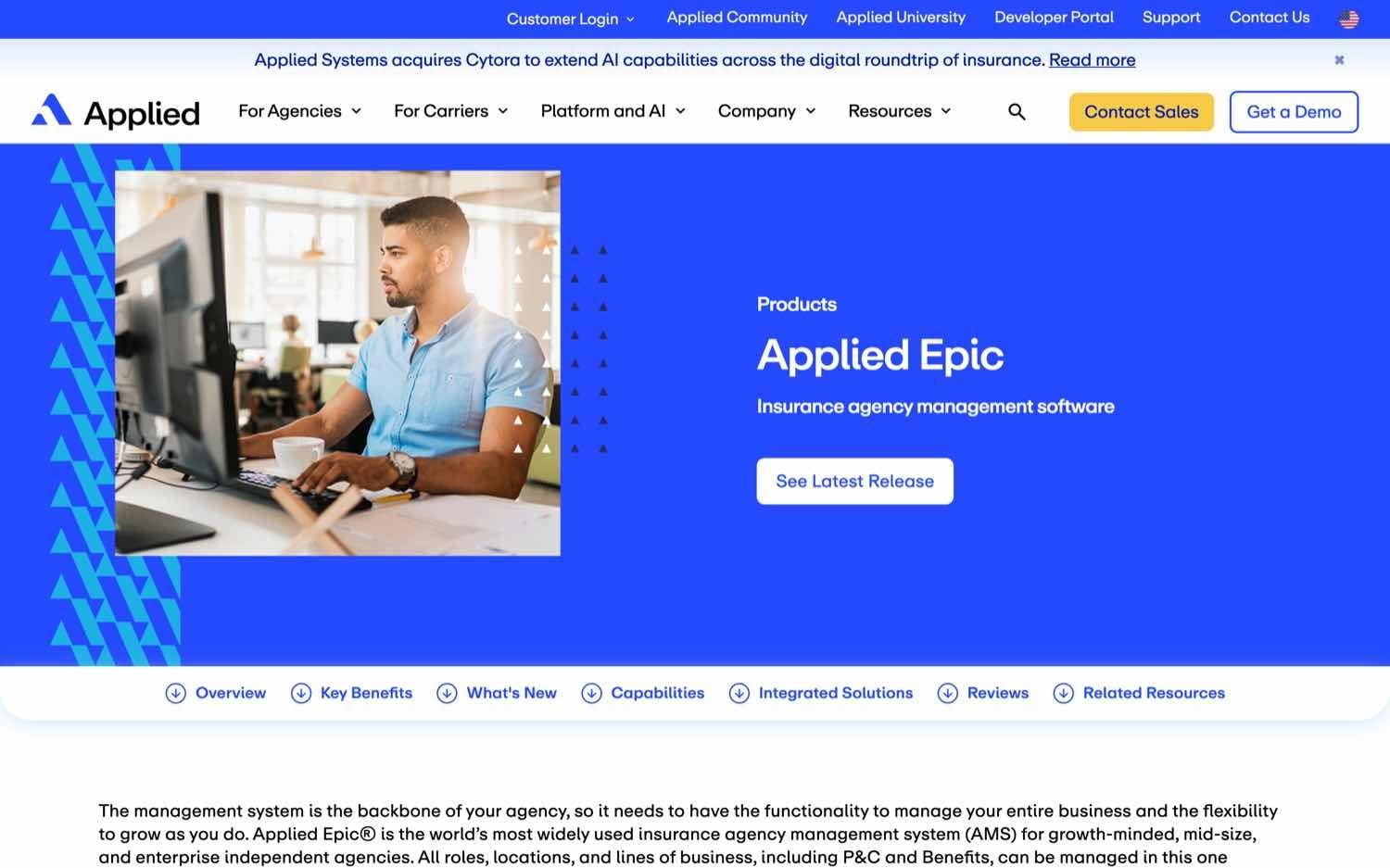
Applied Epic from Applied Systems is the enterprise agency management system in this market, and it dominates mid-size and larger agencies with complex commercial lines operations. It centralizes client data, policy lifecycle management, carrier connectivity through the Ivans network, accounting, benefits, and sales automation in one system. Applied Systems launched its Vendor Certification Program in August 2026, formalizing a single certification path for third-party tools, and Sonant joined the inaugural class of 11 vendors as the first voice AI certified for Applied Epic. Activating a certified integration does not require an additional purchase from Applied.
Ideal For
- Agencies of 20+ users with complex commercial lines
- Multi-location agencies needing one data model across offices
- Agencies with heavy carrier connectivity and download requirements through Ivans
- Finance teams needing deep agency accounting and benefits handling
- Agencies wanting a certification program for third-party tools
Top Features
- Enterprise system of record: Client data, policies, accounting, benefits, and reporting in one platform, which is what multi-location agencies buy it for.
- Carrier connectivity through Ivans: Industry-standard carrier connectivity keeps policy data current without manual entry.
- Deep reporting and sales automation: Reporting depth that smaller systems do not reach, with sales automation built on top of the system of record.
- Vendor Certification Program: Launched August 2026, the program certifies third-party integrations against Applied’s standards for quality and reliability, with certified activations needing no additional Applied purchase.
- Benefits functionality: Separate benefits data model and workflows alongside P&C, which matters for agencies writing both.
Why They Stand Out
Scale, carrier connectivity, and the new Vendor Certification Program are the reasons Applied Epic wins evaluations at the top of the market. Reviewing enterprise AMS options, Capterra and G2 reviewers consistently flag Applied Epic as the depth leader, and the certification program is a meaningful signal for buyers who have had a third-party connector break on them before. It is a fit for agencies with complex commercial lines and multiple locations, and the reporting depth supports the kind of segment-level analysis smaller systems do not produce.
Pros
- Built for scale, with the depth multi-location and commercial-heavy agencies need
- Strong carrier connectivity and downloads through Ivans
- Reporting depth that supports segment and location-level analysis
- Vendor Certification Program reduces the risk of a third-party connector breaking
- Certified integrations activate without an additional Applied purchase, which lowers the total cost of third-party tools
Cons
- No published pricing, and enterprise procurement means a longer buying cycle
- Best suited to agencies with 20+ users, so smaller agencies may be buying depth they do not need yet
- Implementation is a project with training and change management, not an install
- Non-certified third-party tools generally still need Applied API access purchased separately
- The user interface lags newer cloud-native products on day-to-day navigation, per Capterra reviewers
Pricing
Applied does not publish Epic pricing. Quotes are per agency, scoped by user count, modules, and implementation, and the total cost of ownership includes training and data migration. For non-certified third-party tools, budget separately for API access if you plan to connect anything outside the Vendor Certification Program, because that line is easy to overlook at the quote stage.
Final Verdict
Applied Epic is recommended for agencies of 20+ users with complex commercial lines, multiple locations, and reporting needs that smaller systems cannot meet. The new Vendor Certification Program is the strongest protection against integration failure available in this category, and certified activations without additional Applied purchases materially change the economics of the broader tool stack. For the majority of independent agencies it is more system than the operation requires, and the implementation is a project rather than a purchase.
2. HawkSoft™
Overview
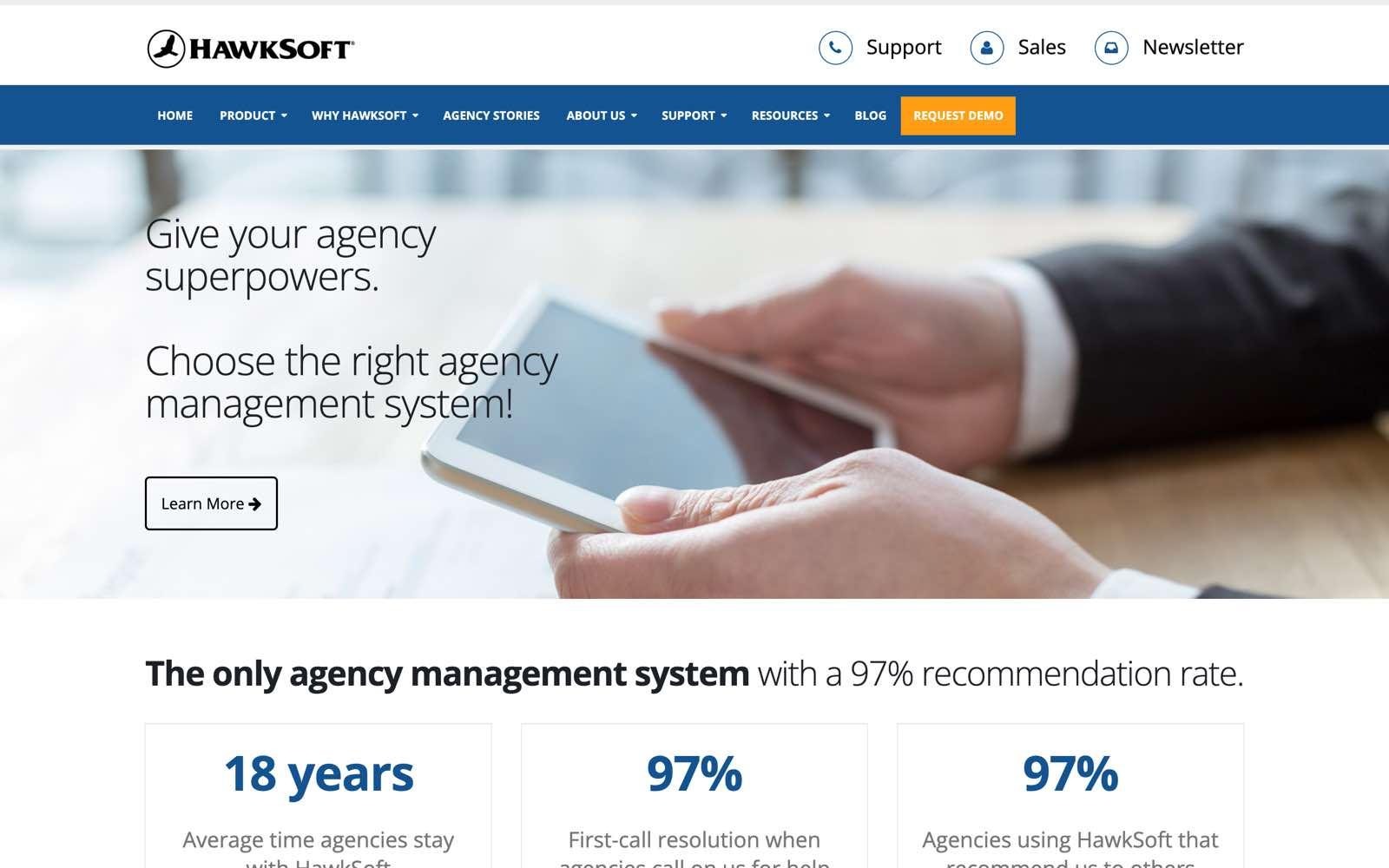
HawkSoft is an independently owned agency management system founded in 1995, and it is the option most often recommended for personal lines agencies that want one record instead of a stack. HawkSoft 6 is the current browser-based release that moved the product off its legacy desktop deployment, and HawkSoft publishes both a retail per-user price and a labeled partner directory. The directory is unusual in this category because it names integrations by type (certified, premier, standard), so buyers can tell which partners run on documented interfaces versus one-way exports.
Ideal For
- Personal lines agencies wanting policy management and client management in one system
- Agencies of 10 to 50 people that value support responsiveness over feature breadth
- Owners who want the price and the partner list published rather than quoted
- Teams that want text messaging and e-signature available as named add-ons
- Agencies migrating off legacy desktop AMS platforms to a browser-based system
Top Features
- Policy and client management in one record: Policy servicing and client relationships live in the same record, with carrier downloads keeping policy data current.
- Trust accounting: Native agency-bill and direct-bill handling with the reconciliation reporting independent agencies need.
- Published partner directory: Third-party partners are listed with the integration type, which is why HawkSoft agencies have more visibility into their tool choices than closed-system agencies do.
- Browser access on HawkSoft 6: The current release runs in the browser, so remote and multi-location work does not need a desktop deployment.
- Text messaging and e-signature add-ons: Both are available as priced add-ons rather than through third-party tools, with messaging covering 10DLC carrier costs at the agency level.
Why They Stand Out
HawkSoft publishes support and loyalty metrics most vendors do not, including 18 years of average customer retention, a 97% first-call resolution rate, and a 97% recommendation rate among users, all vendor-reported. The combination of published pricing and a labeled partner directory makes it the easiest system here to budget and plan around. Sonant is a listed HawkSoft API partner, and the connection is documented on the HawkSoft partner page as pulling real-time client data from HawkSoft during calls and logging detailed call notes under the specific client section.
Pros
- Published retail pricing at $99 per user a month on HawkSoft 6
- Labeled partner directory shows which integrations run on documented interfaces
- Trust accounting and carrier downloads native to the system
- Browser-based HawkSoft 6 release works from anywhere without a desktop deployment
- Published support metrics including 97% first-call resolution, vendor-reported
Cons
- Strongest in personal lines, so complex commercial and specialty books may need more than its focus covers
- Text messaging ($20 per agency a month), e-signature, and self-service certificates ($49 per agency a month) are priced separately
- Reporting depth sits below the enterprise systems, which matters at scale
- Customers migrating from the local server to the cloud release may see a per-user price increase of up to $39 a month, capped at the $99 retail
- Marketing automation is lighter than a dedicated insurance CRM, so sales-heavy agencies often add one alongside
Pricing
HawkSoft publishes HawkSoft 6 at $99 per user a month retail, with a three-user minimum removed on the cloud release. Named add-ons include Self-Service Certificates at $49 a month per agency (unlimited certificates), HawkSoft Text Messaging at $20 a month per agency (covering 10DLC carrier costs), and Exchange Online at $4 a month per user. For agencies moving from the on-premises version, HawkSoft notes a per-user price increase of up to $39 a month on migration, capped at the $99 retail price. All figures are in US dollars.
Final Verdict
HawkSoft is recommended for personal lines agencies that want their system of record to double as their client management system, with published pricing and a labeled partner directory making the shortlist easier to run than most of this category. The support record is the reason existing users stay, and HawkSoft 6 removes the main objection to the earlier product. It is a weaker fit for commercial-heavy agencies that need deep reporting and complex line structures.
3. EZLynx™
Overview
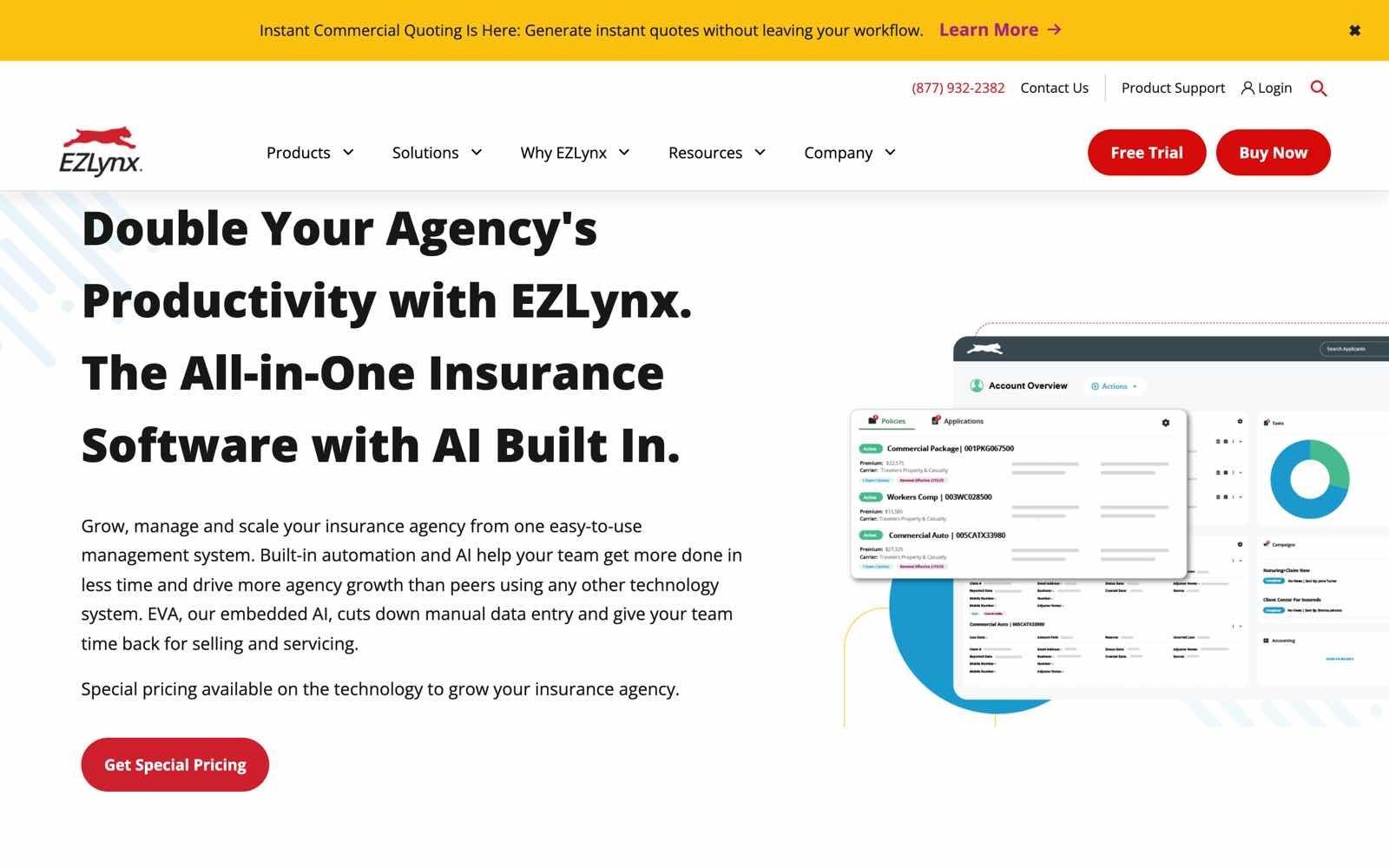
EZLynx, part of Applied Systems, is an agency management system built around a comparative rater, which makes it the natural choice for personal lines agencies where quoting speed decides the week. The platform covers policy management, CRM and marketing automation, a patented retention workflow, commission handling, and digital payments, with commercial submissions and agency websites available alongside. Comparative rating is native rather than integrated, which is the biggest structural difference between EZLynx and most AMS platforms on this list.
Ideal For
- Personal lines agencies where comparative rating volume drives the business
- Agencies wanting quoting, servicing, and CRM in one system
- Teams that want renewal quoting to run automatically
- Agencies wanting commercial submissions from a single data entry
- Owners wanting digital and self-service payments built in
Top Features
- Native comparative rating across 330+ carriers: Real-time quotes with prefill and lookup, which removes the biggest source of duplicate entry in personal lines.
- Policy management with carrier connectivity: The system of record functions independent agencies need, backed by Applied’s broader carrier connectivity investment.
- Patented retention workflow: Automated renewal quoting with at-risk policy prioritization and premium-change summaries.
- CRM and marketing automation inside the system: Pipeline tracking, email campaigns, and lead nurturing without a second product.
- Digital payments and commission automation: Payment acceptance and automated commission calculation inside the AMS.
Why They Stand Out
The native comparative rater is the reason agencies choose EZLynx, and having rating inside the AMS rather than integrated is what separates it from most management systems on this list. It is a fit for high-volume personal lines agencies, and the patented retention workflow gives renewal management more structure than a reminder queue. Being part of Applied Systems also means the carrier connectivity investment continues.
Pros
- Comparative rating across 330+ carriers built into the AMS rather than integrated
- Patented retention workflow with at-risk prioritization and change summaries
- CRM, marketing automation, and pipeline included in the management system
- Single-entry commercial submissions across multiple carriers
- Network discounts available through alliance and cluster programs
Cons
- No published pricing, so cost needs a quote and cannot be compared line by line
- Personal lines orientation means commercial-heavy agencies often find the servicing model built for a different shape of book
- Marketing automation depth sits below dedicated insurance CRMs on campaign and producer-accountability features
- Migration from another management system is a multi-month project, not a switch
- The module structure means the quoted price depends on which modules you take, which complicates like-for-like comparisons
Pricing
EZLynx does not publish pricing on its product pages. Quotes are per agency and scoped by user count and which modules you take, so the rating engine, management system, and websites can be priced separately. Network discounts are available through alliance and cluster programs. Ask specifically what is included in the base management system versus billed as an addition, because the module structure is where the quote moves.
Final Verdict
EZLynx is recommended for personal lines agencies where comparative rating volume is the business and quoting speed is the constraint, and the native rater plus patented renewal workflow is a strong combination for that shape of agency. It is a weaker fit for commercial-heavy agencies, and with no published pricing and a modular quote structure, working out your real annual cost takes a sales conversation rather than a comparison table.
4. Vertafore AMS360™

Overview
AMS360 is Vertafore’s flagship enterprise agency management system, positioned for independent agencies that run finance inside the system of record. It handles the full policy lifecycle, billing and invoicing, reconciliation, carrier downloads, leadership analytics, and the AI email and reconciliation agents Vertafore has added over the last 18 months. The accounting depth is the single feature that distinguishes AMS360 from its peers in this market, with full general ledger capability rather than the lightweight bookkeeping most AMS platforms include.
Ideal For
- Mid-market and larger agencies that want finance inside the AMS
- Agencies with substantial commercial books needing detailed policy tracking
- Finance teams needing a full general ledger and detailed audit trails
- Agencies on Vertafore’s broader ecosystem (AgencyZoom, PL Rating, QQCatalyst) wanting one vendor relationship
- Teams that want leadership analytics inside the system of record
Top Features
- Full general ledger accounting: Agency bill, direct bill, and complex commission splits with detailed audit trails, which is accounting depth most AMS platforms do not match.
- Policy lifecycle management: The system of record functions independent agencies need, with Vertafore’s carrier download investment behind it.
- Leadership analytics: Dashboards and standard reports aimed at owners running the agency by numbers.
- AI email and reconciliation agents: Added over the last 18 months to automate routine finance and communication work inside the AMS.
- Vertafore ecosystem integrations: AgencyZoom (CRM), PL Rating (comparative rater), and QQCatalyst sit alongside AMS360 inside Vertafore’s portfolio.
Why They Stand Out
The accounting depth is the reason agencies choose AMS360, and the Vertafore ecosystem gives it a wider in-platform footprint than most mid-market agencies need from a standalone AMS. For agencies writing substantial commercial books, the complex account hierarchies and commission structures handle cleanly in a way lighter AMS platforms cannot match.
Pros
- Full general ledger accounting with detailed audit trails
- Complex commercial lines capability with sophisticated policy and commission structures
- Vertafore ecosystem gives the broadest set of native integrations with Vertafore-owned CRM, rater, and marketing tools
- AI email and reconciliation agents automate routine finance work
- Native Sonant integration partner, so the call-layer write-back runs through an established connection
Cons
- No published pricing, so budgeting requires a sales conversation
- The user interface reflects legacy architecture, with navigation that feels dated compared to cloud-native alternatives, per fitgap.com and G2 reviewers
- Budget-conscious agencies or those with limited commercial lines revenue may find the investment hard to justify
- Vertafore ecosystem can make it expensive to swap one piece out of the stack later
- Implementation is a project with training and change management, not a self-serve install
Pricing
Vertafore does not publish AMS360 pricing on its product pages. Quotes are per agency and scoped by user count, modules (AgencyZoom, PL Rating, add-ons), and implementation. Industry commentary from mid-2026 places typical AMS360 costs in a per-user-per-month range comparable to Applied Epic, though lower at the entry end. Confirm current rates directly with Vertafore before signing.
Final Verdict
AMS360 is recommended for mid-market and larger independent agencies on Vertafore that want finance inside the AMS and the broader Vertafore ecosystem under one vendor relationship. The accounting depth and commercial lines capability are the structural reasons agencies choose it over lighter systems. It is a weaker fit for small personal-lines-only agencies, where simpler cloud AMS platforms deliver what is needed at a lower total cost.
5. QQCatalyst™
Overview
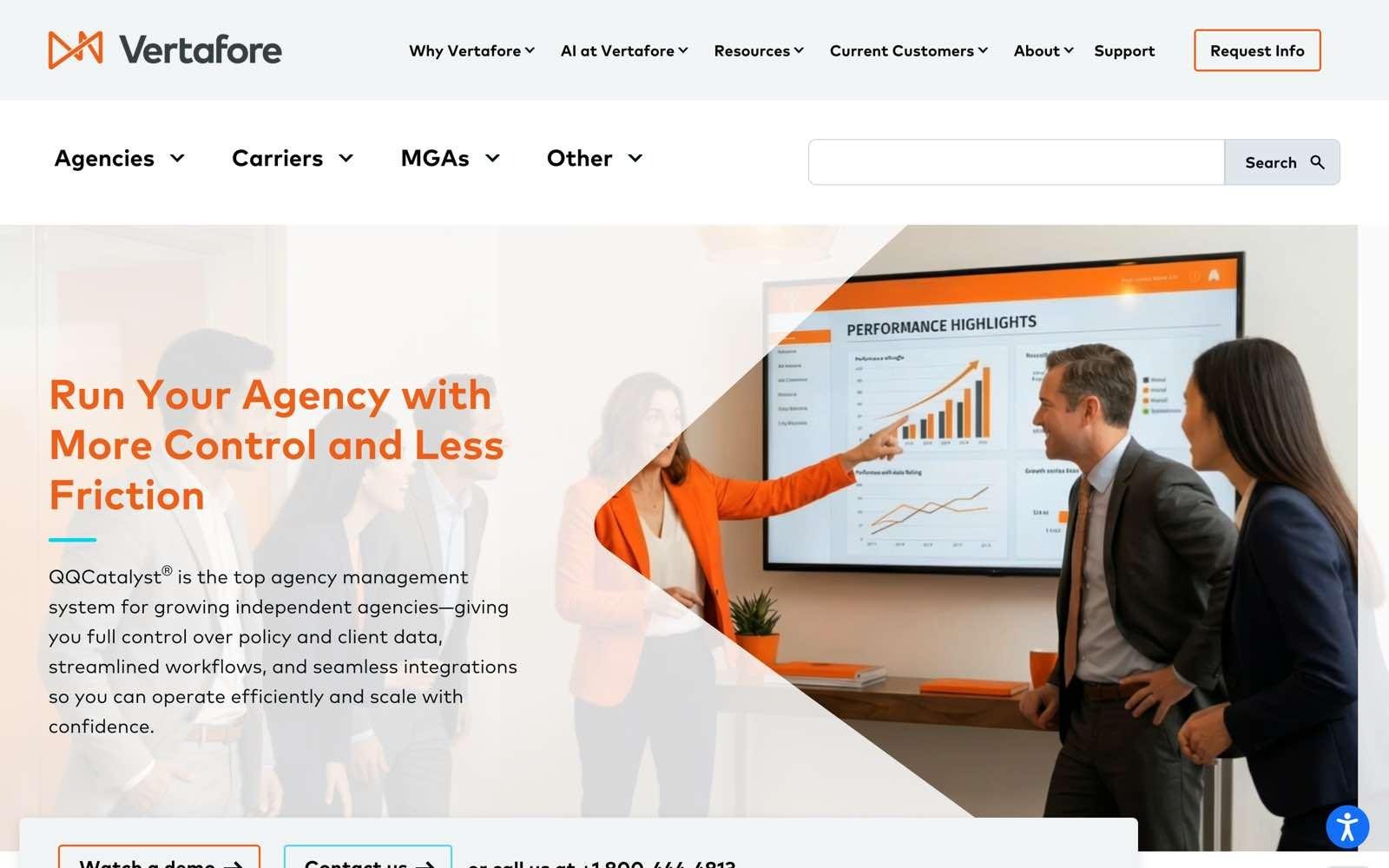
QQCatalyst is Vertafore’s cloud agency management system, built for growing independent agencies moving off desktop software. It centralizes policy and client data, offers customizable dashboards, and includes a sales pipeline manager and workflow automation that most entry-level AMS platforms do not. The product is positioned by Vertafore as "powerful, affordable and modular", which is unusual language from a vendor that otherwise does not publish prices, and it slots below AMS360 in the Vertafore portfolio for agencies that want cloud simplicity without the enterprise rollout.
Ideal For
- Growing independent agencies moving off a desktop AMS
- Small to mid P&C agencies wanting a cloud AMS with a sales pipeline built in
- Agencies wanting access from anywhere without a desktop deployment
- Teams that want 50+ pre-built reports available out of the box
- Agencies on Vertafore’s ecosystem wanting a smaller footprint than AMS360
Top Features
- Cloud-based access: Browser access from anywhere, including mobile, without a desktop deployment.
- Centralized policy and client data: Policy management, contact management, and carrier downloads in one platform.
- Customizable dashboards: Widget-based dashboards that let producers and account managers work from their own view of the book.
- Sales pipeline manager: Native pipeline tracking without a separate CRM, which is unusual at this price point.
- 50+ pre-built reports: Standard reports covering production, retention, and commissions available out of the box.
Why They Stand Out
QQCatalyst occupies the cloud AMS slot in the Vertafore portfolio, which gives agencies on Vertafore’s ecosystem a lighter option than AMS360 without leaving the vendor. The combination of policy management, a sales pipeline, and 50+ reports in one platform is competitive at the small-agency entry point, and the Orange Partner APIs expose a documented integration surface.
Pros
- Cloud-based access from anywhere, including mobile
- Sales pipeline manager included rather than sold as a separate module
- 50+ pre-built reports available out of the box
- Orange Partner APIs expose a documented integration surface
- Native Sonant integration partner, with the call-layer write-back running through an established connection
Cons
- No published pricing, so budgeting requires a quote
- Users on Capterra and G2 report the interface feels dated compared to newer cloud-native products, with occasional slowness and freezing
- Carrier download coverage is lighter than AMS360 or Applied Epic
- Reporting depth sits below the enterprise systems, which matters at scale
- Vertafore ownership can mean price pressure over time, per published user reviews
Pricing
Vertafore does not publish QQCatalyst pricing. Quotes are per agency and scoped by user count and modules. Published user reviews describe pricing that starts low and increases over time, so model total cost over a three-year horizon rather than just the first year. SIAA members may qualify for a discount through the Vertafore partnership. Confirm current rates directly with Vertafore before signing.
Final Verdict
QQCatalyst is recommended for growing independent agencies that want a cloud AMS with pipeline tracking and standard reports out of the box, particularly those already on Vertafore’s broader ecosystem. It is a weaker fit for agencies with significant commercial books that need deeper reporting, or for budget-conscious buyers who need the price in writing before taking a sales call.
6. Momentum AMP™
Overview
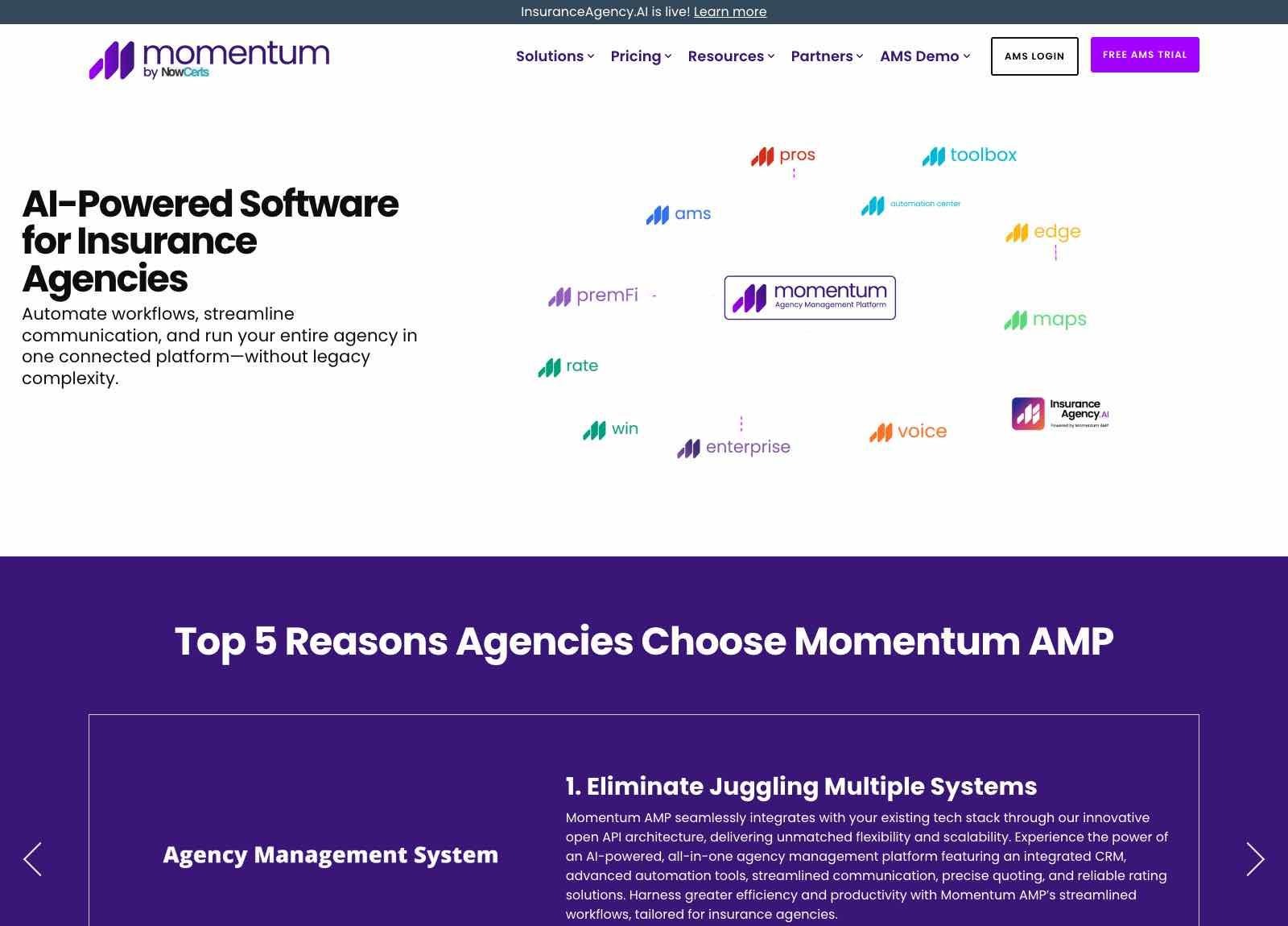
Momentum AMP is an agency management system that combines the record with CRM capability, and it is unusual in this category for publishing a full rate card. Client and policy management, ACORD forms, workflow management, a sales pipeline, a renewal center, billing, and commission reconciliation all sit in the base product, with automation, quoting, premium finance, and voice sold as separate modules. It is the product formerly sold as NowCerts, which merged and rebranded as Momentum in 2024. Anyone who evaluated NowCerts previously is looking at the same lineage under a new name, and the rate card is the reason it is the easiest AMS here to compare on cost.
Ideal For
- Small to mid agencies that want published pricing on an AMS
- Agencies wanting policies, pipeline, and commissions in one product
- Owners who want to start on one or two seats and add users predictably
- Agencies wanting an automation layer they can turn on later
- SIAA member agencies qualifying for the 10% to 15% member discount
Top Features
- Published tiered pricing: Essentials, Professional, Business, and Enterprise tiers with a stated per-seat rate for additions, which makes the cost modelable.
- Policy management with ACORD forms: The system of record functions independent agencies need, including document storage and workflow management.
- Carrier downloads from 300+ carriers: Policy data arrives automatically rather than through manual entry, which is where the time savings come from in daily servicing.
- Renewal center and claims module: Both renewal follow-up and claims tracking are included in the base product, which is unusual at this price point.
- Modular automation, quoting, and voice: Separate modules extend the base system when you are ready rather than at signup, so you are not paying for capability you have not turned on.
Why They Stand Out
Momentum publishes what almost nobody else in this category does, which is a complete rate card including per-seat additions, module prices, and onboarding fees. The combination of system of record, pipeline, carrier downloads, and claims in a product that lists at under $350 a month at the Business tier is a competitive package for small and mid agencies that want transparency.
Pros
- Full published rate card, from $99 a month at entry to $349 for the Business tier
- Additional seats at a flat $45, so growth cost is predictable
- System of record, sales pipeline, carrier downloads, and claims in one product
- Native Sonant integration partner, so the call-layer write-back runs through a published connection
- SIAA members receive 10% discount on all plans and 15% on plans over 10 seats
Cons
- Texting runs through third-party integrations such as Twilio or RingCentral rather than natively, so texting on the client record means adding a second vendor
- Entry tiers are seat-light, with 1 user on Essentials and 2 on Professional, so a 20-person agency lands on Business plus paid seats
- The AMS tier covers the record and the pipeline, while automation, quoting, premium finance, and voice are priced as separate modules, so the total depends on how many you switch on
- Voice minutes on the Momentum Voice module are metered, so a busy month costs more than a quiet one
- The 2024 rebrand from NowCerts means older reviews and community advice still use the NowCerts name
Pricing
Momentum publishes AMS tiers at $99 a month for Essentials with 1 user, $169 for Professional with 2 users, $349 for Business with 5 users, and a quoted Enterprise tier for 50+ users, with additional seats at $45 each. The Automation Center runs free, $99, or $199 a month, and extra automation users cost $25. All prices are in US dollars as published on momentumamp.com and verified against G2’s April 2026 pricing listing. SIAA member agencies receive a 10% discount on all plans and 15% on plans over 10 seats, per Momentum’s SIAA partner page.
Final Verdict
Momentum AMP is recommended for small and mid agencies that want an AMS and a sales pipeline in one product with the price visible before a sales call, and the flat $45 seat rate makes scaling easy to forecast. The free automation tier is a way to test before committing, and the published module prices make the total easy to model. It is a weaker fit for agencies that need texting on the client record out of the box, since messaging depends on a third-party tool you buy and manage yourself.
7. Jenesis™
Overview
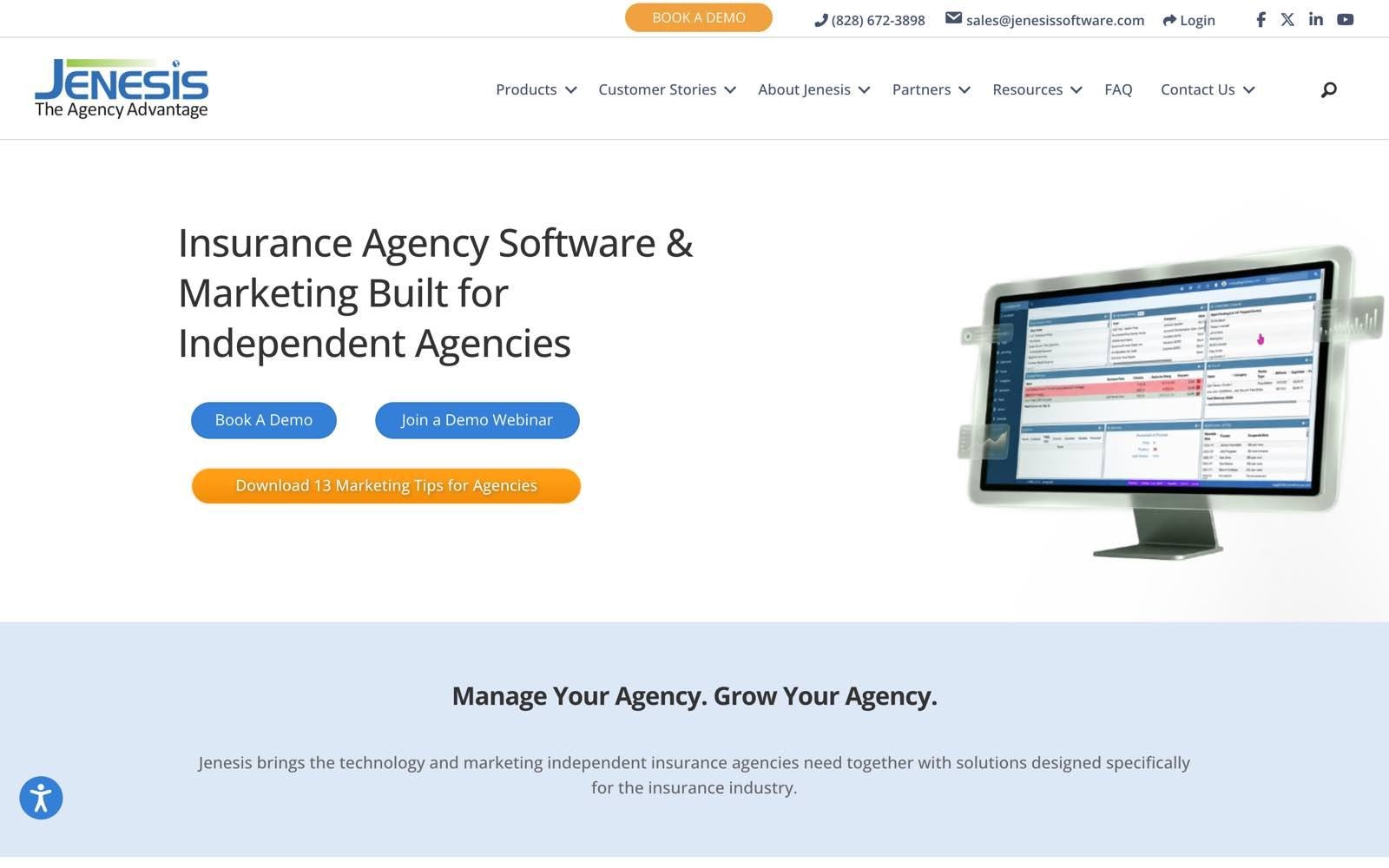
Jenesis is a small-agency agency management system that pairs the servicing basics with a public rate card and a per-location pricing model that suits multi-office small agencies. The platform covers policy tracking, carrier downloads, ACORD forms, two-way email and texting inside the record, commission management, a QuickBooks export rather than a native ledger, a client portal, and e-signature. It is positioned for independent agencies that want servicing tools without an enterprise rollout, and the per-location base fee makes it structurally different to seat-only pricing.
Ideal For
- Small agencies that want a servicing-focused AMS with a published rate
- Multi-location small agencies where location-based pricing works out cheaper than per-seat
- Agencies wanting two-way texting logged against the client record natively
- Teams using QuickBooks for accounting rather than needing a native ledger
- Owners wanting a client portal and e-signature in the base product
Top Features
- Policy tracking with carrier downloads: Policy data arrives through the Ivans network rather than through manual entry, which is where the daily servicing time savings come from.
- Two-way email and texting inside the record: Conversations happen inside the AMS and stay attached to the client, with texting native rather than through a third-party vendor.
- ACORD forms and e-signature: Standard forms and electronic signature capability included in the base product.
- Commission management with QuickBooks export: Commissions calculate inside the AMS and export to QuickBooks for the agency’s accounting workflow.
- Client portal: Policyholders can access documents and ID cards without calling, which reduces inbound volume on routine requests.
Why They Stand Out
Jenesis publishes a per-user plus per-location rate structure, which is unusual in a market dominated by per-seat quotes, and it suits multi-office small agencies in a way most AMS platforms do not. The texting native to the record is also rare at this entry price point, since most AMS platforms rely on third-party integrations for messaging. The combination makes Jenesis a shortlistable option for small P&C agencies that want cloud functionality without an enterprise price tag.
Pros
- Published pricing at $70 per user a month plus a base fee per physical agency location
- Two-way email and texting inside the client record natively
- Commission management with QuickBooks export for accounting workflow
- Client portal and e-signature included in the base product
- Per-location pricing suits multi-office small agencies
Cons
- No native general ledger accounting, so a separate accounting system (such as QuickBooks) is required
- Reporting depth sits well below the enterprise AMS platforms, which limits owners who want segment-level analysis
- Not a Sonant integration partner, so the call-layer write-back runs through webhooks rather than a native connection
- Marketing automation is lighter than dedicated insurance CRM platforms
- Base-fee-per-location pricing can make total cost unpredictable until the vendor quotes the location component
Pricing
Jenesis publishes JenesisNow Pro at $70 per user a month, with a base fee per physical agency location that scales with the office footprint. The published feature set includes 2-way email and text integration, automated marketing campaigns, accounting and commission management, and VoIP integration. A JenesisNow Basic tier is also available at a lower rate for smaller agencies. All prices are in US dollars as published on vendor marketplace listings.
Final Verdict
Jenesis is recommended for small P&C agencies that want a cloud AMS with native texting and a published rate card, particularly multi-office agencies where per-location pricing is structurally cheaper than per-seat alternatives. It is a weaker fit for mid-market or larger agencies that need segment-level reporting and a native general ledger, where the enterprise AMS platforms deliver what is needed despite the longer sales cycle.
8. AgencyBloc™
Overview
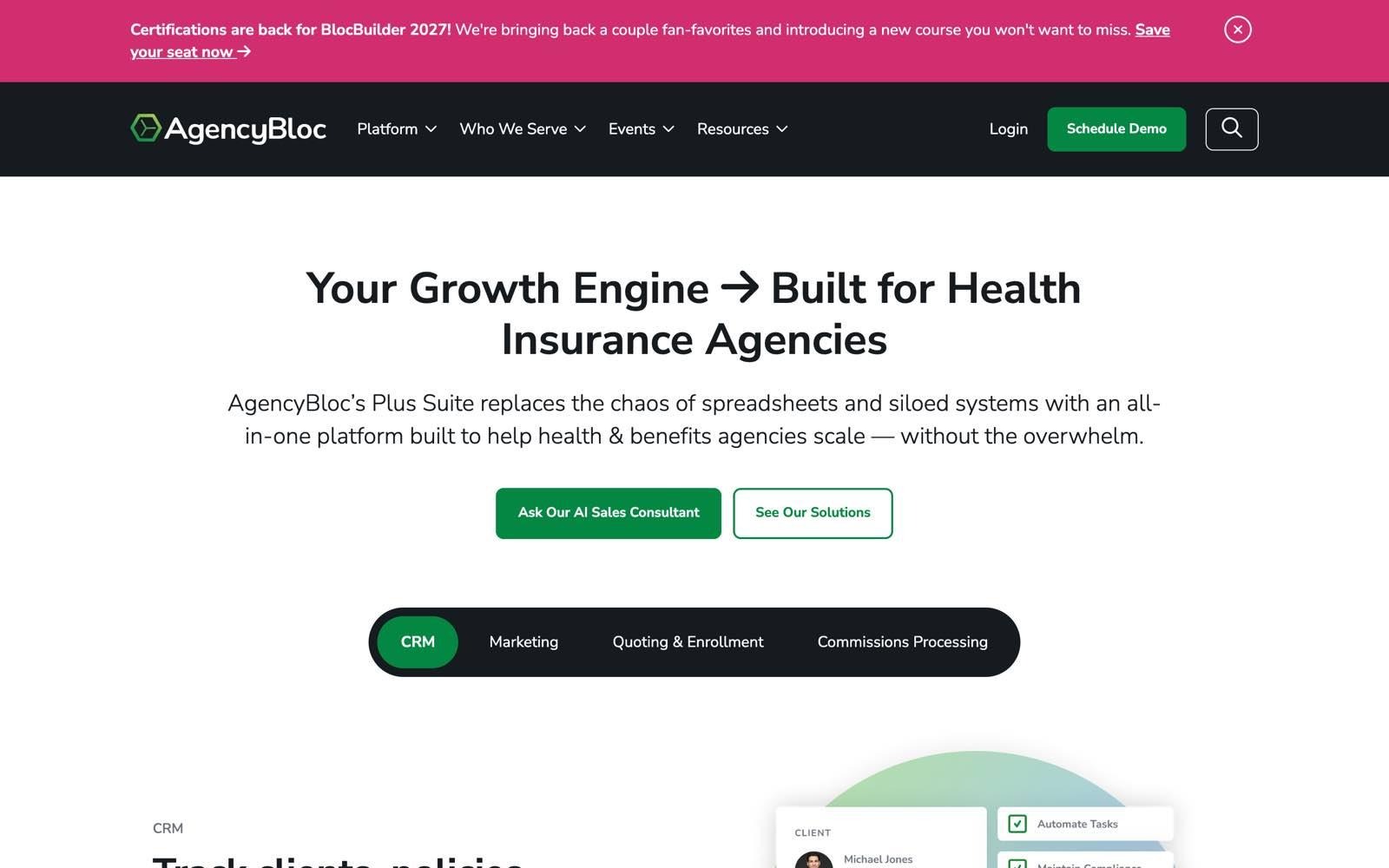
AgencyBloc AMS+ is the vertical AMS for health, senior, and group benefits agencies, and it is a different product from a P&C AMS by design. The data model is built around individual and group benefits rather than property and casualty policies, the commissions module handles the carrier-paid structures benefits agencies live on, and the quoting and enrollment platform covers the group benefits sales workflow. For a P&C-only agency, AgencyBloc is the wrong fit. For a health, Medicare, or group benefits agency, it is the system most often shortlisted.
Ideal For
- Health insurance agencies writing individual and group plans
- Senior and Medicare agencies that need compliant data capture and tracking
- Group benefits agencies needing a quoting and enrollment platform
- General Agencies (GAs), Independent Marketing Organizations (IMOs), and Field Marketing Organizations (FMOs) wanting one platform
- Call centers in the health and benefits space
Top Features
- Benefits-native data model: Individual and group benefits records with the fields and workflows the vertical actually uses.
- Commissions Management System: Carrier-paid commission structures reconciled inside the platform, which is the module most benefits agencies cite as the reason they stay.
- Quoting and Enrollment Platform: Group benefits quoting and enrollment covered as a separate product line.
- Marketing automation and agent tracking: Campaign tooling, policy tracking, and producer activity across the agency.
- Published pricing on the entry tier: AMS+ Grow starts at $109 per user a month, which is one of the few published entry rates in the benefits AMS category.
Why They Stand Out
AgencyBloc describes itself as the #1 recommended insurance industry growth platform for the health, benefits, and senior space, and the specialization is the reason reviewers rate it highly for commissions handling. The combination of a benefits-native data model, carrier-paid commissions reconciliation, and a published entry rate makes it the natural shortlist for an agency on the wrong side of a P&C-focused AMS.
Pros
- Benefits-native data model built for health, senior, and group plans
- Commission reconciliation module built for carrier-paid structures
- Quoting and enrollment platform covers the group benefits sales workflow
- Published AMS+ Grow tier at $109 per user a month with a free trial
- Dedicated onboarding specialist included at no extra cost
Cons
- Not suitable for P&C-only agencies, which should look at the partner integrations above or at Jenesis, Partner XE, or Amplo
- Higher tiers (Accelerate, Elevate) are quoted per agency rather than published
- No dedicated mobile app, per vendor documentation
- Email campaigns are metered at $0.02 per email as a usage add-on
- Not a Sonant integration partner, so the call-layer write-back runs through webhooks rather than a native connection
Pricing
AgencyBloc publishes AMS+ Grow at $109 per user a month, with the Accelerate and Elevate tiers quoted per agency depending on the premium features and seat count. Email campaigns are an add-on usage cost at $0.02 per email. The platform includes a free trial, and the vendor describes a dedicated onboarding specialist as part of the standard engagement. All prices are in US dollars as published on third-party vendor directories; confirm current rates with AgencyBloc before signing.
Final Verdict
AgencyBloc is recommended for health, senior, group benefits, Medicare, and IMO/FMO agencies as the specialized AMS built for that vertical, and the commissions handling is the reason reviewers rank it highly. It is not suitable for P&C agencies, which should pick from the Sonant partner platforms above or from Jenesis, Partner XE, or Amplo depending on size and modernization appetite.
9. Amplo™
Overview
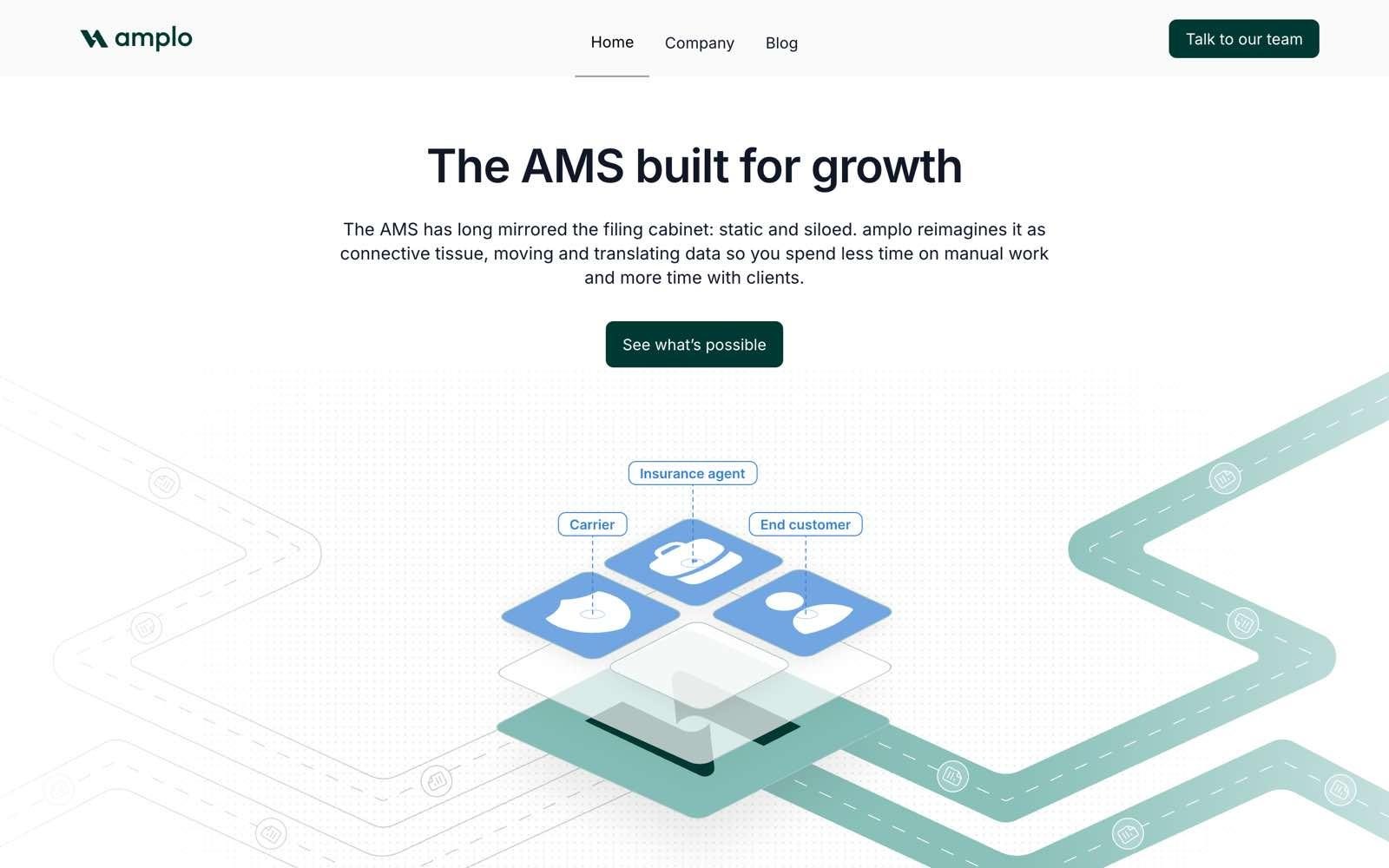
Amplo, formerly known as Veruna, is a modern AI-native agency management system built on the Salesforce platform. The product covers policy and client management, automated data extraction from carrier documents, quoting workflows, and legacy data transformation into real-time insights. The architectural choice (Salesforce as the underlying platform) matters because it gives Amplo access to Salesforce’s ecosystem, security posture, and extensibility, while keeping the AMS logic insurance-specific. It is the shortlist option for independent agencies that want a cloud-native platform rather than a modernized legacy product.
Ideal For
- Modern independent agencies wanting an AI-native AMS rather than a legacy platform
- Agencies that already run Salesforce elsewhere in the business
- Teams that want automated data extraction from carrier documents rather than manual entry
- Agencies modernizing after an acquisition that inherited mixed legacy systems
- Owners wanting real-time insights from unified agency data
Top Features
- AI-powered data extraction: Automated extraction from carrier documents and legacy data transformation, which reduces the manual re-entry step most AMS platforms still require.
- Policy and client management: Insurance-native workflows built on Salesforce’s underlying data platform.
- Automated quoting workflows: Quoting integrated with the AMS rather than run as a separate rater step.
- Real-time insights: Unified agency data feeds reporting and dashboards without a nightly batch job.
- Salesforce foundation: Access to Salesforce’s ecosystem, security posture, and extensibility sits underneath the insurance-specific layer.
Why They Stand Out
Amplo is one of the few AMS platforms built on contemporary cloud architecture rather than modernized from a legacy codebase, and the AI data extraction is a structural answer to the manual re-entry problem that costs agencies hours a day. The Salesforce foundation gives it an integration posture most AMS platforms cannot match, since any tool that integrates with Salesforce has a path to Amplo without a custom build.
Pros
- AI-native architecture built on Salesforce rather than modernized from legacy code
- Automated data extraction reduces manual re-entry from carrier documents
- Salesforce foundation opens the broader Salesforce ecosystem of integrations
- Real-time insights without a nightly batch reporting job
- Modern cloud security and extensibility inherited from Salesforce
Cons
- No published pricing, so budgeting requires a quote
- Industry benchmarks place similar cloud AMS platforms at $100 to $250 per user a month, which positions Amplo above the entry-level AMS platforms
- Not a Sonant integration partner, so the call-layer write-back runs through Salesforce or webhooks rather than a native connection
- The Salesforce foundation can require administration capacity most small agencies do not have in-house
- The 2024-2025 rebrand from Veruna means older reviews and community advice still use the earlier product name
Pricing
Amplo does not publish pricing on its product pages. Industry benchmarks for similar cloud-based AMS platforms place pricing in a $100 to $250 per user a month range according to softwarefinder.com, though actual quotes depend on seat count, modules, and implementation. The Series B funding stage suggests the pricing is set for growth rather than for discounted market entry. All prices are in US dollars; confirm current rates directly with Amplo before signing.
Final Verdict
Amplo is recommended for independent agencies that want a cloud-native AI-first AMS rather than a modernized legacy product, particularly those with Salesforce administration capacity in-house or an existing Salesforce footprint elsewhere. It is a weaker fit for small agencies without administrator capacity, and the lack of published pricing makes it harder to shortlist against HawkSoft, Momentum AMP, and Jenesis without a sales conversation.
10. Partner XE™
Overview
Partner XE from Strategic Insurance Software (SIS) is the independent P&C AMS positioned on ease of use and long-term affordability rather than feature breadth. The platform covers policy management, document management, commission management, renewal management, carrier downloads, and workflow management, with reporting aimed at agency owners who want the business picture rather than enterprise-grade analytics. Partner XE is consistently praised in Capterra reviews for support quality, and reviewers point to the vendor’s responsiveness to feature requests as a structural advantage of a smaller independent vendor.
Ideal For
- Small to mid P&C agencies wanting ease of use over feature breadth
- Agencies that want responsive support from a smaller independent vendor
- Teams moving from an enterprise AMS whose complexity they do not need
- Owners wanting carrier downloads and commission management without enterprise pricing
- Agencies that value long-term affordability over feature maximalism
Top Features
- Policy and document management: The system of record functions independent agencies need, with document management attached to the client record.
- Carrier downloads: Policy data arrives through the Ivans network rather than through manual entry.
- Commission and renewal management: Both commission reconciliation and renewal workflows handled inside the AMS.
- Workflow management: Routing and tracking of agency work without a separate project management tool.
- Responsive feature development: Capterra reviewers specifically praise SIS for listening to suggestions and requests, which contrasts with the roadmap stability of larger vendors.
Why They Stand Out
Partner XE is positioned explicitly on ease of use, breadth of capabilities, and long-term affordability, and the Capterra review record supports the positioning. Reviewers coming from other AMS platforms describe the support experience as the strongest they have had across multi-decade insurance careers. The combination makes it a shortlist option for agencies that have been burned by enterprise AMS complexity or by vendor pricing escalation.
Pros
- Praised in Capterra reviews for ease of use and support quality
- Vendor responsiveness to feature requests, per published reviews
- Carrier downloads, commission management, and renewal workflows included in the core
- Independent vendor positioning on long-term affordability rather than feature maximalism
- Smaller vendor relationship suits agencies that want a direct line to the product team
Cons
- No published pricing, so budgeting requires a quote
- One Capterra reviewer noted the system is not ready for commercial accounts, so complex commercial agencies should test commercial workflows during evaluation
- Not a Sonant integration partner, so the call-layer write-back runs through webhooks rather than a native connection
- Smaller vendor means a thinner third-party integration marketplace than Vertafore or Applied platforms
- Reporting depth sits below the enterprise AMS platforms, which matters for multi-location analysis
Pricing
SIS does not publish Partner XE pricing on its product pages. Quotes are per agency and scoped by user count and modules, with the vendor positioning the system on long-term affordability. Industry listings suggest pricing is competitive with the independent AMS platforms (HawkSoft, Momentum AMP) rather than the enterprise systems. All prices are in US dollars; confirm current rates directly with SIS before signing.
Final Verdict
Partner XE is recommended for small to mid P&C agencies that want an affordable independent AMS with strong support and the responsiveness of a smaller vendor, particularly agencies moving away from enterprise AMS complexity or vendor pricing escalation. It is a weaker fit for complex commercial agencies that need deep commercial lines workflows, and for agencies that depend on a broad third-party integration marketplace.
How to Choose the Best Insurance Agency Management System
Knowing what each product does is only half the decision. This section is the sequence to work through, in order, because most bad AMS purchases come from answering question three before question one.
1. Check Whether the Vendor Publishes a Price at All
Three vendors on this list publish rate cards. HawkSoft at $99 per user a month retail on HawkSoft 6, Momentum AMP from $99 to $349 a month before modules with extra seats at $45, and AgencyBloc AMS+ Grow at $109 per user a month. Jenesis publishes a $70 per user base rate plus a per-location fee. The other six quote only after a demo. That is not an automatic reason to disqualify them, but it means the shortlist cannot start with cost. Work out your real seat count and your required modules before you take any sales calls, because the quote structure is where the money goes.
2. Price the Add-Ons, Not the Seat
Every AMS seat looks reasonable in isolation. The total cost is the seat plus the add-ons: carrier downloads for additional carriers, texting modules, e-signature, certificates, voice minutes, API access, premium finance integrations. Momentum’s module structure makes this visible on the vendor’s own page. HawkSoft publishes named add-on prices for texting ($20 per agency a month) and certificates ($49 per agency a month). For the enterprise systems, ask the quote team to break out every module separately so you can see which charges scale with seats and which with agency size.
3. Check Whether Rating Is Inside the System
Comparative rating is the biggest workflow interruption in personal lines, and the systems where it lives inside the AMS (EZLynx) remove the duplicate entry that costs agencies minutes per quote. For agencies with high personal lines volume, this is the single feature that changes productivity most. For commercial-heavy agencies it matters less, because commercial quoting is a different process and dedicated commercial rating tools cover the gap.
4. Ask Which Integrations Run in Both Directions
A listed integration and a working integration are different things. Ask every vendor three questions: can a third-party tool read the client record live, can it write a structured record back to the AMS, and does the write-back reach the person who owns the account. The Applied Systems Vendor Certification Program documents the integration posture formally. HawkSoft’s labeled partner directory does the same. Everywhere else, confirm the direction of travel in writing before you sign.
5. Confirm Onboarding, Timeline, and Who Supports You After
Time to value is where these purchases fail. An AMS nobody finished configuring is worse than the system it replaced, because the switching cost already landed on your team. Ask how many weeks until the system runs on your data, how much configuration lands back on your team, whether data migration is included, and whether onboarding and support are billed separately. A management system migration is a multi-month project. Plan for three to six months at the median, and ask for named references at agencies your size.
6. Match the System to Your Lines and Your Size
A personal lines agency and a commercial agency need different platforms. A health and benefits agency needs a different platform again. Applied Epic and Vertafore AMS360 lead for complex commercial and enterprise agencies. HawkSoft, EZLynx, Momentum AMP, QQCatalyst, Partner XE, and Jenesis lead for independent personal lines agencies. AgencyBloc is the specialist for health and benefits. Amplo is the modern cloud-native option. The wrong category match is more expensive than the wrong brand within the right category.
7. Decide What Happens to the Phone
Your AMS can hold a perfect record and still be blank on the eight service calls your team fielded this morning, because a phone call only becomes data when a person types it. The call layer is a separate decision from the AMS decision, and it belongs on the shortlist alongside the system of record. Sonant is one option in that layer, and it integrates natively with six of the ten systems reviewed above.
Everything You Need to Know About Insurance Agency Management Software
The table below compresses the whole comparison into one view. Ratings reflect fit for an independent US P&C or benefits agency of 15 people and up, which is why enterprise systems score lower on affordability and ease of use despite being stronger products at scale.
Ratings reflect published documentation, independent reviewer coverage, and vendor-reported product descriptions as of October 2026. Confirm current status with each vendor before signing.
Put Every Call Into Your Agency Management System With Sonant™
Whichever agency management system you pick from this list, it will only ever be as current as the conversations somebody enters. Sonant closes that gap by answering the call, reading the client’s record in your AMS while the caller is still on the line, and writing the outcome back as a documented, routed task. BIG Pickering’s 12% to 100% call answer rate turnaround and 600% ROI in month one documents the pattern inside a Canadian brokerage, and the engagements at Cornerstone, O’Connor, Firefly, and Alpha Direct show the same shape in US agencies on different AMS platforms.
Onboarding, configuration, and support are included, most agencies are live in under 30 days, and the rate does not move when call volume spikes. Applied Epic agencies activate Sonant through the Vendor Certification Program without a separate Applied API purchase. HawkSoft, EZLynx, AMS360, QQCatalyst, and Momentum AMP agencies activate through established partner connections. Everyone else connects through webhooks or the system’s own interface.
Disclaimer
All product names, logos, and brands are property of their respective owners. Sonant™, Applied Epic™ (Applied Systems), HawkSoft™, EZLynx™ (Applied Systems), Vertafore AMS360™ (Vertafore), QQCatalyst™ (Vertafore), Momentum AMP™, NowCerts™, Jenesis™, JenesisNow™, AgencyBloc™, Amplo™, Veruna™, Partner XE™, Strategic Insurance Software™ (SIS), AgencyZoom™ (Vertafore), PL Rating™ (Vertafore), Ivans™, QuickBooks™, Salesforce™, Twilio™, RingCentral™, Vanta™, and SIAA™ are trademarks of their respective companies. No affiliation, endorsement, or sponsorship is implied by the mention of any third-party product. Pricing, plan structure, integrations, certification status, and compliance posture are current as of October 2026 and subject to change; verify with each vendor before making a purchase decision.