

The right insurance agency CRM software, meaning customer relationship management software built for agencies, holds every client, quote, and renewal in one record your whole team can work from, and it earns its license fee by making sure nothing worth money gets forgotten.
Most agencies already own something that does part of that job. What they usually do not own is one place where the sales pipeline, the policy record, and the day’s phone conversations all end up.
That gap is a follow-up problem before it is a software problem, and follow-up only happens when somebody has a record to work from. It is also why the shortlist matters more than the feature list, because these products solve different halves of the job and get bought interchangeably.
This guide reviews 10 options with published pricing where it exists, what each one does with a phone call, and where each one stops being the right fit. It also covers how Sonant™, the AI receptionist built for independent property and casualty (P&C) insurance agencies, fits alongside the systems on this list rather than inside the ranked table.
Key Takeaways (TL;DR)
- The best overall insurance agency CRM software setup: Pair an insurance-specific customer relationship management (CRM) product (AgencyZoom™ or InsuredMine™) or an agency management system (AMS) with CRM capability (HawkSoft™, Momentum AMP™, EZLynx™, Applied Epic™) with a dedicated call layer. Insurance call answering platform sits in that call layer, answering every inbound call, reading the caller’s record in the AMS while the call is live, and writing the outcome back as a routed task. Sonant is a companion to whichever CRM an agency picks from this list rather than a substitute for one, which is why it does not appear in the ranked table.
- Why you need it: Retention is the business model in P&C insurance, and a book being shopped at record rates punishes any missed follow-up. Insurance agency client management software turns scattered notes, inboxes, and voicemails into one record with owners, dates, and next actions attached.
- Who it is for: Independent agencies of 15 people and up where producers, Customer Service Representatives (CSRs), and account managers all touch the same clients, plus operations leaders who need pipeline and service work visible in one place instead of in seven inboxes.
- How to choose the right one: Work out first whether you need a CRM, an AMS, or both, because buying the wrong layer is the most expensive mistake in this category. Then check that every integration runs in both directions, and price it at your real seat count rather than at the headline plan.
- Expected price: Across this list, published pricing runs from $99 a month for an entry-tier agency management system up to $350 per user a month for an enterprise CRM, with several insurance-specific products quoting only after a demo. Sonant charges a predictable partner rate per agency with onboarding, configuration, and support included, so a heavy call week does not change the invoice.
Top Insurance Agency CRM Software in 2026 at a Glance
The table below leads with the Sonant partner integrations, which read and write to Sonant’s call layer natively, and then lists the non-partner CRMs and horizontal platforms an agency should also consider. Every row names the category the product belongs to, because a sales CRM and an AMS solve different halves of the same job.
Pricing is as published by each vendor and verified against the vendor’s own pricing page in October 2026. Confirm current rates directly before you buy. Figures should be re-verified by April 2027.
How Sonant™ Fits With Your Insurance Agency CRM
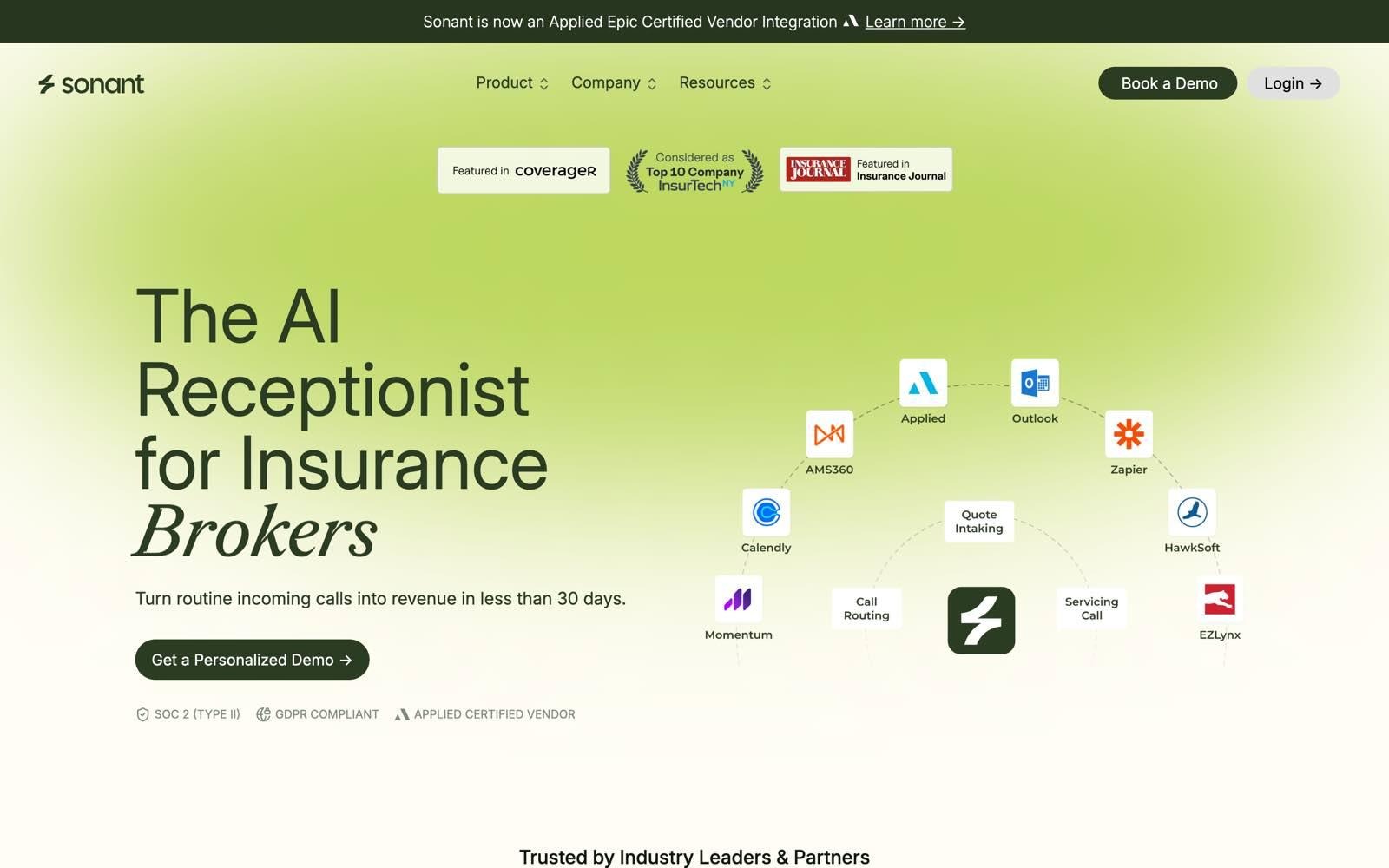
Sonant is not on the ranked list because Sonant is not a CRM. The product occupies the layer the ten systems above all leave empty: the live phone call. Every CRM and AMS on this list is only as current as the conversations somebody enters, which is why the phone work your team fields all day stops counting the moment it hangs up. Sonant answers the call, verifies the caller against the client record, resolves the servicing or quote intake question live during the conversation, and writes the outcome back as a documented, routed task in the system you already run.
Sonant’s AMS and CRM Integration Partners
Sonant plugs natively into six of the ten systems reviewed below. The Applied Epic connection is published through the Applied Certified Vendor Integration Program as of August 2026, which means agencies on Epic do not buy separate Application Programming Interface (API) access to switch Sonant on. The HawkSoft API partnership is documented on HawkSoft’s own partners page, which describes the integration as pulling real-time client data from HawkSoft during calls and automatically logging detailed call notes and tasks under the specific client section. EZLynx, Momentum AMP, AgencyZoom, and AMS360 complete the native partner list.
What the Integration Does on a Live Call
When a caller phones an agency running Sonant alongside one of the partner systems, three things happen inside the one conversation. Sonant opens the client record in the AMS or CRM while the caller is still talking, so a renewal date or coverage question gets answered on the line instead of turning into a callback promise. The call lands on the record as documented notes plus a task routed to whoever owns the account, which is the write-back half of the integration. And mid-call texting sends payment, quote, or claims links to the caller’s phone before the call ends, so the request finishes on the call rather than on a follow-up. Those three behaviors together are what voice AI agents built for insurance change about the shape of a service call.
What Sonant Does and Does Not Replace
Sonant does not quote, does not do agency accounting, and does not hold the sales pipeline. The CRM or AMS the agency picks from this list is still the system of record and the sales layer, and Sonant sits alongside it as the call layer. Agencies on InsuredMine, GloveBox CRM, HubSpot, and Salesforce Financial Services Cloud can still work with Sonant, with the write-back path running through Zapier, webhooks, or the system’s own API rather than through a native connection. The automated AMS note taker and conversation and task management for inbound calls modules do the work either way, with the native partnerships above closing the gap tightest.
How We Chose the 10 Best Insurance Agency CRM Tools
Evaluating this category is different from buying a general business CRM, because the monthly seat price tells you nothing about whether the system can finish a service request. You have to look at "carrier download", meaning whether policy data arrives in the record automatically instead of being typed, and at "account rounding", meaning whether the system surfaces the second policy a household should already have.
We started from more than 40 products that appear in independent agency searches, association technology directories, and agency management system partner listings, then shortlisted 10 using a weighted scoring system. Six of the ten shortlisted products are published Sonant integration partners (Applied Epic, HawkSoft, EZLynx, Momentum AMP, AgencyZoom, AMS360), which we have stated in their entries rather than left implied.
- System integration and routing (25%): Three things, scored separately. Whether the product reads the client record live, so a servicing request can be completed instead of logged. Whether the outcome lands in the system of record as a structured record. And whether the work reaches the CSR or producer who owns the account. A one-way export scores far below a native two-way API connection.
- Insurance-native data model and workflows (20%): Whether policies, carriers, coverages, renewals, and commissions exist as first-class objects out of the box, or whether you build them yourself out of custom fields.
- Onboarding, time to value, and support after go-live (20%): How many weeks until the system is running on your data, how much configuration lands back on your team, and whether onboarding and support are included or billed separately.
- Communication coverage inside the record (15%): Whether calls, texts, and emails are captured on the client record natively, through a paid add-on, or only through a third-party tool you buy and manage yourself.
- True cost at your real seat count (10%): We read each vendor’s own rate card, then modeled a 20-person agency including extra-seat charges, onboarding fees, and message overages. All prices are in US dollars (USD) as published by each vendor and verified in October 2026. Figures should be re-verified by April 2027.
- Security and data documentation (10%): Whether compliance posture, hosting, and retention practices are published rather than promised on a sales call.
Vendor-reported metrics are labeled as such throughout. Where a company publishes a productivity or adoption figure with no independent verification, we have said so instead of treating it as measured.
What Is Insurance Agency CRM Software?
Insurance agency CRM software is a client management system built around how agencies sell and service, so it tracks prospects, quotes, policies, renewals, and service requests against one client record instead of against a generic contact card. A general CRM tracks deals that close once. An agency CRM has to track relationships that renew every 12 months and carry several policies at different stages at the same time.
The confusion worth clearing up first is CRM versus agency management system, because most agencies are shopping for one and describing the other. EZLynx frames the split cleanly in its own guidance, saying agencies choose a CRM when they "sell more than they service" and an agency management system when they "service more than they sell". A closer look at what each layer owns is in this agency management system guide.
- The CRM layer: Leads, pipelines, producer activity, quote follow-up, marketing campaigns, and renewal outreach. This is what people mean by insurance agency lead management software and insurance agency sales tracking software.
- The agency management system layer: The system of record. Policies, endorsements, ACORD forms, carrier downloads, commissions, and agency accounting.
- The communication layer: Calls, texts, and emails, and whether any of them reach the record without someone typing them in.
Four kinds of product compete for this budget, and the group predicts more about your experience than any feature comparison does.
- Insurance-specific CRMs: Built for P&C distribution and designed to sit alongside an AMS. AgencyZoom and InsuredMine sit here, with GloveBox CRM pairing the same automation with a policyholder portal.
- Agency management systems with CRM capability: Management systems rather than CRMs, holding both the record and the pipeline, which is why agencies shortlist them here at all. Applied Epic, HawkSoft, Momentum AMP, EZLynx, and AMS360 sit here, along with QQCatalyst and Jenesis.
- Horizontal CRMs: General-purpose systems you configure into an insurance shape. Salesforce Financial Services Cloud and HubSpot are the two agencies shortlist most, with Zoho CRM close behind.
- The call layer: Voice products that answer the phone and put the result into the systems above. This is where Sonant sits, and it is the layer most agencies discover last.
That last group exists because of a gap nobody’s CRM demo covers. Your CRM can hold a perfect record and still be blank on the eight service calls your team fielded this morning, because a phone call only becomes data when a person stops and types it.
Why Do You Need Insurance Agency CRM Software?
Because in P&C the commission renews, so the revenue you keep depends on service quality and follow-up rather than on new sales alone, and neither survives being tracked in somebody’s memory.
LexisNexis Risk Solutions reported that at the end of the first quarter of 2026, 47.3% of policies in force had been shopped at least once in the previous 12 months, the highest rate since its Insurance Demand Meter began tracking in 2020, and that the direct channel posted the strongest growth at 9.4% year-over-year. Quarterly shopping growth slowed and even turned negative in March 2026, so demand is not what is holding the channel back. Every renewal is now a contested transaction, and the agency that answers first and remembers the last conversation is the one that keeps it.
Agency owners tend to describe the failure in the same handful of sentences. "Manual data entry into AMS eats up a massive amount of time." "No visibility into pipeline or forecast accuracy." "Producers resistant to CRM." "Quote requests sit unanswered for hours and days." Those four describe one problem, which is that the record and the work have come apart.
- Revenue that leaks at follow-up, not at the quote: A quote nobody chases is worth nothing, and the arithmetic favors the follow-up. Commercial auto pays 10% to 15% on new business per Sonant’s published insurance agent commissions breakdown, and AtoB puts the annual premium for an established owner-operator with independent authority at $9,000 to $17,000, so one small commercial account carries more renewing commission than several personal lines households put together. Work that against your own book before you compare rate cards, because it sets what a single dropped follow-up costs you.
- Cross-sell that never happens: Owners say it plainly, that "CSRs do not proactively cross-sell during service calls" and that "tracking cross-sell opportunities systematically" is unsolved. Policies per client is the growth lever most agencies under-execute, and it needs the service conversation to be captured before anyone can act on it, which is why cross-selling in agencies is a data problem before it is a training problem.
- Documentation gaps that become errors and omissions exposure: Analyzing Swiss Re Corporate Solutions claims data, IA Magazine reported that failure to procure coverage accounts for about 30% of all claims, with the next highest cause barely reaching 10%. In those cases what was documented decides the defense, and notes typed from memory at 6pm are the weakest part of that file.
- Producer time spent on the wrong work: Owners describe being "still answering phones myself after 15 years" and having "too many calls, not enough time for revenue work". Every hour a licensed producer spends on a billing question is an hour not spent quoting, and the cost of missed calls at your own answer rate usually settles the business case faster than a feature grid does.
The limit is worth naming. A CRM records and prompts, but it cannot answer a ringing phone, so if the calls generating your service and quote work never make it into the system, better software only gives you a tidier picture of the same blind spot.
Who Needs Insurance Agency CRM Software?
Not every agency needs to buy something new. The pattern that predicts a fast payback is several people touching the same clients, revenue that renews, and an owner who has started asking "which tech actually saves time versus adds complexity". These five situations see it first.
Agencies Where Producers Still Answer the General Line
In agencies of 15 people and up, the general line usually rings out across producer and CSR desks, and everyone picks up because nobody wants the client to wait. The cost is not the interruption, it is that a licensed producer handling a certificate request is doing clerical work on commission time, and none of it gets logged. These agencies need capture and routing before they need another pipeline view. AI lead qualification for insurance agencies takes the first filter off a licensed producer’s desk.
Operations Leaders Routing Callers to Assigned Account Managers
Once accounts are assigned by client, industry, or line, callers cannot reliably name the person they need, so somebody triages all day. Principals in this position usually hand the evaluation to an operations leader, who will judge any system on one thing, which is whether it can look up who owns the account and route by ownership rather than by menu choice. Getting that right converts the general line from a bottleneck into a front door.
Agencies Running an Agency Management System With No Pipeline
Plenty of agencies have a perfectly good system of record and no visible sales process, which is where insurance agency lead management software earns its keep. Leads arrive from carriers, referral partners, and the website, then sit in a shared inbox until someone remembers them, and owners describe the result as "leads coming in but conversion rate is terrible". These agencies want a CRM alongside the management system, not instead of it.
Agencies Whose Renewal and Cross-Sell Follow-Up Depends on Memory
If your renewal process is a spreadsheet and a good CSR’s habit, it works right up until that CSR takes a week off. Agencies in this position need renewal automation, at-risk flags, and account rounding prompts attached to the record, along with a way to see whether the outreach happened. AI appointment booking for insurance sits alongside the renewal cadence by catching inbound scheduling requests on the first ring.
Multi-Location Agencies Standardizing the Client Record
Agencies that grew by acquisition inherit a different way of working at every location, and no consistent answer to how a client is documented. They need one data model and one set of reports before they need more features, and they usually carry a technology gatekeeper who will ask for published security documentation before a demo gets scheduled.
Best Insurance Agency CRM Software: In-Depth Review and Comparison
Each entry covers who the product fits, what it does with a client record, published pricing, where the vendor publishes any, and where it stops being the right choice. Products are ordered with Sonant partner integrations first, since those are the systems where the call-layer write-back works natively, and non-partner systems after. Within the partner group, enterprise AMS leads so Epic agencies find themselves immediately.
1. Applied Epic™
Overview
Applied Epic from Applied Systems is the enterprise agency management system in this market, and it dominates mid-market and larger agencies. It centralizes client data, policy management, accounting, and reporting in one system, with the carrier connectivity and reporting depth that complex commercial operations need. Its CRM capability is real but positioned differently to a sales-first product, tracking client and policy relationships from the system of record rather than driving a producer pipeline. Sonant is a certified integration partner, certified when the Applied integration program launched in August 2026, which means Epic agencies do not buy separate API access to switch it on.
Ideal For
- Agencies of 20+ users with complex commercial lines operations
- Multi-location agencies needing one data model across offices
- Agencies with heavy carrier connectivity and download requirements
- Finance teams needing deep agency accounting and reporting
- Agencies wanting a certified integration program for third-party tools
Top Features
- Single system of record at scale: Client data, policies, accounting, and reporting in one system, which is what multi-location agencies buy it for.
- Carrier connectivity and downloads: Strong download capability keeps policy data current without manual entry.
- Deep reporting: Reporting depth that smaller management systems do not reach, which matters for owners running the agency by numbers.
- Certified integration program: Applied certifies third-party integrations, so agencies can add tools without building the connection themselves.
- Broad integration surface: Among the widest sets of certified and third-party connections in the independent channel.
Why They Stand Out
Scale and connectivity are the reasons Applied Epic wins evaluations at the top of the market, and its certification program is a meaningful signal for buyers who have had a connector break on them before. It is a fit for agencies with complex commercial lines and multiple locations, and the reporting depth supports the kind of segment-level analysis smaller systems do not produce.
Pros
- Built for scale, with the depth multi-location and commercial-heavy agencies need
- Strong carrier connectivity and download capability
- Reporting depth that supports segment and location-level analysis
- Certified integration program reduces the risk of a connector breaking
- A wide range of third-party integrations in the independent agency channel
Cons
- No published pricing, and enterprise procurement means a longer buying cycle
- Best suited to agencies with 20+ users, so smaller agencies may be buying depth they do not need yet
- Implementation is a project with training and change management, not an install
- Third-party tools generally need Applied API access purchased separately unless the vendor holds a certified integration
- Producer-facing sales workflows are thinner than in a dedicated insurance CRM, so many Epic agencies buy one alongside
Pricing
Applied does not publish Epic pricing. Quotes are per agency, scoped by user count, modules, and implementation, and the total cost of ownership includes training and data migration. Budget separately for API access if you plan to connect tools that do not hold a certified Applied integration, because that line is easy to overlook at the quote stage.
Final Verdict
Applied Epic is recommended for agencies of 20+ users with complex commercial lines, multiple locations, and reporting needs that smaller systems cannot meet, and its certification program is the strongest protection against integration failure available in this category. For the majority of independent agencies it is more system than the operation requires, the implementation is a project rather than a purchase, and enough Epic agencies pair it with a dedicated CRM that it is worth budgeting for both.
2. HawkSoft™
Overview
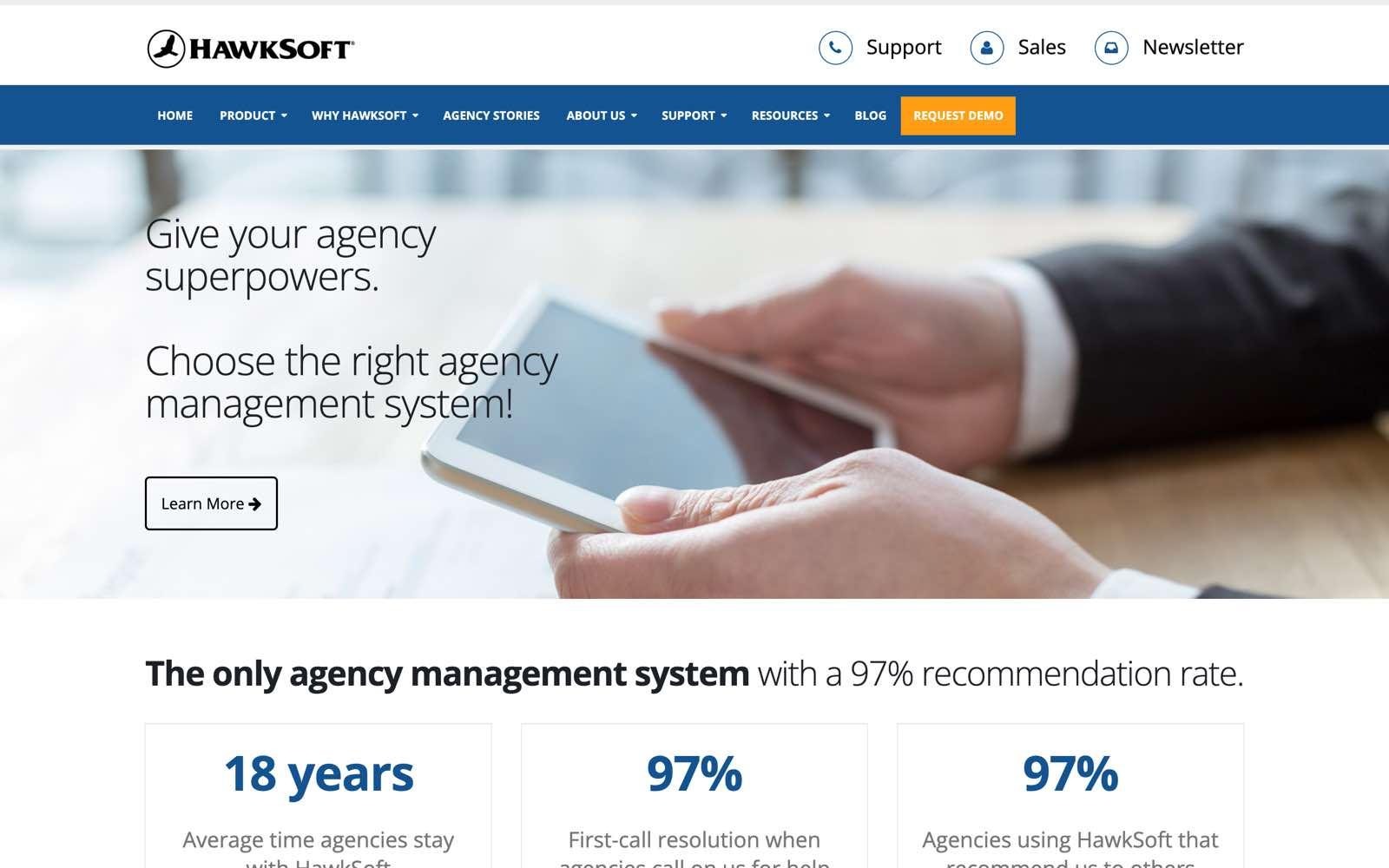
HawkSoft is an independently owned agency management system founded in 1995, and it is the option most often recommended for personal lines agencies that want one record instead of a stack. The CRM capability is native to the system rather than a separate layer, covering lead categorization through the funnel, cross-sell and upsell reporting, and retention alerts that flag which policyholders need attention. It is also a clear example of what a real integration program looks like in this market, running a published partner API that third-party tools build against.
Ideal For
- Personal lines agencies wanting policy management and client management in one system
- Agencies of 10 to 50 people that value support responsiveness over feature breadth
- Owners who want cross-sell and retention reporting from the system of record
- Agencies wanting a documented partner API rather than a closed system
- Teams that want text messaging and e-signature without a separate tool
Top Features
- One record for policies and relationships: Policy servicing and client management live together, so there is no sync to maintain between the record and the pipeline.
- Lead categorization and funnel tracking: Leads are tracked through stages inside the management system, covering the sales tracking job without a second product.
- Cross-sell and retention reporting: Reports surface which households are under-covered and which policyholders are at risk, which is account rounding made visible.
- Text messaging and e-signature: Both are native features rather than integrations you buy separately.
- Published partner API program: Third-party vendors build two-way integrations against a documented API, which is why HawkSoft agencies have a wider tool choice than closed-system agencies do.
Why They Stand Out
HawkSoft publishes support and loyalty numbers most vendors do not, reporting 18 years of average customer retention, a 97% first-call resolution rate, and a 97% recommendation rate among users, all vendor-reported. It is a fit for agencies that want their management system to be the CRM as well, and the partner API means the tools around it stay open. Sonant is a listed HawkSoft API partner, and the connection is documented on the HawkSoft partner page as pulling real-time client data from HawkSoft during calls and automatically logging detailed call notes under the specific client section.
Pros
- CRM capability built into the system of record, so nothing needs syncing
- Documented partner API program with named two-way integrations
- Native text messaging and e-signature included
- Cross-sell and retention reporting aimed at account rounding
- Published support metrics including a 97% first-call resolution rate, vendor-reported
Cons
- No published pricing, so budgeting requires a quote
- Strongest in personal lines, so complex commercial and specialty books may need more than its focus covers
- Marketing automation is lighter than a dedicated insurance CRM, so sales-heavy agencies often add one alongside
- A management system migration is a bigger project than adding a CRM, typically measured in months
- Reporting depth sits below the enterprise systems, which matters at scale
Pricing
HawkSoft does not publish pricing. Quotes are per agency and depend on user count and implementation scope, and the company promotes flexible implementation with live assistance rather than a self-serve signup. Treat migration effort as part of the cost, since moving a system of record is the biggest operational upheaval on this list.
Final Verdict
HawkSoft is recommended for personal lines agencies that want their system of record to double as their client management system, and its open partner API makes it a safer long-term choice than a closed system for agencies that expect to add tools later. The support record is the reason existing users stay. It is a weaker fit for a commercial-heavy agency that needs deep reporting and complex line structures, and no published pricing means you cannot put it in a budget without a sales conversation.
3. EZLynx™
Overview
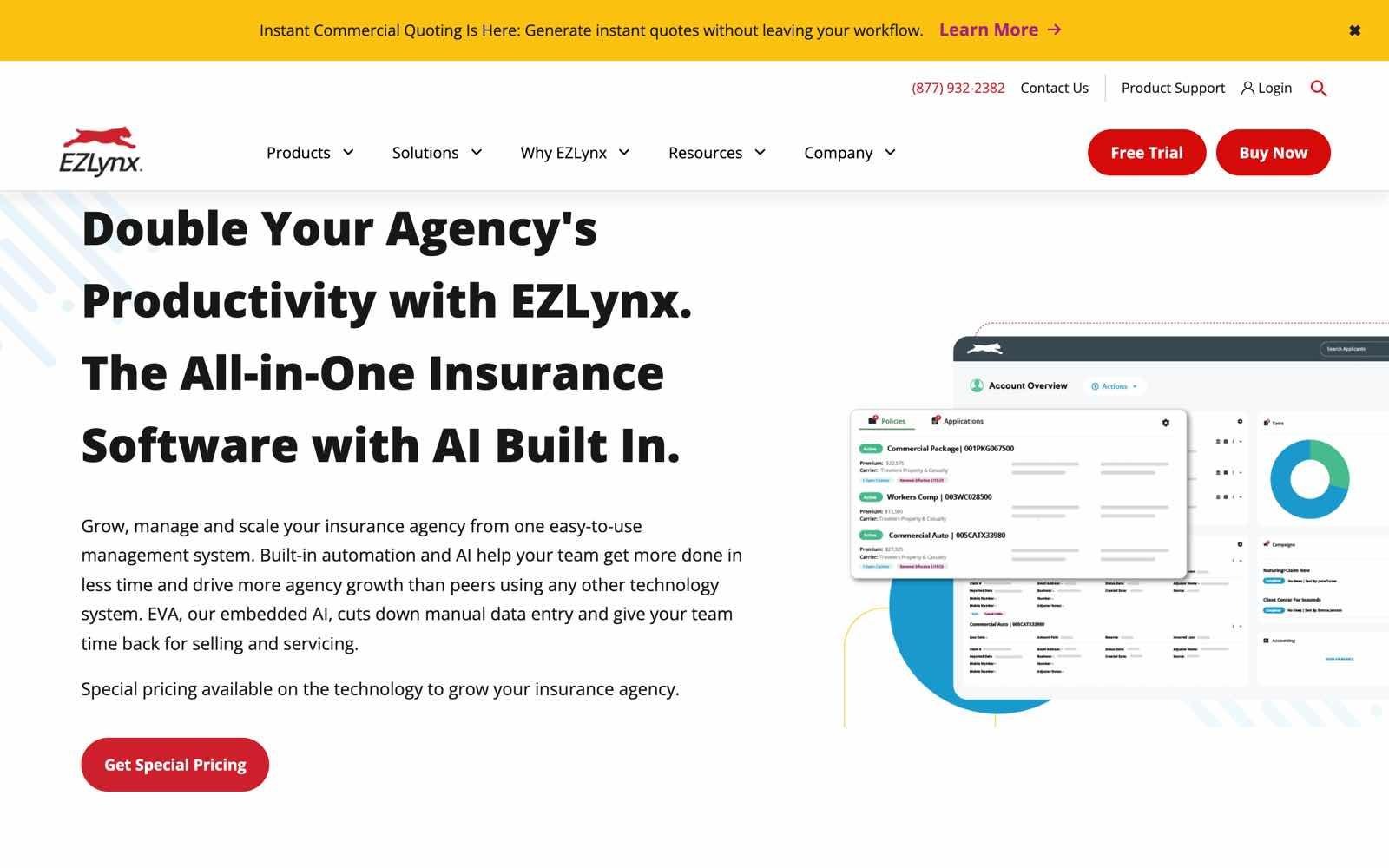
EZLynx, part of Applied Systems, is an agency management system built around a comparative rater, which makes it the natural choice for personal lines agencies where quoting speed decides the day. The management system covers policy servicing, CRM, marketing automation, renewals, accounting, and digital payments, with commercial submissions and agency websites available alongside. The CRM is not a separate module, so relationship and pipeline functions live inside the management system rather than beside it.
Ideal For
- Personal lines agencies where comparative rating volume drives the business
- Agencies wanting quoting, servicing, and CRM in one system
- Teams that want renewal quoting to run automatically
- Agencies wanting commercial submissions from a single data entry
- Owners wanting digital and self-service payments built in
Top Features
- Native comparative rating: Real-time quotes from multiple carriers with prefill and lookup, which removes the biggest source of duplicate entry in personal lines.
- Patented retention workflow: Automated renewal quoting with at-risk policy prioritization and premium-change summaries.
- Single-entry commercial submissions: Multi-carrier commercial submissions from one data entry, which is rare outside enterprise systems.
- CRM and marketing automation inside the system: Visual pipeline tracking, email campaigns, and lead nurturing without a second product.
- Digital payments and commission automation: Payment acceptance and automated commission calculation in the same system as the policy record.
Why They Stand Out
The rating engine is the reason agencies choose EZLynx, and having it native rather than integrated is what separates it from most management systems. It is a fit for high-volume personal lines agencies, and the patented retention workflow gives renewal management more structure than a reminder queue. Being part of Applied Systems also means the carrier connectivity investment continues.
Pros
- Comparative rating built in rather than integrated, which removes duplicate quote entry
- Patented retention workflow with at-risk prioritization and change summaries
- CRM, marketing automation, and pipeline included in the management system
- Single-entry commercial submissions across multiple carriers
- Digital payments and automated commission calculation in the same record
Cons
- No published pricing, so cost needs a quote and cannot be compared line by line
- Texting appears as text-message quoting under the rating engine rather than as full two-way messaging on the client record
- Personal lines orientation means commercial-heavy agencies often find the servicing model built for a different shape of book
- CRM depth sits below dedicated insurance CRMs on campaign and producer-accountability features
- Migration from another management system is a multi-month project, not a switch
Pricing
EZLynx does not publish pricing on its product pages. Quotes are per agency and scoped by user count and which modules you take, so the rating engine, management system, and websites can be priced separately. Ask specifically what is included in the base management system versus billed as an addition, because the module structure is where the quote moves.
Final Verdict
EZLynx is recommended for personal lines agencies where comparative rating volume is the business and quoting speed is the constraint, and the native rater plus patented renewal workflow is a strong combination for that shape of agency. It is a weaker fit for commercial-heavy agencies or for teams whose main gap is producer accountability, and with no published pricing and a modular quote structure, working out your real annual cost takes a sales conversation rather than a comparison table.
4. Momentum AMP™
Overview
Momentum AMP is an agency management system that combines the record with CRM capability, and it is unusual in this category for publishing a full rate card. Client and policy management, ACORD forms, workflow management, a sales pipeline, a renewal center, billing, and commission reconciliation all sit in the base product, with automation, quoting, premium finance, and voice sold as separate modules. It is the product formerly sold as NowCerts, which merged and rebranded as Momentum in 2024. Anyone who evaluated NowCerts previously is looking at the same lineage under a new name, and the rate card is the reason it is the easiest product here to compare on cost.
Ideal For
- Small to mid agencies that want published pricing on a management system
- Agencies wanting policies, pipeline, and commissions in one product
- Owners who want to start on one or two seats and add users predictably
- Agencies wanting an automation layer they can turn on later
- Teams that want commission reconciliation without a separate accounting tool
Top Features
- Published tiered pricing: Essentials, Professional, Business, and Enterprise tiers with a stated per-seat rate for additions, which makes the cost modelable.
- Policy management with ACORD forms: The system-of-record functions independent agencies need, including document storage and workflow management.
- Sales pipeline and renewal center: Both the sales tracking and the renewal follow-up jobs sit in the base product rather than in an add-on.
- Commission reconciliation and reporting: Interactive reports and reconciliation cover the accounting side most CRMs do not touch.
- Modular automation, quoting, and voice: Separate modules extend the base system when you are ready rather than at signup, so you are not paying for capability you have not turned on.
Why They Stand Out
Momentum publishes what almost nobody else in this category does, which is a complete rate card including per-seat additions, module prices, and onboarding fees. It is a fit for agencies that want a modern management system without an enterprise procurement process. It is also a native Sonant integration partner, which we are stating for the same transparency reason as the HawkSoft note.
Pros
- Full published rate card, from $99 a month at entry to $349 for the Business tier
- Additional seats at a flat $45, so growth cost is predictable
- System of record and sales pipeline in one product, with no sync to maintain
- Native Sonant integration partner, so the call-layer write-back runs through a published connection
- Commission reconciliation and interactive reports included in the base product
Cons
- Texting runs through third-party integrations such as Twilio or RingCentral rather than natively, so texting on the client record means adding a second vendor
- Entry tiers are seat-light, with 1 user on Essentials and 2 on Professional, so a 20-person agency lands on Business plus paid seats
- The AMS tier covers the record and the pipeline, while automation, quoting, premium finance, and voice are priced as separate modules, so the total depends on how many you switch on
- Voice minutes on the Momentum Voice module are metered, so a busy month costs more than a quiet one
- The 2024 rebrand from NowCerts means older reviews and community advice still use the NowCerts name
Pricing
Momentum publishes AMS tiers at $119 a month for Essentials with 1 user, $199 for Professional with 2 users, $419 for Business with 5 users, and a quoted Enterprise tier for 50 plus users, with additional seats at $54 each.
The Automation Center runs free, $99, or $199 a month, and extra automation users cost $25. Rate is $100 to $300 a month for 2 to 8 users, and Voice is $150 to $240 a month with 500 to 1,000 minutes included and $0.40 a minute beyond. The managed-staffing PROs service is separate again, at $1,950 or $2,950 a month plus a $900 onboarding fee per person. All prices are in US dollars as published.
Final Verdict
Momentum AMP is recommended for small and mid agencies that want a management system and a sales pipeline in one product with the price visible before a sales call, and the flat $45 seat rate makes scaling easy to forecast. The free automation tier is a way to test before committing, and the published module prices make the total easy to model. It is a weaker fit for agencies that need texting on the client record out of the box, since messaging depends on a third-party tool you buy and manage yourself.
5. AgencyZoom™
Overview
AgencyZoom is a Vertafore product built specifically as an insurance CRM for P&C agencies, aimed at the sales and retention side rather than at the system of record. It covers lead management, producer sales tracking, onboarding automation, and renewal outreach, and it is designed to sit on top of the agency management system an agency already runs. That focus is why it shows up on so many shortlists. Agencies with a solid management system and no visible sales process get a pipeline, goals, and activity reporting without replacing anything underneath.
Ideal For
- Independent, Allstate, and Farmers agencies wanting a sales pipeline on top of an existing management system
- Owners who want producer goals, revenue tracking, and activity reports in one view
- Agencies formalizing a new-business handoff and onboarding process
- Teams that want renewal and winback outreach automated
- Agencies wanting Google Reviews requests built into the workflow
Top Features
- Lead management with custom pipelines: Leads from carriers, vendors, and the website land in defined stages with owners attached, which is the core of insurance agency lead management software.
- Sales and activity tracking: Producer goals, revenue tracking, and activity reports give owners the pipeline visibility most agencies say they lack.
- Renewal and winback automation: Retention outreach runs on a schedule rather than on a CSR’s memory, available from the Growth tier.
- Two-way texting and email: Conversations happen inside the system and stay attached to the contact, on the Growth and Pro tiers.
- Google Reviews requests: Review asks are triggered from the workflow, which matters because reachability complaints show up publicly.
Why They Stand Out
AgencyZoom publishes a real rate card, which is rarer in this category than it should be, and every tier includes 7 users rather than charging per seat. It is a fit for agencies that want sales discipline without a management system migration, and the carrier-specific editions for Allstate and Farmers agencies handle comp calculators and chargebacks that independent-only products do not model.
Pros
- Published pricing with 7 users included on every plan, and a 14-day free trial
- Insurance-specific sales and retention workflows rather than a general CRM configured into shape
- Carrier-specific editions for Allstate ($99 a month for a single location) and Farmers agencies
- Two-way texting and email on Growth and Pro, so conversations stay on the record
- 20% discount on annual billing
Cons
- Two-way texting starts on the $199 Growth tier, so the entry plan covers email and phone
- Click to call arrives on the Pro tier at $349 a month, so call logging sits higher up the rate card
- It is a CRM rather than a system of record, so policy servicing, ACORD forms, and accounting stay in your management system
- The 7-user allowance is generous for a 10-person agency and tight for a 30-person one, so larger teams should confirm how additional users are priced
- Inbound calls still depend on a person answering and typing, since call handling sits outside what the CRM covers
Pricing
For independent agencies, AgencyZoom publishes Essential at $149 a month, Growth at $199 a month, and Pro at $349 a month, each including 7 users with a 14-day free trial and a 20% discount for annual billing. Allstate agencies pay $99 a month for a single location and $129 for multiple locations, and Farmers agency pricing matches the independent tiers. The practical decision is Essential versus Growth, because two-way texting, renewal automation, and Google Reviews all sit on Growth. Pricing is live-verified on agencyzoom.com and support.agencyzoom.com in October 2026.
Final Verdict
AgencyZoom is recommended for agencies that already have a system of record and want producer accountability, pipeline visibility, and automated renewal outreach without changing anything underneath, and the published pricing makes it easy to budget. It pairs naturally with a call layer, since the CRM only knows about the conversations somebody enters. It is not the right buy for an agency that needs one system for policies, accounting, and sales, and the texting and renewal automation most agencies shortlist it for sit on the Growth tier rather than the entry plan.
6. AMS360™

Overview
AMS360 is Vertafore’s flagship agency management system, positioned as a full-featured platform for independent agencies of varying sizes. It handles policy and client management, document storage, carrier downloads, commission tracking, agency accounting, ACORD forms, and reporting, with CRM capability layered in rather than sold as a separate module. The Vertafore footprint means AMS360 agencies have the broadest access to Vertafore-native integrations (AgencyZoom, QQCatalyst sibling tooling, PL Rating), and Sonant is a native integration partner on the call-layer side.
Ideal For
- Independent agencies on Vertafore wanting one platform for policies and client relationships
- Mid-market agencies with a mix of personal and commercial lines
- Agencies that value Vertafore ecosystem depth and carrier download coverage
- Finance teams needing agency accounting inside the AMS
- Teams that want ACORD forms and document management native to the record
Top Features
- Policy management with carrier downloads: The system of record functions independent agencies need, with Vertafore’s carrier download investment behind it.
- Agency accounting inside the AMS: Commission tracking, agency bill accounting, and reporting sit in the same system as policies.
- ACORD forms and document management: Standard forms and document storage attached to the client record out of the box.
- Vertafore ecosystem integrations: AgencyZoom (CRM), PL Rating (comparative rater), and QQCatalyst sit alongside AMS360 inside Vertafore’s portfolio.
- Reporting and analytics: Interactive dashboards and standard reports give owners the view most independent agencies want.
Why They Stand Out
AMS360 pairs independent agency sizing with Vertafore ecosystem depth, which is why it is the AMS Vertafore CRM add-ons target first. The combination of carrier downloads, agency accounting, and native Vertafore integration coverage gives it a wider in-platform footprint than most mid-market agencies need from a standalone AMS.
Pros
- Vertafore ecosystem gives the broadest set of native integrations with Vertafore-owned CRM, rater, and marketing tools
- Carrier download coverage benefits from Vertafore’s long-standing carrier connectivity investment
- Agency accounting inside the AMS rather than through a separate general ledger
- Reporting dashboards aimed at owners running the agency by numbers
- Native Sonant integration partner on the call-layer side
Cons
- No published pricing, so budgeting requires a sales conversation
- Vertafore ecosystem can make it expensive to swap one piece out of the stack later
- CRM depth within AMS360 itself sits below dedicated insurance CRMs on pipeline and producer-accountability features
- Implementation is a project with training and change management, not a self-serve install
- Agency owners report the user interface lags newer cloud-native products on day-to-day navigation
Pricing
AMS360 does not publish pricing on its product pages. Quotes are per agency and scoped by user count, modules (AgencyZoom, PL Rating, add-ons), and implementation. Industry commentary from October 2026 places typical costs in a per-user-per-month range comparable to Applied Epic, though lower at the entry end. Confirm current rates directly with Vertafore before signing.
Final Verdict
AMS360 is recommended for independent agencies on Vertafore that want policies, accounting, and ecosystem CRM add-ons under one vendor relationship. For agencies not committed to the Vertafore ecosystem, Momentum AMP’s published rate card and HawkSoft’s open partner API offer tighter cost control, but the Vertafore depth is the reason AMS360 agencies stay.
7. InsuredMine™
Overview
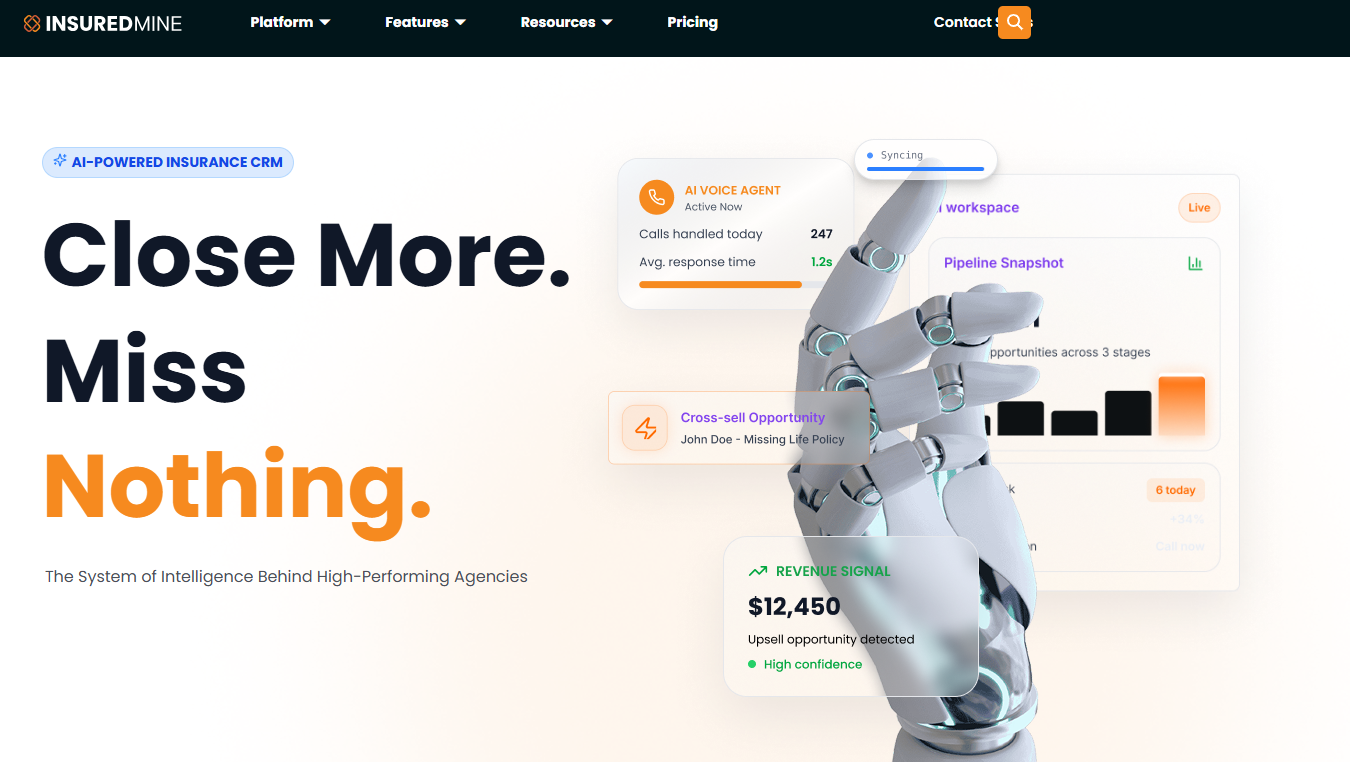
InsuredMine is an insurance CRM built around communication, with deal pipelines, texting, email campaigns, and a client-facing mobile app sitting on top of two-way syncs into the agency management systems independent agencies run. It targets agencies that want client conversations and sales activity in one place without leaving the system of record behind. The integration list is the main argument for it. InsuredMine publishes named connections to AMS360, Applied Epic, HawkSoft, QQ Catalyst, NowCerts, Sagitta, Nexsure, and others, and describes several of them explicitly as two-way syncs.
Ideal For
- Agencies that want texts, emails, and calls logged against the client record
- Agencies on NowCerts, AMS360, or HawkSoft wanting a CRM layer with a real sync
- Producer teams working deal pipelines with stage-based automation
- Agencies wanting a branded client mobile app without building one
- Teams that want e-signature and payment requests inside the same workflow
Top Features
- Two-way agency management system sync: The NowCerts connection, now the Momentum family of products, is described as a two-way sync covering accounts, contacts, policies, notes, and files, which is deeper than most CRM integrations in this category.
- Texting and email inside the record: Twilio-backed messaging keeps conversations attached to the client, making it a credible answer for insurance agency software with texting capability.
- Deal pipelines with automation: Stage-based pipelines with triggered follow-up cover the lead management and sales tracking jobs in one place.
- Client-facing mobile app: A co-branded app gives policyholders self-service access, which takes routine requests out of the queue.
- Rater and data connections: Turborater, PL Rater, QuoteRUSH, Canopy Connect, and miEdge connections reduce re-entry during quoting.
Why They Stand Out
Among insurance CRMs, InsuredMine has one of the broadest published integration lists, and it names the direction of travel for several of them rather than leaving buyers to assume. The communication coverage is wide, spanning texting, email, phone integrations with RingCentral and Lightspeed Voice, and voice drops, all attached to the client record.
Pros
- Named two-way syncs with several agency management systems, including NowCerts across accounts, contacts, policies, notes, and files
- Texting and email built into the client record rather than run through a separate tool, with published overage rates
- 14-day trial for $1, which is a low-friction way to test the workflow
- Co-branded client mobile app included in the base product
- Rater and data-enrichment integrations that cut duplicate entry during quoting
Cons
- Pricing is not published as numerals on the pricing page, so budgeting needs a quote
- Setup and implementation fees can apply, so the first-year total is harder to model than the monthly rate suggests
- Agency management system integrations are not included in the trial, so ask for a guided walkthrough of the sync you are buying it for
- Texts and emails are metered, with add-ons at $10 per 1,000 texts and $10 per 10,000 emails, so heavy outreach adds a variable line item
- Zapier is one-way, so anything outside the named integrations lands as an export rather than a sync
Pricing
InsuredMine does not publish per-user prices as numerals. The page advertises a monthly plan and an annual enterprise plan quoted per user, a 10% saving for annual billing, and setup and implementation fees where applicable. Published add-on rates are $10 a month per 1,000 additional texts and $10 a month per 10,000 additional emails, and the trial is 14 days for $1. All figures are in US dollars.
Final Verdict
InsuredMine is recommended for agencies whose main complaint is that client conversations live in seven places, particularly agencies on NowCerts, AMS360, or HawkSoft that want a CRM layer with a real two-way sync rather than a nightly export. The metered messaging suits agencies with steady rather than spiky outreach. It is a weaker fit for buyers who need a firm budget before a sales call, since the pricing page carries no numbers and the sync is demonstrated rather than trialed.
8. GloveBox™ CRM
Overview
GloveBox CRM is the insurance CRM formerly sold as Better Agency, now part of GloveBox, whose original product was a client self-service portal. That history shapes the product, which pairs outbound automation for sales, service, claims, and renewals with a policyholder portal that takes routine requests out of the queue entirely. Anyone who shortlisted Better Agency in the past should note the change, because betteragency.io now redirects to the GloveBox CRM page and existing users log in at a Better Agency subdomain.
Ideal For
- Agencies that want prebuilt automation rather than campaigns built from scratch
- Agencies pairing outbound follow-up with client self-service
- Service teams running claims and renewal work as pipelines
- Agencies wanting SMS logged to the client record natively
- Carrier or network programs wanting a white-labeled agency CRM
Top Features
- Prebuilt campaign library: More than 100 ready automations covering sales, service, claims, and renewals, which shortens setup for agencies without a marketing resource.
- Service and renewal pipelines: Dedicated pipelines for leads, service requests, and renewals, so servicing work is tracked like sales work.
- Built-in SMS on the record: Messages send and receive inside the CRM and log to the client record automatically.
- Client self-service portal: The GloveBox heritage product lets policyholders pull documents and ID cards without calling, which reduces inbound volume rather than routing it.
- Auto-synced email attachments: Attachments land on the client record without manual filing.
Why They Stand Out
The portal plus CRM combination is unusual, and it attacks inbound volume from a different direction to everything else on this list by removing the reason for the call. GloveBox publishes agency-reported outcomes including NCM Insurance running 40,000 service transactions over 6 months with about half of its 10,000+ customers on the portal, and one CSR moving from 400 to 500 households to 1,400 to 1,500. Those are vendor-reported figures rather than independently verified ones.
Pros
- More than 100 prebuilt campaigns, so automation works before you configure anything
- Native SMS logged to the client record without a third-party texting tool
- Client self-service portal included, which removes routine requests rather than routing them
- Service, claims, and renewal pipelines treat servicing work as trackable
- SOC 2 compliance and white-label capability published on the product page
Cons
- No published pricing at all, so cost needs a demo
- Named agency management system integrations are not listed on the product page, which is the first thing an Epic or AMS360 agency needs to confirm
- The Better Agency rebrand means older reviews, roundups, and community advice still reference the earlier product name
- The published outcome figures are vendor-reported rather than independently audited, and come from a small number of named agencies
- Self-service reduces call volume but does not handle the calls that still come, so the phone gap stays open
Pricing
GloveBox does not publish plan names or prices. Its pricing page describes tailored packages that grow with the agency and directs buyers to a demo, which means a like-for-like comparison against AgencyZoom’s published tiers is not possible without a sales conversation. Budget for a per-agency quote rather than a per-seat rate.
Final Verdict
GloveBox CRM is recommended for agencies whose service queue is full of requests a portal could absorb, especially those wanting prebuilt automation instead of building campaigns from scratch, and for carrier or network programs that need a white-labeled option. It is a poorer fit for agencies that need certainty about the management system connection up front, since the product page names no agency management system integrations and publishes no pricing, so the two questions that decide the purchase are both worth raising early on a call.
9. HubSpot™
Overview
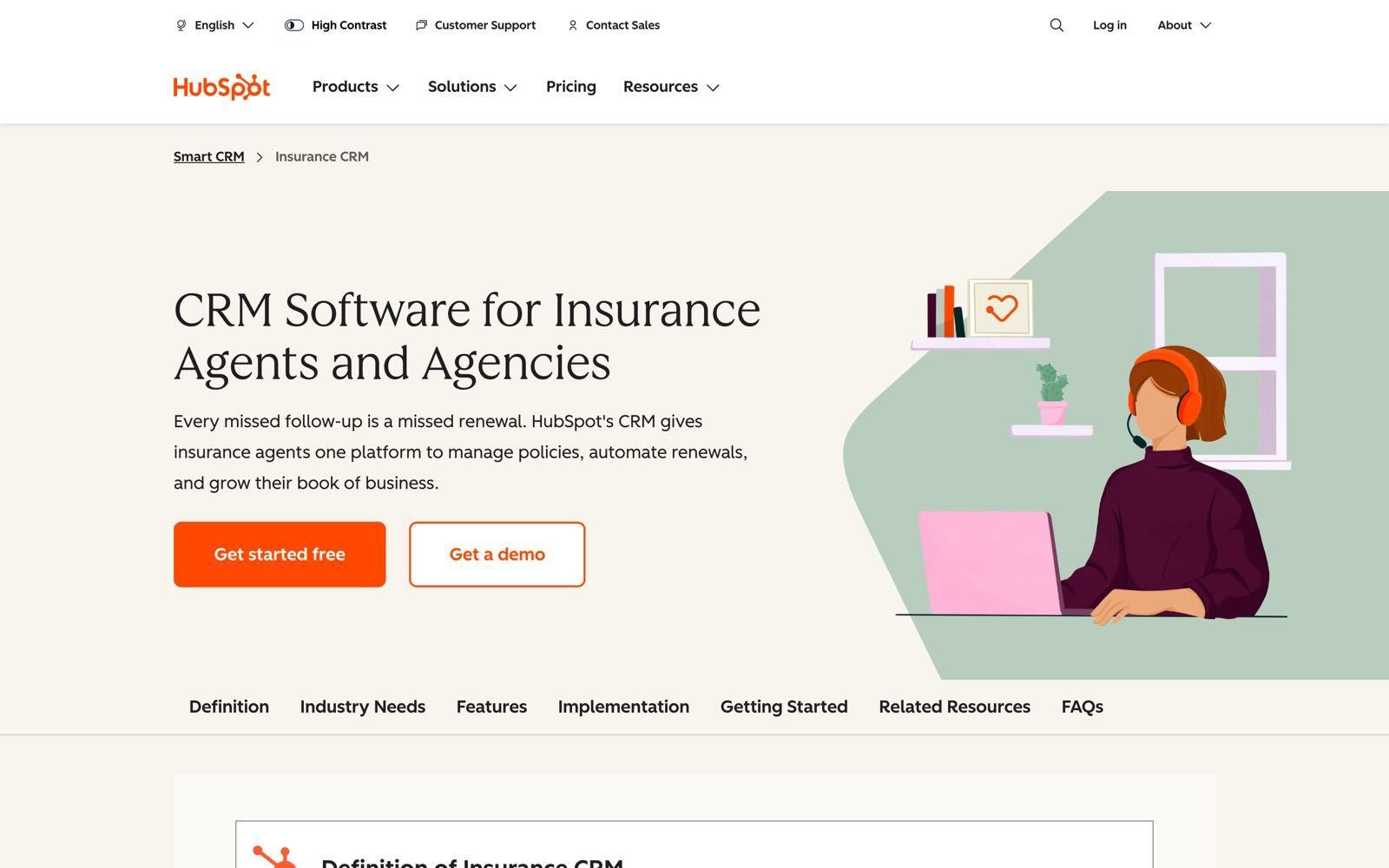
HubSpot is the horizontal CRM agencies shortlist when marketing is the priority, combining contact and deal management with email marketing, automation, and reporting in one place. It has no insurance-specific data model, so policies, coverages, and renewals become custom objects and properties you define yourself. The free tier is usable, which is why so many agencies start here and then hit the point where insurance workflows need building from scratch.
Ideal For
- Agencies where marketing and lead generation are the main growth constraint
- Small teams wanting a free CRM that can grow with them
- Agencies running content, paid, and email campaigns that need attribution
- Teams comfortable configuring custom objects for policies and renewals
- Agencies wanting one system for marketing, sales, and service conversations
Top Features
- Contact and deal management: A clean pipeline with strong usability, which is the reason adoption is rarely the problem.
- Marketing automation and email: Campaign tooling ahead of every insurance-specific CRM on this list.
- Meeting scheduling and sequences: Producer outreach and booking handled inside the CRM.
- Reporting dashboards: Configurable dashboards covering pipeline, activity, and marketing attribution.
- Large app marketplace: Thousands of integrations, though few of them are agency management systems.
Why They Stand Out
HubSpot’s usability is its real advantage, and it directly addresses the complaint owners voice as "producers resistant to CRM", because adoption failures are usually interface failures. It is a fit for agencies whose growth problem is marketing rather than servicing, and the free tier means you can prove the workflow before spending anything.
Pros
- Free tier for up to 2 users, with an upgrade path
- Strong usability in this category, which helps producer adoption
- Marketing automation stronger than any insurance-specific CRM here
- Large app marketplace and a well-documented API
- Reporting and dashboards that non-technical owners can configure
Cons
- No insurance data model, so policies, coverages, carriers, and renewals are all custom build
- No carrier downloads, ACORD forms, or commission handling, so it cannot be your system of record
- Required one-time onboarding fees of $1,500 on Sales Hub Professional and $3,500 on Enterprise, so include them when you compare seat prices
- Per-seat pricing gets expensive at agency headcount, unlike the 7-user allowances in insurance-specific products
- Agency management system integrations generally run through middleware rather than native connections
Pricing
HubSpot publishes Sales Hub as free for up to 2 users, Starter at $15 per seat a month on annual billing (or $20 monthly), Professional at $90 per seat a month on annual billing (or $100 monthly) with a mandatory $1,500 one-time onboarding fee, and Enterprise at $150 per seat a month billed annually with a mandatory $3,500 onboarding fee. For a 20-person agency on Professional annual, that is roughly $21,600 a year in seats plus the $1,500 onboarding, which is worth putting next to AgencyZoom’s $349 a month for 7 users before you decide. Pricing is live-verified on hubspot.com in October 2026.
Final Verdict
HubSpot is recommended for agencies whose binding constraint is marketing and lead generation rather than servicing, and for small teams that want to start free and grow, because its usability directly addresses producer adoption problems. It is not suitable for most agencies as a primary system, because you would be building the insurance data model yourself, and per-seat pricing plus required onboarding fees make it cost more at agency headcount than the insurance-specific products that ship with a policy data model already built.
10. Salesforce™ Financial Services Cloud
Overview
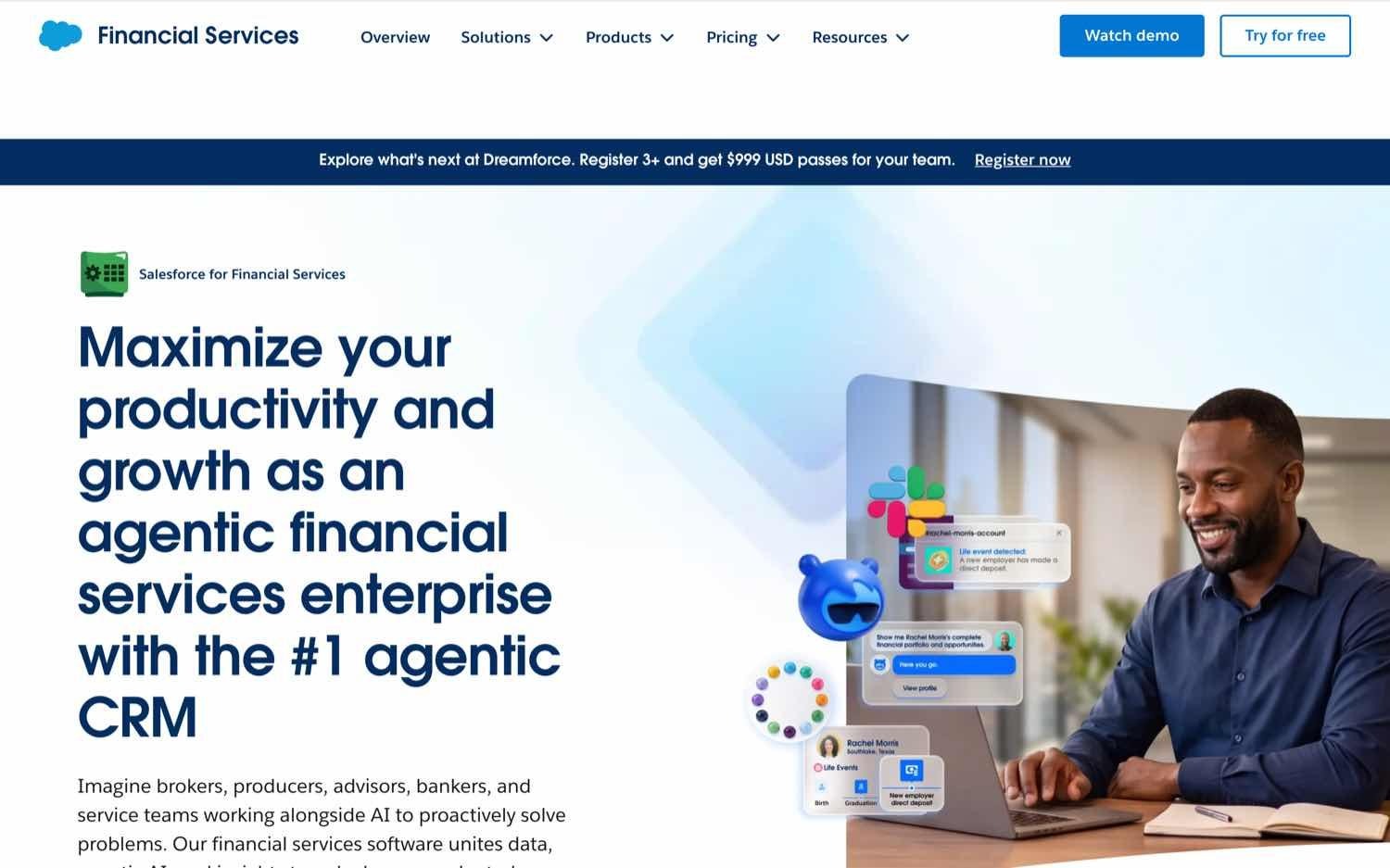
Salesforce Financial Services Cloud is the enterprise horizontal CRM with a financial services layer on top, and it now ships insurance-brokerage-specific data models and workflows. It is built for organizations with the in-house capacity to configure and maintain it, which is a different buyer from an agency looking for something to switch on. The insurance brokerage functionality is worth knowing about, because Salesforce publishes it as a $0 add-on to Financial Services Cloud rather than as a separate purchase.
Ideal For
- Large brokerages with in-house Salesforce administration capacity
- Organizations standardizing CRM across insurance and other financial lines
- Agencies with complex, custom sales processes that off-the-shelf tools cannot model
- Teams needing commission processing and revenue tracking inside the CRM
- Groups with existing Salesforce investment elsewhere in the business
Top Features
- Insurance brokerage data models: Brokerage-specific data models and workflows built on Sales Cloud and Service Cloud, published as a $0 add-on SKU with Financial Services Cloud.
- One record for producers and account managers: A single view for both sides of the relationship, which is the structural problem large brokerages hit first.
- Commission processing and revenue tracking: Included in the insurance brokerage functionality rather than handled in a separate system.
- Configurability without limits: Almost any process can be modeled, which is the reason large organizations choose it.
- Reporting and automation depth: Enterprise-grade analytics and workflow automation across the whole client base.
Why They Stand Out
Most other products here are built for narrower jobs, so Salesforce goes further on configurability and reporting depth, and the insurance brokerage layer means you are no longer building the data model from scratch. It is a fit for large brokerages already running Salesforce elsewhere and wanting one CRM across lines of business, and the commission and revenue tracking functionality closes a gap that used to force a second system.
Pros
- Insurance brokerage data models and workflows at no extra base SKU charge with Financial Services Cloud
- Configurable to almost any sales and service process
- Commission processing and revenue tracking included in the brokerage functionality
- Enterprise reporting and automation depth
- A large application marketplace that opens the broader Salesforce ecosystem
Cons
- The highest-priced option on this list, at $325 per user a month for sales or service and $350 for both, billed annually
- Needs in-house administration, so total cost includes a person or a partner
- No carrier downloads or ACORD forms, so it does not replace an agency management system
- Implementation is measured in months, and the configuration drifts without a named owner
- Built for a larger operation than most independent agencies run, where the configuration flexibility needs someone to own it
Pricing
Salesforce publishes Financial Services Cloud for Sales at $325 per user a month and for Service at $325 per user a month, both billed annually, with the combined Sales and Service edition at $350 per user a month. Financial Services Cloud for Insurance Brokerages is published as a $0 add-on SKU available with the Enterprise and Unlimited editions. The Agentforce 1 editions run $750 per user a month, billed annually. All figures are in US dollars, live-verified on salesforce.com in October 2026.
Final Verdict
Salesforce Financial Services Cloud is recommended for large brokerages with dedicated administration capacity, complex custom processes, and an existing Salesforce footprint, and the $0 insurance brokerage add-on makes it more viable for this market than it was a few years ago. It is not suitable for the majority of independent agencies, where $325 per user a month plus an administrator plus a months-long implementation buys configurability that only pays off with a dedicated owner, and it still does not handle carrier downloads or ACORD forms.
How to Choose the Best Insurance Agency CRM Software
Knowing what each product does is only half the decision. This section is the sequence to work through, in order, because most bad purchases in this category come from answering question three before question one.
1. Decide Whether You Need a CRM, an Agency Management System, or Both
Answer this before you look at a single demo. If your record-keeping is solid and your sales process is invisible, you need a CRM. If policies live in spreadsheets and carrier downloads land in an inbox, you need a management system, and adding a CRM on top will only give you a second place to lose things. Most agencies of 15 people and up end up with both, one system of record plus one sales layer, which is fine as long as you buy them in that order.
2. Check That Every Integration Runs in Both Directions
This is the criterion that separates a working integration from a listed one, and it is the one buyers skip. Ask three questions of every vendor. Can it read the client record live, so a request can be completed rather than logged? Does the outcome land in the system of record as a structured record rather than a pasted note? And does the work reach the person who owns the account? A nightly one-way export and a native two-way API both get called an integration, and only one of them changes anyone’s Tuesday.
3. Test What Happens to a Phone Call
Ask any vendor to show you the path a live inbound call takes to the client record, then watch how many humans are in it. In most demos the answer is that somebody listens, opens the record, and types, which means your data quality is a function of how busy your team was that day. This is the gap the call layer fills, and it is worth checking before you conclude your CRM is the problem.
4. Confirm Whether Texting Is Native, an Add-On, or a Third-Party Tool
Clients text, so this matters more every year, and the three possible answers cost wildly different amounts. Native texting logged to the record is what you want. A paid tier is workable, and AgencyZoom putting two-way texting on its $199 Growth plan is a fair example of that. A third-party dependency, as with Momentum’s texting setup through Twilio or RingCentral, means you are buying and managing another vendor and its message rates.
5. Price It at Your Real Seat Count, With Fees Included
Headline prices mislead in both directions here. Insurance-specific products often bundle seats, so AgencyZoom’s $349 Pro tier covers 7 users, while per-seat products scale linearly, so HubSpot Sales Hub Professional at $90 per seat on annual billing runs around $21,600 a year for 20 people before its required $1,500 onboarding fee. Add setup fees, message overages, extra-seat rates, and API access charges, then compare annual totals rather than monthly headlines.
6. Ask How Long Until It Is Running, and Who Supports It After
Time to value is where these purchases fail, because a system nobody finished configuring is worse than the spreadsheet it replaced. Ask how many weeks until it runs on your data, how much configuration lands back on your team, and whether onboarding, configuration, and support are included or billed separately. A management system migration is a multi-month project, a CRM layer is usually weeks, and a call layer should be live in under 30 days.
7. Get the Security and Data Documentation Before the Demo
You are handing a vendor your entire client book, so compliance posture, hosting, encryption, and retention practices should be published rather than described on a call. If a vendor cannot send documentation before a demo, treat that as an answer. The Big "I" Agency Universe Study counts 39,000 independent P&C agencies in the US and reports that 76% of agencies are small to medium, which means most buyers here have no in-house security team and have to rely on what the vendor publishes.
Everything You Need to Know About Insurance Agency CRM Software
The table below compresses the whole comparison into one view. Ratings reflect fit for an independent US P&C agency of 15 people and up, which is why enterprise systems score lower on affordability and ease of use despite being stronger products at scale.
Ratings reflect published documentation, independent reviewer coverage, and vendor-reported product descriptions as of October 2026. Confirm current status with each vendor before signing.
Put Every Call Into Your CRM With Sonant™
Whichever insurance agency CRM software you choose from this list, it will only ever be as current as the conversations somebody remembers to enter. Sonant closes that gap by answering the call, reading the client’s record while the caller is still on the line, and writing the outcome back as a documented, routed task in the system you already run. Cornerstone Insurance’s 43% productivity gain and O’Connor Insurance’s 8x return on investment in 30 days both ran on phone work arriving as structured tasks instead of as voicemails to chase.
The BIG Pickering 12% to 100% answer rate turnaround documents the same pattern inside a Canadian brokerage. Onboarding, configuration, and support are included, most agencies are live in under 30 days, and the rate does not move when call volume spikes.
Book a Sonant evaluation and see it running against your own agency management system, with your own client records, on a real call.
Disclaimer
All product names, logos, and brands are property of their respective owners. Sonant™, Applied Epic™ (Applied Systems), HawkSoft™, EZLynx™ (Applied Systems), Momentum AMP™, AgencyZoom™ (Vertafore), AMS360™ (Vertafore), QQCatalyst™ (Vertafore), NowCerts™, InsuredMine™, GloveBox™, Better Agency™, HubSpot™, Salesforce™, Financial Services Cloud™, Agentforce™, Vertafore™, PL Rating™, Twilio™, RingCentral™, Lightspeed Voice™, Turborater™, QuoteRUSH™, Canopy Connect™, miEdge™, Jenesis™, Sagitta™, Nexsure™, Zapier™, and SIAA™ are trademarks of their respective companies. No affiliation, endorsement, or sponsorship is implied by the mention of any third-party product. Pricing, plan structure, integrations, and compliance posture are current as of October 2026 and subject to change; verify with each vendor before making a purchase decision.