.svg)


If you are shopping for Voiceflow alternatives, the short answer is that the right pick depends on how much insurance-specific work you need the tool to do out of the box. Voiceflow is a no-code agent builder: a visual canvas for designing chat and voice flows across many industries. That generality is its strength and its cost - an insurance agency still has to build intake, routing, and agency management system write-back itself. This guide ranks seven real vendors, weighted on the proof that is hardest to fake, so a property and casualty (P&C) agency can decide between building on a general platform and buying an insurance-native one.
Key Takeaways
- Voiceflow is a general-purpose, no-code voice and chat agent builder - not an insurance product - so agencies self-build intake and integrations.
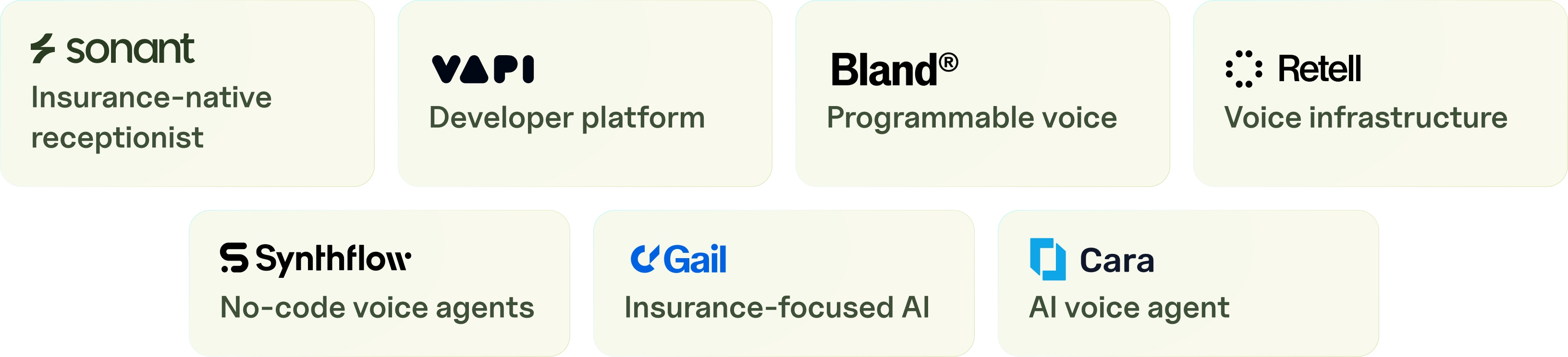
- The best Voiceflow alternatives split into developer platforms (Vapi, Bland AI, Retell AI, Synthflow) and finished insurance tools (Sonant, Gail, Cara).
- We scored each vendor on six criteria weighted to 100%, with the heaviest weight on AMS write-back - the hardest capability to fake.
- Sonant is the insurance-native pick: it answers calls, captures first notice of loss, and writes structured notes back to your AMS.
- Match the tool to your team: buy finished if you lack engineers, build on a platform if you have them and want full control.
What is Voiceflow, and why look for alternatives?
Voiceflow is a no-code platform for designing conversational agents - a visual builder where teams assemble voice and chat flows without writing much code. It serves many industries, which means an insurance agency gets a blank canvas rather than a receptionist that already understands quoting, endorsements, or first notice of loss (FNOL). Agencies look for Voiceflow alternatives when they want less assembly and more insurance workflow on day one.
That is why agencies evaluate a broader field of voice AI for insurance: the category covers software that answers and holds a spoken conversation with a caller, then acts on it. Some of these tools are platforms you build on; others are finished products for a specific vertical.
See how a P&C-native voice agent handles live calls → Talk to Sonant
How big is the missed-call problem for agencies?
Inbound phone volume is the core operational pressure behind this whole category: callers who reach voicemail often do not leave one, and an unanswered quote or claim call is revenue and retention walking out the door. Consumer expectations for fast, automated response keep rising, which raises the bar for how agencies staff the phones.
The Sonant Consumer AI Readiness Report documents how ready insurance consumers now are to interact with automated systems. For wage and staffing context on customer service representatives (CSRs), the Bureau of Labor Statistics occupational data is a defensible source, and the Insurance Information Institute is useful for broader industry framing. Average agency call-abandonment rates vary widely, so treat any single figure as rather than a benchmark.
How we scored the Voiceflow alternatives
We reviewed 20+ voice and conversational AI tools and narrowed to seven that a P&C agency would realistically consider. Scoring leans on niche-specific concepts most general platforms ignore: AMS write-back (pushing structured call notes into the agency management system), FNOL intake, and intent routing (classifying why a caller phoned and sending them to the right place). The weights total exactly 100%, with the heaviest weight on the capability that is hardest to fake.
- AMS write-back (30%): whether the tool logs structured notes and fields into agency systems (EZLynx, Applied Epic, HawkSoft, AMS360) natively versus via custom code.
- Insurance workflow depth (25%): built-in handling of quotes, endorsements, certificates of insurance (COIs), and FNOL - measured against out-of-the-box behavior.
- Call handling and routing (20%): answer quality, intent routing, and escalation to licensed staff on live calls.
- Compliance and security (15%): handling of personally identifiable information (PII), SOC 2 posture, and alignment with regulator guidance such as the NAIC model bulletin on AI.
- Setup effort (5%): engineering required before the tool answers a real call.
- Support and roadmap (5%): vendor responsiveness and insurance-specific investment.

The 7 best Voiceflow alternatives for insurance agencies
The best Voiceflow alternatives fall into two groups: developer platforms you build on, and finished products you deploy. Below, each vendor is described factually - what it is and who it fits - with any specific pricing or metric marked.
1. Sonant - the insurance-native pick
Sonant is an AI receptionist built for insurance agencies: it answers inbound calls, captures FNOL and service requests, routes by intent, escalates to licensed staff, and writes structured notes back to the AMS. Unlike a general builder, the insurance workflow ships in the product rather than being assembled. It fits P&C agencies that want a finished answering layer, not an engineering project. Specific SOC 2 status and integration details are.
2. Vapi - developer voice platform
Vapi is a developer platform for building voice agents through APIs and SDKs. It fits teams with engineering capacity that want low-level control over latency, models, and telephony. Insurance workflow and AMS write-back are things you build. Pricing and model support are.
3. Bland AI - programmable phone-call automation
Bland AI is a programmable platform for automating inbound and outbound phone calls at scale. It suits technical teams comfortable defining behavior in code or prompts. Like other platforms, it has no insurance-specific intake by default. Specifics are.
4. Retell AI - voice-agent infrastructure
Retell AI provides infrastructure for building and running low-latency voice agents. It targets developers integrating a voice layer into their own applications. Insurance logic and integrations are custom work. Feature and pricing details are.
5. Synthflow - no-code voice agents
Synthflow is a no-code builder for voice agents, positioned close to Voiceflow's model but voice-first. It fits non-engineers who still want to assemble flows themselves. It is not insurance-specific out of the box. Specifics are.
6. Gail - insurance-focused AI
Gail is an AI tool positioned for the insurance sector. It fits agencies wanting vertical focus rather than a general platform. Exact feature scope, integrations, and pricing are.
7. Cara - insurance voice AI
Cara is a voice AI offering oriented toward insurance use cases. It fits agencies evaluating insurance-specific voice tools alongside Sonant and Gail. Capabilities and pricing details are.
Comparison table: Voiceflow alternatives at a glance
The table summarizes each option by type and insurance fit. It is directional; verify vendor specifics before you buy.
For a wider field, compare this shortlist against our roundup of voice AI vendors for insurance and the broader directory of AI tools for insurance agencies.
How Sonant fits
Among Voiceflow alternatives, Sonant is the option that skips the build step for a P&C agency. The workflow is direct: a caller phones the agency, Sonant answers and identifies intent (quote, service, or claim), captures FNOL details or the service request, and either books the next step or escalates to licensed staff. The metric that matters is answered calls that turn into logged, actionable records - not just minutes of talk time. The output is a structured note pushed into your agency management system through native AMS integrations with EZLynx, Applied Epic, HawkSoft, and AMS360.
That write-back is the difference between a general builder and an insurance tool. To see how automated intake reduces manual entry, read our overviews of FNOL intake automation and insurance workflow automation, and the practical guide on how to implement AI in your agency.
Ready to compare Voiceflow alternatives on a real call? Book a Sonant demo →
Related reading
- Automated phone answering for P&C agencies
- Cutting down on missed inbound calls
- What is an AI voice agent?
- 7 Best Yellow.ai Alternatives for Insurance Agencies






.svg)


.svg)


