.svg)

AI tools for insurance agencies are software that answers phones, gathers quote inputs, updates records, and drafts client messages so a retail agency runs the same book with fewer manual steps. This guide organizes those tools by the way an agency actually works: the phone and front desk, quoting, service and renewals, documents, and marketing. Instead of ranking everything against everything, it groups tools by the job they do, because a quoting engine and a phone answering system rarely compete. For P&C (property & casualty) agencies specifically, the highest-friction point is usually the phone, so that is where this guide starts.
Key Takeaways
- AI tools for insurance agencies fall into five workflow buckets: phone/front desk, quoting, service and renewals, documents, and marketing.
- The phone is the first bottleneck for most retail agencies, which is why front-desk answering is the highest-leverage place to start.
- Tools work best when they write back to the AMS (agency management system) rather than creating a separate data silo.
- No single product owns every workflow; agencies assemble a small stack and connect it through the AMS and CRM (customer relationship management) system.
- Sonant is the phone and front-desk pick, answering calls and escalating anything that needs a licensed person.
Which agency workflows can AI tools actually help with?
AI tools for insurance agencies help most where the work is repetitive, phone-heavy, or record-keeping: answering and routing calls, collecting quote inputs, sending renewal reminders, filing documents, and drafting outbound messages. These are the tasks that consume a CSR (customer service representative) day without requiring a license on every step. The point of mapping tools to workflows is to avoid buying overlapping products that each solve a slice of the same problem.
An agency rarely needs one giant platform. It needs a phone layer, a quoting helper, a service layer, a document layer, and a marketing layer, connected through the systems it already runs. For a broader catalog organized the same way, the complete 2026 catalog of agency AI tools lists far more options than this explainer, and a primer on software that acts on tasks rather than just answering questions explains where the category is heading.
See how phone answering fits your workflow → Talk to Sonant
Phone and front desk: where should an agency start?
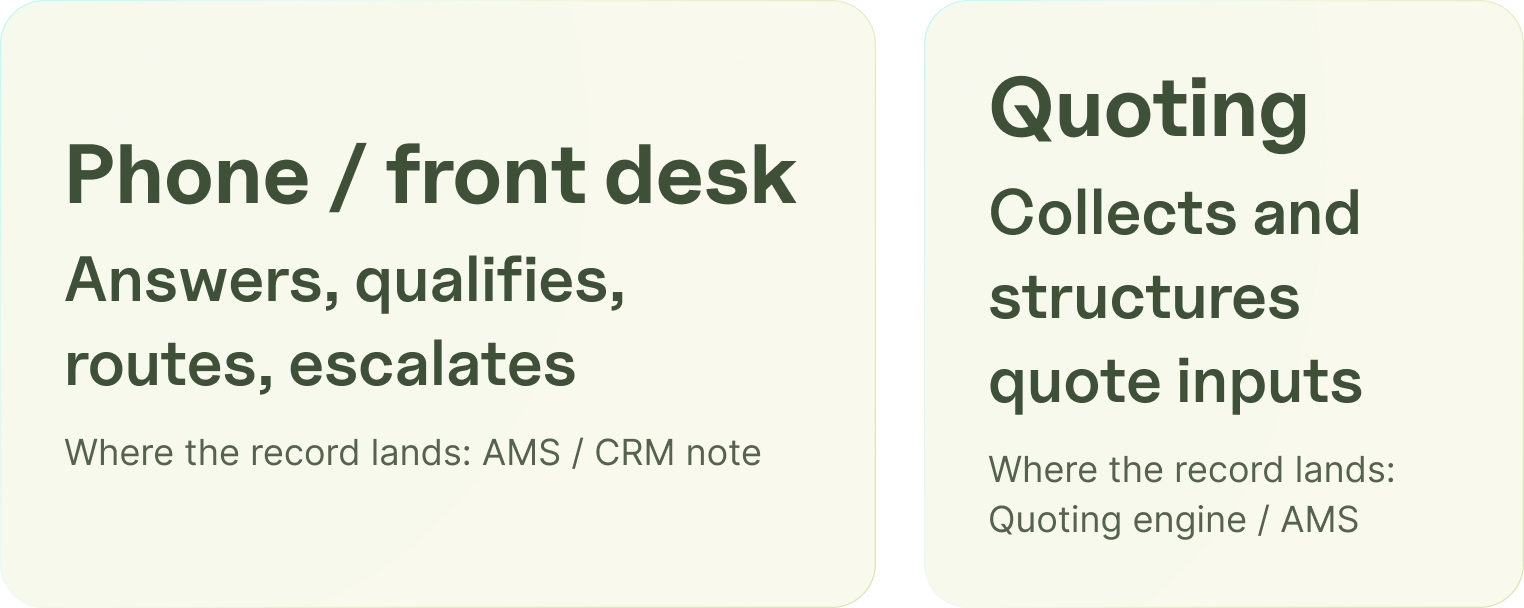
The phone and front desk is where most retail agencies lose the most work, so it is the first workflow to address with AI. Missed calls during business hours, overflow at renewal season, and after-hours callers all leak revenue and service. A front-desk AI answers every call, captures caller intent, and routes or escalates without a person picking up first.
Consumer expectations here are shifting quickly. The Sonant Consumer AI Readiness Report documents how comfortable insurance callers now are with AI handling routine calls. The operational case is simpler still: every call that goes to voicemail is a quote or a service request an agency may never see again. Tools in this bucket include AI receptionists and answering layers; you can compare the field in this roundup of voice AI vendors serving insurance, and read the workflow detail in this explainer on an AI receptionist built for agency phones. For agencies drowning in volume, the tactics in cutting down on missed calls pair well with a front-desk tool.
Quoting, service, and documents: what can AI handle here?
Beyond the phone, AI tools for insurance agencies cluster around quoting, service, and documents. Quoting tools collect and structure the inputs a rater needs; service tools send renewal and payment reminders and handle routine status questions; document tools read a COI (certificate of insurance) or a declarations page and file the data instead of a person retyping it. Each reduces manual keystrokes rather than replacing judgment.
The connective tissue is write-back. A tool that captures a quote request but leaves it stranded outside the agency management system creates a second inbox to check. The better pattern is described in this overview of end-to-end agency workflow automation, where each tool posts its output back to the system of record. On the claims side, automating first notice of loss intake - FNOL (first notice of loss) - captures loss details at the moment a client calls, so the file starts complete.
Insurance is a document-heavy business, and the Insurance Information Institute maintains context on how the industry runs at iii.org. Reducing the retyping and re-keying is often the clearest early win; the case is laid out in this piece on trimming administrative work across the agency.
Marketing and adoption: how do agencies roll these out?
Marketing tools draft renewal emails, review requests, and social posts, but adoption is the real question for most agencies. The practical sequence is: fix the phone first, connect it to the AMS, then layer quoting, service, and marketing tools once the highest-friction workflow is stable. Rolling out everything at once tends to strand data and frustrate staff.
Governance matters as adoption grows. State regulators have issued guidance on AI use in insurance, and the NAIC (National Association of Insurance Commissioners) publishes its model bulletin at content.naic.org; staffing and wage context for planning capacity sits with the BLS at bls.gov. A phased plan is easier to govern, and this guide to putting AI to work inside an insurance agency walks through the order. For client-facing text and web chat specifically, see this overview of chat assistants for insurance.
How Sonant fits
Among AI tools for insurance agencies, Sonant is the phone and front-desk pick: it answers every inbound call, gathers caller intent, and escalates anything that needs a licensed person. The workflow is straightforward - a call comes in, Sonant answers and qualifies it, and it writes a note back to the system of record. The metric agencies watch is missed calls answered, and the output is a complete activity record instead of a voicemail.
Sonant connects through native AMS integrations - EZLynx, Applied Epic, HawkSoft, and AMS360 - so the call record lands where CSRs already work rather than in a separate tool. Calls that require quoting, binding, or a coverage decision escalate to your licensed staff. Handling the front desk this way also feeds cleaner data into every downstream workflow, which is why phone answering is the first of the AI tools for insurance agencies most operators turn on. For a fuller view of how phones tie into daily operations, see this explainer on managing agency call flow.
Ready to start with the workflow that leaks the most work? Book a Sonant demo →
Related reading
- A closer look at AI answering built for agency phone lines
- Why after-hours and overflow calls quietly cost agencies revenue
- How software is beginning to act on agency tasks, not just answer
- A step-by-step order for adopting AI inside your agency
- Connecting front-desk tools to your system of record
- Insurance agency AI: where to start and what to buy
- 16 Best AI Tools for Insurance Agents






.svg)

.svg)


