.svg)

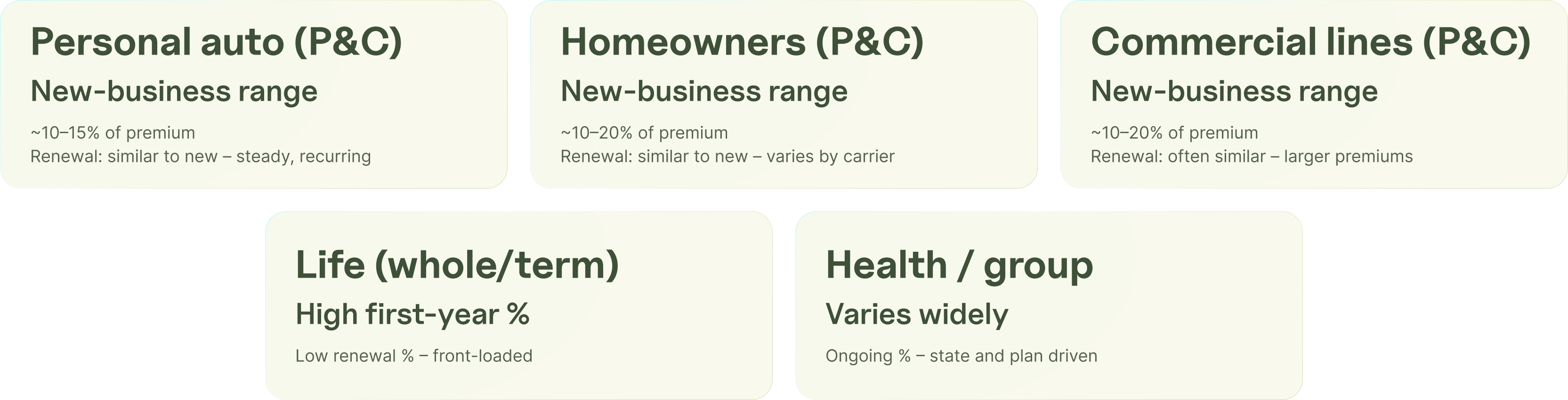
The average insurance agent commission is not one figure - it moves with the state you write in and the line you sell. For property & casualty (P&C) business, industry-typical new-business commissions land in a range of roughly 10–15% of premium, with renewals lower; life products can pay a much higher first-year percentage on the initial premium. State rules, carrier appointments, and whether you are captive or independent shift the number further. This guide explains what drives those averages, shows a plain by-line and by-state comparison, and points you to verified sources so you can check figures against real data rather than a single quoted rate.
Key Takeaways
- There is no single average insurance agent commission - it depends on line of business, state, carrier, and captive vs. independent status.
- P&C commissions are usually a steady percentage of premium; life often pays a high first-year rate then drops sharply on renewals.
- State variation comes from premium levels, regulation, and carrier mix, not from a national fixed rate.
- Always confirm specific figures against BLS occupational data, the Insurance Information Institute (III), and state or NAIC filings.
- Commission is only half the picture: how many calls you answer and quotes you capture determines what that percentage is actually worth.
What is the average insurance agent commission?
The average insurance agent commission is the typical share of a policy's premium an agent earns for selling and servicing that policy. This share is expressed as a percentage of premium and differs by line: P&C tends to pay a consistent percentage on new and renewal business, while life and health follow different schedules. Because premium sizes and carrier terms vary, the same percentage produces very different dollar amounts across regions.
Two agents earning "12%" can take home wildly different pay if one writes small personal auto policies and the other writes commercial accounts. That is why averages should be read as ranges, not fixed rates. For a broader view of total earnings including salary and bonus, see our explainer on what insurance agents actually earn in a year, and for the mechanics behind the percentages, read how agent commission is calculated and paid.
Want to see how call handling protects your commission → Talk to Sonant
Average commission by line of business
Commission averages differ most by line of business, not by agent skill. P&C personal lines (auto, home) typically pay a moderate percentage on both new and renewal premium, commercial lines can run higher, and life products commonly pay a large first-year percentage that falls steeply afterward. The table below shows industry-typical ranges only - confirm exact rates with your carrier and with published sources before quoting them.
For a role-by-role breakdown of how these percentages feed producer pay, see how producer compensation plans are built. If you are comparing agent pay to a brokerage path, our broker earnings overview covers the difference. Occupational wage data for insurance sales agents is published by the U.S. Bureau of Labor Statistics (BLS), which is a better anchor than any single quoted percentage.
Why the average commission varies by state
State-level variation in the average insurance agent commission comes from premium levels, regulation, and carrier mix - not from a fixed national rate. States with higher premiums (driven by weather risk, litigation, or repair costs) produce larger commission dollars at the same percentage, so a 12% rate is worth more in a high-premium state than a low-premium one. Regulatory differences and carrier availability also shape which products, and which rates, are common locally.
The Insurance Information Institute (III) publishes premium and market data that helps explain why a state's average dollar commission can be high even when the percentage is ordinary. State regulators and the National Association of Insurance Commissioners (NAIC) are the authoritative places to confirm rules that affect how commissions may be paid and disclosed.
Because dollar commission depends on how many policies you actually write, agencies that lose calls lose commission regardless of their rate. Our note on call volume in insurance agencies shows how much inbound demand a typical office handles.
Captive vs. independent: how status changes the average
Whether an agent is captive or independent changes the average commission more than most state differences do. Captive agents usually receive lower percentages plus salary or support, while independent agents keep a larger share of premium but cover their own costs. This is why two agents in the same state and line can report very different commission averages - their contract type, not their geography, is the main lever.
The trade-off shows up in agency economics: higher percentages raise both income and expense. If you are weighing how commission structure affects the worth of a book of business, see our overview of how agencies are valued. Support-role costs matter too - compare against a typical customer service representative (CSR) pay range to understand the full cost of servicing the policies that generate commission.
How Sonant fits
Sonant is an artificial intelligence (AI) voice receptionist for P&C insurance agencies that answers inbound calls, captures quote requests, books callbacks, and writes structured notes into your systems - so the average insurance agent commission you earn is not eroded by calls that ring out. The workflow is direct: a caller reaches Sonant instead of voicemail, Sonant qualifies and routes the request, then writes the interaction back to your agency management system (AMS) or customer relationship management (CRM) tool. That produces a measurable output - more captured leads per week and fewer missed opportunities per producer.
Sonant offers native integrations with common agency management systems including EZLynx, Applied Epic, HawkSoft, and AMS360, and escalates anything requiring a licensed decision to your licensed staff. To see how automated answering reduces lost inbound demand, read how to cut missed calls and how agencies handle more calls without adding headcount. For the broader operational context, our guides on automating agency workflows, choosing an agency management system, and what an AI receptionist does for agencies explain how call capture connects to commission.
See what a full call day looks like when nothing goes to voicemail. Book a Sonant demo →
Related reading
- A plain guide to annual insurance agent income
- How commission percentages are structured and paid
- Designing a producer pay plan that works
- Putting a value on an agency book
- What consumers now expect from AI answering, per the Sonant readiness report
- How much commission do insurance agents make?
- Average life insurance commission






.svg)

.svg)


