.svg)

If you are weighing Bland AI alternatives for an insurance agency, the right pick depends on how much of your call and claims work needs to live inside your agency management system, and how the tool hands a caller to a licensed person. Bland AI is a developer voice-AI platform: it gives teams the building blocks to create and deploy automated phone agents programmatically. That flexibility fits engineering teams, but a property and casualty (P&C) agency usually wants a finished workflow, not a toolkit. This guide reviews eight real alternatives, scores them on criteria that matter to a P&C shop, and shows where each one fits. Every claim stays factual, and anything vendor-specific is marked to confirm directly.
Key Takeaways
- Bland AI is a developer platform for building phone-calling agents; insurance workflows, routing, and AMS logging are things you build on top of it.
- The best fit depends on native integration with your agency management system (AMS), first notice of loss (FNOL) intake, and clean escalation to a licensed customer service representative (CSR).
- Developer platforms like Vapi, Retell AI, Synthflow, and Voiceflow provide components rather than an insurance-ready receptionist out of the box.
- Sonant is the insurance-native pick: it answers calls, captures caller intent, handles routine requests, and writes structured notes back to the AMS.
- Score vendors on hard-to-fake proof - AMS write-back and compliance posture - not on marketing claims.
Why insurance agencies look for Bland AI alternatives
Agencies look for Bland AI alternatives when they need a voice tool matched to their stack, call mix, and compliance duties rather than a blank development platform. Voice AI for insurance is software that answers or places calls, understands what the caller wants, and either resolves the request or routes it to a person. The category matters because every missed call can be a lost quote or an unhappy policyholder waiting on a service request.
Consumer expectations add pressure. The Sonant Consumer AI Readiness Report documents how policyholders now expect fast, around-the-clock responses. Staffing is the other half of the squeeze: the U.S. Bureau of Labor Statistics tracks CSR wage and employment data that make answering every call live expensive. Our roundup of the voice AI vendors that serve insurance best is a useful companion to this list.
See how an insurance-native receptionist handles your call flow → Talk to Sonant
How we scored these Bland AI alternatives
We reviewed 20-plus voice and answering tools, then narrowed the field to eight a P&C agency could realistically deploy. The evaluation leans on niche-specific concepts: AMS write-back (whether the tool logs structured data into your agency management system), FNOL intake (whether it captures a first notice of loss cleanly), and intent routing (whether it can tell a certificate of insurance (COI) request from a claim and route accordingly).
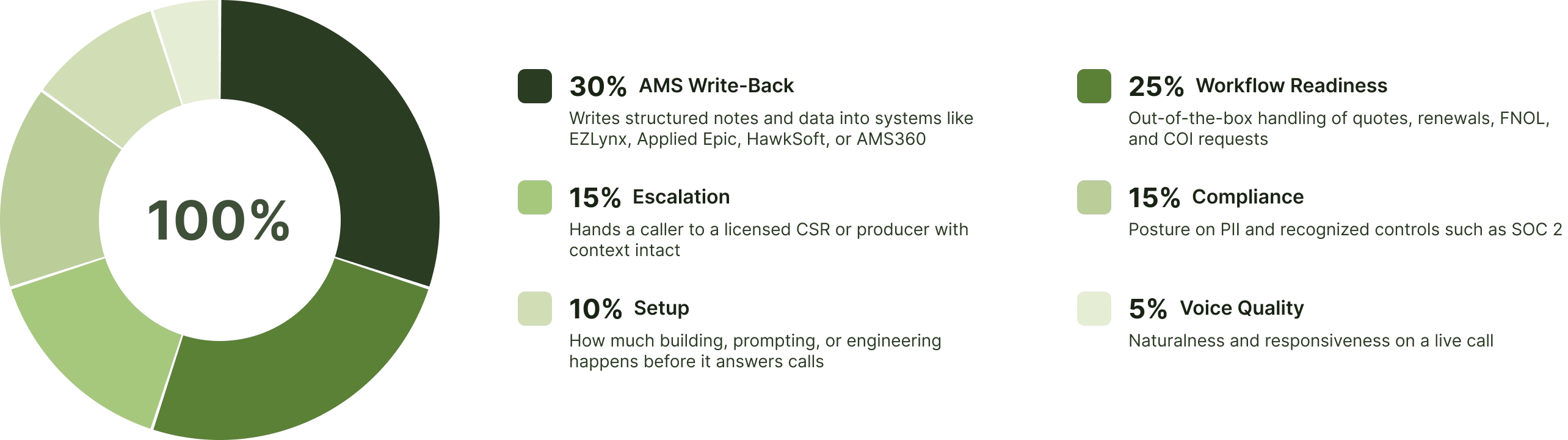
Each vendor is scored against six weighted criteria. The weights total exactly 100%, with the heaviest weight on the proof that is hardest to fake.
- AMS write-back and integration depth (30%): whether the tool writes structured notes and data into systems like EZLynx, Applied Epic, HawkSoft, or AMS360, measured against published integrations and vendor documentation.
- Insurance workflow readiness (25%): out-of-the-box handling of quotes, renewals, FNOL, and COI requests versus generic call handling.
- Escalation to licensed staff (15%): how cleanly the tool hands a caller to a licensed CSR or producer with context intact.
- Compliance and data handling (15%): posture on personally identifiable information (PII) and recognized controls such as SOC 2 [verify per vendor].
- Setup and time to value (10%): how much building, prompting, or engineering happens before the tool answers real calls.
- Voice quality and latency (5%): naturalness and responsiveness on a live call.
For the mechanics behind these categories, see our primer on how voice AI works in insurance and the wider view in conversational AI across the insurance workflow.
The 8 best Bland AI alternatives, ranked
Below are eight real vendors, ranked for a P&C agency use case. Descriptions are general and factual; confirm current features and pricing with each vendor before you buy.
1. Sonant - the insurance-native pick
Sonant is an AI voice receptionist built specifically for P&C insurance agencies. It answers inbound calls, identifies caller intent, handles routine requests, and writes structured notes back to the AMS, escalating to a licensed CSR when a call needs a person. Because it is designed around agency workflows rather than adapted from a general platform, it maps to quotes, renewals, and service calls without heavy configuration. See how it works in our overview of the AI receptionist for insurance agencies. Best for: agencies that want call answering and AMS logging without building anything.
2. Vapi
Vapi is a voice AI developer platform for creating and deploying voice agents programmatically. Like Bland AI, it is flexible but not insurance-specific out of the box, so FNOL intake and insurance workflow automation would be custom work. Best for: technical teams comfortable assembling their own stack.
3. Retell AI
Retell AI is a developer platform for building voice agents. It supplies the components to design call flows and connect them to your systems, which means insurance workflows and AMS write-back are things you build rather than buy. Best for: agencies with engineering resources that want to construct a custom agent.
4. Synthflow
Synthflow is a no-code and low-code platform for building voice AI agents. It lowers the technical bar compared with pure developer tools, but an agency still designs the insurance logic and integrations itself. Best for: agencies that want to configure a voice agent without deep engineering but can invest setup time.
5. Voiceflow
Voiceflow is a platform for designing and building conversational and voice agents across channels. It is a general design tool rather than an insurance product, so routing, FNOL handling, and AMS logging are yours to define. Best for: teams that want a visual builder for conversation flows and will add the insurance layer themselves.
6. Gail
Gail is a vendor offering AI voice technology aimed at insurance use cases. Because it sits in the insurance-focused segment, agencies should confirm which lines of business and workflows it supports before comparing it head to head. Best for: agencies wanting an insurance-oriented voice option to evaluate.
7. Cara
Cara is another insurance-focused voice AI vendor. As with any newer entrant, confirm its AMS integrations and how it handles FNOL and escalation before committing. Best for: agencies building a shortlist of insurance-specific voice tools.
8. Bland AI (the baseline)
Bland AI is a developer platform for building and deploying automated phone-calling agents at scale. It is general-purpose infrastructure, so any insurance-specific handling, intent routing, or AMS logging is on your team to build. Best for: engineering teams that need programmatic outbound or inbound calling and will own the insurance layer themselves.
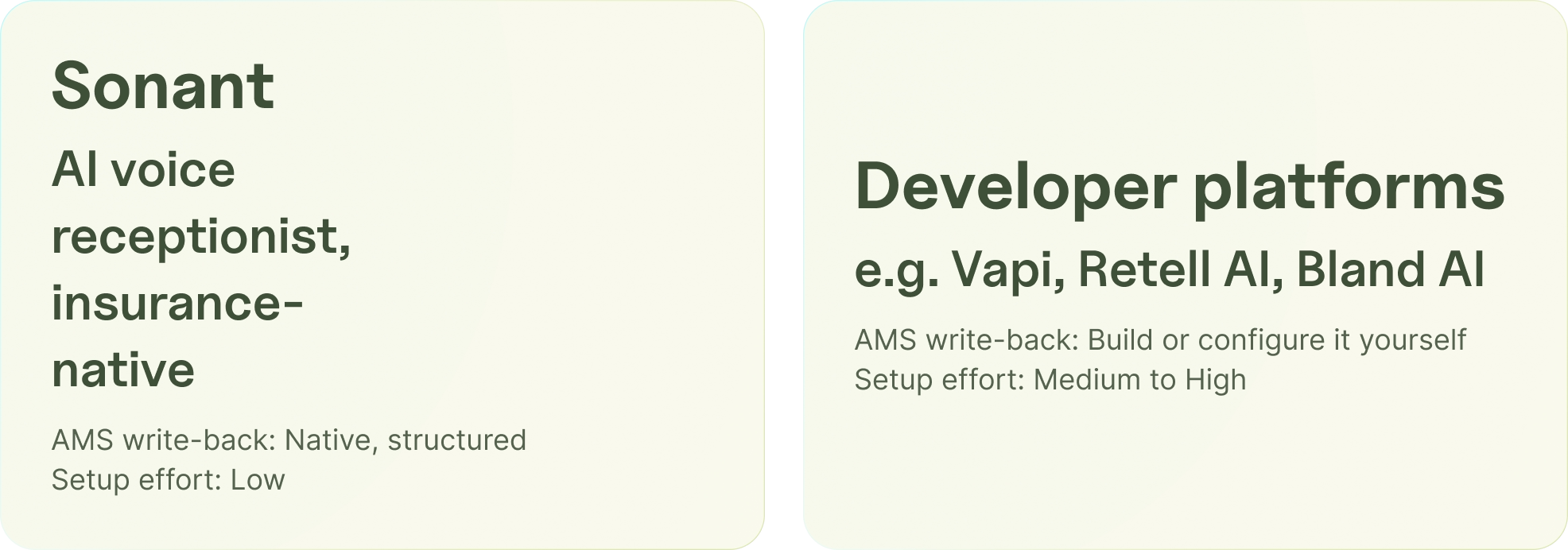
Summary comparison table
Beyond voice, the complete 2026 guide to AI tools for insurance agencies covers adjacent categories, and our look at where agentic AI is heading in insurance helps set expectations on what these agents can decide on their own.
How Sonant fits among the bland ai alternatives
Among the Bland AI alternatives here, Sonant is the option purpose-built for the P&C agency workflow: call in, intent captured, note written, person looped in when needed. A caller reaches the agency after hours or during a busy stretch; Sonant answers, determines whether the call is a quote, a service request, a COI, or an FNOL, and handles or routes it. The metric that matters is fewer missed calls - see how agencies cut down on missed calls - and the output is a structured record in your AMS.
Sonant connects to native AMS platforms including EZLynx, Applied Epic, HawkSoft, and AMS360, so the note lands where your team already works. When a call needs a licensed decision, it escalates to a CSR or producer with the context attached. If you are new to how these systems connect, our explainer on the agency management system and our comparison of where AI and human agents each work best in insurance fill in the background.
Before choosing a vendor, review the Insurance Information Institute resources on consumer data expectations so your call handling meets what policyholders assume about their information.
Want to see how an insurance-native option stacks up against your bland ai alternatives shortlist? Book a Sonant demo →
Related reading
- Which voice AI vendors serve insurance best
- What an AI phone answering setup looks like for agencies
- A plain look at conversational AI in the insurance workflow
- How voice AI actually works inside an insurance agency
- The full 2026 catalog of AI tools for insurance agencies
- What is an AI voice agent?
- 8 Best Conversational AI Companies for Insurance Agencies






.svg)

.svg)


