.svg)

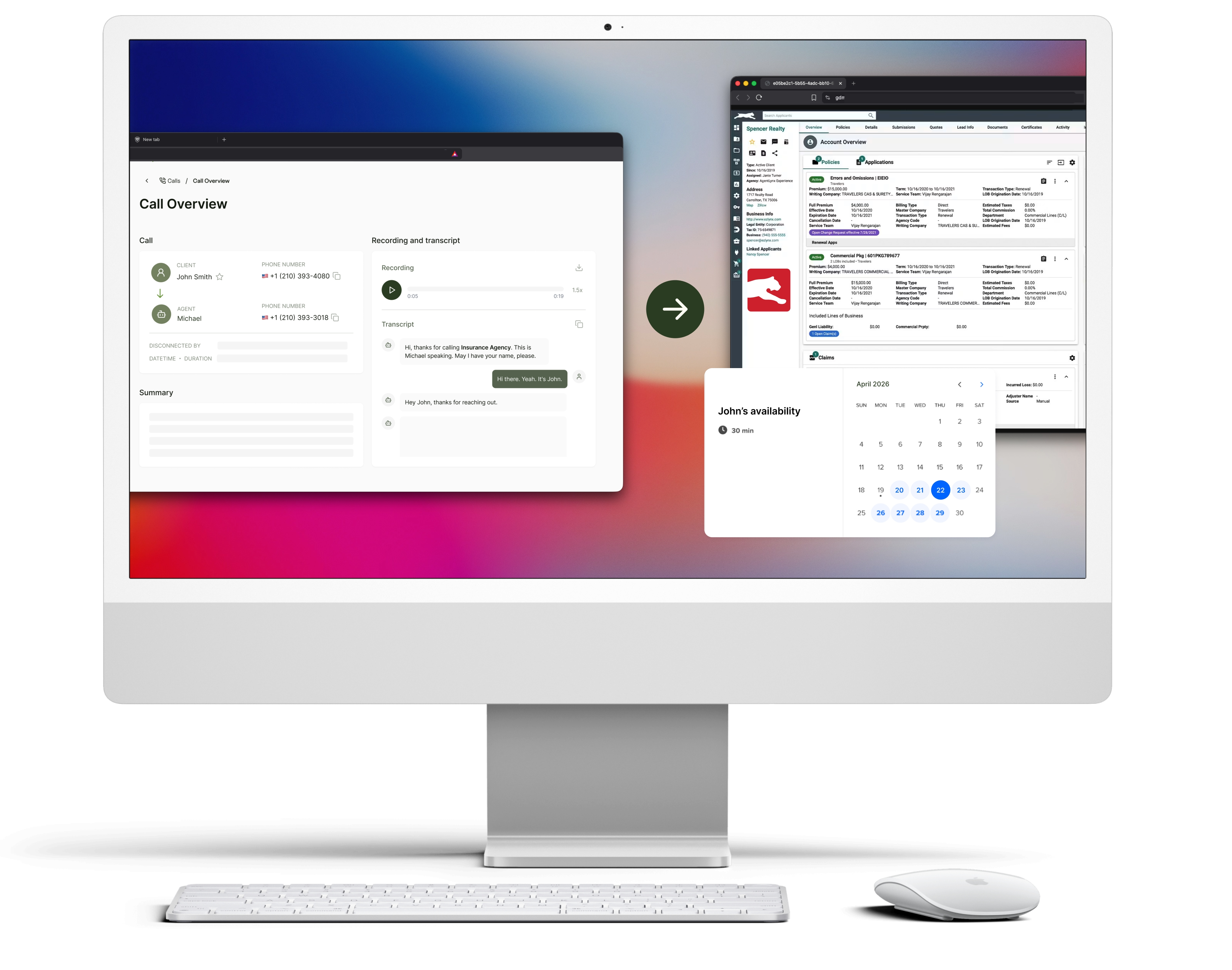
An insurance AI assistant is software that takes on the repeatable work in a property and casualty (P&C) agency: answering the phone, logging call details, reading and sorting documents, and booking appointments. Instead of one product doing everything, most agencies assemble a few assistants around the jobs that eat the most staff time. The phone is usually first, because a missed call is often a missed quote. This guide explains what an insurance AI assistant actually does, the main types you will encounter, and how to choose one that fits an agency management system (AMS) and a licensed team rather than fighting them. Sonant is the phone and answering pick here.
Key Takeaways
- An insurance AI assistant automates one or more agency jobs: phone answering, admin data entry, document intake, and appointment scheduling.
- Most agencies use several narrow assistants rather than a single tool that claims to do all of it.
- The phone assistant tends to deliver the fastest return because unanswered calls turn into lost quotes and lapsed renewals.
- The best fit writes back into your AMS, follows disclosure rules, and escalates to a licensed customer service representative (CSR) when a caller needs one.
- Judge tools on integration depth and escalation, not on how many features a landing page lists.
What does an insurance AI assistant do?
An insurance AI assistant performs specific agency tasks on its own: it answers and routes calls, writes notes and updates records, reads submitted documents, and schedules callbacks or reviews. The strongest ones connect to your AMS so the work lands where staff already look, and they hand off to a person the moment a caller needs licensed advice. It is a set of tools, not one brain.
Four job areas cover most of what agencies automate:
- Phone and answering: picking up inbound calls, capturing caller intent, answering routine questions, and routing or booking. This is the core of an AI receptionist built for insurance agencies.
- Admin and data entry: logging call summaries, updating policy fields, and cutting the manual keying that fills a CSR's day. See how agencies cut repetitive admin work across the office.
- Documents: reading declarations pages, certificates of insurance (COIs), and loss runs, then extracting the fields that matter. First notice of loss (FNOL) intake is a common early use - automating the FNOL step removes a slow manual handoff.
- Scheduling: booking policy reviews and callbacks without the back-and-forth. Agencies report meaningful weekly time savings from scheduling assistants that book reviews automatically.
Want to see call answering with AMS write-back live? → Talk to Sonant
What are the main types of insurance AI assistants?
The main types split by the job they own: voice or phone assistants, chat assistants, document and workflow assistants, and scheduling assistants. Each type solves a different bottleneck, and few agencies need every one at once. Picking a type starts with naming which task is currently costing the most staff hours or the most lost business.
Consumers increasingly expect a fast answer on their own channel, a shift the Sonant Consumer AI Readiness Report documents. That expectation is why the phone assistant usually comes first.
For a broader map of the market, this catalog of AI tools for insurance agencies sorts vendors by job. The line between an assistant and a full agentic workflow that acts across systems is mostly a question of how many steps the tool completes without a human.
.avif)
Which insurance AI assistant tools are worth knowing?
Several real tools serve the categories above, and the right pick depends on the job you are automating. The names below are grouped by type; treat any specific pricing or feature as something to confirm during a demo. For P&C phone and answering, Sonant is the insurance-native choice because it writes back to the AMS and escalates to licensed staff.
- Phone and answering: Sonant (P&C insurance-native), plus generalists such as Smith.ai, Ruby, AnswerConnect, and Nexa. Some agencies also evaluate builder platforms like Vapi or Retell AI when they want a custom voice flow.
- Chat and messaging: website chat assistants overlap with a chatbot built for insurance questions; confirm whether a given tool hands off cleanly to phone or staff.
- Documents and workflow: assistants that read declarations pages and loss runs feed into broader insurance workflow automation.
- Scheduling: calendar-first assistants that book reviews and callbacks.
If you are weighing an AI assistant against a human contractor, compare capabilities and cost directly with a guide to the best virtual assistant options for insurance and a breakdown of what an insurance virtual assistant costs. Human wage benchmarks for CSRs and support roles are published by the U.S. Bureau of Labor Statistics (BLS), and general industry context on agency operations is available from the Insurance Information Institute (III).
How do you choose an insurance AI assistant?
Choose by matching the assistant to your biggest bottleneck, then testing integration and escalation before features. An assistant that cannot write into your AMS or hand a caller to a licensed CSR creates a second silo instead of removing one. Start with the job, confirm the handoffs, and only then compare surface features.
Five checks separate a fit from a demo that looks good:
- Job fit: does it own the task costing you the most hours or the most lost quotes?
- AMS write-back: does it update records in EZLynx, Applied Epic, HawkSoft, or AMS360 rather than sit beside them?
- Escalation: does it route to a licensed person for anything that needs advice or binding?
- Compliance posture: does the vendor handle personally identifiable information (PII) responsibly and follow guidance such as the NAIC model bulletin on AI? A SOC 2 report (AICPA) is a useful signal of controls.
- Proof: can they show real call logs or write-back, not slideware?
The clearest measure of value is what an assistant returns - the documented benefits of AI receptionists for insurance center on captured calls and freed staff time. For a staged rollout, this walkthrough on putting AI into an insurance agency covers sequencing one assistant before the next.
How Sonant fits
Sonant is the insurance AI assistant for the phone: it answers inbound and after-hours calls, captures caller intent, books callbacks and reviews, and writes the summary and fields back into your system. The workflow is direct - a caller reaches Sonant, Sonant handles the routine request or captures the details, and the note lands in the AMS through native integrations with EZLynx, Applied Epic, HawkSoft, and AMS360. The metric that matters is calls answered and logged rather than missed; the output is a record your team can act on without rekeying. When a caller needs licensed advice or a bind, Sonant escalates to a licensed CSR instead of guessing. That combination - answering, write-back, and escalation - is what makes a phone-focused insurance AI assistant pull weight in a P&C agency rather than adding another disconnected tool.
See how a phone-first assistant answers, logs, and escalates in your agency. Book a Sonant demo →
Related reading
- Where agentic AI is heading in insurance operations
- A complete 2026 catalog of AI tools for agencies
- Comparing virtual assistant choices for insurance work
- What insurance virtual assistant pricing looks like
- Reclaiming ten weekly hours with a scheduling assistant
- Insurance agency AI: where to start and what to buy
- AI answering service for insurance agents






.svg)

.svg)


