.svg)

AI voice agents for insurance are software callers that answer the phone, understand what a policyholder or prospect wants, and complete or route the work: a quote intake, a first notice of loss, a billing question, or a renewal. For property and casualty (P&C) agencies, that means fewer missed calls, faster after-hours coverage, and a written record in your system without a customer service representative (CSR) typing it. This guide explains what these voice agents do for an insurance agency, where they fit across the policy lifecycle, the benefits worth measuring, how to choose one, and the objections you should raise before you sign. It is an explainer, not a ranking - if you want the ranked shortlist, we link to it below.
Key Takeaways
- AI voice agents for insurance answer, qualify, and route calls across quoting, FNOL, billing, and renewals, then write a record to your system.
- The strongest use cases are high-volume, repetitive calls: after-hours coverage, quote intake, and status checks that pull CSRs off higher-value work.
- Benefits worth measuring are answer rate, first-contact resolution, after-hours capture, and hours of admin work removed - not vague "efficiency."
- Insurance-native fit matters more than generic voice quality: AMS write-back, licensed-staff escalation, and PII handling separate real fits from demos.
- Choose on integration depth, escalation logic, security posture, and transparent pricing, and always keep a licensed human in the loop for advice.
What are AI voice agents for insurance?
AI voice agents for insurance are voice-based systems that hold a natural phone conversation with a caller, capture the details an agency needs, and take the next action - booking a callback, collecting quote information, or logging a claim. Unlike an interactive voice response (IVR) menu that makes callers press numbers, a voice agent listens and responds in plain language. It sits closer to a receptionist than to a phone tree, which is why many agencies frame the category as voice AI built for insurance workflows rather than as a generic answering tool.
The category overlaps with a few related ones. Some agencies compare it to conversational AI applied to insurance service, which covers chat and messaging as well as voice. Others evaluate it against staffing choices, weighing AI voice agents versus live call-center reps on cost and consistency. The common thread is a phone conversation that ends with structured data, not a voicemail.
See how a voice agent handles a live insurance call → Talk to Sonant
Where do AI voice agents fit in an insurance agency?
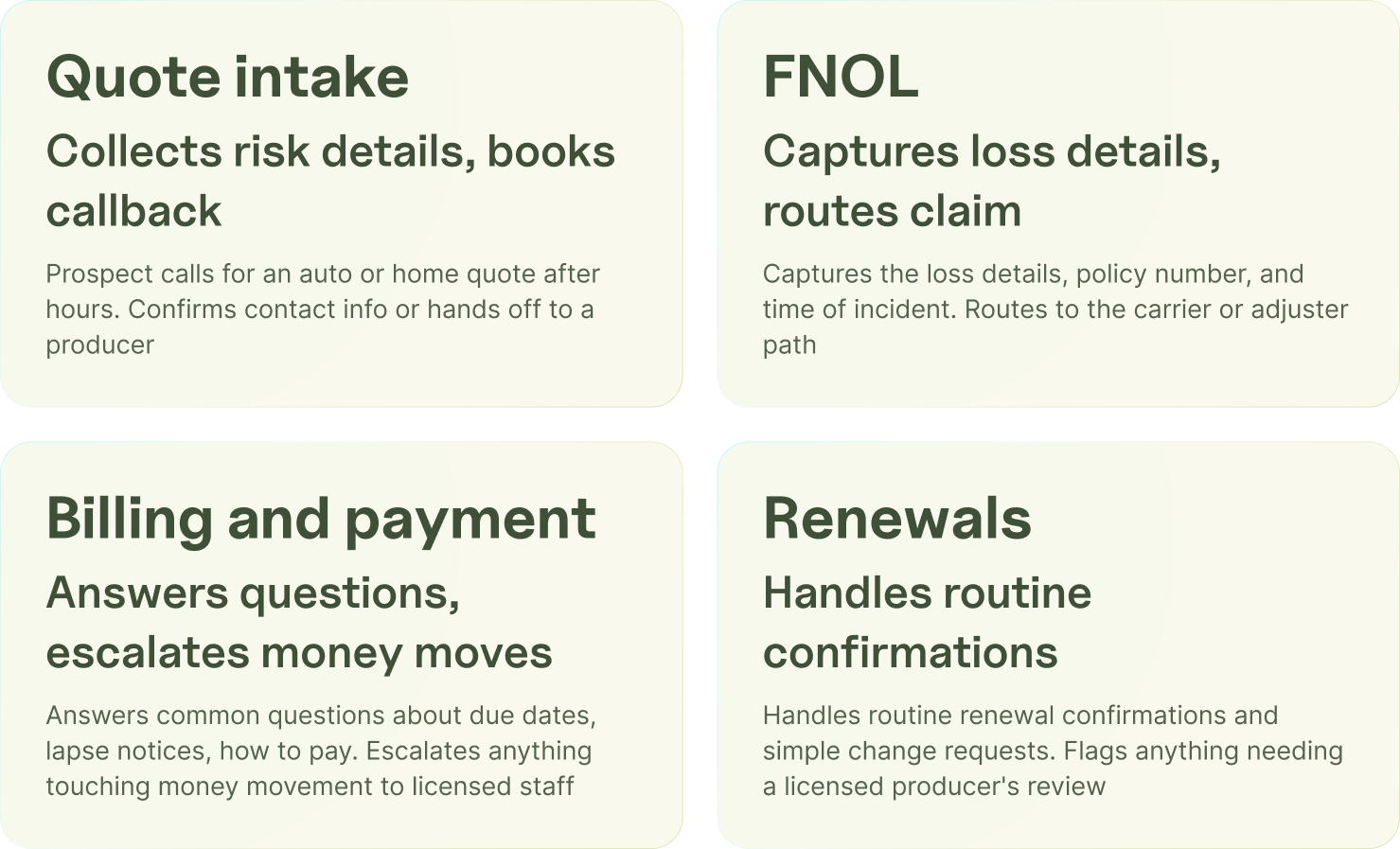
AI voice agents for insurance fit anywhere the phone rings on a repetitive, rules-based request: new-business quote intake, first notice of loss, billing and payment questions, and renewal or endorsement calls. Each of these is high-volume, time-sensitive, and mostly scripted - the exact profile a voice agent handles well while a licensed human takes the judgment calls.
- Quote intake. A prospect calls for an auto or home quote after hours. The voice agent collects the risk details, confirms contact information, and books a callback or hands off to a producer, so the lead never lands in voicemail. This is where an AI phone answering setup for insurance agencies directly affects your close rate.
- First notice of loss (FNOL). A policyholder reports a claim. The agent captures the loss details, the policy number, and the time of incident, then routes to the carrier or adjuster path your agency uses. Structured intake here is the whole point of FNOL automation for agencies.
- Billing and payment. Callers ask about a due date, a lapse notice, or how to pay. The agent answers the common questions and escalates anything that touches money movement to licensed staff.
- Renewals and endorsements. The agent handles routine renewal confirmations and simple change requests, flagging anything that needs a licensed producer's review.
Across all four, the value is the same: the call is answered, the caller is served, and a note lands in your system. That is why agencies increasingly treat this as core phone answering for insurance agencies rather than an add-on.
What are the benefits, and how do you measure them?
The benefits of AI voice agents for insurance are concrete and measurable: a higher answer rate, more after-hours leads captured, faster routing on claims, and hours of manual note-taking removed from CSRs. The mistake is to buy on "efficiency" and never define the number that proves it. Tie each benefit to a metric you already track.
Consumer expectations reinforce the case. The Sonant Consumer AI Readiness Report documents how policyholders now expect fast, always-on responses from their insurance provider. Missed and abandoned calls are a real cost line: the Insurance Information Institute publishes industry context on service expectations and claims volume that helps size the opportunity. And because CSR time is expensive - the Bureau of Labor Statistics (BLS) tracks customer-service and insurance-support wages - every routine call a voice agent absorbs frees a person for work that needs a license.
A fuller treatment of the payoff lives in our breakdown of the benefits of AI receptionists for insurance, and the operational case for never letting the phone go unanswered is covered in how to reduce missed calls at an insurance agency.
How do you choose an AI voice agent for insurance?
Choosing an AI voice agent for insurance comes down to five things: how deeply it writes back to your agency management system (AMS), how it escalates to licensed staff, its security posture around personally identifiable information (PII), the transparency of its pricing, and whether it was built for insurance at all. Generic voice quality is table stakes; the insurance-specific plumbing is what fails in production.
Work through the criteria below rather than trusting a scripted demo. An AI voice agent that sounds great but cannot write a note to EZLynx or hand a coverage question to a licensed producer will create rework, not remove it.
On security specifically, ask for the vendor's SOC 2 report rather than accepting a "secure" label. If you want the ranked shortlist with named products, see our roundup of the best voice AI vendors for insurance; this post stays on the how-and-why. For the wider rollout question - where a voice agent sits alongside your other systems - start with our guide to how to implement AI in your insurance agency.
What objections should you raise before buying?
The objections worth raising about AI voice agents for insurance are compliance, caller experience, and integration - in that order. Address each before signing, because each one, unaddressed, turns a time-saver into a liability. None is a reason to avoid the category; each is a reason to buy carefully.
- Compliance and licensing. A voice agent must not give coverage advice or bind policies. Confirm that anything requiring a license routes to a human, and that the vendor tracks the NAIC's direction on AI use in insurance. Keep the agent to intake, information, and routing.
- Caller experience. Some policyholders dislike talking to software, especially on a claim. Confirm the agent discloses that it is AI, offers a fast path to a person, and does not trap callers in loops. Coverage for after-hours insurance calls is where callers most value a real answer over a voicemail.
- Integration reality. The demo works; production is where write-back breaks. Verify the agent reads and writes to your agency management system the way your team actually uses it, not just in a sandbox.
How Sonant fits
Sonant is an AI receptionist built for P&C agencies, and it is a clear fit for agencies evaluating AI voice agents for insurance. The workflow is simple: a call comes in, Sonant answers, captures the quote, FNOL, billing, or renewal details, and writes the note and contact back to your AMS. Sonant integrates natively with EZLynx, Applied Epic, HawkSoft, and AMS360, so the record lands where your team already works.
Escalation stays deliberate. Anything that needs a license - coverage advice, binding, or money movement - routes to your licensed staff with the context already captured, so the human starts informed. The measurable outputs are the ones from the benefits table: answer rate, after-hours leads booked, time to a logged FNOL, and CSR hours returned each week. Because Sonant is an AI receptionist purpose-built for insurance agencies, the insurance-specific plumbing - intake fields, routing rules, AMS write-back - is the product, not an afterthought.
Ready to see AI voice agents handle your agency's calls end to end? Book a Sonant demo →
Related reading
- Compare named products in the ranked shortlist of voice AI vendors for insurance.
- See the broader category in conversational AI for insurance service teams.
- Understand the payoff in what AI receptionists do for agency operations.
- Plan the setup with a practical guide to phone answering for agencies.
- Cut lost opportunities with tactics to stop missing agency calls.
- What is an AI voice agent?
- AI voice assistants for insurance agencies






.svg)

.svg)


