.svg)

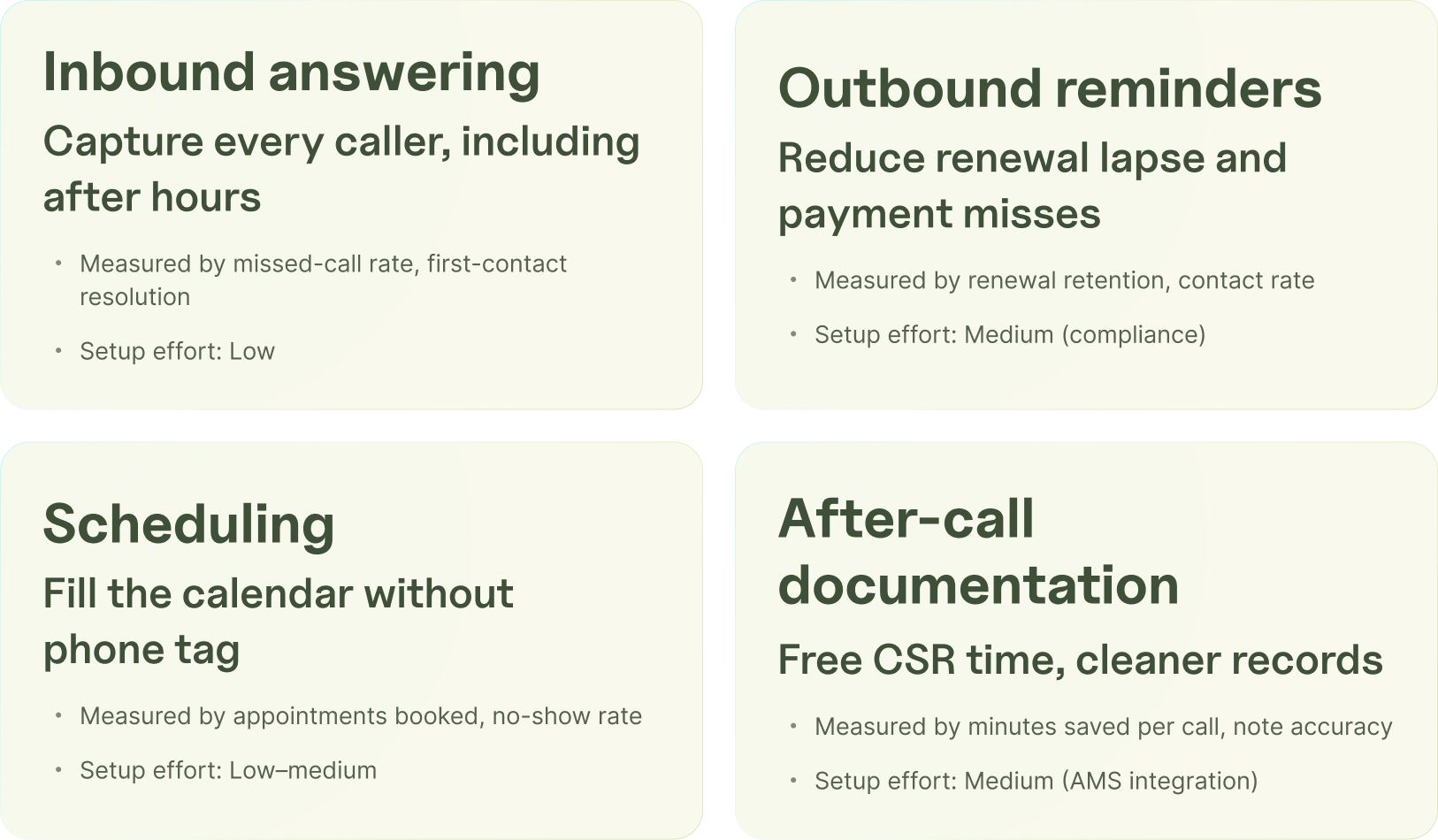
AI voice assistants are software agents that speak and listen on the phone, so an insurance agency can answer, remind, schedule, and document calls without pulling a person off other work. For a property and casualty (P&C) agency, the value shows up across four tasks: answering inbound callers, placing outbound reminders, booking and confirming appointments, and writing after-call notes into your systems. No single tool is equally good at all four, and no agency needs every task automated at once. This guide explains what AI voice assistants do at each stage, where each one saves the most time, and how to decide which task to hand off first.
Key Takeaways
- AI voice assistants cover four agency tasks: inbound answering, outbound reminders, scheduling, and after-call documentation - treat them as separate decisions, not one purchase.
- Inbound answering usually delivers the fastest payback because every missed call is a lost quote or a frustrated policyholder.
- Outbound reminders (renewals, payment lapses, document requests) reduce churn but carry compliance rules you must respect.
- After-call documentation is the quietest win: notes written straight into the agency management system (AMS) save customer service representative (CSR) time on every call.
- Pick the task with the clearest, most measurable pain first; add the others once the workflow proves out.
What tasks can AI voice assistants actually handle in an agency?
AI voice assistants handle four repeatable phone tasks in a P&C agency: answering inbound calls, making outbound reminder calls, scheduling or confirming appointments, and documenting each call afterward. These voice assistants work best on structured, high-volume interactions where the caller's intent is predictable - a certificate of insurance (COI) request, a renewal reminder, a callback booking - and they escalate anything complex to licensed staff.
The distinction matters because agencies often buy for one task and get frustrated when the tool underperforms on another. An assistant tuned for after-hours inbound answering is not automatically good at compliant outbound dialing. Deciding by task keeps expectations honest. For the broader category and how these systems fit insurance specifically, the primer on how voice AI applies to insurance operations is a useful starting point.
See how one voice assistant covers all four tasks → Talk to Sonant
Which task should an agency automate first?
Most agencies should automate inbound answering first, because missed calls have the most direct revenue and retention cost. When a caller reaches voicemail, a share of them simply dial the next agency - the Insurance Information Institute publishes context on how consumers shop and switch carriers (III), and lost first contact is hard to recover. Inbound is also the easiest task to measure: you already know your missed-call rate.
The order below reflects typical payback speed and setup effort, not a rule. An agency drowning in renewal churn might reasonably start with outbound reminders instead.
For the answering task on its own, the deeper walkthrough of an AI receptionist built for insurance agencies covers routing and escalation in detail.
How do AI voice assistants handle inbound calls?
On inbound calls, an AI voice assistant answers immediately, identifies the caller's intent, handles routine requests, and routes or escalates the rest to a licensed person. For a P&C agency that means fielding COI requests, taking first notice of loss (FNOL) details, answering billing questions, and capturing new-quote leads - day, night, or during a storm surge.
The payoff concentrates in two windows: peak daytime overflow, when every line is busy, and after hours, when the alternative is voicemail. Agencies that struggle most with the second window will find the breakdown of handling after-hours insurance calls relevant, and the case for cutting your missed-call rate lays out the retention math. A good assistant does not try to close complex claims - it collects clean information and hands off, which is where conversational AI for insurance workflows earns its place.
How do outbound reminders and scheduling work?
Outbound voice assistants place proactive calls - renewal reminders, payment-lapse notices, document and photo requests - and route interested callers to booking or to staff. Scheduling assistants handle the calendar side: offering times, confirming appointments, and reducing no-shows through reminder calls. Both tasks lift retention, but outbound carries rules you must respect.
Outbound dialing to consumers is governed by telemarketing and robocall regulation; review the FCC telemarketing and robocall rules before launching any outbound reminder program, and note the NAIC model bulletin on insurer use of AI (NAIC). On scheduling, the analysis of AI scheduling assistants that recover weekly hours for agencies quantifies the calendar win, and the guide to automating call-back scheduling for insurers shows how the two tasks connect. Time saved on reminder and booking calls typically runs in the range of several hours per CSR per week.
What does after-call documentation actually save?
After-call documentation is the task where an AI voice assistant transcribes and summarizes each conversation, then writes the note into the agency's system so a CSR does not retype it. In a P&C agency, that means a structured record - caller, intent, action taken, follow-up - landing in the AMS while personally identifiable information (PII) is handled under your data controls.
The saving is small per call but constant across every call, which is why it compounds. CSR time is expensive relative to the task - wage context is published by the Bureau of Labor Statistics - so minutes reclaimed on documentation flow straight back into quoting and service. Agencies rebuilding their back office around this will find the overview of insurance workflow automation and the mechanics of FNOL intake automation directly applicable.
How Sonant fits
Sonant is an AI voice receptionist built for P&C agencies, and it runs all four tasks as one workflow rather than four disconnected tools. Inbound: Sonant answers, identifies intent, handles routine requests, and escalates complex cases to licensed staff. Outbound and scheduling: it places reminder and callback calls and books appointments. Documentation: it writes a structured note into the AMS after every call - with native integrations for EZLynx, Applied Epic, HawkSoft, and AMS360.
The result is a measurable chain: workflow (answer or place a call) → metric (missed-call rate, retention, minutes saved per call) → output (a clean AMS record and a scheduled next step). Because AI voice assistants only pay off when they connect to your system of record, the AMS write-back and the escalation path to a licensed person are the parts that matter most. To compare how vendors handle these tasks, see the roundup of voice AI vendors serving insurance.
Ready to see AI voice assistants handle every agency call? Book a Sonant demo →
Related reading
- Weighing the benefits of AI receptionists for agencies
- How AI is reshaping the insurance industry
- A guide to insurance-agency management systems
- Cutting down the calls that overload your CSRs
- What is an AI voice agent
- 7 Best AI Phone Agents for Insurance Agencies






.svg)

.svg)


