

AMS360 pricing is one of the first things agencies want to see when they start comparing insurance agency management systems, and it's one of the hardest to find.
Vertafore, the parent company, doesn't publish its rates anywhere and sells AMS360 through a quote, so what you pay depends on your seat count, the package you land on, and which modules you switch on.
This review covers what Vertafore does put in writing, what the software directories list, and the costs that show up after the contract is signed.
Key Takeaways (TL;DR)
- What it is: AMS360™ is Vertafore's cloud agency management system for independent property and casualty (P&C) agencies, covering the policy lifecycle, insurance accounting, and carrier download in one system of record.
- Best for: Established multi-user agencies, roughly 15 people and up, with a real accounting burden and enough carrier connectivity to justify staying inside the Vertafore family.
- Standout feature: Insurance accounting. Trust accounting, direct bill, and commission reconciliation are handled natively, which is the job that otherwise needs a second ledger and a monthly reconciliation between the two.
- Biggest limitation: No published rate. Vertafore quotes every agency individually, so budgeting starts with a scoping conversation rather than a rate card.
- AMS360 pricing: Not published by Vertafore. Every route on the AMS360 product page ends at a demo request or the sales number, so the rate arrives with a proposal and moves on seat count, package tier, and modules.
- Best alternative: Depends on which problem you have. Applied Epic™, HawkSoft™, EZLynx™, and QQCatalyst™ are the credible system-of-record swaps. Sonant is not one of them, and is covered below as the companion for the call layer AMS360 leaves open.
- The verdict: Buy AMS360 if agency accounting is your bottleneck and you want carrier download, service workflows, and the general ledger under one login. Get the seat rate, the package name, and the renewal terms in writing first, because none of the three is published anywhere.
AMS360 Pricing at a Glance
What Is AMS360?
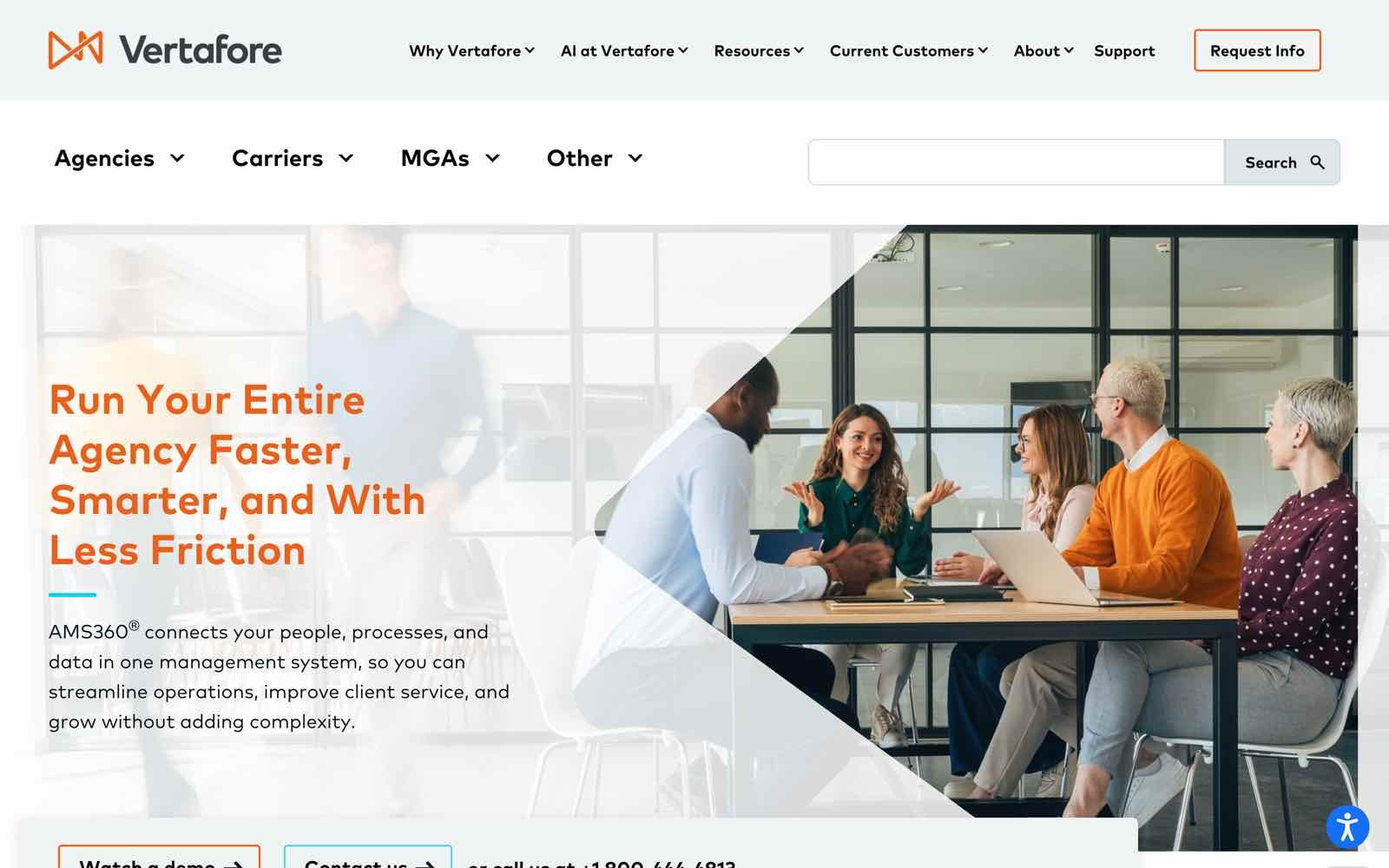
AMS360 is the agency management system Vertafore builds for independent P&C agencies, and it holds the client record, the policy record, and the agency's books in one place.
Vertafore describes it as a system that "connects your people, processes, and data in one management system, so you can streamline operations, improve client service, and grow without adding complexity", then splits it into three areas it calls:
- Service
- Accounting
- Leadership
The insurance-specific plumbing underneath is what agencies are paying for when they choose AMS360 software over a general business system. Carrier download pulls policy, endorsement, claim, and renewal data straight in through IVANS, while the accounting handles trust accounting, direct bill, and commission reconciliation without a second ledger anywhere in the picture.
Those two jobs are why an AMS360 agency management system gets expensive to leave once it's running, and why a data conversion sits at the front of every switch.
Vertafore’s AMS360 page now carries two Velocity AI agents, an Email Agent advertised at "80% time saved | 98% accuracy" and a Reconciliation Agent advertised at 90% time saved, 94% accuracy, and coverage of more than 200 carriers.
The same page states that agencies using AMS360 "have seen up to 26% revenue growth without adding employees."
AMS360 Pricing in 2026: Plans, Packages, and What Vertafore Publishes
Vertafore publishes no rate card for AMS360. There's no pricing page, no per-seat figure, and no published minimum anywhere on the site, and every route on the product page ends at "Watch a demo," "Request Info," or the sales number, which puts AMS360 pricing behind a scoping conversation rather than a calculator.
The package structure does get put in writing, though, and it turns up somewhere nobody thinks to look. On its Client Communications page, Vertafore states that "AMS360 users with AgencyOne on a Core or VAP package using VSSO are eligible for Vertafore Client Communications at no cost."
This names the two package tiers most buyers don't hear about until a quote lands, and it tells you something useful: module eligibility follows the tier you sit on, not what you ask for.
How we verified these figures
Every figure above comes from Vertafore's own live pages, checked in September 2026, and each row says which.
Several pages quote AMS360 at $150 to $200, or $150 to $300, per user per month. Those ranges live on marketing blogs run by companies selling competing products, and on none of Vertafore's pages, so they're excluded here rather than repeated.
An unattributed range isn't a price.
What AMS360 pricing does not include
Four costs sit outside whatever seat rate you negotiate, and the last one is the one agencies discover late.
- Implementation and data conversion. Moving a book off a previous system carries a project cost that Vertafore does not publish. Ask for the conversion quote and the go-live date in the same document, because the weeks between them are staff hours you are already paying for.
- Modules that carry their own line. InsurLink, WorkSmart, Proposal Builder, and RiskMatch are separate products in Vertafore's own navigation. Client Communications is free only on the Core or VAP path described above, which means the same module can be bundled for one agency and billed to another.
- Renewal terms. Because the rate is quoted rather than published, the renewal is a negotiation rather than a rate-card lookup. Agree the renewal terms alongside the year-one price and get both in the contract; the same discipline any quoted enterprise system deserves.
- The integration line item. Anything you want connected to AMS360 goes through the Vertafore Orange Partner Program, which Vertafore describes as connecting "agencies and MGAs with vetted technology solutions that complement their Vertafore products." Vertafore publishes no fee schedule for that access.
AMS360 Cost by Agency Size: How to Model It
With no rate to anchor against, the useful exercise is working out the shape of your own bill before you take the call. Total AMS360 cost lands in three layers, and most agencies budget for the first one only.
Seats are the layer everyone counts, and usually undercounts. The number that matters is everyone who touches a client record, which sweeps in service assistants and accounting staff alongside the licensed producers.
Modules come next, so walk through InsurLink, WorkSmart, Proposal Builder, and RiskMatch one at a time and establish which sit inside your quoted package and which get billed on top at your tier.
Integration is the third layer, meaning every connection between AMS360 and the rest of your stack, priced per partner. That third layer deserves the same scrutiny you'd give the tool itself.
When Applied Systems certified Sonant as an integration vendor in August 2026, the announcement made its point in cost terms rather than technical ones, promising Epic agencies voice AI inside their workflows with "no integration fee, no separate line item."
Put the same question to every AMS360 partner on your shortlist. Who pays for the API access, and does the connection read the client record live or only write to it once the call has ended? Ask before the demo, not after the invoice.
AMS360 Main Features
Four jobs sit at the centre of AMS360, and no independent agency gets to skip any of them: servicing the policy lifecycle, keeping insurance-standard books, staying connected to carriers, and reporting on the result. Each capability below is described by what it changes in an ordinary week rather than by its spec sheet.
Policy lifecycle service
The Service area carries the client and policy record from bind through endorsement to renewal, with activity tracking and task management hanging off it.
The gain is that a service request stops living in one CSR's memory or inbox, which is exactly where documentation gaps and errors and omissions (E&O) exposure tend to start.
Insurance accounting and commission tracking
Trust accounting, direct bill, general ledger, and commission reconciliation all run inside the same system as the policy record, and that one fact is why established agencies pick AMS360 over lighter systems.
It takes out a whole second tool, along with the monthly reconciliation between the two. Reviewers call the accounting capable and, in the same breath, say it takes training to use well.
Carrier download through IVANS
Policy, endorsement, claim, and renewal data arrives from carriers instead of being keyed in by staff.
The value shows up in the errors that never happen rather than in any report, because a downloaded renewal is a renewal nobody had to type twice.
Business intelligence and reporting
The Leadership area handles reporting and key performance indicator analysis, and it's the one part reviewers name as a strength on both directories.
For an owner or an ops leader, this is what turns retention and book growth from an anecdote into a number somebody has to own.
Velocity AI agents
Vertafore now ships an Email Agent and a Reconciliation Agent on the AMS360 page, advertised at 80% and 90% time saved respectively, with the Reconciliation Agent covering more than 200 carriers.
Both work on documents and statements after the fact, which puts them in back-office automation rather than live conversation.
The Vertafore product family around it
InsurLink gives clients a self-service portal, WorkSmart handles content management, Proposal Builder produces client-facing proposals, and RiskMatch adds analytics. Buying inside one family usually means fewer vendors to chase when a sync breaks. It also means your renewal conversation is with a single counterparty holding your books, your policies, and your client portal at the same time.
The next step is to match these features to individual workflows at your company, but you first need to understand who AMS360 is built for
Who Is AMS360 For?
AMS360 is built for agencies carrying real operational weight, and best suited to "established independent agencies" and "multi-user or multi-department agencies."
The five profiles below take that further:
Established multi-department agencies
An agency of 15 to 50 people running separate personal lines, commercial lines, and accounting functions is the design centre.
Those departments need shared records, defined workflows, and a general ledger that survives an audit, and AMS360 was built for exactly that shape.
Agencies where accounting is the bottleneck
If your monthly close still involves exporting commissions into a spreadsheet and reconciling by hand, the accounting module is the line item that pays for itself first. This is the reason to buy AMS360, and the hardest one for a lighter system to answer.
Agencies committed to the Vertafore family
Already running Vertafore products, or want the client portal, content management, and analytics from one vendor? Staying inside the family cuts the number of integrations you own and the number of people you call when something breaks.
Weigh that against the concentration, because one vendor holding the record, the books, and the portal is also one renewal conversation with no second vendor to price against.
Growing agencies with a migration ahead
Agencies leaving a legacy system have the most to gain here and the most to lose. The gain is a modern cloud record with carrier download working properly from day one. The loss is the conversion project, so get its scope and cost written down before you agree the seat rate.
The seat rate is the number everyone negotiates hard, and the conversion is the one that overruns.
Agencies whose real bottleneck is the phone
AMS360 is built to hold and organize work that has already reached the agency, so live call handling sits outside its design centre by intention rather than by omission.
If producers are interrupted all day, calls ring out through the lunch rush, and evening quote calls land in voicemail, that's an intake problem, and the answer sits in a different layer of the stack. Solve intake first, then judge AMS360 on the accounting and reporting jobs it was built to do.
AMS360 Reviews: The Good and The Bad
AMS360 reviews on Capterra show it holds 3.6 out of 5 across 58 reviews, with features at 3.5, customer service at 3.3, and both ease of use and value for money at 3.2. Here’s a deeper insight into this:
Pros
- Insurance accounting done properly: Reviewers describe it as a "great accounting system and for pulling accounting reports," which is the capability that keeps agencies on it through interface complaints.
- Reporting depth: Strong analytical reporting comes up repeatedly, and it is what gives owners a defensible view of retention and production.
- Carrier and platform connectivity: Reviewers name integrations with insurance platforms including IVANS and Outlook as a strength, and carrier download is the daily version of that.
- Trainable for everyday work: Reviewers report that new hires pick up everyday servicing tasks quickly, even where the accounting takes longer.
- Reliable day to day: Reviewers report dependable uptime with overnight updates, which is what a service team notices on a Monday morning.
Cons
- Pricing is quoted, not published: Vertafore publishes no rate, so the cost cannot be modelled before a scoping conversation, and Capterra rates value for money 3.2 out of 5.
- Ease of use scores lowest: Capterra rates ease of use 3.2, level with value and below features and support. Staff arriving from a newer system should work the daily screens in a demo before signing.
- Accounting depth carries a training cost: The accounting is the deepest part of the product, which is why reviewers point to training time. Budget the hours rather than assuming the team absorbs it.
- Support scope varies by tier: Capterra rates customer service 3.3. Ask which support tier your quote includes and what response time comes with it.
- Modules are priced separately: InsurLink, WorkSmart, Proposal Builder, and RiskMatch are separate products in Vertafore's own navigation, so the package you land on decides which arrive included.
Best AMS360 Alternatives
You might be wondering which management system to run instead of AMS360, or what to run alongside it, since the management system is scoped to the record rather than to the phone.
The first entry below answers that second question and isn't a system-of-record swap:
1. Sonant, the companion for the call layer AMS360 leaves open
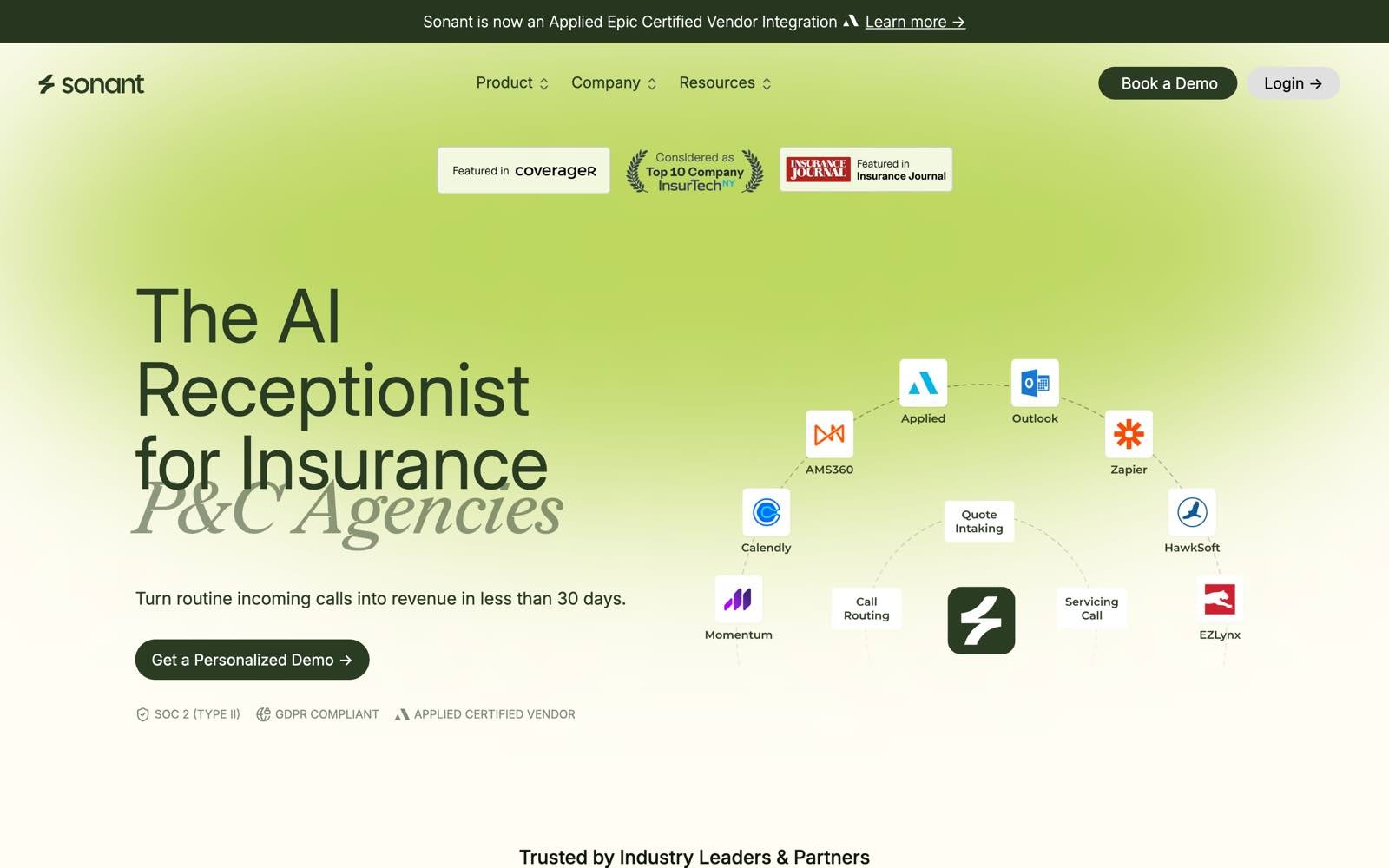
Sonant is the AI receptionist built for insurance agencies, and it sits alongside an agency management system rather than replacing one. It answers every inbound call around the clock, recognizes and verifies the caller, opens their record mid-conversation, takes the details for a quote or service request, and routes the call to whoever owns the account with the request already documented.
The reason it belongs in an AMS360 pricing article is the integration layer. Sonant's AMS360 integration runs on API connectivity, and Sonant's own description states that during calls it pulls client and policy information to provide personalized service, after calls it pushes structured outcomes back into AMS360, and the data exchange works in both directions.
The read direction is the half that gets overlooked. Writing a note afterwards documents the request, while reading the record during the call is what lets a renewal date or a coverage question get answered at 9 pm instead of promised as a callback.
It's the same mechanism that lifted staff productivity 43% at Cornerstone Insurance Services, a Saskatchewan brokerage, where the team went from 70 to 100 tasks a day because phone traffic arrived as triaged tasks with the information already collected.
Pricing is a predictable partner rate per agency, with onboarding, configuration, and support included, and it doesn't move when call volume spikes. It's also quoted rather than published, which is a fair thing to hold against a review arguing for published pricing, and an agency whose real need is a better system of record should shortlist from the four entries below instead.
Book a Demo, and we will run it against your own AMS360 data and call flows, so you can judge the write-back yourself rather than take it from a page.
2. Applied Epic™, best for larger and multi-location agencies
Applied Epic is the other enterprise-scale management system in the US independent market, covering personal lines, commercial lines, and benefits in a single record with a large partner ecosystem around it. Agencies pick it when scale, multi-location structure, and integration breadth matter more than simplicity.
Against AMS360, it's the heavier system in both capability and implementation, and that cuts both ways. Applied publishes no pricing either, so the comparison comes down to quote against quote, with both vendors scoping on seats and modules. Agencies with no multi-location or benefits requirement often find the extra weight is capacity they pay for and never use.
3. HawkSoft™, best for service-led independent agencies
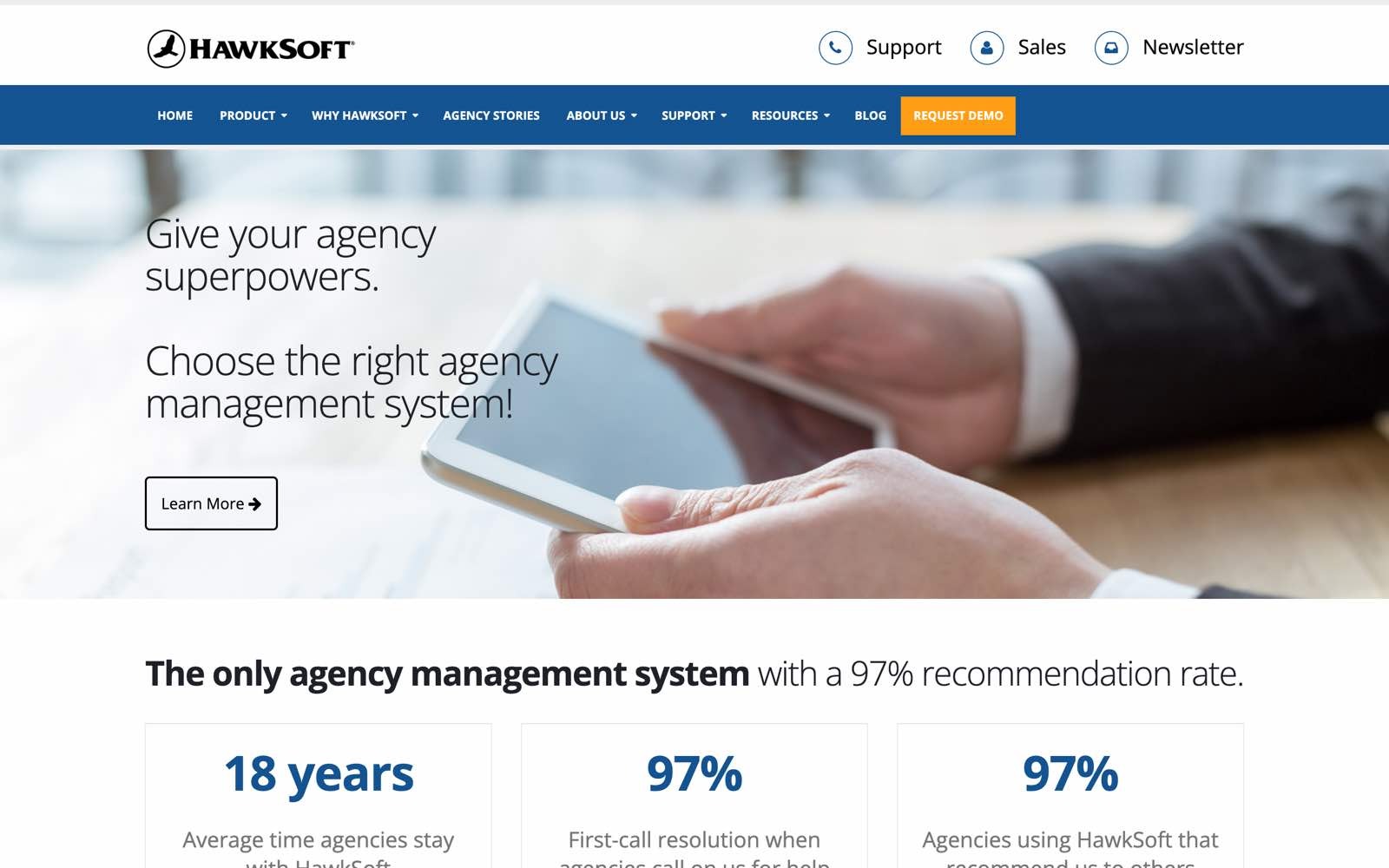
HawkSoft is a management system built around independent agency servicing workflows, privately owned and running since 1995. Agencies choose it when day-to-day servicing quality and staff experience matter more than breadth of modules.
It is also the one system here that publishes numbers. $99/user retail price, and its additional services terms publish an add-on rate card including e-signature at $39.00 per license per month and text messaging at $20.00 per agency per month, both on its page.
Read the fine print carefully, because e-signature, certificates, and texting are billed rather than bundled. HawkSoft also states on its own rater page that it shares data to 10 named comparative raters rather than including one, so a rating license sits on your side of the comparison.
4. EZLynx™, best for agencies that want rating and management together
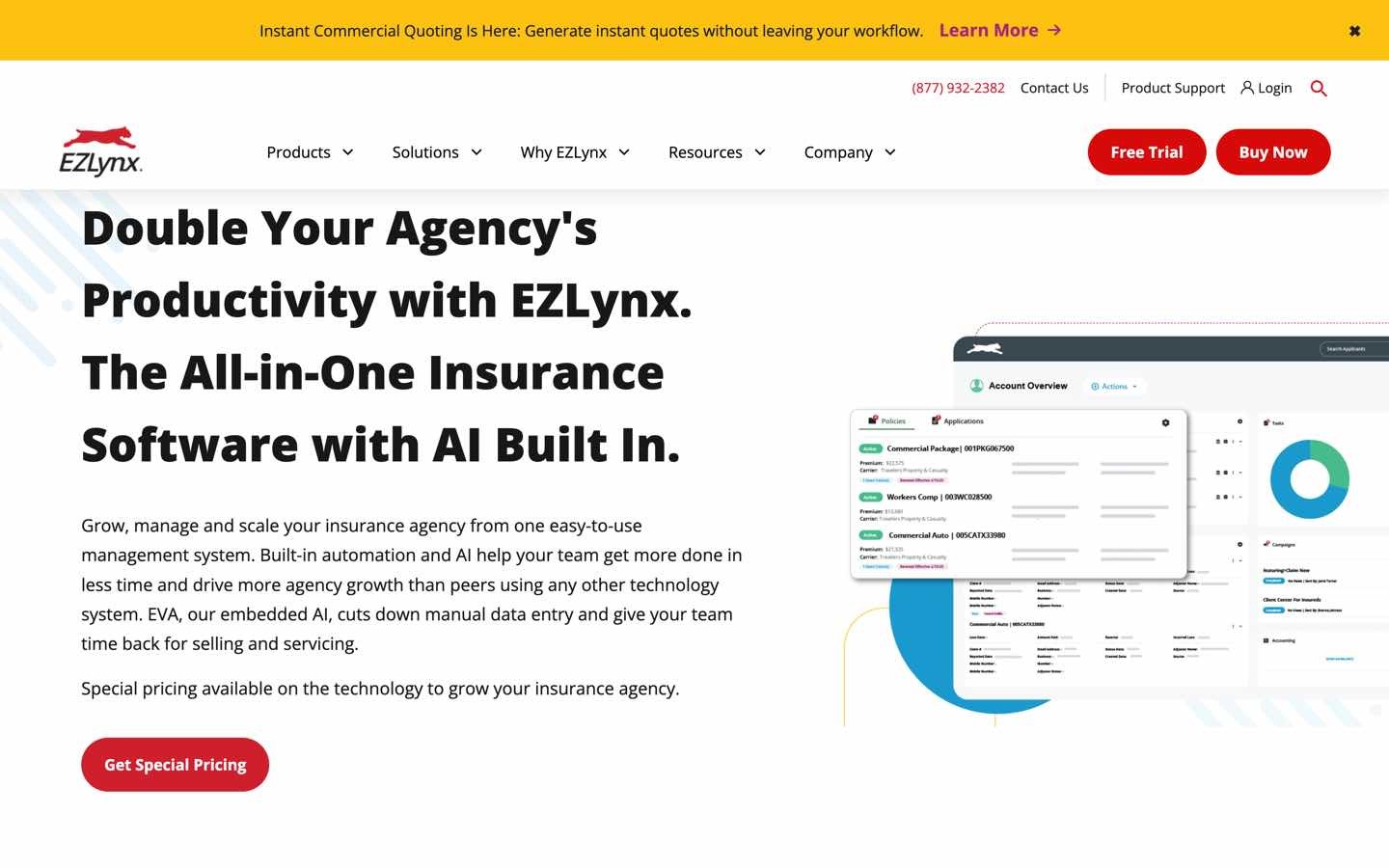
EZLynx, which Applied Systems acquired on March 9, 2021, bundles a comparative rater, a management system, and CRM features into one product. If you're currently paying for a management system plus a separate rater, consolidating can shrink both the bill and the number of places data has to sync.
EZLynx publishes no figure either. Its pricing page states that "EZLynx pricing is based on the number of users at your agency and the products you need, so there's no single flat rate," and makes a stacking argument worth weighing: that once you add "a separate rater, CRM, eSignature tool, and client portal," a cheaper per-seat system can total more.
That argument applies to AMS360 as much as to anyone. The trade is that a bundled CRM is generally less developed than a dedicated one.
5. QQCatalyst™, best for smaller agencies staying inside Vertafore
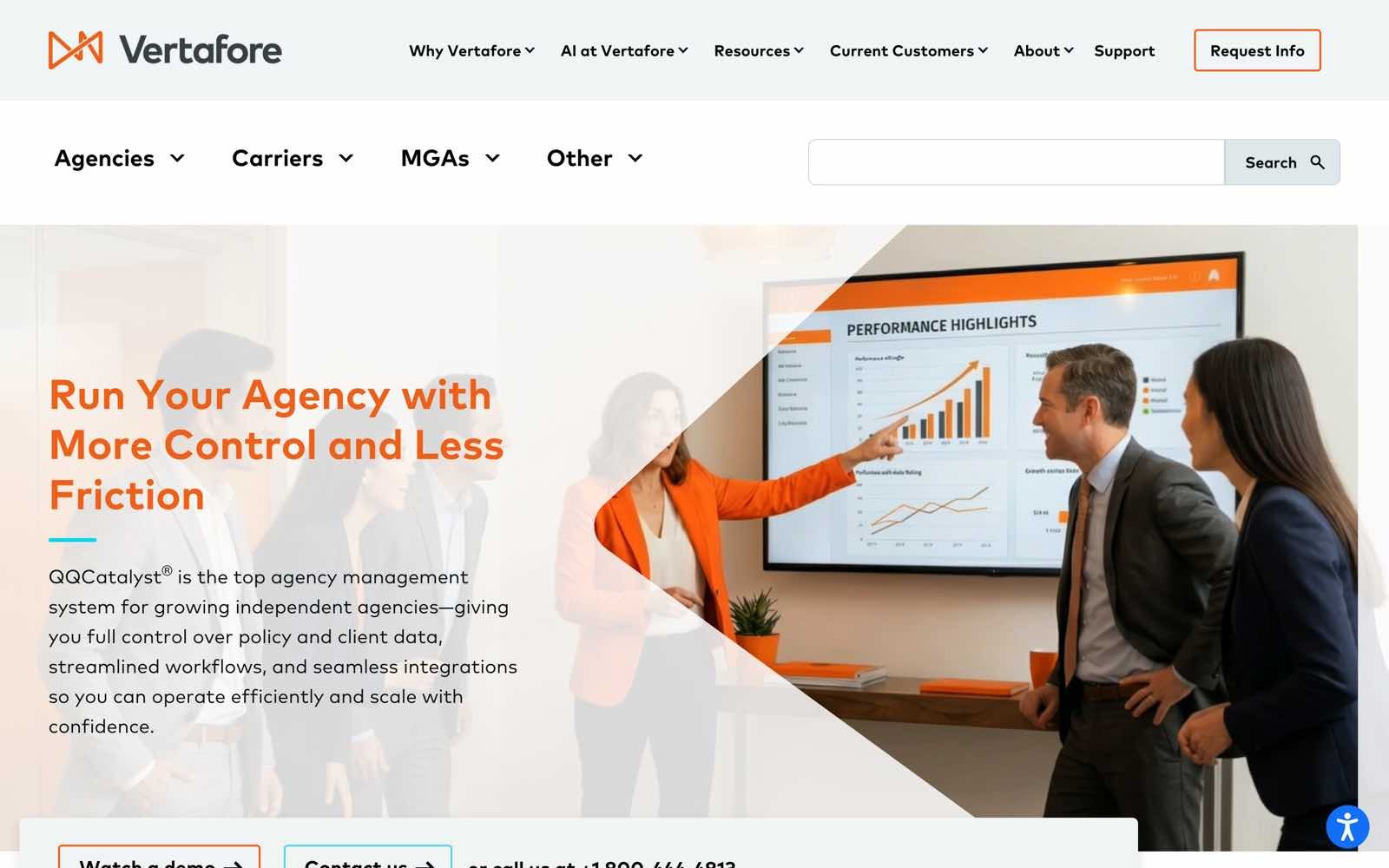
QQCatalyst is Vertafore's lighter management system, described on its own page as "the top agency management system for growing independent agencies" and shipping with more than 50 pre-built reports. It suits smaller agencies whose accounting needs are simpler than what AMS360 is built to carry.
Compared with AMS360, it is a step down in accounting depth and a step down in cost, and it sits with the same vendor, so a later move up stays inside one relationship.
Like AMS360, it pairs with a separate Vertafore rating product rather than rating inside the system, and like AMS360, its price is quoted rather than published.
Everything You Need to Know About AMS360
Before you sign off anything in this category, our buyer's checklist covers the questions that separate a real integration from an export, including how AMS call notes get logged without staff typing them.
Disclaimer:
All product names, logos, and brands are property of their respective owners. AMS360™, QQCatalyst™, AgencyOne™, InsurLink™, WorkSmart™, RiskMatch™, and Vertafore™ are trademarks of Vertafore, Inc. Applied Epic™ and EZLynx™ are trademarks of Applied Systems, Inc. HawkSoft™ is a trademark of HawkSoft, Inc. No affiliation, endorsement, or sponsorship is implied. Product features, pricing, and availability are current as of September 2026 and subject to change; verify with each vendor before making a purchase decision.