.svg)

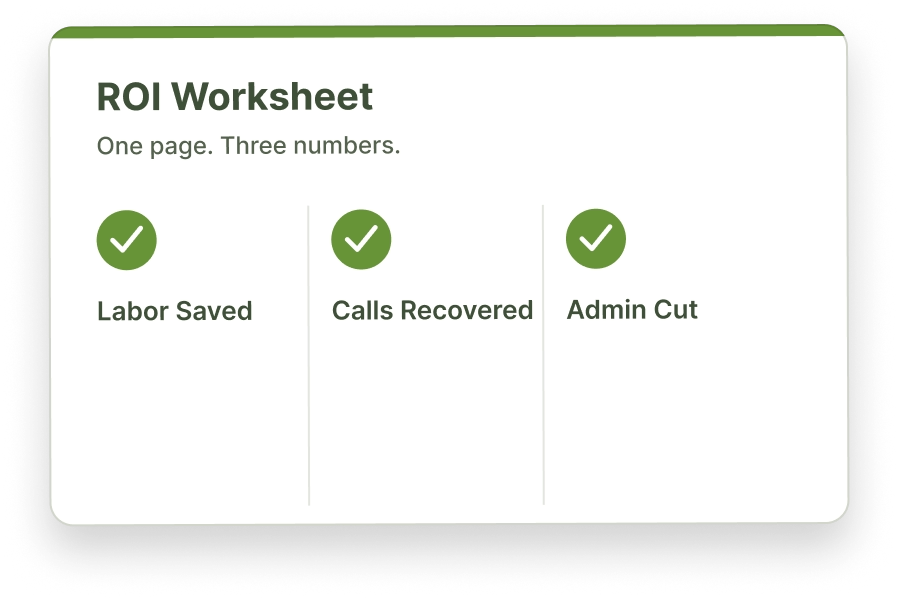
An AI receptionist saves an insurance agency money in three measurable ways: it removes staff hours spent on routine calls, it recovers revenue from calls that would have gone unanswered, and it cuts the administrative typing that follows every call. The honest answer to "what is the ROI of an AI receptionist for an insurance agency" is that it depends on your call volume, your staffing cost, and how much of your day is routine service versus licensed advice, but each of those levers is something you can size with numbers you already have. This post walks through the math so you can build a figure you would defend to a partner, not a marketing headline.
Key Takeaways
- AI receptionist ROI comes from three levers: labor hours saved, calls recovered, and admin work eliminated. Size each separately.
- Agencies that connect an AI receptionist to their AMS commonly cut administrative overhead 60-80%, which is usually the largest and most predictable line.
- Recovered after-hours and overflow calls are real revenue, but estimate them conservatively using your own answer rate, not a vendor's.
- The comparison that matters is not "AI vs nothing." It is AI against the true loaded cost of a CSR, an answering service, or a virtual assistant.
- The best ROI comes from a hybrid model: AI handles routine and overflow, your licensed staff keep the judgment calls.
What is the ROI of an AI receptionist for an insurance agency?
The return on an AI receptionist is the value of the time and revenue it protects, minus what it costs to run. Start with the work it removes. An AI receptionist for insurance agencies connects to your AMS (EZLynx, Applied Epic, AMS360, HawkSoft), resolves routine calls on the spot, logs every interaction, and routes what needs a licensed person. Agencies that adopt this pattern commonly cut administrative overhead 60-80%. That number is where most of the ROI lives, because it is recurring and it is tied to hours your team is paid for regardless of call outcome.
The second lever is recovered calls. If your team misses calls during lunch, overflow spikes, or after hours, those are quotes and retention conversations that leak out. One agency found 641 after-hours calls that had gone unanswered. You do not need to guess at your own number. Pull it from your phone system, run it through the live-transfer ROI calculator, and compare it to your true cost of missed calls. The third lever is the admin tail: the note-typing and task-creation after every call, which an AI receptionist writes back automatically instead of consuming a CSR's afternoon. For a fuller picture of the raw price side of the equation, see how much an AI receptionist costs.
Want us to run the numbers against your call volume? → Talk to Sonant
How to size each ROI lever
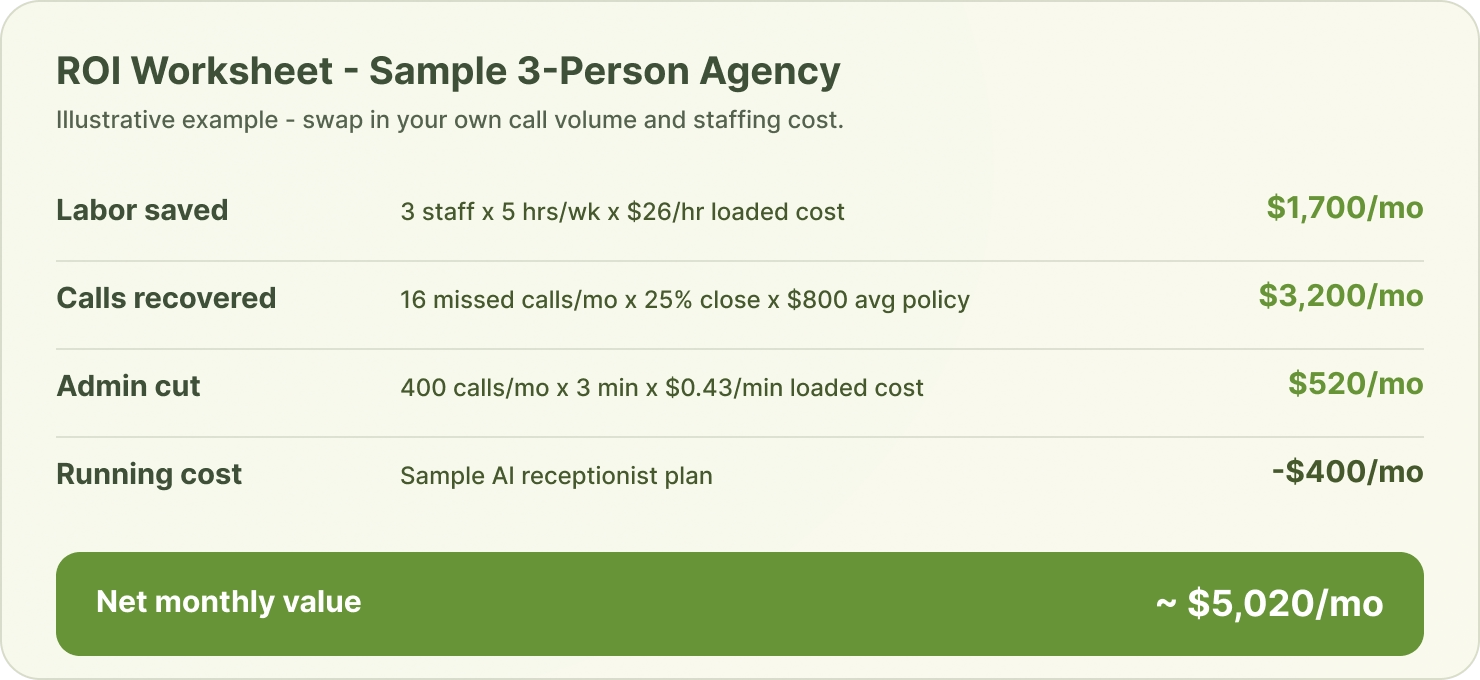
Build the number from the three levers separately, then net out the running cost. Use figures you can pull from your own AMS and phone system rather than assumptions.
Two cautions. First, do not double-count: a call that AI resolves is either labor saved or a call recovered, not both. Second, be conservative on close rate for recovered calls: use your real historical number. For the labor side, compare against the true loaded cost of alternatives, whether that is hiring an in-house CSR or the ongoing insurance virtual assistant cost.
What to evaluate before you trust the ROI number
A savings figure only holds if the tool actually does the work reliably and safely. Before you commit, evaluate three things. First, data handling: ask whether the vendor is SOC 2 audited, since your call logs contain client PII. The AICPA SOC 2 framework is the standard to ask about. Second, regulatory posture: review how the vendor treats AI disclosure and consumer protection against your state's stance, guided by the NAIC model bulletin on AI. Third, the market context for your own volume: the Insurance Information Institute is a neutral source for industry benchmarks you can sanity-check against.
Also evaluate what the tool does *not* do. If a large share of your calls are complex coverage discussions or emotionally charged claims, those still belong with a licensed person, and your ROI should not assume they get automated. Being honest here makes the number credible. You can compare pricing structures, such as per-minute vs flat-rate, to understand how running cost scales with volume before you divide it into the savings.
How Sonant fits
Sonant is an AI receptionist built for P&C agencies, and it maps directly onto the three ROI levers. On labor, it resolves routine calls end-to-end (verifying callers against AMS data, texting the matching carrier's payment link, answering common service questions), so those hours come off your team's plate. On recovered calls, it answers overflow, after-hours, and Spanish-speaking calls 24/7, collects claim details, texts the carrier claims link, flags urgent items, and creates a task with a full transcript. On admin, after every call a note lands on the client record and a task is assigned, with no manual typing, which is where the 60-80% overhead reduction shows up. See how this connects to your system in insurance call center automation.
Sonant is not a replacement for your team. It is coverage for the calls the team can't reach and the routine work that pulls licensed staff off higher-value conversations, a factor worth weighing alongside why insurance staff quit and the drag of missed calls. The judgment calls stay with people. That hybrid is what makes the ROI both real and defensible. If you already model returns on other spend, the same discipline behind our ROI calculator applies here.
Ready to see the number for your own call volume? Talk to Sonant →
Related reading
- How much does an AI receptionist cost for an insurance agency?
- AI receptionist pricing: per-minute vs flat-rate
- The real cost of missed calls at an insurance agency
- AI receptionist vs hiring an in-house CSR
- Insurance virtual assistant cost
- Reduce missed calls at your insurance agency
- AI receptionist for insurance agencies






.svg)

.svg)


