.svg)


Choosing the best AI for insurance companies depends less on brand names and more on which function you are trying to fix: underwriting, claims, policyholder service, or distribution. Each function rewards a different kind of model and a different tolerance for error. This ranked guide names real tool categories and vendors by function, explains what each does well, and scores them against criteria that matter to carriers and agencies - accuracy, integration depth, compliance posture, and how cleanly the AI escalates to a licensed human. If you run an agency and your first bottleneck is the phone, distribution-side answering tools will move your numbers faster than an underwriting model will.
Key Takeaways
- The "best" AI depends on the function: underwriting, claims, service, and distribution each need different tooling.
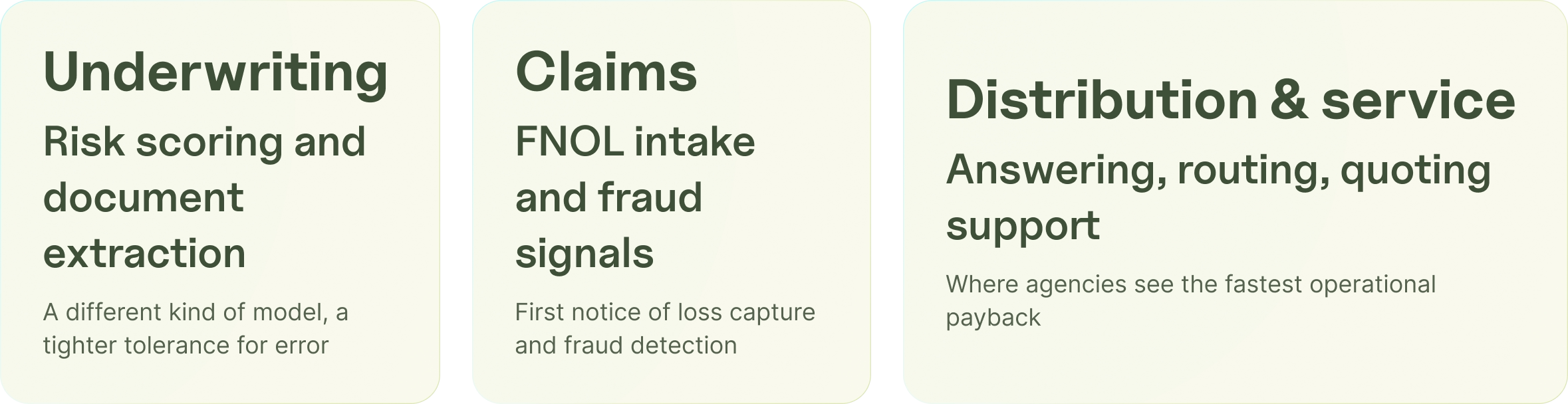
- Underwriting AI focuses on risk scoring and document extraction; claims AI focuses on first notice of loss (FNOL) intake and fraud signals.
- Distribution and service AI - answering, routing, quoting support - is where agencies see the fastest operational payback.
- Integration with your agency management system (AMS) and clean human escalation matter more than raw model quality.
- Sonant is the distribution- and agency-facing pick for answering, capturing, and routing calls with AMS write-back.
What counts as the "best" AI for an insurance company?
The best AI for insurance companies is the tool that measurably improves one function without creating compliance or handoff risk in the others. Insurance is not one workflow - it is four (underwriting, claims, service, distribution), and a model that scores risk well is useless at answering a renewal call. Judge tools by function fit, not hype.
That framing matters because buying decisions often start with a generic "AI platform" pitch and end in a tool that touches nothing your team does daily. A carrier tightening loss ratios needs underwriting and claims AI. An independent agency losing after-hours calls needs distribution AI. For a fuller map of the landscape, our complete directory of AI tools for insurance agencies breaks the field down by category, and our overview of how AI is reshaping insurance operations covers the direction of travel.
Tell us which function is your bottleneck → Talk to Sonant
How we scored the best AI for insurance companies
We reviewed 20+ tools across underwriting, claims, service, and distribution, and weighted them against six criteria. We paid particular attention to niche-specific capabilities - AMS write-back, FNOL intake quality, and intent routing - because those are the hardest features to fake and the ones that separate insurance-native tools from generic AI wrappers.
The weights below total exactly 100%, with the heaviest weight on the proof that is hardest to fabricate: real integration and demonstrated function accuracy.
- Function accuracy and depth (25%): how well the tool performs its core job - risk scoring, claims extraction, or call handling - measured against the function it targets.
- Integration and AMS write-back (25%): whether the AI reads from and writes back to systems of record like the AMS or claims platform, versus living in a silo.
- Compliance and data handling (20%): posture on PII (personally identifiable information), audit logging, and alignment with regulatory guidance such as the NAIC model bulletin on AI.
- Human escalation quality (15%): how cleanly and quickly the AI hands off to a licensed human when it hits its limits.
- Ease of deployment (10%): setup time, staff training load, and time to first measurable result.
- Insurance specificity (5%): whether the tool was built for insurance workflows or adapted from a horizontal product.

The ranked list: best AI for insurance companies by function
The list below groups tools by the function they serve. Rankings reflect function fit for the target use case, not a single universal winner - a claims tool and an answering tool are not competing for the same job. Descriptions are factual and general; specific pricing and performance figures are marked.
1. Sonant - distribution and agency-facing answering
Sonant is an AI voice receptionist built for property and casualty (P&C) insurance agencies. It answers calls, captures caller intent, books and routes, and writes structured notes back to the AMS, escalating to licensed staff when a call needs a human. For agencies whose first constraint is missed and after-hours calls, this is the distribution-side pick; see how an AI receptionist handles insurance agency calls and the approach behind reducing missed calls at an agency. Best fit: independent agencies and distribution teams. specific volume and pricing.
2. Underwriting risk-scoring platforms
Underwriting AI ingests submissions and third-party data to score risk and flag exposures faster than manual review. This category fits carriers and MGAs tightening loss ratios. Named examples in the market include Cape Analytics (property risk) and Planck; capabilities and pricing vary and should be confirmed directly. Best fit: carriers, program administrators.
3. Document extraction and submission-intake AI
These tools read ACORD forms, loss runs, and policy documents, extracting fields into structured data for underwriting or servicing. Examples include Roots Automation and Sensible. This category pairs well with broader insurance workflow automation initiatives. Best fit: operations teams drowning in PDFs.
4. Claims and FNOL intake AI
Claims AI captures the first notice of loss, structures the details, and triages severity. Strong FNOL intake shortens cycle time and improves data quality downstream; our primer on automating first notice of loss explains the mechanics. Vendors marketing claims automation include Five Sigma and Tractable. Best fit: carriers and TPAs.
5. Fraud-detection models
Fraud AI scores claims and applications for anomaly patterns, flagging suspicious cases for special-investigation review. Shift Technology is a widely cited vendor here. Best fit: claims and SIU teams at scale.
6. Conversational service and chatbots
Text-based assistants answer policyholder questions and deflect routine service tickets. See our overview of conversational AI applied to insurance. Best fit: carriers and larger agencies with high service volume.
7. Agentic workflow orchestration
Emerging agentic systems chain multiple steps - pull data, draft, act - across insurance workflows with human checkpoints. Our explainer on agentic AI in insurance covers what is real versus aspirational today. Best fit: teams with mature data plumbing.
8. Lead qualification and distribution support
These tools score and route inbound leads so producers spend time on the ones likely to bind; our guide to AI-powered lead qualification walks through the workflow. Best fit: growth-focused agencies.
9. Contact-center and VoIP platforms with AI add-ons
Interactive voice response (IVR) and voice-over-IP (VoIP) systems now bundle AI routing and transcription. These are horizontal tools adapted for insurance rather than insurance-native. Best fit: agencies already standardized on one phone vendor. insurance-specific features.
Summary comparison table
What does the market data say about readiness?
Adoption is uneven across the four functions, and buyer readiness is shifting faster than vendor capability in some areas. The Sonant Consumer AI Readiness Report tracks how policyholders feel about interacting with AI on the phone and in service - useful context before you deploy anything customer-facing. For occupational and wage context on the roles AI augments, the Bureau of Labor Statistics publishes insurance-sector data, and the Insurance Information Institute covers industry trends.
How Sonant fits
Among the best AI for insurance companies, Sonant occupies the distribution and service lane: the phone. The workflow is direct - a call comes in, Sonant answers and captures the caller's intent, books or routes the request, then writes a structured note back to the AMS. Native integrations include EZLynx, Applied Epic, HawkSoft, and AMS360, so the record of the call lands where your customer service representatives (CSRs) already work. When a call needs judgment or a licensed decision, Sonant escalates to your staff rather than guessing.
The metric that matters is captured-call rate turning into booked or routed outcomes, with the output being a clean AMS note and no dropped after-hours caller. Compliance posture - PII handling and audit logging - follows guidance like the NAIC model bulletin on AI. To weigh the payback, our breakdown of insurance agency software ROI and the mechanics of your agency management system show where the hours come back.
See where AI moves your numbers first - start with the phone. Book a Sonant demo →
Related reading
- Automating first notice of loss for faster claims
- What agentic AI can and cannot do in insurance today
- Where AI is changing the broader insurance industry
- Streamlining repetitive agency tasks with workflow automation
- Using conversational AI to answer policyholder questions
- Insurance agency AI: where to start and what to buy
- Insurance agency automation software ROI






.svg)

.svg)


