.svg)

Calculating insurance agency automation software ROI comes down to three measurable inputs: the staff hours the software gives back, the calls it recovers that would otherwise go to voicemail, and the retention it protects when clients get answered on the first try. You subtract the annual cost of the tool from the dollar value of those three gains, then divide by the cost. This guide walks through each input, the formula that ties them together, what drives the number up or down, and a worked framework you can copy into a spreadsheet today. No invented benchmarks - every figure here is either sourced or flagged for you to verify with your own numbers.
Key Takeaways
- Insurance agency automation software ROI has three core inputs: time saved, calls recovered, and retention protected.
- The formula is straightforward: (annual gains − annual cost) ÷ annual cost, expressed as a percentage.
- Time saved is valued at the loaded hourly cost of a CSR (customer service representative), not their base wage.
- A recovered call is worth the average revenue per new policy multiplied by your close rate - use your own figures and mark estimates.
- Payback period matters as much as ROI percentage; many agencies target payback under 12 months before committing.
What counts as ROI for insurance agency automation software?
Insurance agency automation software ROI is the net financial return an agency earns from a tool after subtracting its cost, measured across time saved, revenue recovered, and clients retained. ROI is not a single vendor stat - it is a calculation built from your agency's own inputs. The three levers below cover the vast majority of the value, and each can be estimated from data you already have in your phone system and your agency management system.
The mistake most agencies make is measuring only one lever. Counting hours saved but ignoring recovered calls understates the return; counting recovered revenue but ignoring retention misses the compounding effect of renewals. A defensible number combines all three. For the operational context behind these levers, see how agencies think about the broader return on agency technology spend.
Want the calculation applied to your own call volume? → Talk to Sonant
How do you value the time automation saves?
Time saved is valued at the fully loaded hourly cost of the staff whose work the software absorbs - typically a CSR handling routine calls, intake, and note-taking. Take the annual hours the tool removes, multiply by the loaded hourly rate, and you have the labor component of ROI. Loaded rate means wage plus benefits, taxes, and overhead, not the base salary alone.
Start with the base wage. The U.S. Bureau of Labor Statistics publishes occupation-level wage data you can use as a reference point for insurance service roles at the BLS wage and occupation portal; pair that with your own payroll and read our breakdown of what an insurance CSR typically earns. A common convention is to multiply base wage by roughly 1.25 to 1.4 to reach loaded cost.
Then estimate hours removed. If automation answers repetitive calls, captures caller details, and writes notes back to your system, those minutes add up across a year. Agencies focused on cutting administrative work off the CSR desk and on reducing overall operational cost treat this as the most predictable ROI lever because the hours are directly observable.
What is a recovered call worth?
A recovered call is one that would have gone unanswered but instead got captured, and its value equals your average revenue per new policy multiplied by the share of recovered callers who become clients. Missed calls are lost quotes; recovering them turns a leak into pipeline. This lever is often larger than time saved, but it takes more discipline to estimate honestly.
Pull three numbers: missed-call volume, close rate on answered new-business calls, and average first-year commission per policy. Missed-call volume comes from your phone system reports. For commission benchmarks, the Insurance Information Institute at iii.org publishes industry context, though you should use your own book's figures and mark any assumed rate. Agencies that want to answer more inbound calls without adding headcount and stop losing callers to voicemail tend to see this lever dominate their ROI. After-hours coverage matters here too - see the value of capturing calls that arrive outside business hours.
The ROI formula and a worked framework
The formula is: ROI % = (annual gains − annual software cost) ÷ annual software cost × 100, where annual gains is the sum of time-saved value, recovered-revenue value, and retention value. Below is the framework laid out as inputs - fill each cell with your own agency's figures and treat every bracketed item as a placeholder, not a claim.

The retention row is the one most agencies skip. When a client reaches a person or a competent automated answer on the first call, they are less likely to shop elsewhere at renewal. Value that as the annual commission you keep on clients you would otherwise have lost. Because renewals compound, even a modest retention lift moves the number meaningfully - but only estimate it from your own churn data.
What drives the ROI number up or down?
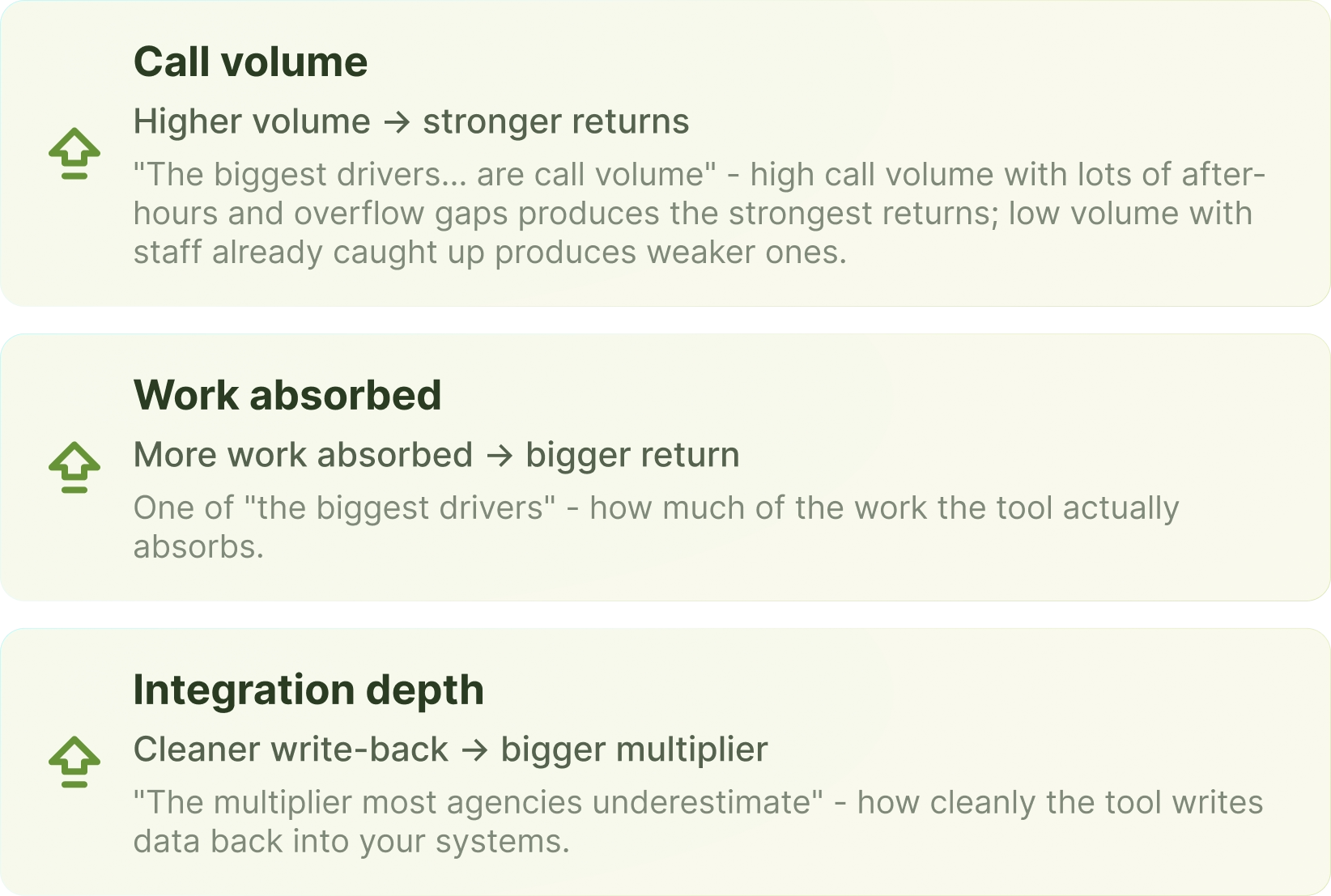
The biggest drivers of insurance agency automation software ROI are call volume, how much of the work the tool actually absorbs, and how cleanly it writes data back into your systems. High call volume with lots of after-hours and overflow gaps produces the strongest returns; low volume with staff already caught up produces weaker ones. Integration depth is the multiplier most agencies underestimate.
Software that dumps a transcript but does not update the record forces staff to re-key everything, which erases the time-saved lever. Tools that connect natively to your agency management system preserve it. The maturity of your broader approach to automating agency workflows also shapes the ceiling - the more repetitive processes the tool can touch, the higher the return. Security posture matters for adoption too; vendors carrying an independent attestation like SOC 2 reduce the review friction that delays payback. Consumer willingness to be served by automation is rising as well, as documented in the Sonant Consumer AI Readiness Report.
How Sonant fits
Sonant is an AI voice receptionist built for P&C (property and casualty) agencies, and it maps directly to the three ROI levers in this guide: it answers calls, captures caller and policy details, and writes structured notes back to the record, which is the workflow → metric → output loop that makes insurance agency automation software ROI measurable rather than theoretical. The workflow is answer and route the call; the metric is calls recovered and CSR minutes returned; the output is a written note in your system and, when needed, a clean escalation to licensed staff.
Because Sonant integrates natively with EZLynx, Applied Epic, HawkSoft, and AMS360, the time-saved lever holds - there is no re-keying - and the recovered-call lever runs around the clock. When a caller needs a licensed human, Sonant escalates rather than guessing. To see the operational case in plainer terms, read how agencies weigh the benefits of an AI receptionist and what an AI receptionist does for an insurance agency day to day.
Ready to put your own numbers into the framework? Book a Sonant demo →
Related reading
- A wider view of return on agency technology investments
- Practical ways to cut operational costs across the agency
- Trimming the administrative load on your CSR team
- Automating the repetitive workflows that eat agency hours
- Handling higher call volume without hiring more staff
- Insurance agency AI: where to start and what to buy
- Insurance agency valuation calculator: how it works






.svg)

.svg)


