.svg)

Choosing the best AI phone agent for an insurance agency comes down to one job: answering the inbound agency line the way a trained front-desk person would, then writing what happened into your system of record. This guide ranks seven real tools for that inbound job specifically - the calls that ring your main number for a certificate, a claim, or a quote status. Some vendors are insurance-native; others are developer platforms you assemble yourself. Each pick is scored on a weighted system so you can match a tool to how your agency actually takes calls.
Key Takeaways
- The best AI phone agent for an inbound agency line answers, verifies the caller, routes or books, and writes a note back to your AMS (agency management system).
- Insurance-native tools (like Sonant) ship agency workflows out of the box; developer platforms (Vapi, Retell AI, Bland AI) require you to build them.
- General-purpose receptionist services (Smith.ai, Goodcall, Dialzara) answer calls well but are not built around P&C (property & casualty) intake.
- AMS write-back and safe escalation to licensed staff are the two hardest capabilities to fake - weight them heavily.
- Match the tool to call volume, after-hours needs, and whether you need FNOL (first notice of loss) intake, not to a feature list.
What does "best AI phone agent" mean for an inbound agency line?
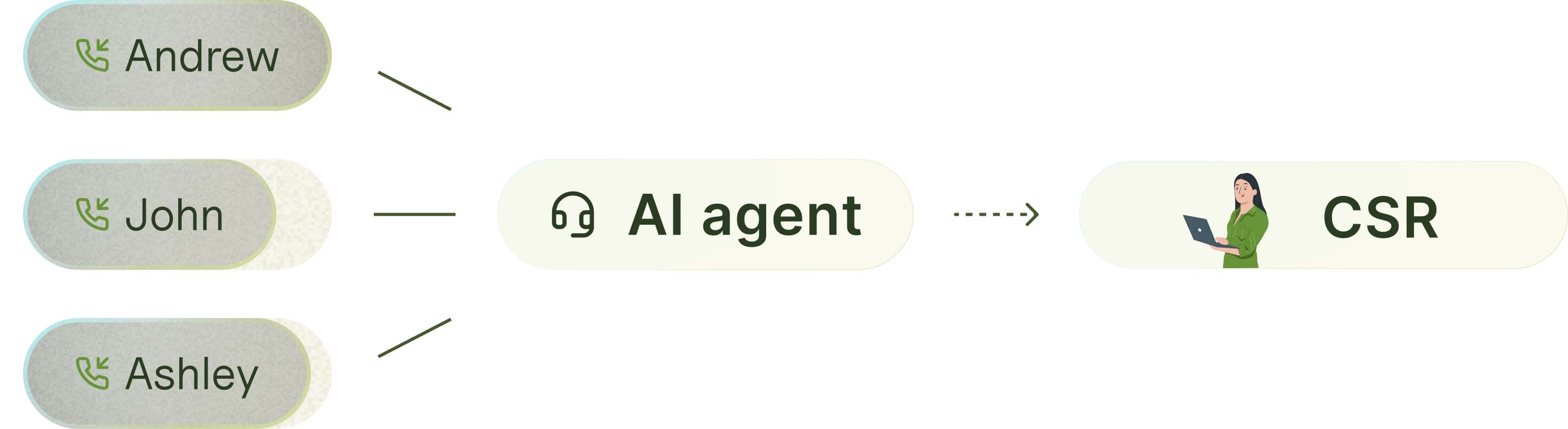
The best AI phone agent for an inbound line is software that picks up the agency's main number, identifies why the caller is calling, handles routine requests, and hands complex or licensed matters to a human. For a P&C agency, that means recognizing a certificate request, a billing question, or a first notice of loss, then routing or booking and logging the outcome. The measure is how cleanly it answers, captures, and escalates real caller intents.
See how inbound answering maps to your agency line → Talk to Sonant
Roughly two-thirds of consumers now expect a business to answer or respond quickly, per the Sonant Consumer AI Readiness Report. Agencies feel that pressure most on the phone, where the Insurance Information Institute documents how service expectations shape retention across P&C lines. If you want the broader category first, our overview of voice AI in the insurance industry sets the context before you shortlist vendors.
How did we score these AI phone agents?
We reviewed 20+ tools and narrowed to seven that can realistically answer an inbound insurance line today. Scoring focuses on the parts that are hardest to fake - writing structured notes back to the AMS and escalating cleanly to a licensed producer - not on demo polish. Each tool was rated against six criteria, weighted to total 100%, with the heaviest weight on proof that a caller's request actually lands in your system correctly.
- AMS write-back (30%): Does the agent log the call, caller, and request into EZLynx, Applied Epic, HawkSoft, or AMS360 without manual re-entry - the insurance-specific test.
- Inbound answering quality (20%): How naturally it answers the main line, recognizes intent, and handles interruptions on a live call.
- Escalation to licensed staff (20%): Whether it recognizes licensed or urgent matters and hands off to a human CSR or producer with context.
- Insurance workflow fit (15%): Out-of-the-box handling of P&C intents - certificates (COI, certificate of insurance), billing, quote status, FNOL.
- Setup and maintenance effort (10%): How much building, prompting, or engineering the agency must do to go live.
- Security and compliance posture (5%): Handling of PII (personally identifiable information) and audit evidence such as SOC 2 attestation.

The 7 best AI phone agents for insurance agencies
Each tool below can answer an inbound line, but they differ sharply in how much insurance work they do before a human steps in. Insurance-native picks lead because the scoring rewards AMS write-back and safe escalation. Developer platforms rank lower for a typical agency only because you build the workflow yourself - they are strong if you have engineering time.
1. Sonant - best for insurance-native inbound answering
Sonant is an AI phone agent built specifically for P&C insurance agencies. It answers the main line, verifies the caller, handles certificates, billing, and quote-status questions, takes FNOL details, and escalates licensed matters to your staff - then writes a structured note back to the AMS. Because it ships with agency workflows rather than a blank builder, it is the closest fit for an agency that wants inbound handled without an engineering project. See how it works in our guide to AI phone answering for insurance agencies.
2. Smith.ai - best staffed answering with AI assist
Smith.ai offers a blended human-plus-AI answering service used across many industries. It answers calls, screens callers, and books appointments, which suits agencies that want a live-agent feel. It is not organized around P&C intake or AMS write-back, so insurance-specific logging is limited. Compare the tradeoffs in our look at AI answering services for insurance.
3. Goodcall - best simple small-business phone agent
Goodcall is a phone agent aimed at small businesses that need calls answered, questions handled, and messages captured. Setup is fast and approachable. It lacks native insurance workflows and AMS integrations, so it fits a small agency with basic answering needs rather than deep intake.
4. Dialzara - best lightweight virtual receptionist
Dialzara provides an AI virtual receptionist that answers, qualifies, and forwards calls for small teams. It is straightforward to configure for general use. Insurance-specific routing and system-of-record write-back are not core features, so pair expectations with our comparison of AI receptionists for insurance agencies.
5. Bland AI - best for building a custom phone agent
Bland AI is a developer platform for building phone agents with programmable call flows. It gives engineering-capable teams control over prompts, actions, and integrations. There is no out-of-the-box insurance workflow or AMS connector - you build both. It suits agencies with technical resources.
6. Vapi - best voice platform for developers
Vapi is a voice AI platform for developers assembling their own agents from models, telephony, and tools. It is flexible and API-first. Like other platforms, it ships no insurance intake or AMS write-back by default, so a general agency would need to build the workflow before it answers the line usefully.
7. Retell AI - best voice infrastructure to assemble intake
Retell AI provides voice agent infrastructure for developers to design conversational call flows. As with the other builder platforms, insurance logic and AMS integration are do-it-yourself.
Which AI phone agent fits which agency?
The right pick depends on whether you need insurance workflows out of the box, a staffed feel, simple answering, or a platform to build on. Insurance-native tools answer and log P&C calls immediately; services answer well but log generically; platforms answer only after you build the flow. The table below summarizes the fit against the scoring criteria.
Wage context matters here too: front-desk and CSR staffing costs, tracked by the Bureau of Labor Statistics, are part of the reason agencies weigh an AI phone agent against another hire. For a fuller vendor landscape, see our roundup of voice AI vendors for insurance, and if you are cataloging your stack, the complete 2026 guide to AI tools for insurance agencies is a useful index.
How Sonant fits
Sonant answers the inbound agency line, resolves routine requests, and escalates anything licensed to your team - the practical definition of the best AI phone agent for insurance intake. The workflow is simple: a caller dials the main number, Sonant answers and identifies intent (certificate, billing, quote status, or FNOL), then either books, routes, or hands off to a licensed CSR with full context. Every call produces a metric - answered, routed, captured - and an output: a structured note written back to native AMS integrations including EZLynx, Applied Epic, HawkSoft, and AMS360. That closes the loop most tools leave open. For the day-to-day picture, read how agencies handle after-hours insurance calls and manage overall call volume.
Ready to hear the best AI phone agent answer your agency line? Book a Sonant demo →
Related reading
- Automating first notice of loss intake
- What an agency management system does for your calls
- Easing CSR call overload without new hires
- The 2026 guide to inbound AI tools for agencies
- What is an AI voice agent?
- 7 Best AI Voice Agents for Insurance Agencies (2026)






.svg)

.svg)


