.svg)

Contact center AI solutions are software layers that answer calls, route them to the right person, transcribe conversations, and score quality automatically. For a property and casualty (P&C) insurance agency, the practical question is narrower than the enterprise version: you rarely need a 200-seat platform. You need calls answered, callers identified, quotes and first notices of loss (FNOL) captured, and clean notes written back to your systems. This guide explains what contact center AI actually does, where it fits an agency versus a large enterprise contact center, and how to choose. Sonant sits inside this category as the insurance-native answering layer built for agencies rather than call floors.
Key Takeaways
- Contact center AI solutions cover four core jobs: answering, routing, transcription, and quality assurance (QA).
- An agency needs an answering-and-capture layer; an enterprise contact center needs seat-scale queueing, workforce management, and analytics.
- Voice over internet protocol (VoIP) platforms move calls; AI answering layers handle the conversation. They are different purchases.
- Choose on insurance fit: does it capture FNOL, book callbacks, and write to your agency management system (AMS)?
- Sonant is the insurance-native answering layer that escalates to licensed staff when a call needs a human.
What do contact center AI solutions actually do?
Contact center AI solutions automate the repetitive parts of a phone conversation: greeting the caller, answering routine questions, sending the call to the right destination, writing down what happened, and reviewing the transcript for quality. In an insurance agency, that means capturing a certificate of insurance (COI) request or a claim without a customer service representative (CSR) picking up. The category spans four jobs, and most vendors do one or two well rather than all four evenly.
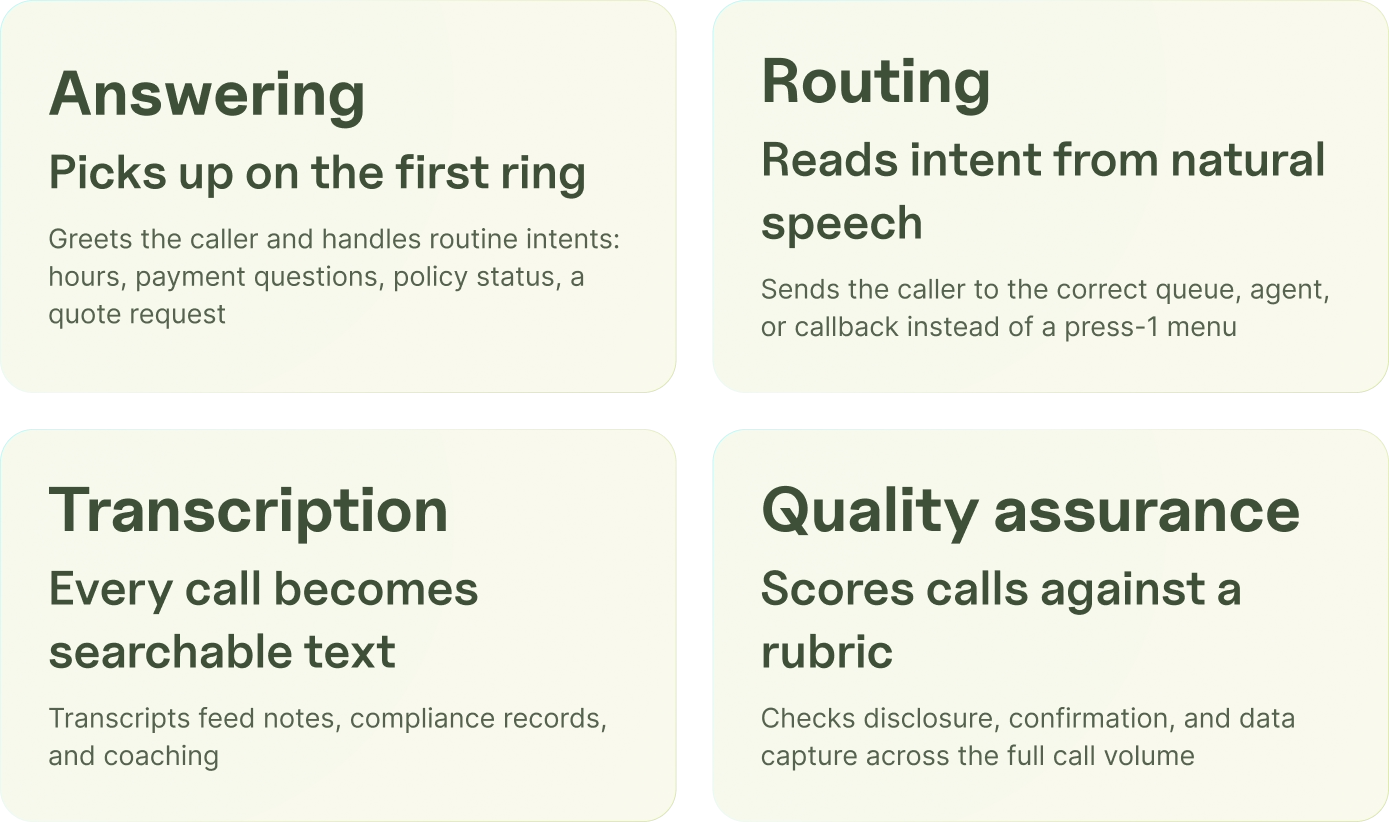
Answering. The AI picks up on the first ring, greets the caller, and handles routine intents: hours, payment questions, policy status, a quote request. This is where an AI phone answering system for insurance agencies does most of its work, and where callers form their first impression.
Routing. Interactive voice response (IVR) menus are the old version of routing. AI routing reads intent from natural speech instead of "press 1 for claims," then sends the caller to the correct queue, agent, or callback. Done well, it removes the menu tree entirely, which is the goal of modern conversational AI in insurance.
Transcription. Every call becomes searchable text. Transcripts feed notes, compliance records, and coaching. For agencies, the real value is a clean summary written into the file so a CSR sees context before returning a call.
Quality assurance. QA models score calls against a rubric - did the agent disclose, confirm, capture the right data - across the full call volume rather than the 2% a manager can listen to by hand.
Fastest way to see it on your own lines → Talk to Sonant
Where does contact center AI fit an agency vs an enterprise?
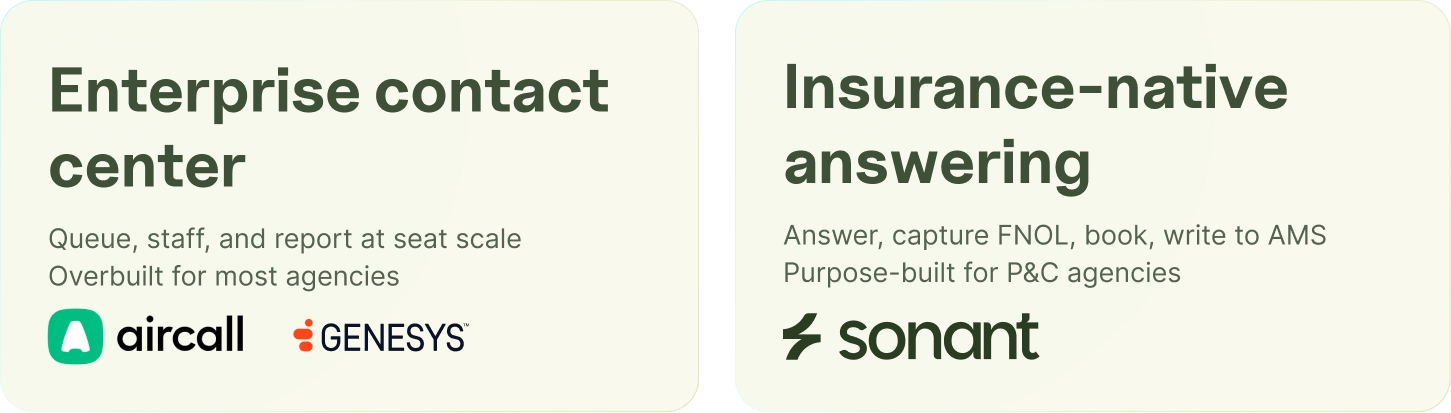
An agency needs an answering-and-capture layer; a large enterprise contact center needs seat-scale infrastructure. The distinction matters because buying enterprise contact center software to solve an agency's missed-call problem is expensive and slow, while buying a lightweight answering tool for a 300-seat operation leaves gaps in workforce management and reporting. Match the tool to the shape of the problem.
Most independent and mid-size agencies have a handful of lines, a small CSR team, and a spike of calls at renewal and after hours. The problem is not queue management at scale - it is that calls go unanswered, which is why so many agencies focus first on reducing missed calls and covering after-hours insurance calls. An answering layer solves that directly.
Enterprise contact centers - think a national carrier's claims floor - need workforce scheduling, omnichannel queueing, and detailed analytics across hundreds of agents. Platforms like Genesys and Five9 are built for that scale. Those capabilities are largely wasted on a ten-person agency, and their implementation timelines rarely fit an agency budget.
The middle ground is insurance call center automation: applying contact center techniques - routing, transcription, QA - without standing up a full contact center. That is where agency-focused AI lives, and where agency call management becomes a workflow decision rather than a staffing one.
How do the platform categories compare?
Contact center AI solutions are not one product category - they are three that overlap. VoIP and phone systems move the call, contact center platforms queue and report at scale, and AI answering layers handle the actual conversation. Reading the table below by what each is built to do, rather than by brand, prevents the common mistake of buying a phone system and expecting it to answer and route calls on its own.
The horizontal voice AI tools deserve a note: Bland AI, Vapi, and Retell AI give developers building blocks to create voice agents. They are capable, but they hand you the parts, not the finished insurance workflow. Compare that against a shortlist of voice AI insurance vendors and the trade-off is clear: build-it-yourself flexibility versus a system that already knows what a COI or an FNOL is.
How should an agency choose a contact center AI solution?
Choose on insurance fit before features, price, or brand: the best general-purpose tool that cannot capture an FNOL or write to your AMS will create more manual work, not less. An agency's evaluation should test the tool against real call types - a mid-term change, a claim, an after-hours quote - rather than a generic demo script. Weigh these against your own numbers.
- Does it capture the right data? Quotes, FNOL, COI requests, and callback details need to land as structured fields, not just a transcript.
- Does it write back to your systems? Native integration with an AMS like EZLynx, Applied Epic, HawkSoft, or AMS360 is the difference between automation and re-keying.
- Does it escalate cleanly? Licensing rules mean some calls must reach a human. The tool should hand off to a licensed CSR with context, not drop the caller. This is the core of the AI voice agent versus live call center rep decision.
- Does it fit consumer expectations? Comfort with AI on the phone is rising; the Sonant Consumer AI Readiness Report tracks how insurance callers respond to AI handling.
- Does the math work? Compare the fully loaded cost of a CSR seat - the Bureau of Labor Statistics (BLS) publishes wage data for customer service roles - against the tool's cost per handled call. Mark any per-call figure.
Governance matters too. State regulators have issued guidance on AI use in insurance; the NAIC model bulletin on AI is a reasonable starting point for what disclosure and oversight your carriers may expect. And because call volume is a moving target, size the tool against your busiest week, not your average - the Insurance Information Institute (III) is a useful reference for seasonal claim and shopping patterns.
How Sonant fits
Sonant is the insurance-native answering layer inside the contact center AI solutions category. The workflow is direct: a call comes in, Sonant answers on the first ring, identifies the caller and intent, and captures the details - quote, policy change, FNOL, or COI request - as structured data. That data writes back to native AMS integrations including EZLynx, Applied Epic, HawkSoft, and AMS360, so a CSR opens the file already populated rather than re-keying from a voicemail.
The metric that moves is answered calls: every ring is picked up, including after hours and during renewal spikes, which reduces the leakage agencies feel when handling more calls without adding staff. The output is a booked callback, a captured claim, or a clean handoff. When a call needs a licensed human - a coverage question, a binding decision - Sonant escalates to your staff with full context instead of forcing the caller to repeat themselves. Pair it with your insurance workflow automation and FNOL automation and the phone stops being the bottleneck.
See how contact center AI solutions handle a live agency call end to end. Book a Sonant demo →
Related reading
- A practical guide to automating the agency phone
- What an AI receptionist does for a P&C shop
- Cutting the calls that never get answered
- Managing agency phone volume without more hires
- Comparing voice AI options for insurers
- Inbound call center software for insurance agencies
- Customer service software for small insurance agencies






.svg)

.svg)


