.svg)

Enterprise customer service software for insurance is the layer that routes, tracks, and resolves policyholder contact across many offices, teams, and channels at once - phone, email, text, and web - while writing every interaction back to the systems of record. For a small agency, a shared inbox and a phone tree are enough. For a multi-office brokerage handling thousands of calls a week, service breaks down without shared queues, role-based access, reporting, and governance. This guide names the real software categories that large agencies combine, explains what each one does, and shows where AI call answering fits so no policyholder reaches a recording during a renewal or a claim.
Key takeaways
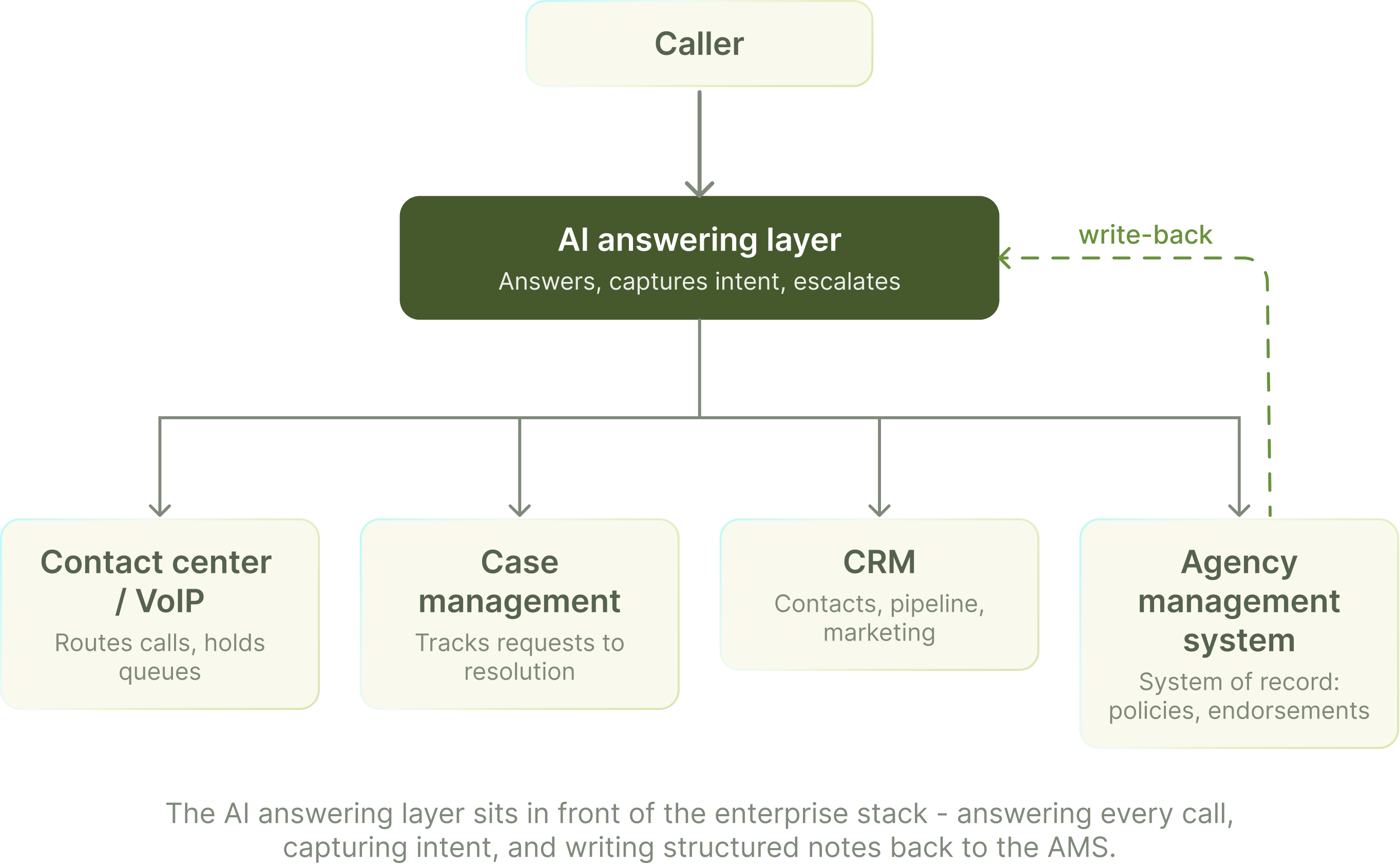
- Enterprise customer service software for insurance is a stack, not one product: phone/contact center, case management, a customer relationship management system (CRM), the agency management system (AMS), and increasingly an AI answering layer.
- The hard problems at scale are consistency across offices, integration to the AMS, and governance - not features on any single screen.
- AI answering sits in front of the stack: it answers every call, captures intent, and escalates licensed matters to staff.
- Buy for write-back and role-based access first; a tool that cannot log to your AMS creates duplicate work.
- Measure abandoned calls, after-hours capture, first-contact resolution, and time-to-log - not seat count.
What counts as enterprise customer service software for insurance?
Enterprise customer service software for insurance is any platform built to manage policyholder service across multiple offices and teams with shared queues, permissions, reporting, and audit trails. The distinction from small-agency tools is scale and control: enterprise buyers need to route a Phoenix caller to a Phoenix CSR (customer service representative), enforce who can view protected data, and prove what happened on any account. It is usually several connected systems rather than one.
Independent brokerages rarely rip out what they have. They add layers around the AMS - the system of record for policies, endorsements, and commissions. Getting those layers to log cleanly back into that record is the real test. For how the AMS anchors everything else, see our primer on the insurance agency management system as the system of record.
Sizing your call volume before you buy? → Talk to Sonant
The software categories large agencies actually combine
Large agencies combine five categories, each owning a different slice of the service workflow. No single vendor does all five well, so enterprise buyers integrate rather than consolidate. Below is what each category does and where its edges are. Name your incumbents in each row so you can see the gaps before you add a sixth tool.
The contact-center and case categories overlap in ways that create duplicate records if routing is sloppy. For the phone side specifically, our guide to managing call routing across an agency covers queue design, and the deeper piece on automating repetitive call work in the agency covers where automation belongs versus where it does not.
Why enterprise scale changes the buying decision
At enterprise scale the decision shifts from features to control: consistency across offices, integration to the AMS, and governance of who touches protected data. A single-location agency can run on judgment and a shared calendar. A brokerage with a dozen offices needs the same greeting, the same escalation rules, and the same audit trail everywhere, or service quality drifts location by location.
Three constraints dominate. First, integration: every added tool must write to the AMS, or CSRs re-key data and records diverge. Second, governance: enterprise buyers handle personally identifiable information (PII) at volume and answer to carriers and regulators. The AICPA's SOC 2 trust criteria for handling customer data is a common bar vendors are asked to meet, and the NAIC model bulletin on the use of AI by insurers sets expectations for governance and testing that increasingly reach the agencies carriers work with. Third, volume: enterprise call load means the cost of a missed call is not one lost quote but a daily leak - a pattern we break down in the piece on rising agency phone-call volume.
Consumer expectations are part of why this matters now. The Sonant Consumer AI Readiness Report documents how policyholders expect an immediate answer, and industry context from the Insurance Information Institute on the P&C landscape helps size why service responsiveness moves retention. Present any specific retention or cost figure as industry-typical and verify against your own book.
Where AI call answering fits at large agencies and brokerages
AI call answering sits in front of the enterprise stack: it answers every inbound call, identifies why the caller is calling, handles routine requests, and escalates anything requiring a licensed producer to the right person. At enterprise scale its job is not to replace the contact center - it is to guarantee the first response and to log it, so no call about a claim or renewal lands on a recording.
The value concentrates in three moments. Overflow during business hours, when all lines and CSRs are busy: the answering layer catches the call instead of dropping it. After hours and weekends, when a small brokerage cannot staff every office but claims and quotes still come in - our piece on handling after-hours calls without a night shift covers that window. And triage, where the layer captures intent and routes to the correct office queue. For the operational case behind this, see why answering every call reduces the daily leak and how agencies add capacity without adding headcount.
How Sonant fits
For a multi-office brokerage, Sonant is the enterprise customer service software layer that answers the phone: a caller reaches Sonant on the first ring, states why they are calling, and Sonant captures the intent, resolves routine requests, and escalates any licensed matter to the correct CSR or producer. That workflow produces a measurable output - a logged, summarized interaction - rather than a voicemail.
The write-back is what makes it enterprise-grade. Sonant integrates natively with the major agency management systems large agencies run - EZLynx, Applied Epic, HawkSoft, and AMS360 - so each answered call posts a summary to the policyholder's record without a CSR re-keying it. The metric to watch is time-to-log and abandoned-call rate across offices; the output is a consistent first response everywhere, with licensed advice always escalated to a person. For a broader view of adding automation across the agency, see our guides on the benefits of an AI receptionist for agencies and the AI receptionist built for insurance agencies.
See how Sonant answers every call and logs it to your AMS across every office. Book a Sonant demo →
Related reading
- Comparing AI answering services built for insurance agencies
- Cutting the daily leak from unanswered agency calls
- Covering the nights-and-weekends call window
- Designing routing across an agency's phone lines
- Adding call capacity without hiring more CSRs
- Inbound call center software for insurance agencies
- Five9 review: fit for insurance agencies






.svg)


.svg)


