.svg)

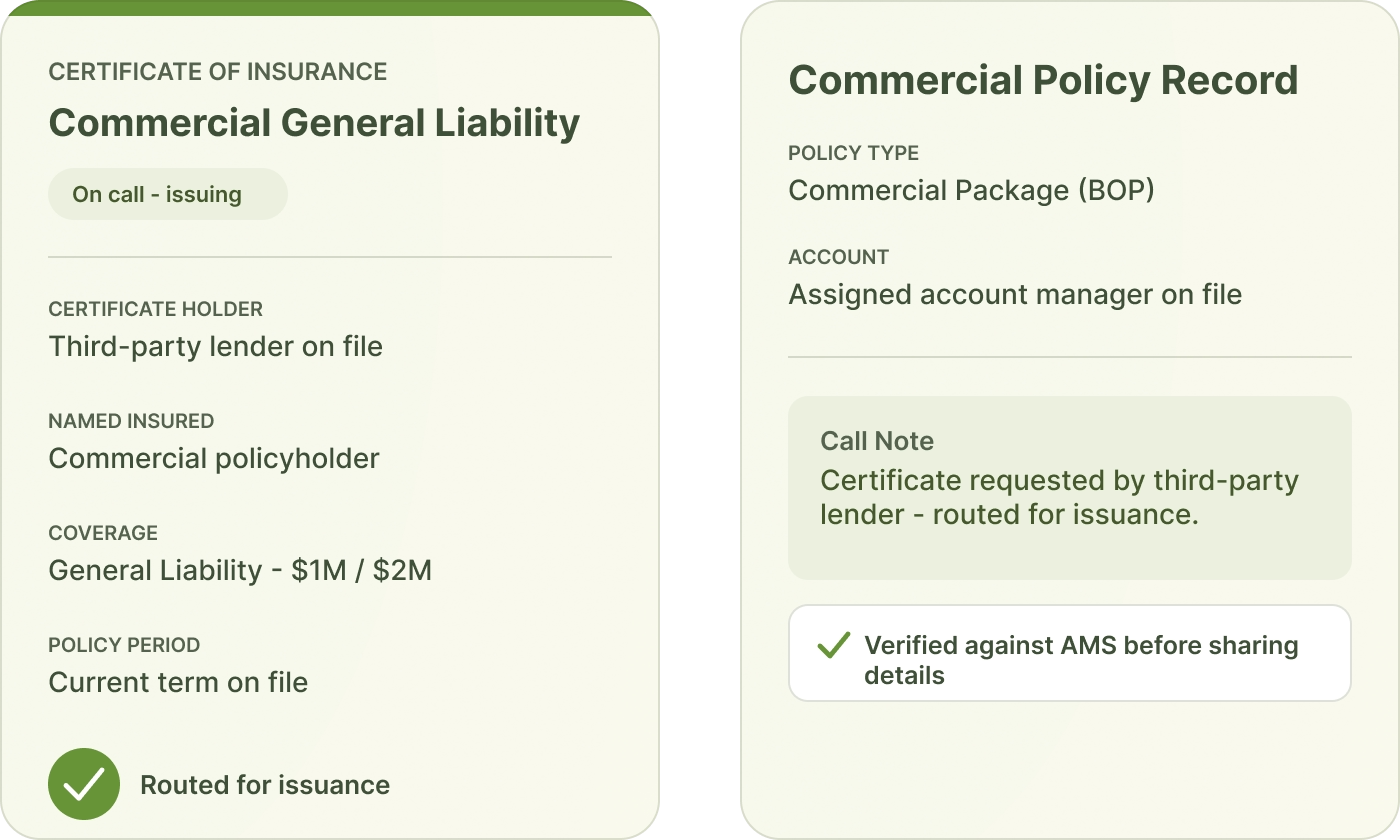
An AI receptionist for a commercial insurance agency answers the high-volume, routine calls that come with commercial lines (certificate of insurance requests, payment questions, claim intake, and status checks), verifies the caller, and logs a note back to the AMS. It does not replace the producer or account manager who handles underwriting judgment and complex accounts; it clears the repetitive volume that keeps pulling them off that work. For a commercial book, that trade is often where the real time savings live.
Key Takeaways
- Commercial lines generate a steady stream of routine service calls - COI requests especially - that an AI receptionist can resolve or triage without a live handoff.
- The receptionist verifies the caller against AMS data before sharing any account details, then logs the call with a transcript.
- Complex commercial work - underwriting questions, coverage placement, claims strategy - stays with your licensed team. The AI routes those with context attached.
- After-hours commercial claims get captured and flagged instead of hitting voicemail.
- The goal is to keep account managers on the accounts that need judgment, not on the calls that don't.
What can an AI receptionist do for a commercial insurance agency?
An AI receptionist for a commercial insurance agency handles the routine, repeatable calls that commercial books generate in volume. Certificate of insurance requests are the clearest example: they arrive constantly, they are time-sensitive, and they rarely need a licensed decision. An AI receptionist can take the request, verify the caller against your AMS data, capture the details, and route it for issuance, logging the whole interaction on the client record. It does the same for payment questions, claim intake, and status checks.
What it does not do is make coverage calls. Placing a commercial risk, answering an underwriting question, or advising on a claim strategy stays with a producer or account manager. The receptionist's job is to resolve or triage the routine layer so your licensed team spends its time where judgment is required. We cover that boundary in what AI should handle vs a licensed agent. For background on the request type that dominates commercial service, see our explainer on the certificate of insurance and the deeper guide to COI request automation. The broader category is covered in our AI receptionist for insurance agencies overview.
Certificate requests eating your account managers' day? → Talk to Sonant
Commercial calls: what to automate vs route
Not every commercial call is a fit for automation. The table sorts the common ones by whether an AI receptionist should resolve, triage, or route them.

What to evaluate for a commercial book
When you assess an AI receptionist for commercial lines, weigh these:
- Verification depth. Commercial callers include insureds, brokers, lenders, and certificate holders. The receptionist should verify identity against AMS data and refuse to share account details when a caller can't confirm. See caller verification.
- AMS write-back. Every call should land as a note with a transcript, with a task assigned, so account managers aren't re-keying. See AMS call notes automation.
- After-hours claim capture. Commercial losses don't keep business hours. Confirm how after-hours claims are collected, flagged, and routed. See after-hours calls and FNOL intake.
- Clean escalation. When a call needs underwriting judgment, the handoff should carry the full context.
- Compliance and security. Hold the vendor to a recognized attestation like SOC 2 and ask how they align with the NAIC model bulletin on AI. For market context on commercial lines, the Insurance Information Institute is a useful independent source, and our Consumer AI Readiness Report covers caller acceptance.
For the bigger picture on how routine service volume drains a commercial team, see service calls pulling your sales team off revenue and our overview of insurance agency call management.
How Sonant fits
Sonant is built for P&C agencies, and on a commercial book its role is specific: clear the routine service layer so account managers stay on the accounts that need them. It answers overflow and after-hours calls, verifies the caller against your AMS data, captures certificate requests and claim details, and detects the caller's carrier to text the matching payment link instead of transferring. After each call, it writes a note with the transcript to the client record and assigns a task. It connects to EZLynx, Applied Epic, AMS360, and HawkSoft.
It is deliberately not a producer. Placing coverage, answering underwriting questions, and advising on a commercial claim require a licensed person, and Sonant routes those to your team with the context already gathered. It will not improvise a coverage answer. On a complex commercial account, a human relationship still wins, and the point of the AI is to protect your team's time for exactly those relationships. For context on the market you serve, see our commercial insurance market overview.
Want to see how routine commercial calls would be handled and logged? Talk to Sonant →
Related reading
- AI receptionist for insurance agencies
- AI answering for certificate of insurance (COI) requests
- Certificate of insurance, explained
- What AI should handle vs a licensed agent
- AI answering for FNOL intake
- Service calls pulling your sales team off revenue
- The commercial insurance market






.svg)

.svg)


