.svg)

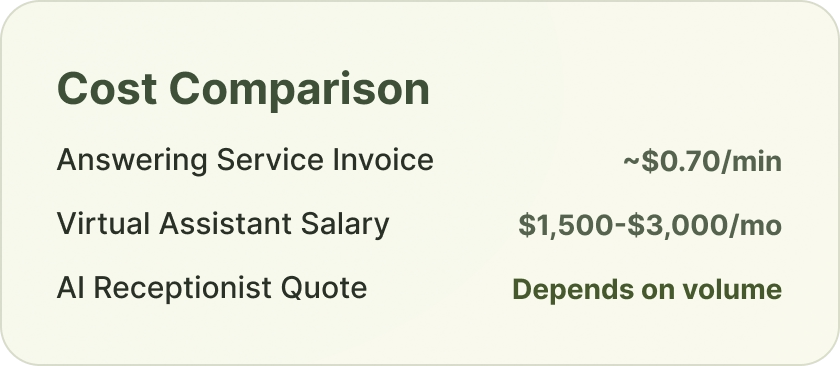
An AI receptionist's cost for an insurance agency depends on your call volume and how it's set up, so there isn't one flat price that fits every agency. What you can do is size it against the alternatives: a traditional answering service typically runs about $500 to $800 a month for roughly 100 calls, and a virtual assistant costs about $1,500 to $3,000 a month. Where an AI receptionist lands relative to those depends on how many calls you get and what you need it to do, which is why the honest answer to "how much does an AI receptionist cost" is a quote from a demo, not a number off a page.
Key Takeaways
- AI receptionist pricing depends on call volume and configuration, so there is no universal sticker price - get a quote for your agency.
- For reference, an answering service runs about $500 to $800 a month for roughly 100 calls (often around $0.70 a minute), and a virtual assistant about $1,500 to $3,000 a month.
- Compare on what you get, not just the monthly line: an answering service takes messages, a VA works set hours, an AI receptionist resolves routine calls and logs them to your AMS.
- Factor in hidden costs of the alternatives - VA ramp time and turnover, or the rework an answering service leaves behind.
- The cheapest option on paper is rarely the cheapest once you count the calls it doesn't finish.
How much does an AI receptionist cost for an insurance agency?
There is no single price, because the cost scales with your call volume and what you ask the tool to handle. A solo agency fielding a few dozen calls a week has a different footprint than a multi-producer shop with heavy overflow, and pricing reflects that. Rather than quote a number we can't stand behind for your specific situation, the right move is to look at what you're paying today and what you'd be replacing or supplementing.
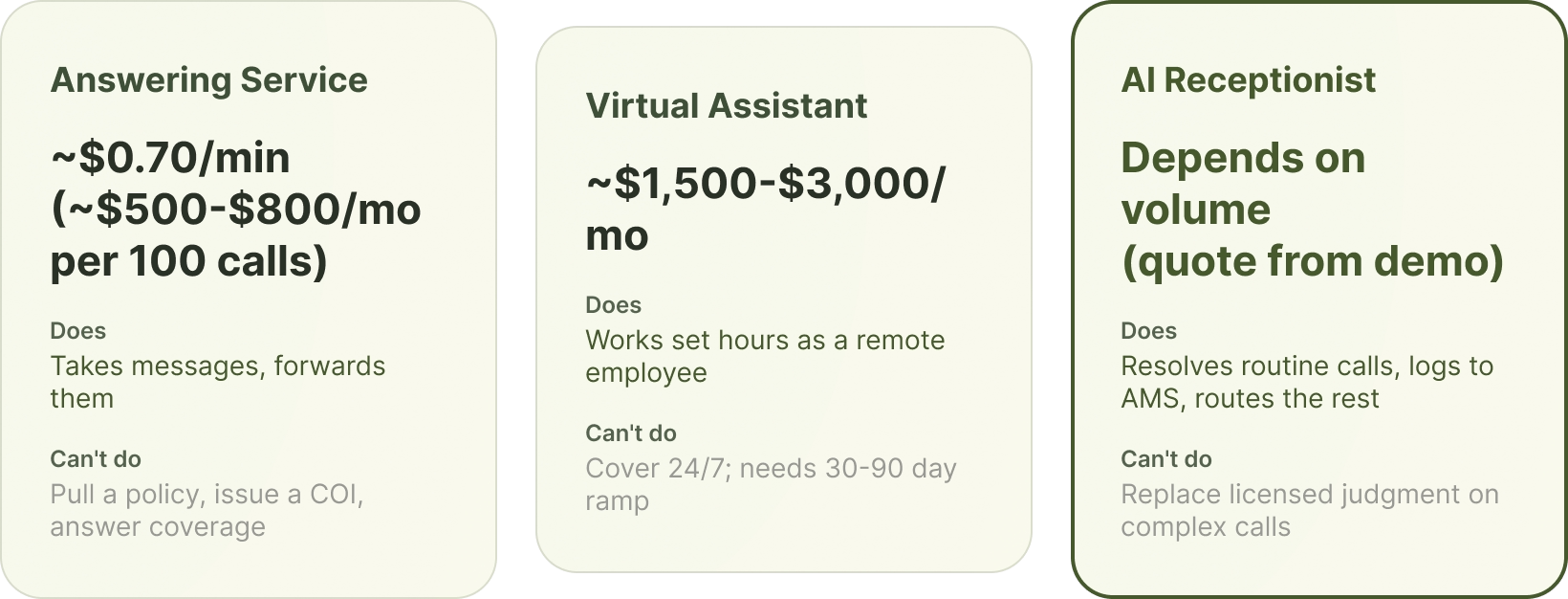
The useful comparison is against the two things agencies usually buy instead. A traditional answering service is a human call center that takes messages; it can't pull a policy, issue a certificate, or answer a coverage question, and it usually bills per minute: around $0.70 a minute, or roughly $500 to $800 a month for about 100 calls, with a different person each time. A virtual assistant is a remote employee at about $1,500 to $3,000 a month who works set hours and needs a 30-to-90-day ramp. An AI receptionist for insurance agencies sits in a different category: it connects to your AMS, resolves routine calls on the spot, logs every interaction, and routes what needs a person. For the full side-by-side on the two traditional options, see answering service vs virtual assistant, and for VA economics specifically, insurance virtual assistant cost.
Want a cost estimate based on your actual call volume? → Talk to Sonant
Cost comparison: three ways agencies cover the phones
Line the options up on price and on what the price buys.
Notice the comparison is not only about the monthly number. The answering service's low price comes with rework, since a message is not a resolved request. The VA's cost is a real salary plus turnover risk. Insurance turnover runs high, and replacing a burned-out hire has its own cost, which is part of why insurance staff quit and a core theme in VA vs hiring a CSR. For a broader look at trimming these lines, see reduce insurance agency labor costs.
What to evaluate beyond the monthly price
Price is only half the decision; the other half is what you're getting and whether it's safe. If the tool touches client data, ask for a current SOC 2 report, evidence of independent auditing against the AICPA SOC 2 framework for how it stores and handles data. Confirm the vendor's approach aligns with state guidance modeled on the NAIC model bulletin on the use of AI. And keep the caller in mind. The Insurance Information Institute is a fair reference for what policyholders expect when they call about a policy or a claim, which is what you're really paying to deliver.
Then weigh total cost, not the headline. A cheap message-taking service that leaves your CSRs reworking every call may cost more in staff time than it saves. A VA who takes three months to ramp isn't at full value on day one. The way to compare honestly is to look at cost per resolved call and cost per hour of staff time returned. For those angles, see AI receptionist ROI for an insurance agency, is an AI receptionist cheaper than an answering service, and AI receptionist vs hiring a CSR. If you're deciding between hiring and automating at all, hire a receptionist or automate lays out the trade-offs.
How Sonant fits
Sonant is an AI receptionist built for P&C agencies, and our pricing depends on your call volume rather than a one-size flat fee, which is why we quote from a demo instead of publishing a single number. On a call, Sonant connects to your AMS (EZLynx, Applied Epic, HawkSoft, AMS360), verifies the caller, resolves routine requests like carrier-specific payment links, and writes a note and task back to the client record. Agencies use it to cut administrative overhead substantially by having routine calls resolved and documented without staff time.
Sonant is coverage for the calls your team can't reach (overflow, after-hours, and Spanish-language calls), not a replacement for the team. A human is still better on a complex, emotional claim or a nuanced coverage question, and an answering service is genuinely fine if all you want is pure message-taking. The reason to think about cost per resolved call, rather than the lowest monthly bill, is that the cheapest option often leaves the most work behind. If you tell us your call volume, we can put a real number against it.
Want a cost estimate built on your real call volume? Talk to Sonant →
Related reading
- Insurance virtual assistant cost
- Insurance answering service vs virtual assistant
- AI receptionist pricing: per-minute vs flat-rate
- Is an AI receptionist cheaper than an answering service?
- AI receptionist vs hiring an in-house CSR: cost comparison
- What an AI receptionist actually saves an agency (ROI)
- Reduce insurance agency labor costs






.svg)

.svg)


