.svg)

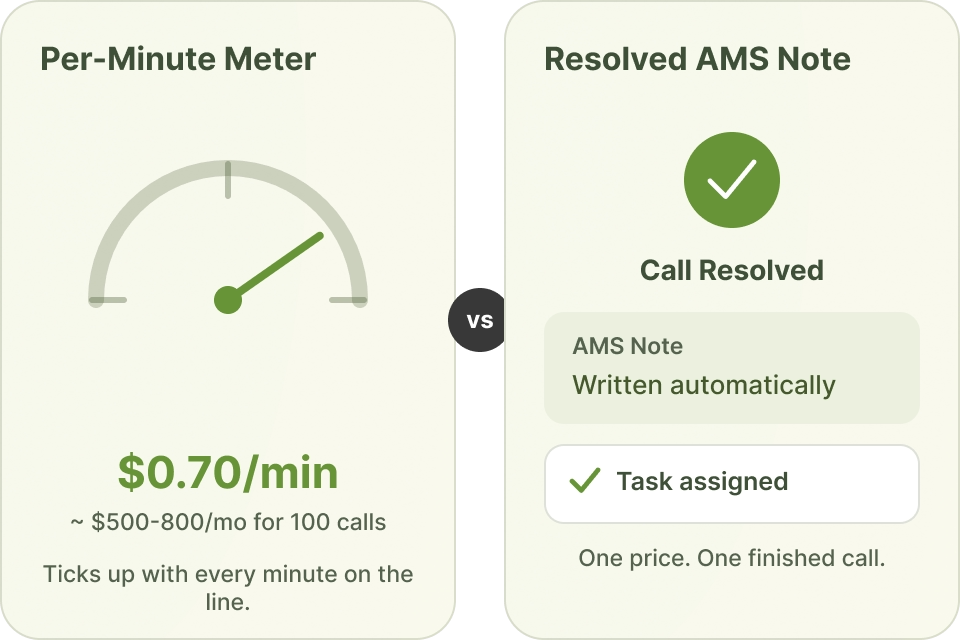
An AI receptionist is often cheaper than an answering service once you count what each one actually resolves, but not always. It depends on your call volume and how many of your calls are routine. Answering services usually bill per minute (roughly $0.70 a minute, or about $500-$800 a month for 100 calls) and simply take a message: they can't pull a policy, issue a COI, or answer a coverage question. An AI receptionist costs money too, but it resolves routine calls on the spot and writes the note back to your AMS, so the comparison is not price against price. It is cost per message against cost per resolved call. This breakdown shows how to compare them fairly.
Key Takeaways
- Answering services typically bill per minute (about $0.70/min, or roughly $500-$800/month for 100 calls) and take messages only.
- An AI receptionist resolves routine calls end-to-end and writes to your AMS, so you pay for outcomes, not just answered rings.
- The honest comparison is cost per resolved call, not headline monthly price.
- A per-minute model punishes you exactly when call volume spikes, which is when you most need coverage.
- Message-taking is fine for a low-volume agency, but an AI receptionist wins when routine service calls are eating staff time.
Is an AI receptionist cheaper than an answering service?
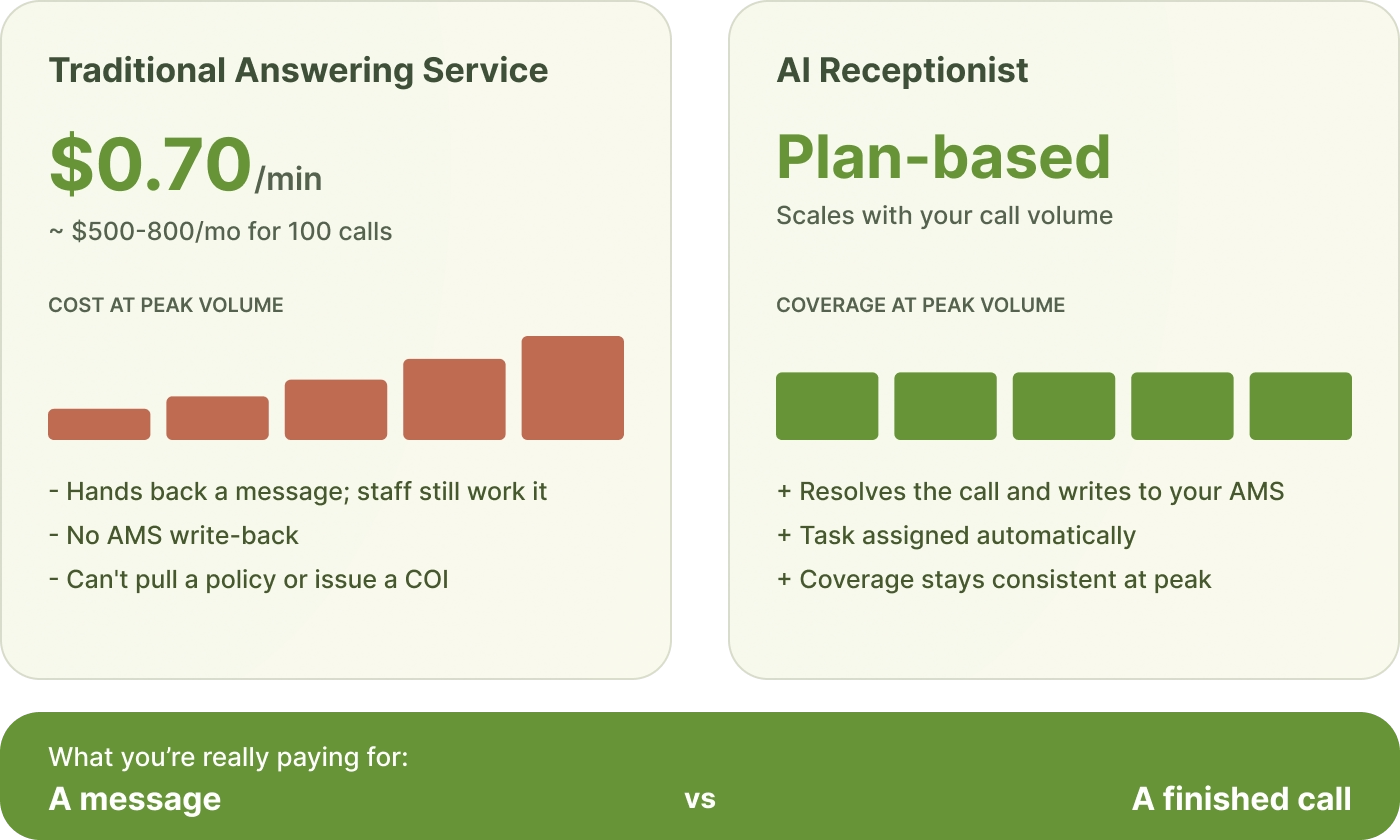
It usually is on a cost-per-resolved-call basis, and the reason is what each tool does with a call. A traditional answering service is a human call center. It answers, takes a message, and hands it back to your team, but it can't pull a policy, issue a certificate of insurance, or answer a coverage question, and you often get a different person each call. Pricing is typically per minute, around $0.70 a minute, landing near $500-$800 a month for 100 calls. You are paying for the phone to be answered, not for the work to be done. For the fuller capability picture, see answering service vs virtual assistant.
An AI receptionist for insurance agencies connects to your AMS, resolves routine calls on the spot, logs every interaction, and routes what needs a licensed person. So even where the monthly numbers look similar, the value per dollar differs: one hands back a message your CSR still has to work, the other closes the loop and writes the note. To see how running cost scales with volume, compare the two on pricing model and the full cost breakdown.
Want a cost-per-resolved-call estimate for your agency? → Talk to Sonant
Cost breakdown: answering service vs AI receptionist
The table compares the two on the dimensions that actually change your bill and your workload. Figures shown for the answering service are the common industry ranges cited above; we do not publish a fixed Sonant price here because it depends on your volume.
The hidden cost of the answering service is the second touch: every message still has to be worked by a paid CSR, so the true cost of a message includes the staff time behind it. That downstream labor is exactly what an AI receptionist removes when it writes the note and creates the task itself, the same logic behind insurance call center automation and the broader ROI picture. If you are weighing a move, switching from an answering service to an AI receptionist covers what changes operationally.
What to evaluate beyond price
Cost is only half the decision; the other half is whether the service handles your clients' data responsibly. Whichever option you weigh, ask whether the vendor is SOC 2 audited, because call logs and messages contain PII. The AICPA SOC 2 framework is the standard. For AI specifically, review disclosure and consumer-protection expectations against the NAIC model bulletin on AI. And to sanity-check your own call economics against the industry, the Insurance Information Institute is a neutral reference.
Then be honest about fit. If your agency takes a low volume of calls and mostly needs a human to jot a message after hours, a per-minute answering service can be the cheaper and simpler choice, as covered in live answering vs AI answering. The moment routine service calls start eating staff hours, or missed calls start costing you real money (quantified in the cost of missed calls), the AI receptionist's cost-per-resolved-call advantage takes over. Compare against people too, using the insurance virtual assistant cost.
How Sonant fits
Sonant is an AI receptionist for P&C agencies, priced to scale with your volume rather than by the minute. Where an answering service hands back a message, Sonant verifies the caller against AMS data, resolves routine requests (texting the matching carrier's payment link, collecting claim details, answering common service questions), and writes a note back to the client record with a task assigned. That is the difference the cost breakdown turns on: you stop paying twice for the same call. For the direct capability view, see AI receptionist vs answering service and our roundup of AI answering services.
Sonant is not a replacement for your team, and it is honest about that. Complex coverage discussions and emotionally charged claims still go to a licensed person; Sonant flags urgent items and routes them. It is coverage for the routine and the after-hours calls your staff can't reach, at a cost tied to resolved work rather than metered minutes.
Want to compare the true cost per resolved call for your agency? Talk to Sonant →
Related reading
- Insurance answering service vs virtual assistant
- AI receptionist vs a traditional answering service: cost and capability
- How much does an AI receptionist cost?
- AI receptionist pricing: per-minute vs flat-rate
- What an AI receptionist actually saves an agency (ROI)
- Switching from an answering service to an AI receptionist
- Live answering vs AI answering services






.svg)

.svg)


