.svg)

According to the Big "I" 2025 Market Share Report, independent agencies wrote 87.2% of U.S. commercial-lines premiums in 2024, which means for most P&C agencies the phone is still where business is won or lost. The best AI phone answering service for an insurance agency is not simply the one that picks up fastest; it is the one that resolves routine calls, writes back to your AMS, handles Spanish-speaking and after-hours callers, and routes licensed decisions to a person. This guide gives you a weighted scorecard so you can score any vendor on the criteria that matter to an insurance agency, compares the main capability categories honestly, and shows where each type of tool fits.
Key Takeaways
- The best AI phone answering for insurance resolves routine calls and writes to your AMS - not just answers the ring.
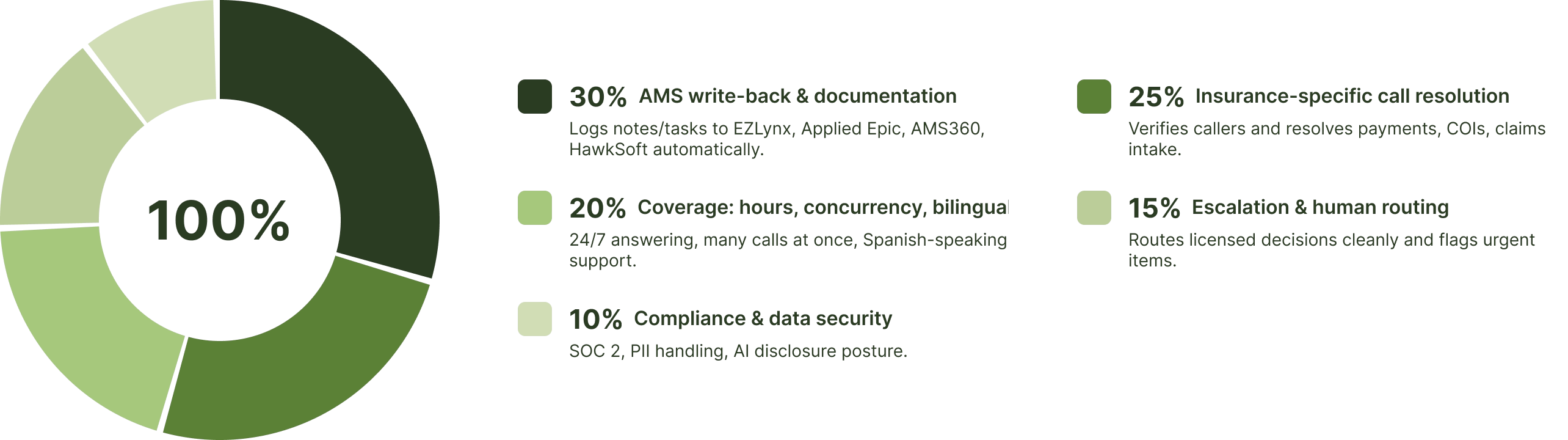
- Use the weighted scorecard below (five criteria totaling 100%) to rate any vendor consistently.
- Insurance-specific training and AMS write-back matter more than generic voice quality for a P&C agency.
- Compare capability categories - hours, concurrency, AMS write-back, insurance training, escalation, compliance - not marketing claims.
- Whatever you choose, verify SOC 2 and test on your own call types before committing.
What makes the best AI phone answering for an insurance agency?
The right answer starts with the job. An AI phone answering service for insurance agencies has to do more than greet a caller. It has to understand insurance intents (a payment, a COI request, a claim), act on them, and document them in your system. The generic AI answering tools do the first part well; the insurance-built ones do all three. That distinction is why AMS write-back and insurance training carry so much weight below, and why our roundups of AI answering services and AI receptionists lean on capability rather than brand.
Before the scorecard, one honesty note: a tool that only takes messages can still be a fine fit for a very low-volume agency. But if routine service calls are eating staff time, the value is in resolution and documentation. For the deeper vendor-selection process, pair this with how to choose an AI receptionist and the shortlist in best voice AI vendors.
Want us to score your current setup against this list? → Talk to Sonant
Methodology: how we weighted the criteria
We scored the category on five criteria weighted by how much each affects a P&C agency's outcomes. The weights sum to exactly 100%. Rate any vendor 1-5 on each, multiply by the weight, and total the score. This is a repeatable way to compare tools without relying on anyone's marketing figures.
A note on scope: we compare capability *categories*, not invented vendor statistics. Generic AI voice tools tend to score well on coverage and voice quality but lower on AMS write-back and insurance resolution; traditional live answering services score on human nuance but not on documentation or concurrency; insurance-built AI receptionists are designed to score across write-back, resolution, and escalation. The weight on write-back reflects the point made in AI phone answering with AMS write-back.
What to evaluate before you shortlist
Apply the scorecard, but do your diligence on the two criteria that carry legal and reputational risk. On security, confirm the vendor is SOC 2 audited, since every answered call touches client PII. The AICPA SOC 2 framework tells you what the audit covers, and our own SOC 2 compliance guide frames the questions to ask. On regulation, check how the tool discloses that a caller is speaking with AI and how it treats consumers, measured against the NAIC model bulletin on AI.
Then evaluate fit against your call mix. Decide upfront what AI should handle versus a licensed agent so you score escalation honestly. The best tools make that handoff clean rather than pretending to resolve everything. Weigh coverage needs like after-hours answering and bilingual support, and factor in what an AI receptionist costs as a tiebreaker, not the headline.
How Sonant fits
Measured against this scorecard, Sonant is built for the criteria that carry the most weight. On AMS write-back, after every call a note lands on the client record with a task assigned (no manual typing) across EZLynx, Applied Epic, AMS360, and HawkSoft. On insurance-specific resolution, it verifies callers against AMS data, texts the matching carrier's payment link, and handles routine service requests end-to-end. On coverage, it answers overflow, after-hours, and Spanish-speaking calls 24/7 and handles concurrent calls. On escalation, it routes licensed decisions to a person and flags urgent items. See the full picture in AI receptionist for insurance agencies.
Sonant is not the right answer for every call, and we'd rather say so. Complex coverage discussions and emotionally charged claims belong with a licensed person; Sonant's job is to resolve the routine, cover the calls your team can't reach, and route the rest cleanly. Whichever vendor you shortlist, score it on the five criteria above and test it on your own call types before you commit. That is the honest way to find the best AI phone answering for your agency.
Ready to score AI phone answering against your own calls? Talk to Sonant →
Related reading
- AI phone answering for insurance agencies
- Best AI answering services for insurance
- Best AI receptionists for insurance agencies
- How to choose an AI receptionist vendor
- AI phone answering that writes back to your AMS
- Is an AI receptionist SOC 2 compliant?
- What AI should handle vs a licensed agent






.svg)

.svg)


