
QQ Catalyst pricing is quoted rather than published, so the number arrives with a proposal instead of off a rate card.
It's a cloud agency management system (AMS) from Vertafore, built for growing independent property and casualty (P&C) agencies that want policy data, client records, and a sales pipeline in one place.
Our verdict is that it's a capable, sales-minded system of record, and the quote you sign covers the record rather than the phone traffic that fills it.
Key Takeaways (TL;DR)
- What it is: QQ Catalyst, styled QQCatalyst™ by Vertafore, is a cloud agency management system for independent P&C agencies, covering policy and client data, workflows, reporting, and a sales pipeline.
- Best for: Growing independent agencies of roughly 5 to 25 people that want one cloud system of record with sales tracking built in, without moving to an enterprise AMS.
- Standout feature: Salesroom, the built-in pipeline manager, which puts prospecting and book rounding inside the same system that holds the policy record.
- Biggest limitation: No published rate card. Vertafore prices by agency, so the cost comes from a quote rather than from a page you can model against.
- Pricing: Quoted per agency through Vertafore's sales team, with no free plan and no trial published. Every route on the product page ends at a contact form, a demo request, or the sales line.
- Best alternative: Momentum AMP is the swap if you want a same-class AMS you can price without a sales call. If the record is fine and the calls are the leak, pair Sonant with the AMS you already run.
- The verdict: Buy QQ Catalyst if you want a cloud AMS with sales tracking and you're comfortable pricing it through a sales conversation. Look elsewhere if you need to model the cost before a demo, and pair it with a phone layer if calls are what's costing you quotes.
QQ Catalyst Pricing at a Glance
What Is QQ Catalyst?
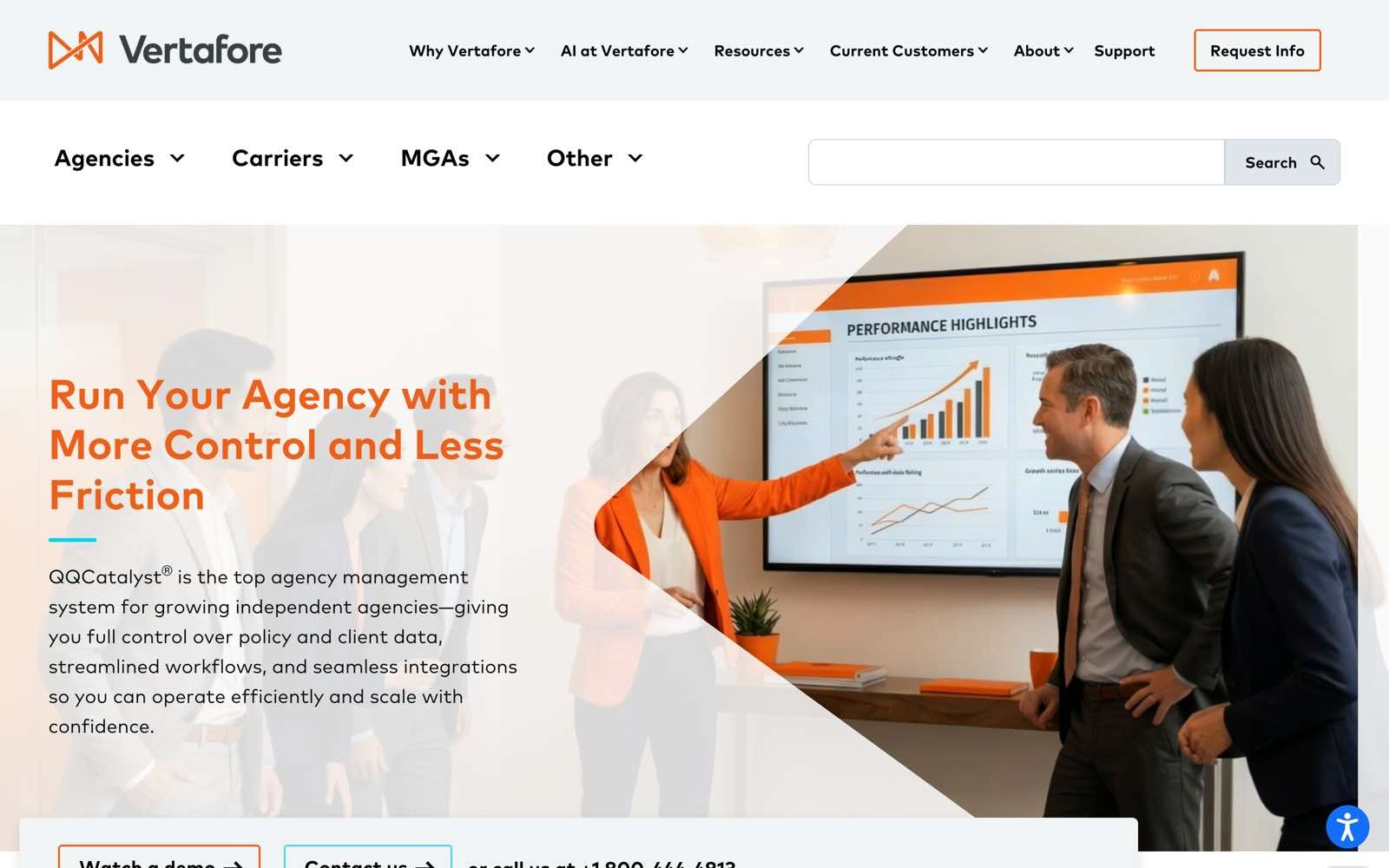
QQ Catalyst is Vertafore's cloud agency management system for independent agencies, holding client and policy data, automating routine workflows, and tracking new business through a sales pipeline.
Vertafore describes it as "the top agency management system for growing independent agencies," giving agencies "full control over policy and client data," with 50 or more pre-built and customizable reports.
It sits in the same bracket as the mid-market systems of record we assessed in our Applied TAM review. Agencies that outgrow it move up to AMS360, and Vertafore publishes a QQCatalyst to AMS360 data sheet for exactly that move.
The product came from QQ Solutions of Deerfield Beach, Florida, which Vertafore acquired on June 16, 2015, describing Catalyst then as "a SaaS-based agency management system."
It now sits at the entry point of Vertafore's agency management range, with PL Rating for personal lines quoting, InsurLink as a client portal, and AgencyZoom for sales automation sold alongside it.
That range is what makes the total harder to pin down than the feature list, because the AMS is only one of the products. Start with what the AMS itself covers.
QQ Catalyst Main Features
QQ Catalyst covers three jobs, which are holding the record, moving new business through a pipeline, and telling the owner what happened. Each feature below uses the module names Vertafore publishes in its own QQCatalyst data sheet.
Policy and client management
Every client, policy, and document lives in one cloud record, with a summary of current and future policies attached to each customer.
The practical gain is that a CSR answering a coverage question doesn't have to open three systems to answer it, and renewals stop depending on a spreadsheet somebody maintains privately.
Salesroom sales pipeline
Salesroom is the built-in pipeline manager, and Vertafore describes it as a way to "identify new business, round out your current accounts, and strategically manage prospect sales cycles."
Because it lives inside the AMS, a producer's prospect list and the policy record are the same data, which is the argument for it over a standalone system plus a separate CRM.
Agency Intelligence marketing
Agency Intelligence sends email marketing campaigns to service existing clients, cross-sell, or bring in new ones.
For a small agency with nobody on marketing, it's the difference between renewal campaigns going out and renewal campaigns not going out.
Employee Productivity and Time Clock
Employee Productivity tracks what staff does inside the system, so owners can see where the work goes.
The Employee Time Clock records clock-in and clock-out activity with payable reasons attached, which owners running a hybrid team use as a management view rather than a surveillance tool.
Reporting and carrier downloads
Vertafore publishes 50 or more pre-built and customizable reports covering book of business, retention, and production, plus a carrier partner list for downloads.
That means you can run a book analysis without exporting anything to a spreadsheet first.
Third-party integrations
QQ Catalyst connects to Vertafore's own products and a wide set of outside tools, including phone systems and AI phone handling.
Sonant reads and writes the QQ Catalyst record through API connectivity, which we cover in the Sonant QQCatalyst integration documentation. That read direction is what lets a servicing call be finished on the call instead of logged for later.
Those features are fixed. Whether they're worth a quote depends on how your agency is shaped, which is the next question.
Who Is QQ Catalyst For?
The deciding factor with QQ Catalyst is rarely the feature list. The five profiles below cover who gets real value from it, and who should shortlist elsewhere.
Growing independent P\&C agencies
An agency of 5 to 25 people that has outgrown spreadsheets and a shared inbox is the core buyer.
There's enough new-business volume for Salesroom to matter, and the agency is still small enough to run one system rather than a stack of them.
Agencies moving off an on-premise system
If your current AMS runs on a server in the back office, QQ Catalyst removes the machine, the backups, and the version upgrades.
Budget for a data conversion, since that's the one setup cost the sales conversation will raise. Ask for the conversion quote in writing at the same time as the rate.
Compare it against the setup time of everything else you're buying that year.
Sales-led agencies rounding accounts
Owners measured on new business and account rounding get the most out of the pipeline manager sitting inside the record.
If your producers currently track prospects in their own spreadsheets, the value here is standardization rather than any single feature.
Agencies already inside the Vertafore range
If you run PL Rating for personal lines quoting or you're weighing AMS360 later, buying inside one vendor's range means fewer places for data to fall between systems.
Ask about bundled pricing across the products, and ask what the upgrade path to AMS360 costs before you need it rather than after.
Agencies whose bottleneck is the phone, not the record
If quotes are dying on hold, after-hours callers are getting voicemail, and producers are interrupted all day, a new AMS won't change that.
QQ Catalyst organizes information that already reached you, so agencies in this position get more from fixing intake first, then judging the AMS on how cleanly the outcome of each call lands in it.
QQ Catalyst Reviews: The Good and The Bad
Reviews show it holds 3.2 out of 5 across 44 reviews on Capterra, checked September 2026. Reviewer counts for agency management systems are small, so a handful of strong opinions move the average.
Here's what the product itself supports, and what it leaves to you:
Pros
- Cloud-based from the start: There's no server to maintain and no upgrade weekend, which matters for an agency without in-house IT.
- Pipeline inside the system of record: Salesroom means prospect tracking and the policy record share one dataset, so new business doesn't live in a separate tool nobody updates.
- Reporting depth for the price band: 50 or more pre-built reports covering book, retention, and production is a lot of visibility for a mid-market AMS.
- Dashboards you can shape: Vertafore's page describes customizable dashboards with alerts and task management, so the daily view matches how your team works.
- Backed by a vendor with a published upgrade path: Vertafore documents the move from QQCatalyst to AMS360, so growth doesn't mean starting a vendor search from scratch.
Cons
- Pricing is quoted, not published: Vertafore prices by agency, so modeling the cost means a conversation with its sales team first.
- Rating and the client portal are separate products: PL Rating and InsurLink are sold alongside the AMS rather than inside it, so the working stack costs more than the AMS line.
- Support and training sit in the portal: Existing customers raise cases and take training through MyVertafore, so name an internal system owner who learns it properly.
- Call handling sits outside the AMS: The record is complete once someone takes the call and types it up, so the phone layer is a separate purchase.
Every one of those is a cost or a scope question, and the pricing section is where you find out which ones have a public answer.
QQ Catalyst Pricing: Plans and Costs in 2026
Vertafore publishes no rate card and no tier list for QQ Catalyst. Every route on the product page ends at a contact form, a demo request, or the sales line, so the rate arrives with a proposal built for your agency.
That puts the work on you before the call: ask how many users the quote covers, which modules sit inside it, and what a conversion from your current system costs.
How we verified these figures. Product details and module names come from Vertafore's own QQCatalyst product page and data sheet, checked September 1, 2026. AgencyZoom rates come from that product's own pricing page. Where a cost isn't published, this review says so rather than estimating.
The American Agents Alliance offers members a "10% discount off the QQCatalyst system for new users" as a member benefit, so if you belong to an alliance or a cluster, ask what your group rate is before you accept a list quote.
What QQ Catalyst pricing doesn't include
Four costs sit outside the AMS quote, and the last one sits outside the AMS budget entirely.
- Users you add later: Ask how the quote changes when you add people, and get the renewal uplift in writing at the same time as the first-year number.
- Rating and the client portal: PL Rating and InsurLink are separate Vertafore products. Price the working stack, not the AMS line, so a comparison against an all-in-one product is like for like.
- Data conversion in and data extraction out: Conversion from your current system is quoted separately, and extraction terms aren't stated on the product page either. Ask for both in writing.
- The phone layer: Nothing in the AMS answers a ringing phone. When a client calls at 7 pm about a renewal or a prospect calls back during the lunch rush, that call rings out, goes to voicemail, or lands in a menu. An IVR phone tree can route a call, and it can't look up a policy or take quote details.
For a commercial lines agency, that last gap is the expensive one. The question stops being “how many calls arrive after 6 pm?” You then start to analyze what one of them is worth, and a small commercial account is worth it again every year it renews.
It's worth reading the cost of missed calls against your AMS spend, then running the same payback math you'd run on any AI receptionist ROI case.
Best QQ Catalyst Alternatives
You might be wondering which system to run instead of QQ Catalyst, or what to run alongside it. Those are different questions with different answers, so the list below covers both.
1. Sonant™, the fit when calls are the bottleneck
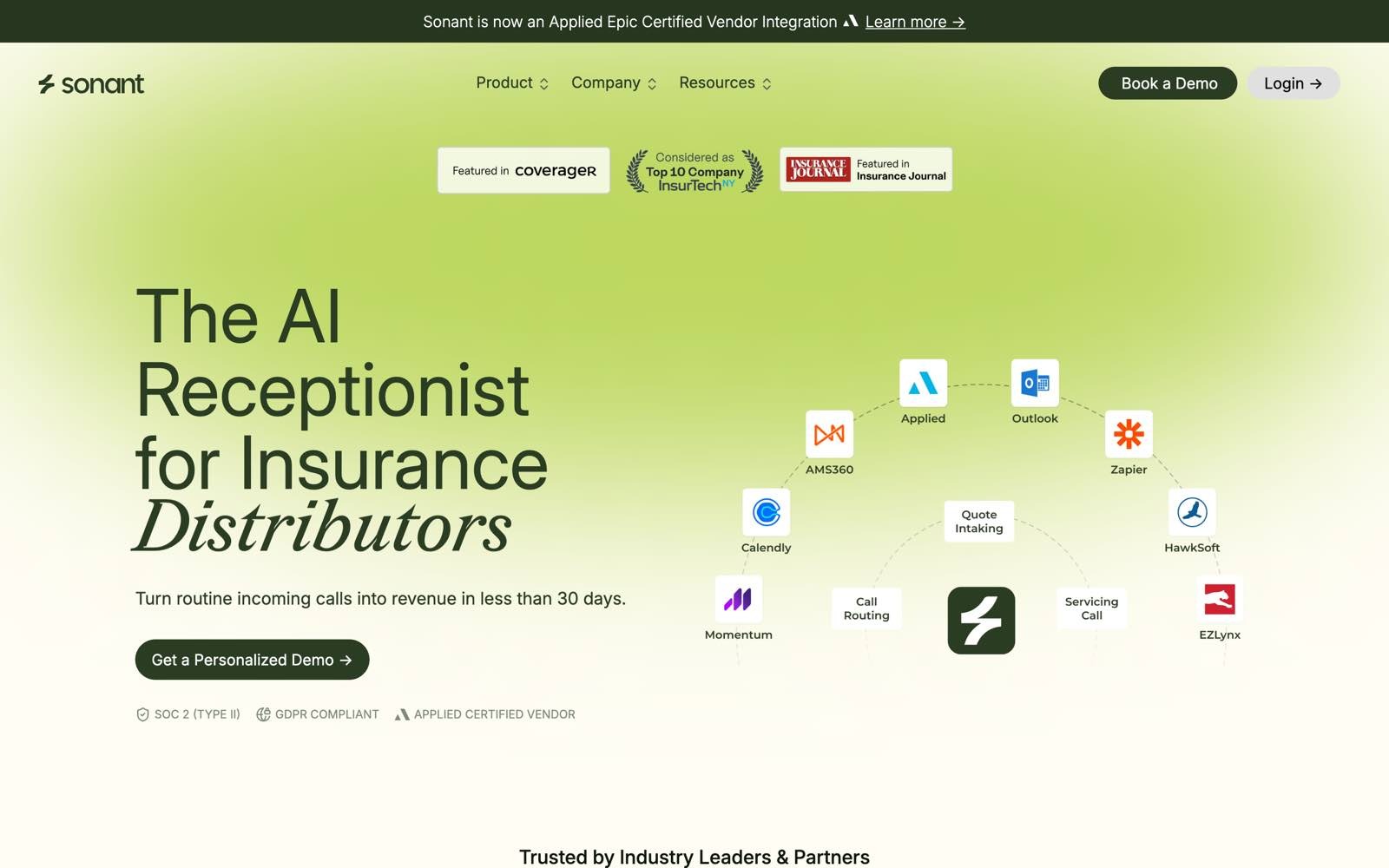
Sonant is the AI receptionist built for insurance agencies. It answers every inbound call 24/7, verifies the caller, looks up their record live, intakes the information for a quote or service request, and routes the outcome as a task to the person who owns the account.
Be clear about the swap, because this one isn't a replacement. Sonant isn't an AMS and won't hold your policy record, so it works alongside QQ Catalyst rather than instead of it. It reads client and policy information from QQ Catalyst during the call, then pushes structured notes and tasks back into it through a two-way API connection.
That two-way depth is checkable on someone else's site, which is the part that matters when every vendor claims an integration. HawkSoft labels its partners by integration type on its own HawkSoft partner page, where Sonant is listed as two-way API integrated and described as searching HawkSoft in real time, logging conversations, and creating tasks.
Sonant is also an Applied Certified Integration Vendor, the first voice AI platform certified for Applied Epic., and it's natively integrated with Momentum AMP.
The mechanism behind AMS write-back is worth understanding before any vendor demo, because a transcript emailed to a shared inbox and a routed task on the client's file score the same on a feature grid.
Pricing is a predictable partner rate per agency with onboarding, configuration, and support included, and it doesn't move when call volume spikes. It's quoted rather than published, which is a fair criticism if you want to model the cost without talking to anyone, and it's the wrong tool if your problem is the system of record rather than the phones.
2. Momentum AMP™, best for a published rate card
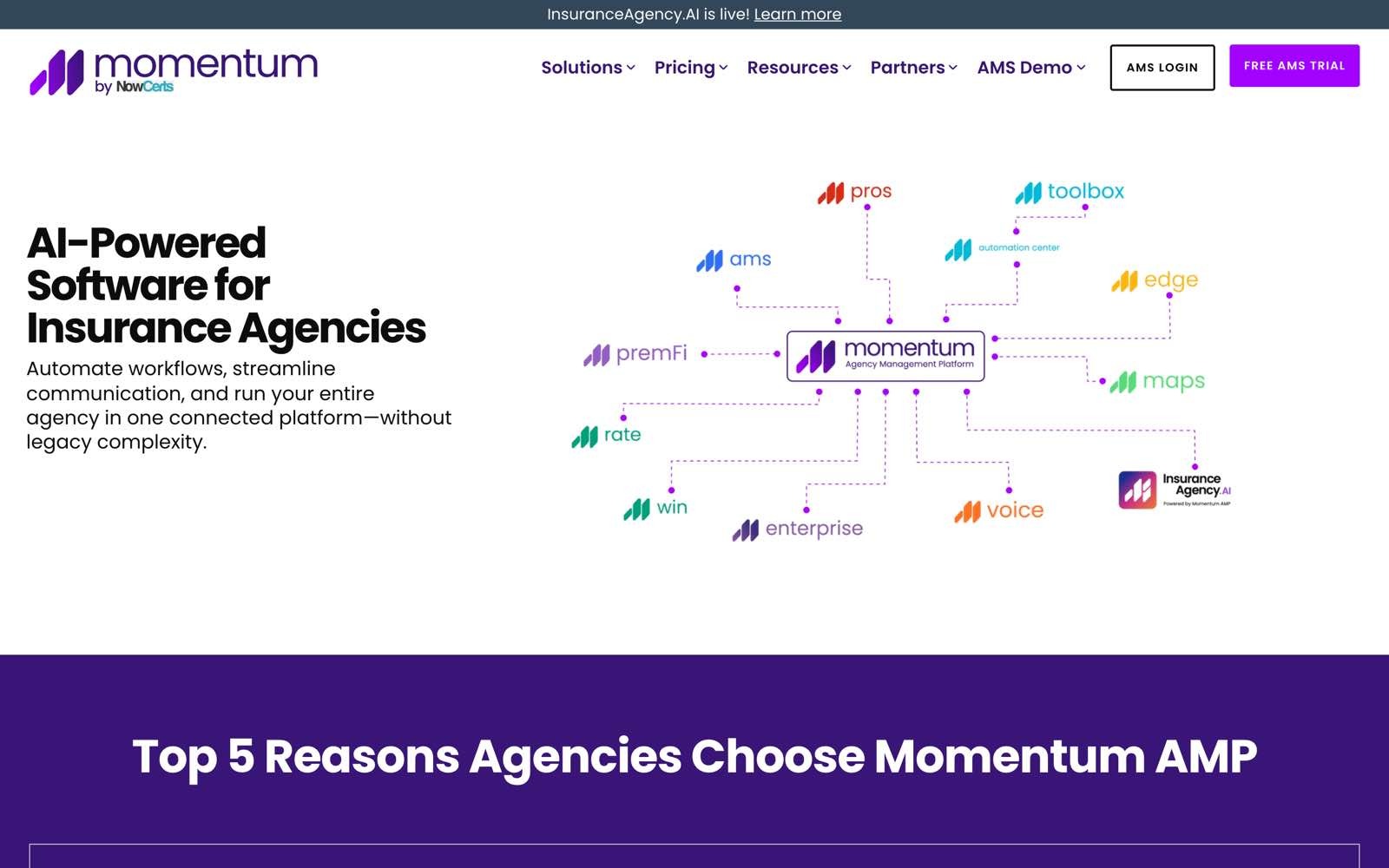
Momentum AMP is the rebranded NowCerts, and it's the closest same-class alternative that lets you model the bill yourself.
Its pricing page publishes AMS tiers at $119 a month for one user, $199 for two, and $419 for five, with extra seats at $54 each and IVANS carrier downloads at $35 a month, checked September 2026. It also publishes a free AMS trial, with no length or terms stated on the trial page, so confirm the scope before you sign up.
The rest of the stack is public too: rating is a separate Momentum product at $100 to $300 a month, an automation center runs free to $199, and a voice add-on starts at $150 for 500 minutes with overage at $0.40 a minute.
For a larger commercial book, carrier connectivity matters more than the seat price, so compare the download lists on both sides, and note that IVANS downloads sit on top of the tier as a separate $35 line.
3. Vertafore AMS360™, best for agencies outgrowing QQ Catalyst
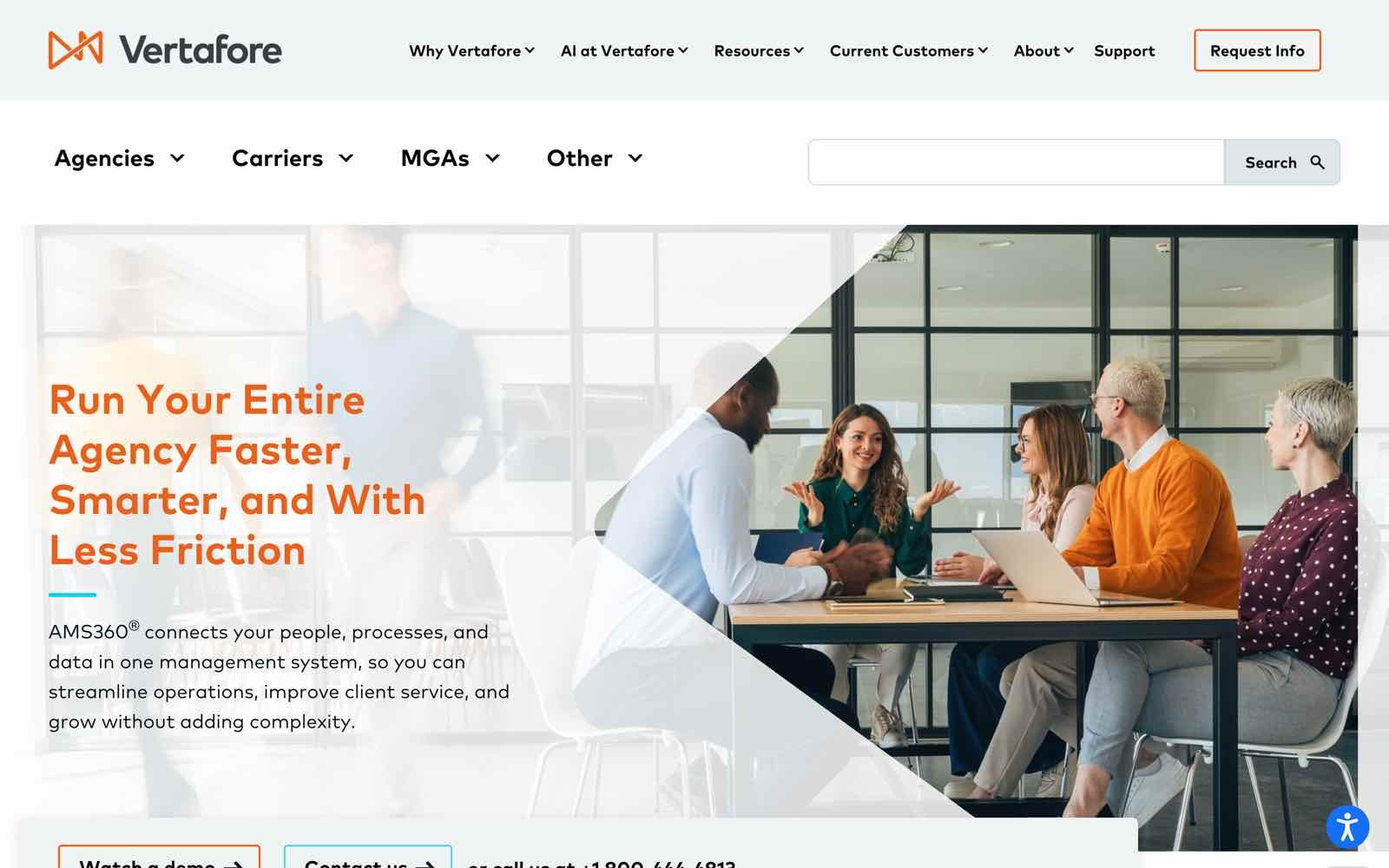
AMS360 is Vertafore's larger agency management system, and it's the documented upgrade path from QQ Catalyst rather than a competing purchase. Vertafore publishes a QQ Catalyst to AMS360 data sheet specifically for agencies making that move.
Against QQ Catalyst, the difference Vertafore documents is accounting depth, including a general ledger, billing and invoicing, and producer pay. Vertafore says it scales whether you're a small independent agency or a large multi-location firm.
Pricing isn't published, so the cost can't be modeled until a scoping conversation is finished. The phone question doesn't change with the move up, as our note on AMS360 agencies sets out.
4. HawkSoft™, best for service-led independent agencies
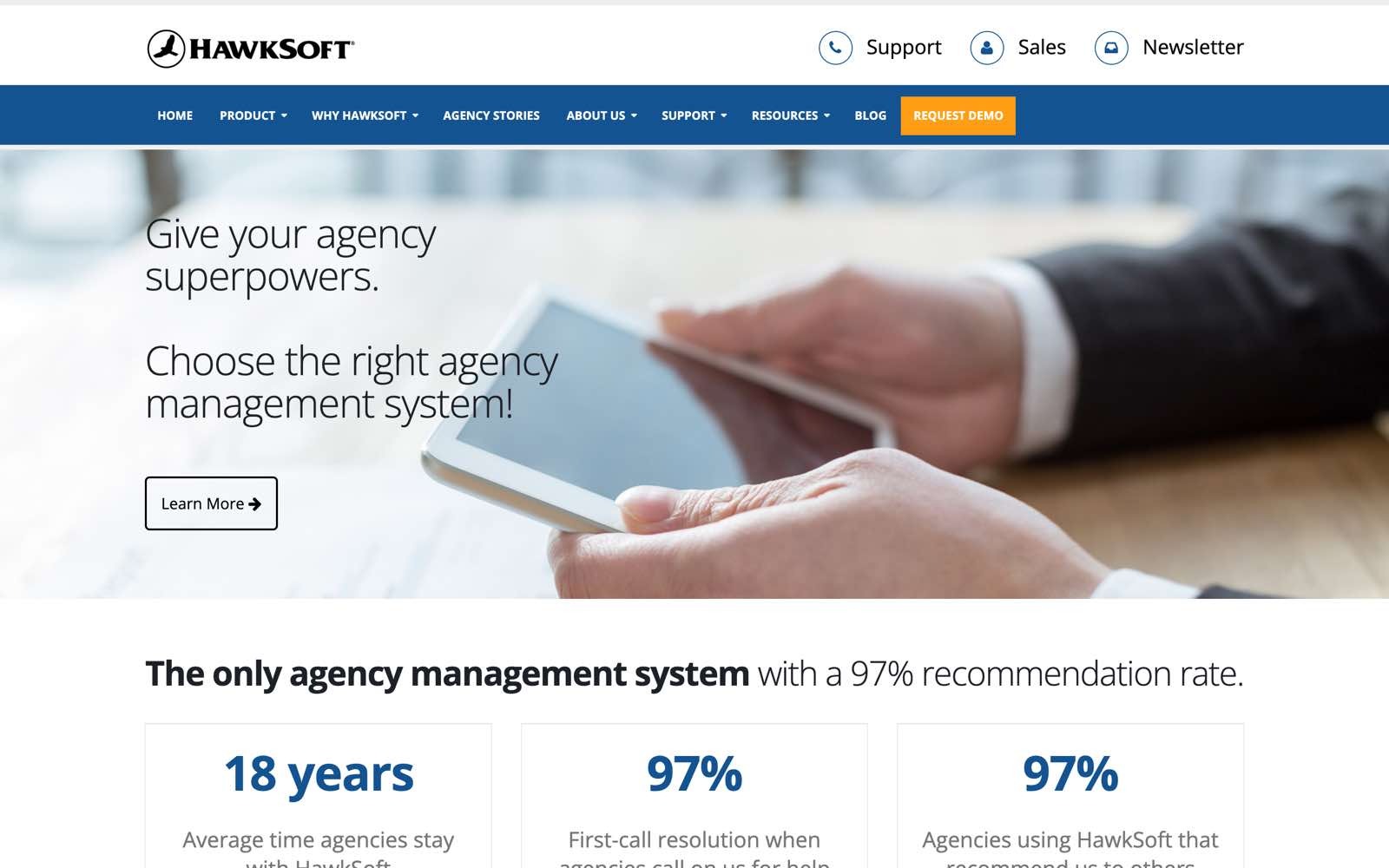
HawkSoft is an agency management system built around independent agency workflows, privately owned and in the market since 1995. Agencies choose it when servicing quality and staff workflow matter more than sales tracking.
Against QQ Catalyst, the emphasis is reversed, built around the client record and servicing workflows rather than around a sales pipeline, which is why many HawkSoft agencies run a separate sales tool alongside it. Our guide to the HawkSoft AI receptionist setup covers how calls land on that record.
Pricing is quote-based. HawkSoft shares management-system data with the 10 comparative raters named on its own rater page, including PL Rating and the EZLynx Rating Engine, so a rating license is a separate line on that side of the comparison.
5. EZLynx™, best for combining rating and management
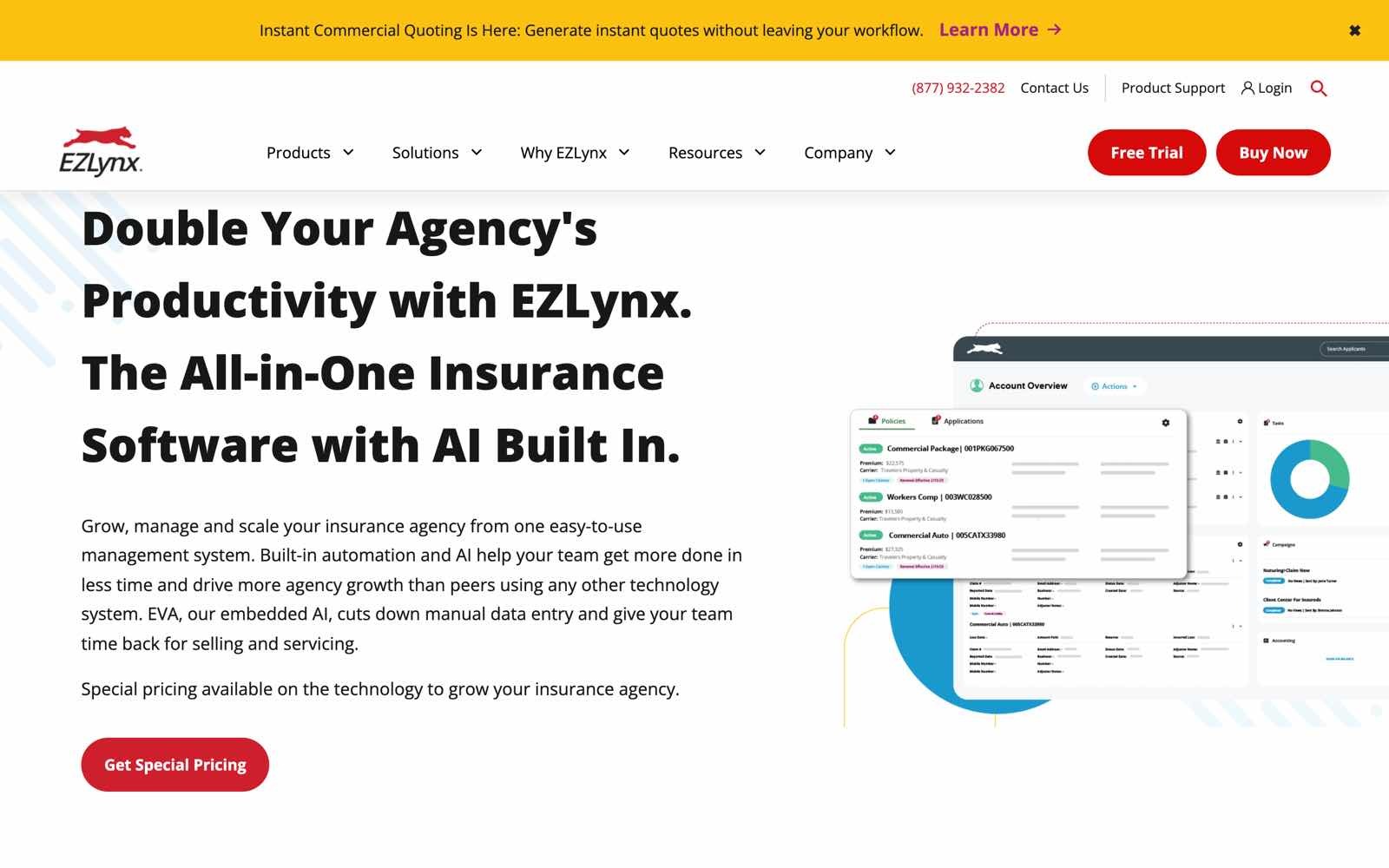
EZLynx bundles a comparative rater, an agency management system, and CRM features into one product for independent agencies. For an agency currently paying for an AMS plus a separate rater, consolidating can cut both the bill and the number of places data has to sync.
Compared with QQ Catalyst, the rater is the reason to look, since rating is where most personal lines agencies spend their day. EZLynx publishes no figures either, saying its pricing "is based on the number of users at your agency and the products you need, so there's no single flat rate," checked September 2026.
A bundled CRM covers the shared workflows rather than replacing a dedicated sales tool, so agencies that already like their AMS keep both, and EZLynx agencies run the same calculation on the phone layer.
Everything You Need to Know About QQ Catalyst™
Before you commit to any product in this category, our buyer's checklist covers the questions that separate a real integration from a report, including how AMS call notes get logged without manual entry.
See What the Phone Layer Adds to Your QQ Catalyst Record
An AMS is only as complete as what your team manages to type into it, and the calls nobody could get to never make it that far.
Sonant answers those calls, verifies who's on the line, pulls the policy context out of QQ Catalyst, and writes the outcome back as a routed task, so the record fills itself while your producers are quoting.
O'Connor Insurance Associates, an 11-person agency, published 8X ROI on monthly spend inside 30 days with 58+ hours a month freed; while Cornerstone Insurance Services went from 70 tasks a day to 100, a 43% productivity gain, with the numbers on our case studies page.
Disclaimer:
All product names, logos, and brands are property of their respective owners. QQCatalyst™, AMS360™, PL Rating™, InsurLink™, AgencyZoom™ (Vertafore), Momentum AMP™, HawkSoft™, EZLynx™, and Applied Epic™ (Applied Systems) are trademarks of their respective companies. No affiliation, endorsement, or sponsorship is implied. Product features, pricing, and availability are current as of September 2026 and subject to change; verify with each vendor before making a purchase decision.