.svg)

Sonant and AnswerConnect both keep your phone answered, but they do different jobs. AnswerConnect is a human-staffed live answering and virtual receptionist service used across many industries; it greets callers, takes messages, and routes calls. Sonant is an AI receptionist built specifically for P&C insurance agencies that connects to your agency management system, resolves routine requests on the call, and logs a note to the client record afterward. If you're comparing Sonant vs AnswerConnect for insurance, the decision is whether you want live human message-taking across industries or insurance-specific call resolution that writes back to your AMS. This post compares the two on hours, concurrency, AMS write-back, cost model, insurance training, escalation, and compliance.
Key Takeaways
- AnswerConnect is a human live-answering and virtual receptionist service; Sonant is an AI receptionist purpose-built for P&C insurance agencies.
- Both answer the phone; the difference is depth - Sonant connects to your AMS and can resolve routine insurance requests, while a general service is stronger at message-taking than at insurance tasks.
- Sonant answers 24/7 and handles many calls at once; live-answering services are bounded by how many agents are on shift.
- Both should escalate licensed or complex decisions to your staff - the difference is whether the routine 60-80% is resolved first.
- Decide on your own numbers: after-hours volume, Spanish-speaking callers, and how much time your team spends on manual AMS documentation.
Sonant vs AnswerConnect for insurance agencies: which fits your book?
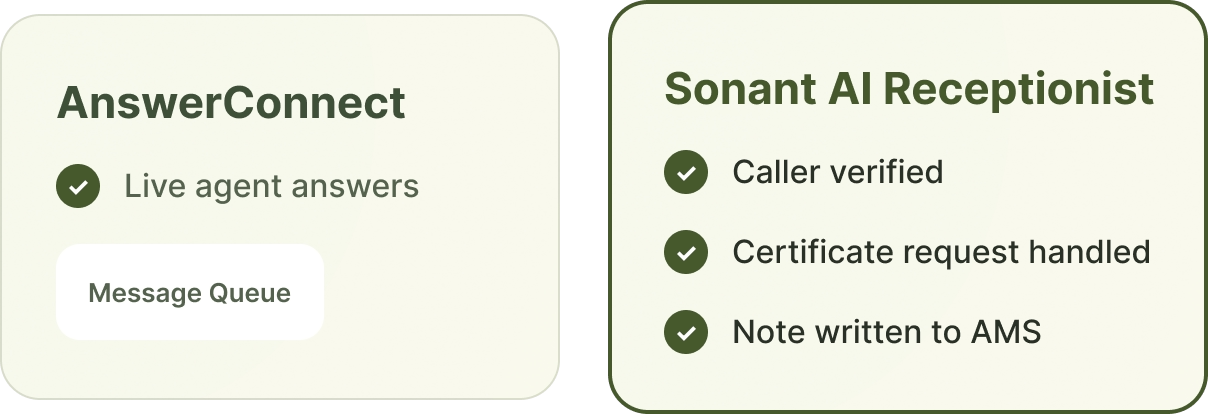
They overlap at the greeting and diverge on the work. AnswerConnect's strength is live human coverage, where a real person answers and captures the call across a wide range of businesses. If your need is a warm greeting and reliable message-taking, that's a solid fit. But most agency call volume is repetitive service work: payments, ID cards, certificate requests, address changes, after-hours claims intake. For that, you want an AI receptionist for insurance agencies trained on insurance workflows and connected to your AMS so the routine call is completed, not just relayed.
The framing we use is resolution versus relay. A general live-answering service captures who called and why and hands it back; Sonant treats the call as an insurance transaction (verifying the caller, detecting the carrier, texting the matching payment link), which is why the comparison is less answering service versus virtual assistant and more about whether the work gets finished. For the deeper split, see AI receptionist versus a traditional answering service.
Not sure whether your calls need live message-taking or actual resolution? → Talk to Sonant
Sonant vs AnswerConnect: capability comparison
Here's the side-by-side on the categories agencies ask about. We compare AnswerConnect only on capability categories, using its known model as a human-staffed live answering and virtual receptionist service.
The rows to weigh are AMS write-back and insurance training. A generalist live-answering agent can be professional without knowing how to verify a caller against a policy or handle a certificate request. Sonant is trained on those workflows, and after each call a note lands on the client record with the transcript and a task is assigned, with no manual typing. If documentation is where your team loses hours, read how AI call notes get logged to your AMS automatically.
What to evaluate before you choose
Decide on the categories that map to your workload, and verify compliance yourself instead of trusting a marketing page.
- Security and data handling. Anything touching client policy data should explain how it verifies callers and protects data. Ask both providers for a current SOC 2 report and read what it covers using the AICPA SOC 2 framework. Sonant verifies identity against AMS data before sharing anything; see caller verification and our SOC 2 notes.
- AI governance. If you adopt AI answering, know your state's stance. The NAIC model bulletin on the use of AI by insurers is the reference regulators point to.
- Consumer expectations. The phone is still where clients turn under stress. The Insurance Information Institute is a neutral source on how policyholders engage with agencies.
- Cost model. A minute- or tier-based plan can look inexpensive until volume climbs; a flat model is easier to forecast. Compare against your real numbers with the AI receptionist cost guide.
How Sonant fits
Sonant is coverage for the calls your team can't reach, not a replacement for your team. It answers 24/7, absorbs overflow and after-hours volume, resolves the routine requests, and hands anything requiring a licensed decision to a person with the full transcript attached. Agencies running this hybrid model cut administrative overhead by a large margin because the routine 60-80% of calls get resolved and documented without staff involvement, while judgment stays with licensed people. Where a live human service still wins is complex empathy. A distraught client after a loss is a person-to-person moment, and Sonant routes those on purpose. The point isn't that live answering is bad; it's that most agency call volume is routine work that can be finished on the call instead of relayed.
For the honest line between AI and staff, read what AI should handle versus a licensed agent, and to see how always-on coverage changes after-hours results, see after-hours calls. To weigh the wider field, the best virtual assistant for insurance overview, AI phone answering for insurance agencies, and our Sonant vs Smith.ai and Sonant vs Ruby Receptionists comparisons are useful next reads.
Want to see resolution instead of relay on your own routine calls? Talk to Sonant →
Related reading
- Best virtual assistant for insurance
- AI receptionist for insurance agencies
- Insurance answering service vs virtual assistant
- AI receptionist vs a traditional answering service
- Sonant vs Smith.ai for insurance agencies
- Sonant vs Ruby Receptionists for insurance agencies
- Does an AI receptionist log call notes to your AMS automatically?






.svg)


.svg)


