.svg)

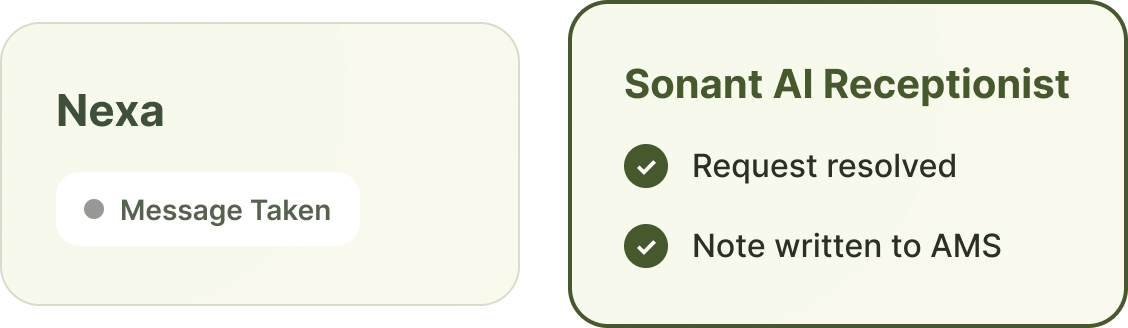
If you are weighing Sonant vs Nexa for insurance agency phone answering, here is the direct answer: Nexa is a live-agent answering and virtual receptionist service that takes messages, books appointments, and routes calls across many industries, while Sonant is an AI receptionist built specifically for P&C insurance that resolves routine calls on the spot and writes a note back to your AMS. Both keep your phone from going to voicemail. The difference is what happens after "hello": whether the call ends as a message for your team to work later, or as a completed request already documented in the client record.
This is a capability comparison, not a takedown. We name Nexa factually and compare on the categories that actually change your day: coverage hours, concurrency, AMS write-back, insurance training, escalation, cost model, and compliance. For a broader view of the category, see our guide to AI phone answering for insurance agencies and the deeper answering service vs virtual assistant breakdown.
Key Takeaways
- Nexa is a live human answering / virtual receptionist service; Sonant is an AI receptionist purpose-built for P&C insurance agencies.
- Answering services are strong at message-taking and warm transfers; they generally cannot pull a policy, verify a caller against your AMS, or resolve a coverage question.
- Sonant connects to insurance AMS platforms (EZLynx, Applied Epic, AMS360, HawkSoft), resolves routine requests, and logs a note plus a task after every call.
- Compare on capability categories - hours, concurrency, AMS write-back, insurance training, escalation, cost model, compliance - not on brand.
- A hybrid model wins for most agencies: AI handles routine and overflow; licensed staff keep the judgment calls.
Sonant vs Nexa: which fits your agency's phone?
The honest way to choose between Sonant and Nexa is to look at your call mix, not the marketing. If most of your inbound calls are "please have someone call me back," a live answering service handles that well and callers reach a person every time. If a large share of your calls are routine service, such as a client asking for a certificate, wanting to make a payment, updating a mailing address, or reporting a claim after hours, then the question becomes whether the call gets *resolved* or just *recorded*.
Nexa's model is a human call center: trained live agents answer under your agency's name, take messages, schedule, and transfer. That is real coverage, and for pure message-taking it is a legitimate option. Where it stops is inside your systems. A general answering agent typically does not have access to your insurance AMS to pull a policy or confirm a caller's identity against your own records, so those requests come back to your team as a message to work later.
Sonant is built the other direction. It connects to your AMS, verifies the caller against your data, resolves the routine request, and writes the interaction back to the client record automatically. What needs a licensed person still gets a licensed person. Sonant routes it and hands off context. If you want the vendor-neutral rundown of where Nexa fits, our Nexa alternative review covers it, and the answering service vs AI receptionist post walks the general trade-off.
Not sure which model matches your call mix? → Talk to Sonant
Sonant vs Nexa: capability comparison

The rows that matter most for an insurance agency are AMS write-back and insurance training. A live service can be excellent at tone and warm transfers, but it lives outside your AMS, so the documentation and follow-up still land on your team. Sonant's whole reason for existing is to close that loop. For how the write-back works in practice, see does an AI receptionist log call notes to your AMS.
What to evaluate before you sign
Whichever direction you lean, run the same checklist so you are comparing like for like.
- Coverage math. How many calls go unanswered today, and when? If it is after-hours and overflow, weigh a 24/7 option. See what happens to after-hours calls and our take on reducing missed calls.
- Resolution vs. message-taking. Ask each vendor to walk through a real client request end to end. Does the call get resolved, or handed back to staff?
- AMS documentation. Confirm exactly what gets written to the client record and whether a task is created.
- Compliance posture. Ask about SOC 2. Review the AICPA SOC 2 framework so you know what a report should cover, and check the NAIC model bulletin on AI for how regulators expect insurers and producers to govern AI use.
- Consumer expectations. The Insurance Information Institute tracks how policyholders interact with agencies; match your channel coverage to how your book actually contacts you.
Our full buyer's checklist turns this into a scoring sheet you can bring to a demo.
How Sonant fits
Sonant is coverage for the calls your team can't get to (overflow, after-hours, and Spanish-language calls), not a replacement for your people. On a routine call, Sonant verifies the caller against your AMS, handles the request (a certificate, a payment link, an address change, an after-hours claim intake), and then writes a note to the client record with a transcript and assigns a task. Nobody on your team retypes anything.
It is a hybrid on purpose. Anything that requires a licensed judgment, such as a coverage recommendation, a quote decision, or a complex complaint, is routed to a person with the context already gathered. A human is still better on high-empathy and complex calls, and Sonant is designed to hand those off cleanly rather than fake its way through them. If bilingual coverage matters, Sonant handles full conversations in Spanish and remembers a client's language preference. For where an AI receptionist sits next to virtual assistants and services generally, see best virtual assistant for insurance.
Want to see how Sonant resolves a call and writes the note before you compare vendors? Talk to Sonant →
Related reading
- AI phone answering for insurance agencies
- AI receptionist for insurance agencies
- Insurance answering service vs virtual assistant
- AI receptionist vs a traditional answering service
- Nexa alternative review
- Does an AI receptionist log call notes to your AMS?
- How to choose an AI receptionist vendor






.svg)

.svg)


