.svg)

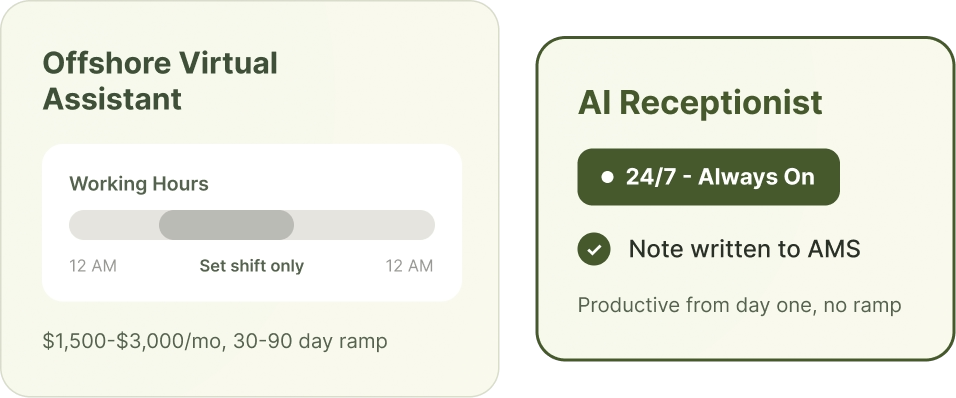
An AI receptionist and an offshore virtual assistant are two ways to cover calls without hiring locally, but they work differently. An offshore virtual assistant is a remote human employee, typically around $1,500 to $3,000 a month, who works set hours and needs a 30-to-90-day ramp before they're productive. An AI receptionist answers 24/7, handles many calls at once, connects to your AMS, resolves routine requests on the call, and writes a note to the client record afterward. If you're comparing AI receptionist vs offshore virtual assistant, the trade-off is a trained human on a schedule versus always-on, insurance-specific resolution. This post compares both on cost, hours, concurrency, AMS write-back, insurance training, escalation, and compliance.
Key Takeaways
- An offshore VA is a remote human employee (roughly $1,500 to $3,000 a month) on set hours with a 30-to-90-day ramp; an AI receptionist is always on and productive from day one of setup.
- Insurance turnover runs about 78% a year, so a VA you train can leave - and you ramp the next hire from scratch.
- An AI receptionist connects to your AMS and resolves routine requests on the call; a VA's capability depends on training, tools, and the hours they work.
- An AI receptionist answers 24/7 and handles many calls at once; a VA covers one call at a time within their shift.
- The strongest setup is often hybrid: AI covers routine and after-hours volume, and people - onshore or offshore - handle judgment and complex empathy calls.
AI receptionist vs offshore virtual assistant for insurance: which fits?
Both are ways to add capacity without a local hire, and both have real strengths. An offshore virtual assistant is a genuine team member: they can learn your processes, handle nuanced back-office work, and build relationships over time. The catch is that they're human. They work set hours, cost roughly $1,500 to $3,000 a month, and need a 30-to-90-day ramp. And because insurance turnover is high (about 78% a year), the person you trained may not be there next year, at which point you ramp again. An AI receptionist for insurance agencies doesn't ramp, doesn't leave, answers around the clock, and is trained on P&C workflows out of the box.
That said, this isn't AI versus humans. It's about which work goes where. Routine, high-volume, repeatable calls are exactly what an AI receptionist should own; relationship-heavy and complex back-office work is where a good VA earns their keep. Our answering service versus virtual assistant breakdown frames AI as a third option alongside the two human choices, and for the ongoing cost of a human seat see the insurance virtual assistant cost guide.
Trying to decide what to automate and what to keep human? → Talk to Sonant
There's a third option most agencies don't frame clearly: rather than choosing between a human answering service and a human virtual assistant, an AI receptionist covers the routine and after-hours load and escalates the rest to your people.
Cost and capability: the comparison
Here's the side-by-side on the categories agencies weigh. The VA figures below are typical, known ranges for a remote human assistant.

The rows that move the decision are ramp time, continuity, and hours. A VA is only as available as their schedule and only as trained as their tenure, and if they leave, you start over. High turnover is a structural reality in insurance; our piece on why insurance staff quit explains the pressure. An AI receptionist is consistent every call and writes a note to the client record afterward. See how AI call notes get logged to your AMS automatically.
What to evaluate before you choose
Weigh the full cost of each option (including ramp, turnover, and coverage gaps) and verify compliance rather than assuming it.
- Security and data handling. Any remote worker or vendor touching client policy data needs clear controls. Ask a vendor for a current SOC 2 report and read what it covers using the AICPA SOC 2 framework; with a VA, define access and handling explicitly. Sonant verifies identity against AMS data before sharing anything. See caller verification and our SOC 2 notes.
- AI governance. If you adopt AI answering, know your state's stance. The NAIC model bulletin on the use of AI by insurers is the reference regulators point to.
- Consumer expectations. The phone is still where clients turn under stress. The Insurance Information Institute is a neutral source on how policyholders engage with agencies.
- True cost per resolved call. Divide total monthly cost by calls actually resolved, factoring in a VA's ramp and idle hours, and compare with our cost of an offshore VA seat and AI receptionist cost guides.
How Sonant fits
Sonant is coverage for the calls your team can't reach, not a replacement for your team. It answers 24/7, absorbs overflow and after-hours volume, resolves the routine requests, and hands anything requiring a licensed decision to a person with the full transcript attached. Agencies running this hybrid model cut administrative overhead by a large margin because the routine share of calls gets resolved and documented without staff involvement, while judgment stays with your people. A good offshore virtual assistant is genuinely valuable for relationship-heavy and nuanced back-office work, and a human is better on a complex, emotional call, and Sonant routes those on purpose. The point isn't to replace the VA; it's to stop paying human hours for the repetitive calls that can be finished automatically, and to close the coverage gap when the VA is off shift.
If your agency serves Spanish-speaking clients, Sonant handles the full conversation in Spanish and remembers the caller's preference for next time; see the bilingual AI receptionist breakdown. For the honest line between AI and staff, read what AI should handle versus a licensed agent. To compare against the other coverage options, see AI receptionist versus a traditional answering service, the best virtual assistant for insurance overview, and AI phone answering for insurance agencies.
Want to see which of your calls should be automated and which should stay human? Talk to Sonant →
Related reading
- Best virtual assistant for insurance
- AI receptionist for insurance agencies
- Insurance virtual assistant cost
- AI receptionist vs a traditional answering service
- Why insurance staff quit
- What AI should handle vs a licensed agent
- Does an AI receptionist log call notes to your AMS automatically?






.svg)


.svg)


