
HawkSoft vs EZLynx comes down to a question most comparison pages skip. Are you buying a system of record built around servicing your book, or one vendor's bundle that puts rating, management, and marketing behind a single login?
HawkSoft is the former. EZLynx, owned by Applied Systems since 2021, is the latter.
This comparison runs through servicing depth, comparative rating, automation, integrations, support, ease of use, and what each one costs, using verified agency review scores and each vendor's own documentation.
Key Takeaways (TL;DR)
- Primary difference: HawkSoft is an independently owned agency management system (AMS) built around servicing workflow, and it expects you to connect outside tools through its published two-way application programming interface (API) directory. EZLynx is an Applied Systems bundle where the comparative rater, the management system, the customer relationship management (CRM) features, and the agency website all come from one vendor.
- Best overall choice: No single system wins across the board. HawkSoft leads on support and usability; EZLynx leads on rating breadth and vendor consolidation. The right pick depends on which of those an agency prioritizes.
- Rating and quoting winner: EZLynx. Its comparative rater connects to "over 330" carriers, while HawkSoft ships no native rater and instead shares data out to 10 third-party raters, one of which is the EZLynx Rating Engine.
- Integrations and API depth winner: HawkSoft. It publishes a partner directory that labels each connection one-way or "Two-way API Integrated", so you can check what a vendor can do with your data before you sign.
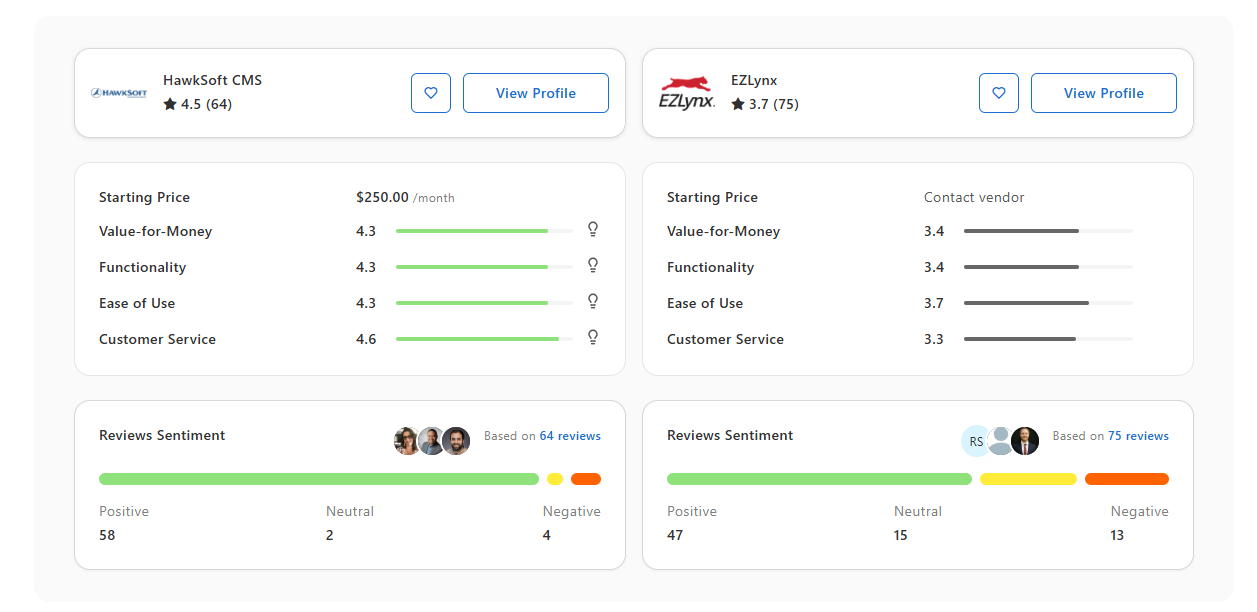
- Support and onboarding winner: HawkSoft. It claims a "97% first-call resolution rate" and scores 4.6 for customer service on Capterra, against 3.3 for EZLynx.
- Pricing winner: HawkSoft, and on first-party evidence it isn't close. HawkSoft publishes a $99 per user retail rate, an hourly services list, and a monthly price for every marketplace add-on, while EZLynx publishes no figure anywhere on its own site.
- Ease of use winner: HawkSoft, at 4.3 on Capterra against 3.7 for EZLynx, with reviewers repeatedly flagging a long EZLynx implementation and a steep learning curve.
HawkSoft™ vs EZLynx™ in 2026: At a Glance
Ratings reflect verified review scores and vendor documentation checked in August 2026. The two systems tie on the overall row because they win different halves of the job, which is exactly why the line mix in your book decides this more than any feature list does.
HawkSoft and EZLynx: The Basics
Before the criteria, it helps to be precise about what an AMS is responsible for, because half the confusion in this category comes from vendors bundling a rater, a CRM, and a website builder into the same subscription and calling all of it one product.
What Are Agency Management Systems?
An agency management system is the system of record for an insurance agency. It holds the client, the policy, the carrier, the documents, the activity history, and usually the accounting, and every servicing task in the agency either starts or ends inside it.
Producers, customer service representatives (CSRs), and account managers live in it all day, which is why usability and support carry more weight here than in almost any other software an agency buys.
The category is consolidating fast. Applied Systems and Vertafore now own most of the systems an independent agency would shortlist, and the independents that remain, HawkSoft among them, sell that independence as a feature.
Your AMS also decides which newer tools you can realistically connect, which is the part buyers underweight, and our guide on where to start with insurance agency AI covers the sequencing.
Adoption is running ahead of the consolidation, with the Big "I" Agents Council for Technology reporting that two-thirds of independent agencies plan to increase their use of artificial intelligence in the next 12 months while only 8% have it embedded in daily workflows today.
What Is HawkSoft?
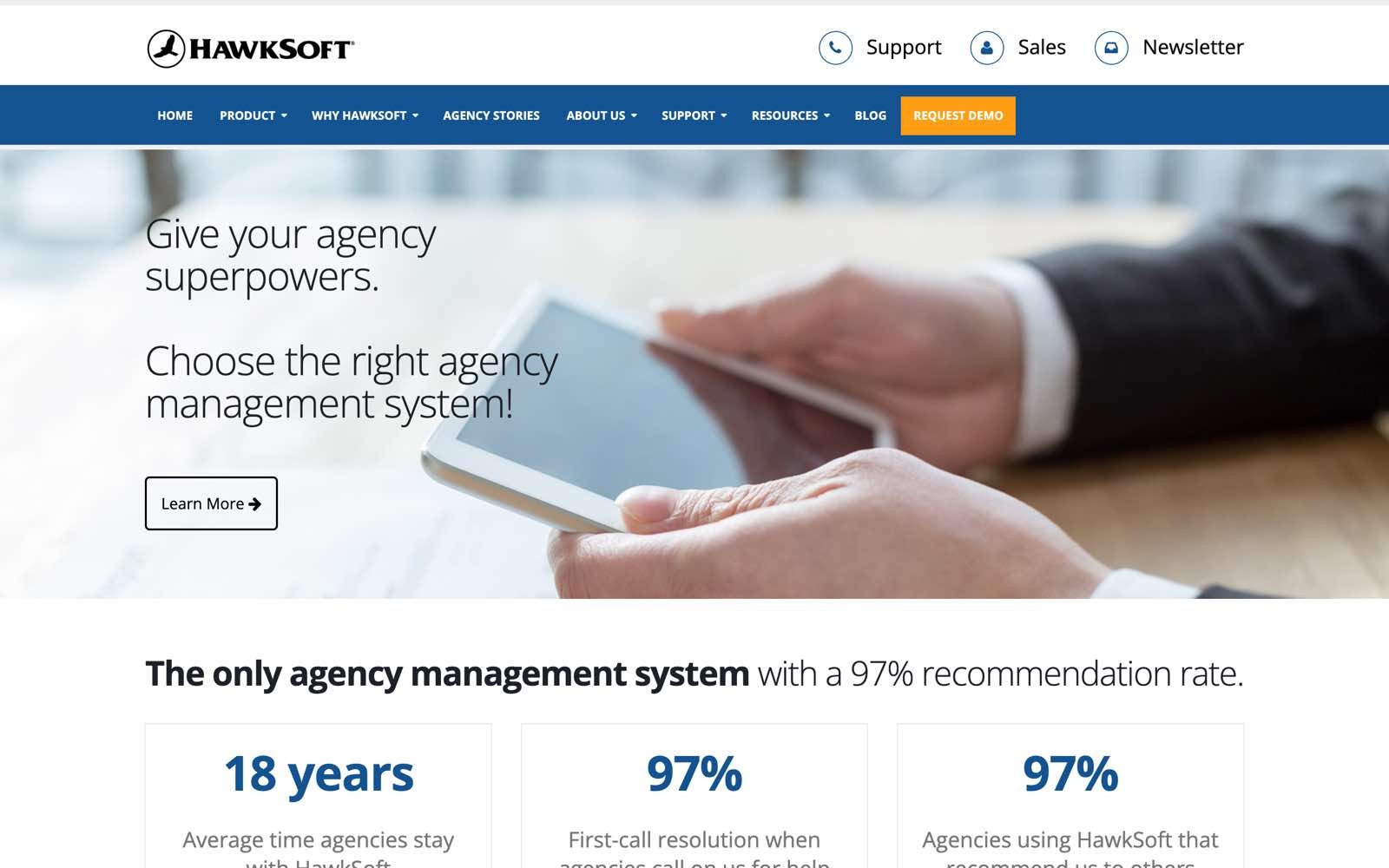
HawkSoft™ is a privately held agency management system for independent P&C agencies, in the market since 1995 and still independently owned rather than backed by an institutional owner.
The product is built around servicing, so the client file, the policy history, and the workflow a CSR follows to close out a request are the center of the interface rather than a sales dashboard layered on top.
Its reporting comes through the Agency Intelligence suite, which puts book of business, retention, cross-sell, and pipeline key performance indicators in one place and carries "no additional cost".
Support is the part agencies talk about most, and HawkSoft leans on it hard, publishing a "97% first-call resolution rate" alongside an average phone answer time under two minutes. Where it deliberately stops is rating, and that's a real gap rather than an oversight.
What Is EZLynx?
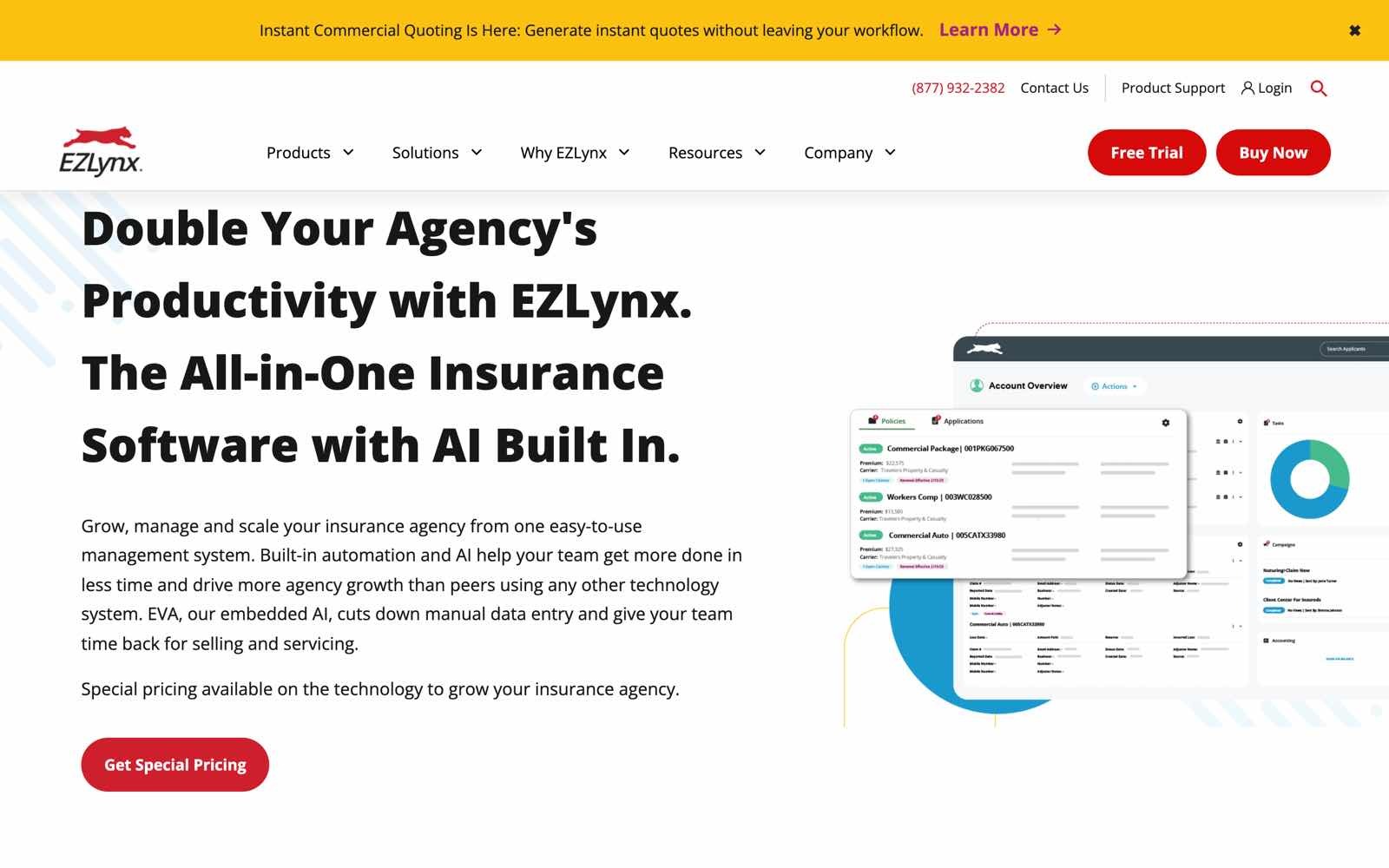
EZLynx™ started as a real-time comparative rater and grew into a full management system around it. Applied Systems acquired EZLynx in a deal announced in January 2021 and closed that March, so it now sits inside the same portfolio as Applied Epic. That ownership matters more than most buyers realize, and we come back to it below.
EZLynx sells breadth. The rater connects to "over 330" carriers for personal lines, and the management system covers policy servicing, CRM, marketing automation, renewals, accounting, payments, and agency websites.
On the same page, it says it "powers more independent agencies than any other agency management software", reports "100+ New Agencies Choose EZLynx Every Month", and handles "7M+ Quotes Per Month". Where reviewers push back is on implementation length and support responsiveness.
HawkSoft vs EZLynx: A Detailed Feature Comparison
Seven criteria decide this comparison in practice. Five of them are product capability, and the last two, ease of use and price, are where agencies most often override a feature decision they'd already made.
Core Agency Management and Servicing
HawkSoft
Servicing is HawkSoft's home ground. The client file consolidates policies, documents, and activity history so a CSR can work a request start to finish without leaving the record, and features like self-service certificates, e-signature, batch communications, and the Insured Mobile App exist to take routine work off the desk entirely, which is the same logic behind automating certificate of insurance requests.
Retention alerts flag at-risk clients before the renewal conversation is already lost.
The limitation reviewers raise is rigidity. Custom reports and agency-specific workflow changes are harder than in a more configurable system, and standalone accounting is narrow outside a QuickBooks connection.
EZLynx
EZLynx covers the same servicing ground and adds more modules around it, including a client self-service portal, native accounting and payments, commission management, and a commercial submissions tool alongside the personal lines rater.
Everything shares one data set, so a quote that becomes a policy doesn't need rekeying between systems.
The trade-off is depth per module. Reviewers report that once a certificate or policy has been issued, it's hard to update, and that the breadth comes with a heavier interface.
ð Winner
HawkSoft, narrowly. EZLynx covers more ground, but HawkSoft's servicing workflow is tighter for the people who spend all day in it, and Capterra scores it 4.3 for functionality against 3.4 for EZLynx. Choose EZLynx here only if consolidating accounting and payments into the AMS is worth accepting a shallower servicing workflow.
Comparative Rating and Quoting
HawkSoft
HawkSoft ships no native comparative rater. It states plainly that it "can share data from our management system to the following comparative raters" and then lists 10 of them, including Applied Rater, TurboRater, PL Rating, QuoteRUSH, FSC Rater, and the EZLynx Rating Engine. You pick the rater that suits your states and carriers, and you pay for it separately.
That's genuine flexibility, and it's also a second vendor, a second bill, and a second support queue. For an agency where quoting volume is the whole job, the handoff between two systems is friction you'd rather not own.
EZLynx
Rating is what EZLynx was built to do, and it remains the stronger of the two here. One entry produces real-time quotes across the carrier panel, driver and vehicle data prefills the ACORD forms, and the quote flows straight into the management system as a prospect record without rekeying. Commercial submissions have their own tool alongside the personal lines rater.
The carrier depth is heavily weighted toward personal lines, so a commercial-dominant agency gets less of the value it's paying for.
ð Winner
EZLynx, decisively. A native rater across 330-plus carriers feeding directly into the client record is the single strongest argument for the product, and no amount of rater flexibility on the HawkSoft side closes that gap for a personal lines book. If more than about 70% of your premium is personal auto, home, renters, and umbrella, this criterion alone can settle the decision.
Automation, CRM, and Renewals
HawkSoft
HawkSoft handles the retention side well. Agency Intelligence surfaces cross-sell and account rounding opportunities against real book data, retention alerts fire on at-risk clients, and automated communications plus text messaging cover the routine outreach a renewal cycle needs.
What it doesn't try to be is a sales system. There's no deep pipeline management or marketing campaign builder, which is why plenty of HawkSoft agencies run a separate CRM alongside it.
EZLynx
EZLynx includes marketing automation, email campaigns, a visual sales pipeline, and a renewals workflow EZLynx describes as a "patented retention workflow" with automated renewal quoting attached. Because the rater sits in the same product, a renewal can be requoted against the carrier panel without leaving the record, which is a real advantage at scale.
The CRM covers the basics well, and agencies that already run a dedicated sales tool tend to find it duplicative.
ð Winner
EZLynx. Requoting a renewal inside the same system that holds the policy is a workflow HawkSoft structurally can't match without a rater integration in the middle, and the marketing automation is a real addition rather than a checkbox.
Integrations and API Depth
HawkSoft
This is where HawkSoft's independence pays off. Its partner directory lists every integration and labels each one, so a vendor is shown either as offering "One-Way Integration" or as "Two-way API Integrated", and you can verify the depth of a connection before a sales call rather than after implementation.
Payments, accounting, marketing, service center tooling, and phone systems all appear there.
The counterweight is that reviewers report some third-party connections are fiddly to set up and prone to syncing problems, so a published label isn't a guarantee of a painless rollout.
EZLynx
EZLynx takes the opposite approach. Because rating, management, CRM, accounting, and websites all come from one vendor, the argument is that you need fewer integrations in the first place, and the ones you do need are supported through Applied's wider partner program.
That's true up to the point where you want something Applied doesn't sell. Third-party integration options are narrower, and the all-in-one design means more of your stack depends on a single roadmap.
ð Winner
HawkSoft. Publishing the direction of every API connection is a level of transparency few vendors in this category publish, and it's the difference between a vendor that can read your client record live and one that can only push data at you. Agencies that expect to add tooling over the next three years should weigh this criterion heavily.
Support and Onboarding
HawkSoft
Support is HawkSoft's most consistently praised attribute and the reason a lot of agencies stay. The company publishes a 97% first-call resolution rate, says "Every phone call is answered in less than 2 minutes, on average", and reviewers describe the team as responsive and knowledgeable. Capterra scores it 4.6 for customer service.
Onboarding is correspondingly lighter, partly because there's less product to configure.
EZLynx
Support is where EZLynx scores lowest with reviewers. They describe slower responses and a long implementation with a steep learning curve, which is the predictable cost of standing up a rater, a management system, a CRM, and accounting at once. Capterra scores customer service at 3.3.
Applied does bring scale, documentation, and a large user community behind the product, which matters for a system you plan to run for a decade.
ð Winner
HawkSoft, by the widest margin of any criterion here. A 1.3-point gap in customer service scores matters most at an agency with no systems administrator, where support is the first place a stuck request goes.
Ease of Use
HawkSoft
HawkSoft scores 4.3 for ease of use on Capterra, and new hires generally get productive quickly because the interface follows the servicing workflow rather than asking staff to learn a data model. The Agent Portal gives browser-based access without a full desktop install.
The rigidity shows up here too, since workflow changes that would suit your agency aren't always configurable.
EZLynx
EZLynx scores 3.7. Reviewers describe the interface as straightforward once they're past the learning curve, and the vendor ships frequent updates. The difficulty is front-loaded into a long implementation, and agencies migrating from another AMS report that the first quarter is hard.
Training an agency of 20 through that curve is a real cost, so budget for it alongside the subscription.
ð Winner
HawkSoft. The 0.6 point gap understates the difference, because the EZLynx learning curve concentrates in the period when your team is least able to absorb it. This is the criterion that most often reverses a decision made on features alone.
HawkSoft vs EZLynx Pricing
This section prices both systems using only what HawkSoft and EZLynx publish themselves. The figures that circulate on comparison sites are left out, because neither vendor stands behind them, and on that basis the two are nowhere near each other on disclosure.
HawkSoft
HawkSoft publishes a per-user rate. Its migration FAQ names the "$99/user retail price" for HawkSoft 6 and works an increase through in the open, noting that "if your agency is currently paying $70/user, your price will only go up by $29/user". The same page says "the 3-user minimum license requirement goes away" on HawkSoft 6, which matters to a small agency, because the master agreement otherwise sets the minimum at three seats. Contracts run on a "month-to-month basis" unless a sales proposal says otherwise, and HawkSoft can revise charges on "not less than 30 days' notice".
The add-ons are priced in public too, which is rarer than a published base rate. HawkSoft E-Signature is "$39.00/license" a month, Self-Service Certificates $49.00 an agency, and HawkSoft Text Messaging $20.00 an agency, with Main Number Texting a $99.00 one-time fee.
Hourly work runs $150.00 an hour for training, consulting, data extraction, and custom programming, while Agency Intelligence reporting carries no additional cost. Budget a rater on top of all of it, since HawkSoft ships none.
EZLynx
EZLynx publishes no number at all. Its pricing page says "EZLynx pricing is based on the number of users at your agency and the products you need, so there's no single flat rate", promises "your costs stay predictable", and notes that network members "usually get a discount through your membership".
Its Buy Now button leads to a landing page carrying no figures either. So the quote you're handed can't be sanity checked against anything, and it moves as you hire.
What the page offers instead is an argument, and it's a fair one. It concedes that "Some competitors may show a cheaper price" per seat, then answers that "Once you add in the cost of a separate rater, CRM, eSignature tool, and client portal, the total climbs well past what you'd pay for EZLynx".
Pricing also scales with headcount by design, so that "a solo agent or small startup pays for what they actually need". Whether it holds for your agency depends on how many of those four you'd buy.
ð Winner
HawkSoft, decisively, on transparency rather than on the final invoice. It publishes a retail per-user rate, an add-on price list, hourly service rates, and its contract terms, and EZLynx publishes none of the four, so only one of these two can be budgeted before a sales call.
EZLynx's stacking argument is still the one to test at quote stage, because HawkSoft's own price list is partial evidence for it, with e-signature and certificates billed separately and the rater a third contract entirely.
How we verified these figures. All prices are in United States dollars, come only from HawkSoft's and EZLynx's own pages, and were checked in August 2026. HawkSoft's per-user rate and seat minimum come from its HawkSoft 6 FAQ and master agreement, and the add-on and hourly rates from its published additional-services terms.
EZLynx's wording comes from its own pricing page, and we confirmed its Buy Now landing page carries no figures. We don't link to vendor sites, so confirm current rates directly before you buy. Third-party figures that appear on comparison sites but on neither vendor's own pages are excluded. Figures should be re-verified by February 2027.
EZLynx vs HawkSoft: The Verdict, Feature by Feature
How EZLynx Compares to Sonant, Applied Epic, Vertafore, and TAM
Most agencies shortlisting these two also look at the systems Applied and Vertafore sell alongside them, and the ownership map explains more about each product's roadmap than its feature page does.
Sonant leads the list because it's the only one here that pairs with the others rather than replacing any of them.
Sonant and EZLynx: How They Fit Together
Sonant sits in a different layer from everything else in this section, so it's a companion to your agency management system rather than a candidate to replace it. EZLynx, Applied Epic, AMS360, QQCatalyst, and TAM hold the record, while Sonant works the calls in front of whichever one you run, then writes each outcome back into it as a routed task.
It leads this list because it's the least locked-in decision on the page. An AMS choice follows your line mix and is costly to reverse, while the phone layer can be added or changed without touching your system of record.
Sonant connects to Applied Epic, AMS360, EZLynx, HawkSoft, Momentum AMP, and QQCatalyst, so the configuration work carries over if you move between them.
Applied Epic vs EZLynx
Applied Epic vs EZLynx is a comparison inside one vendor's portfolio, since Applied Systems owns both.
Epic is the enterprise-grade choice, built for larger agencies, multi-branch operations, and commercial books where accounting complexity and standardized processes across locations matter more than quoting speed. EZLynx is Applied's answer for smaller and mid-sized agencies weighted toward personal lines.
The practical rule is size and line mix. Under roughly 20 users with a personal lines book, EZLynx is the better fit. Above that, or with a commercial-heavy book across multiple offices, Epic is the system agencies grow into. Sonant works with both, and our notes for Applied Epic agencies cover what the integration looks like in practice.
EZLynx vs Vertafore: AMS360 and QQCatalyst
EZLynx vs Vertafore is in practice a comparison against AMS360 and QQCatalyst, the two management systems Vertafore sells to independent agencies.
AMS360 is the closer competitor to Epic than to EZLynx, with accounting and reporting depth aimed at established agencies, and it's the system most often shortlisted when an agency outgrows a lighter product. Our notes for AMS360 agencies cover the same ground on the phone side.
The strategic point is that choosing EZLynx means choosing Applied's roadmap, and choosing AMS360 or QQCatalyst means choosing Vertafore's. Between them, the two vendors own most of the independent agency market, which is the argument HawkSoft makes for staying independent.
QQCatalyst vs EZLynx
QQCatalyst vs EZLynx pits Vertafore's cloud system for growing agencies against Applied's all-in-one. Vertafore positions QQCatalyst as "the top agency management system for growing independent agencies", with customizable dashboards, workflow automation, over 50 pre-built reports, and a built-in sales pipeline manager.
It doesn't include a native comparative rater, so QQCatalyst agencies pair it with Vertafore's PL Rating in much the same way HawkSoft agencies pair a rater with theirs.
That makes the real comparison bundled-versus-assembled rather than feature-versus-feature. EZLynx wins on having everything under one contract, and QQCatalyst wins for agencies that want to choose each piece.
Applied Epic vs TAM
Applied Epic vs TAM isn't a live buying decision anymore, and any agency still running Applied TAM should treat it as a migration question. Applied's own migration hub says TAM "is built on an architecture that will soon no longer receive support from Microsoft®.
This means potential degrading performance and increased security exposures over time", and directs TAM agencies toward Epic or EZLynx.
So the framing for a TAM agency is that you're choosing your next system, not comparing your current one. Our Applied TAM review covers what that means for budgeting. Migration is where the real cost sits, because moving decades of policy, client, and accounting history without breaking commission reconciliation is harder than learning the new interface.
The Job Neither System Does: Answering the Phone
Both of these systems hold the record, and neither changes how inbound calls reach your team. Neither one picks up when a client calls about a certificate at 4:55 on a Friday, and neither routes the after-hours calls that follow; that gap is where two complaints agency owners raise constantly sit, phrased as "manual data entry into AMS eating massive time" and "integration nightmares with our AMS."
A static phone tree doesn't close either one.
Sonant is the AI receptionist purpose-built for P&C agencies, and it's a companion to whichever system you choose rather than a replacement for it. On a call, it verifies the caller, opens their record live, answers the renewal date or coverage question instead of promising a callback, and collects what a quote or service request needs.
When the call ends, a structured note and a routed task land back in the AMS. The read direction is the half buyers underweight, because reading the record is what lets a servicing request be finished on the call rather than logged for someone else to finish, and it's the difference between a note in the AMS and a message someone has to action.
That mechanism depends entirely on integration depth, which is why this section belongs in an AMS comparison at all:
- On HawkSoft: Sonant appears in HawkSoft's own partner directory labeled "Two-way API Integrated", described there as searching "your HawkSoft in real time" and creating tasks routed to the right team member, and our notes for HawkSoft agencies cover the call flow. That's a third party publishing the depth of the connection rather than a vendor claim about itself.
- On EZLynx: EZLynx is on Sonant's published list of agency management system integrations alongside Applied Epic, AMS360, Momentum AMP, and QQCatalyst, and the same call flow applies for EZLynx agencies that pick the Applied bundle.
- On Applied Epic: Sonant became a Certified Integration Vendor with Applied Systems the first voice AI platform certified for Applied Epic, which means Epic agencies don't buy separate API access or sign an extra agreement to connect it.
The results follow the integration rather than the phone system. At Cornerstone Insurance Services, a Saskatchewan brokerage, staff moved from 70 to 100 tasks a day, a 43% productivity gain, because call chaos arrived as triaged tasks with the information already collected.
Two limits before you shortlist it. Sonant is built for P&C agencies only, so a life or health book gets less out of it, and there's no public rate card, which means a price-first comparison needs a demo first.
If you want the mechanics before any vendor call, our explainer on AMS write-back, the buyer's checklist for choosing, and the AI buyer's guide cover what separates a real two-way integration from a report, and the cost of missed calls sets the number the whole decision turns on.
Final Verdict: Which Should You Choose?
Your line mix and your tolerance for a long implementation decide this more than any single feature does.
Choose HawkSoft If:
- Servicing is the bulk of the work: Your team spends its day on endorsements, certificates, claims follow-up, and renewals rather than on new-business quoting, and you want the client file, not a pipeline, at the center of the interface.
- You want to pick your own tools: A published API directory that labels every connection one-way or two-way means you can add a phone layer, a payments tool, or a sales system over the next three years and check the depth before you commit.
- Support quality is a deciding factor: A 97% first-call resolution rate and a 4.6 customer service score matter most for agencies of 5 to 25 people with no dedicated systems administrator.
- You already license a rater you like: HawkSoft shares data to 10 raters including Applied Rater, TurboRater, and PL Rating, so an existing rater contract stays useful.
Choose EZLynx If:
- Personal lines carry your book: With 70% or more of premium in auto, home, renters, and umbrella, a native rater across 330-plus carriers feeding straight into the client record is worth more than any other difference here.
- You want one vendor and one bill: Rating, management, CRM, accounting, payments, and the agency website under a single contract removes the integration work and the finger-pointing when something breaks.
- Renewals are your retention problem: Requoting a renewal against the carrier panel without leaving the record is a workflow HawkSoft can't match structurally.
- You can absorb the implementation: Budget a long rollout and a steep first quarter, and make sure your team has the capacity to learn the system while still servicing the book.
See Sonant Running on Your Own AMS
Whichever system you pick, it holds the record and waits for someone to type into it. Sonant answers every inbound call 24/7, opens the caller's file live, finishes routine service requests, and writes the outcome back as a routed task, so the AMS you chose ends the week accurate without anyone doing data entry to keep it that way.
It's SOC 2 Type II compliant, and HawkSoft's own partner directory lists the integration as a two-way API. O'Connor Insurance Associates, an 11-person agency, recorded an 8X return on investment (ROI) on monthly spend and freed more than 58 hours a month, and the rest of the numbers are in our case studies.
Onboarding, configuration, and support are included, and setup time runs under 30 days for most agencies.
Disclaimer:
All product names, logos, and brands are property of their respective owners. HawkSoft™, EZLynx™, Applied Epic™, Applied TAM™, AMS360™, QQCatalyst™, Momentum AMP™, and the rating, accounting, and review products named in this comparison are trademarks of their respective companies. No affiliation, endorsement, or sponsorship is implied. Review scores, pricing, and product features are as published in August 2026 and subject to change; verify with each vendor before making a purchase decision.